

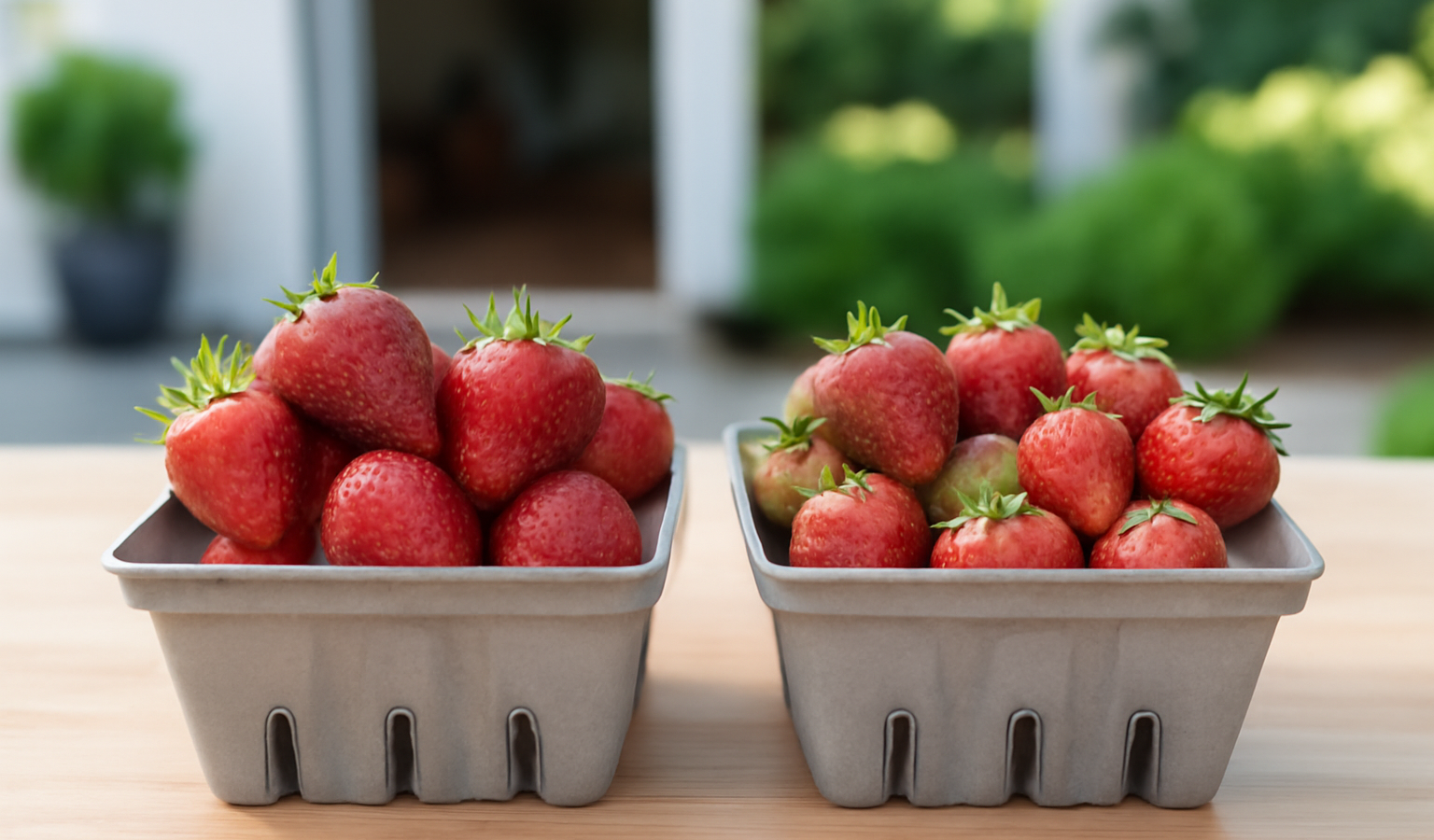
The single biggest decision when planting strawberries is which type to grow, because it determines when and how you’ll harvest for years. June-bearing strawberries produce one big, concentrated crop over two to three weeks in late spring to early summer — ideal if you want a flood of berries for jam, freezing, or putting up. Everbearing (and the closely related day-neutral) strawberries spread a smaller total harvest across several flushes from early summer into fall, giving you a steady trickle for fresh eating. Neither is “better”; they suit different goals. This guide compares yield, timing, runner production, and lifespan, then walks through how to grow each so you can match the right strawberry to your kitchen and your space.
Key Takeaways
- June-bearing gives one large, concentrated crop in late spring/early summer — best for jam, freezing, and big harvests at once.
- Everbearing (and day-neutral) spread a smaller total yield across summer into fall — best for a steady supply of fresh berries.
- June-bearers produce many runners (great for filling a matted-row bed); everbearers make few runners (better for containers and small spaces).
- Pinch the first-year flowers off both types so plants establish; June-bearers especially reward this with a bigger crop the next year.
- For total volume, June-bearing usually wins; for season-long fresh eating in limited space, everbearing/day-neutral wins.
| Factor | June-Bearing | Everbearing / Day-Neutral |
|---|---|---|
| Harvest timing | One concentrated crop, late spring–early summer | Several flushes, early summer through fall |
| Total yield | Higher overall, all at once | Lower overall, spread out |
| Berry size | Often larger | Often smaller to medium |
| Runners | Many — fills a matted row | Few — stays compact |
| Best for | Jam, freezing, preserving, big in-ground beds | Fresh eating, containers, small spaces |
| Triggered by | Short days (sets buds in fall) | Long days (ever) / day-length-neutral |
| Productive lifespan | 3–5 years with renovation | Often replaced every 1–2 years |
June-Bearing Strawberries: How They Grow
June-bearing strawberries are the classic type and, despite the name, may fruit in May, June, or early July depending on your climate and variety. They’re short-day plants: they form their flower buds in the fall as days shorten, then bloom and fruit the following late spring, delivering one heavy, concentrated harvest over roughly two to three weeks. That burst is the whole appeal — if you want enough berries at once to make jam, freeze trays, or feed a crowd, June-bearers deliver volume that the staggered types can’t match. They also tend to produce the largest individual berries, and varieties are commonly grouped as early, midseason, and late, so planting two or three cultivars stretches your single harvest window to four or five weeks.
June-bearers are also vigorous runner producers. Each mother plant throws out numerous runners (stolons) that root into new daughter plants, which is why they’re traditionally grown in the matted-row system: set plants 18 inches apart in rows about 3 to 4 feet apart, then let the runners fill in to form a dense, productive band roughly 18 to 24 inches wide. That free propagation is a gift if you’re filling a bed, but it means more thinning and management. With proper care — including an annual renovation after harvest — a June-bearing bed stays productive for three to five years before yields decline and you renew it from daughter plants.
Planting and care
Plant dormant crowns or plugs in early spring in full sun (at least 6 to 8 hours) in fertile, well-drained soil rich in organic matter, with a slightly acidic pH around 5.5 to 6.8. Set crowns at the correct depth — the midpoint of the crown right at the soil line, roots fanned down, neither buried nor exposed — because planting too deep rots the crown and too shallow dries out the roots. The most important first-year task: pinch off every flower the first season. It feels wrong, but it forces the plant to build roots, leaves, and runners instead of fruit, setting up a much larger crop the following year.
During the season, keep plants consistently moist — about an inch of water a week — mulch with straw to keep berries clean and suppress weeds, and feed lightly. After the single harvest ends in summer, perform renovation: mow or shear the foliage to about an inch above the crowns (don’t cut the crowns), narrow the rows by removing excess and older plants, thin the remaining plants, weed, fertilize, and water to push fresh growth that will set next year’s buds in fall. This annual reset is the key to keeping a June-bearing bed vigorous. In cold climates, mulch heavily over winter to protect the fall-set flower buds, which are essential to next spring’s crop.
Everbearing & Day-Neutral Strawberries: How They Grow
“Everbearing” traditionally describes plants that fruit in two or three flushes across the season — typically a crop in early summer, a lighter one in fall, and sometimes a bit in between. Day-neutral varieties are a more modern refinement that fruit more or less continuously whenever temperatures are favorable (roughly 35–85°F), regardless of day length, often from a couple of months after planting right up to frost. The two are frequently sold and discussed interchangeably, and for the home gardener the practical takeaway is the same: instead of one big harvest, you get a steady trickle of berries over many weeks, perfect for picking a bowlful for breakfast all summer rather than processing a glut at once.
The trade-off is total volume: spread across the season, the overall yield per plant is usually lower than a June-bearer’s concentrated crop, and the berries often run smaller. The upside for small-space gardeners is that everbearing and day-neutral types produce few runners, putting their energy into fruit instead. That compact, well-behaved habit makes them the obvious choice for containers, hanging baskets, raised beds, and balconies, where rampant runners would be a nuisance — see our guide on growing strawberries in containers. Because they’re worked harder and often decline faster, many gardeners treat day-neutral plants as a one- to two-year crop and replace them, rather than maintaining a long-lived bed.
Planting and care
Site and soil needs match June-bearers: full sun, rich well-drained soil, slightly acidic pH, and crowns set at the proper depth. Because they make few runners, day-neutral and everbearing plants are grown in a hill or spaced system rather than a matted row — set plants about 12 inches apart in staggered double rows, or one to a pot, and remove any stray runners that do form to keep energy on fruiting. This spacing also keeps them ideal for tucking into containers and raised beds.
The first-year flower rule still applies, but with a twist: pinch off blossoms for the first six to eight weeks after planting to let plants establish, then allow them to fruit for the rest of that first season — one of the appeals of day-neutrals is a harvest in their planting year. Because they fruit continuously, they’re hungrier and thirstier: keep them evenly moist and feed regularly with a balanced fertilizer through the season to sustain the repeated flushes. They have no single renovation moment; instead, keep them tidy, deadhead old fruit, and watch for the gradual decline that signals it’s time to replace them. In hot climates, day-neutrals may pause fruiting during peak summer heat and resume as temperatures ease.
Head-to-Head: Yield, Timing, and Space
The decision really comes down to how you want your berries delivered. June-bearing gives you a fire-hose of fruit for a few weeks — fantastic if you preserve, freeze, or want a big seasonal event, and generally the higher total yield. Everbearing and day-neutral give you a garden hose set to drip — a modest but reliable supply over months, ideal if you’d rather snack on fresh berries all summer than process a mountain in June. If your honest answer is “I just want to walk out and pick a handful whenever,” choose day-neutral; if it’s “I want to make a year’s worth of jam,” choose June-bearing.
Space and management push the choice further. June-bearers’ aggressive runners suit roomy in-ground beds where you want a self-filling matted row and don’t mind annual renovation, and they reward that effort with three to five years of production. Everbearers and day-neutrals stay compact, throw few runners, and thrive in pots, baskets, and raised beds — perfect for patios and small yards — but tend to be shorter-lived and need steadier feeding and watering to keep producing. Many gardeners hedge by planting both: a June-bearing bed for the big preserving crop and a few day-neutral containers for fresh eating the rest of the season. If your existing plants are underperforming, our guide on why strawberries turn out small covers the common culprits.
Verdict: Which Strawberry Should You Plant?
You want a big harvest for jam, freezing, or preserving: June-bearing. The concentrated late-spring crop gives you volume all at once, and planting early/mid/late varieties stretches the window.
You want fresh berries to snack on all summer: Everbearing or day-neutral. The staggered flushes keep a steady supply coming from early summer into fall.
You’re growing in containers, baskets, or a small raised bed: Everbearing/day-neutral. Their few runners and compact habit fit tight spaces far better.
You have room for an in-ground bed and want years of production: June-bearing in a matted row, renovated each year after harvest for three to five productive seasons.
There’s no wrong answer — only the answer that matches your kitchen and your space. Decide first whether you value a single big harvest or a long, steady one, then factor in how much room you have and whether you want a long-lived bed or a replaceable container crop. Both types share the same fundamentals: full sun, rich well-drained slightly acidic soil, crowns set at the right depth, first-season flower-pinching, consistent moisture, and straw mulch to keep fruit clean. Get those basics right and either type will reward you. And if you genuinely want the best of both worlds, plant a June-bearing bed for volume and a few day-neutral pots for all-season picking.
Common Care Mistakes to Avoid
Whichever type you choose, a handful of mistakes account for most disappointing strawberry beds. The first is planting depth — burying the crown rots it, while exposing the roots dries the plant out; the crown’s midpoint should sit right at the soil line. The second is skipping the first-year flower removal. It’s tempting to let those early blooms fruit, but on a June-bearer especially, pinching them off the first season dramatically increases the following year’s crop by letting the plant build a strong root system instead of spending itself on a few early berries. The third is inconsistent watering: strawberries are shallow-rooted and need steady moisture (about an inch a week), particularly day-neutrals carrying fruit continuously.
Other frequent errors include letting June-bearer runners overcrowd the bed until plants compete and berries shrink — thinning and annual renovation prevent this — and forgetting to mulch. A straw mulch keeps berries off the soil so they stay clean and rot-free, conserves moisture, suppresses weeds, and in cold regions protects the fall-set flower buds of June-bearers through winter, which is essential to next spring’s crop. Finally, don’t expect a long bed life from hard-working day-neutrals; plan to replace them every year or two rather than fighting their natural decline. Avoid these pitfalls and match the type to your goals, and you’ll be picking ripe, healthy strawberries on the schedule you actually wanted.
Frequently Asked Questions
What’s the difference between everbearing and day-neutral strawberries?
Everbearing traditionally fruits in two or three distinct flushes (early summer and fall), triggered by long days. Day-neutral varieties fruit more continuously regardless of day length whenever temperatures are favorable. They’re often sold interchangeably, and for home gardeners both mean a spread-out harvest rather than one big crop.
Which type gives more strawberries overall?
June-bearing usually produces the higher total yield, all concentrated in a two-to-three-week window in late spring or early summer. Everbearing and day-neutral types spread a smaller total harvest across the whole season, so any single picking is lighter even though you pick for months.
Do I really need to pinch off the first-year flowers?
For June-bearers, strongly yes — removing first-season blooms builds a much bigger crop the next year. For day-neutrals, pinch flowers for the first six to eight weeks to establish the plant, then let them fruit the rest of that season, since a planting-year harvest is one of their advantages.
Which is better for containers and small spaces?
Everbearing and day-neutral types, because they produce few runners and stay compact, putting their energy into fruit rather than spreading. June-bearers throw many runners that quickly outgrow a pot. Day-neutrals are ideal for hanging baskets, balconies, and raised beds.
How long does a strawberry bed stay productive?
A well-renovated June-bearing matted-row bed typically produces well for three to five years before you renew it from daughter plants. Hard-working day-neutrals often decline faster and are commonly replaced every one to two years for best yields.