

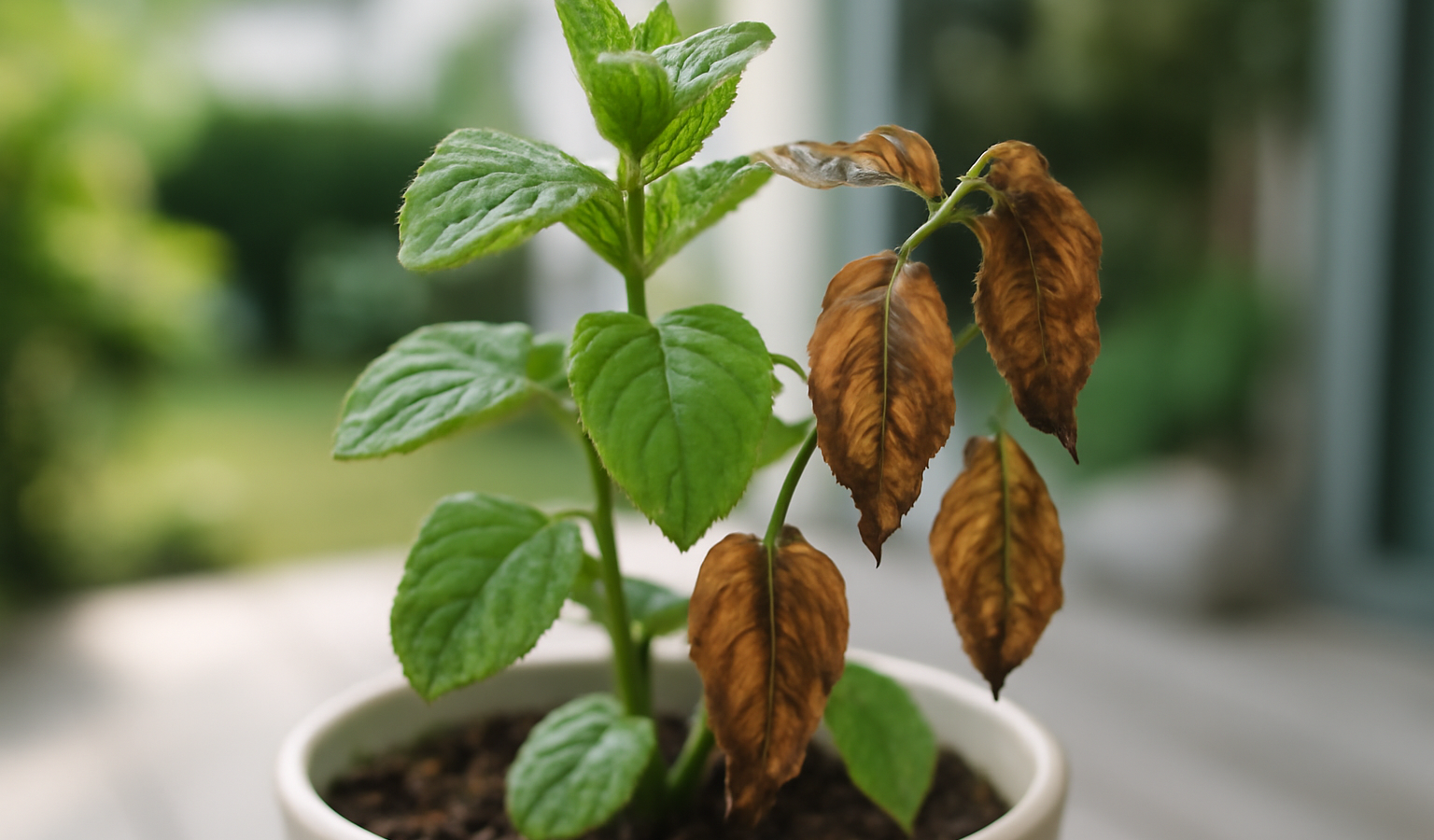
Mint is supposed to be the plant that takes over your garden, so when the leaves start going brown it feels like a personal insult. The good news: mint is tough, and brown leaves almost always trace back to one of a handful of fixable causes. The trick is reading the browning correctly. Crispy brown edges mean something different from mushy brown stems, and orange-brown speckles on the undersides of leaves are a completely separate problem. This guide walks through the five things that turn mint brown, how to tell them apart, and exactly what to do about each one. Spend two minutes diagnosing before you reach for the watering can or the fungicide, because the wrong fix can make things worse.
Key Takeaways
- Dry, crispy brown edges usually mean underwatering or heat scorch; mushy brown stems near the soil line point to overwatering and root rot.
- Mint wants consistently moist soil that never stays waterlogged. In summer that often means watering pots every 1 to 2 days.
- Orange-brown raised pustules on the undersides of leaves are mint rust, a fungal disease that spreads fast and needs aggressive removal.
- Fine stippling and a dull bronze cast, especially in hot dry spells, usually means spider mites. Check the leaf undersides with a hand lens.
- Mint in the same pot for over a year is often root-bound and starving; brown lower leaves and water that runs straight through are the tells.
Watering problems: too little or too much
Watering is behind more brown mint than anything else, and it cuts both ways. Mint has shallow roots and large, thin leaves that lose moisture quickly, so it dries out faster than most herbs. But it also rots easily when its roots sit in soggy soil. Both extremes produce brown leaves, just in different patterns.
How to diagnose
Look at where the brown is and how it feels. Underwatered mint browns from the edges and tips inward. The brown is dry, crispy, and papery, the lower leaves usually go first, and the whole plant may look limp or wilted by afternoon even though it perks up after a drink. Push a finger 2 inches into the soil; if it is bone dry, you have your answer.
Overwatering and root rot look almost opposite. The browning starts low, near the soil line, and the stems and leaf bases go soft, dark, and mushy rather than crispy. The soil stays wet for days, you may smell something sour or swampy, and if you slide the plant out of its pot the roots are brown and slimy instead of white and firm. Yellowing leaves that drop while the soil is still damp are another root-rot signal.
How to fix
For underwatered mint, water deeply until it runs out the drainage holes, then settle into a rhythm that keeps the soil consistently moist, not soggy. In hot weather a potted mint may need water every 1 to 2 days; in the ground, a deep soak twice a week is usually enough. A 1 to 2 inch mulch of straw or shredded leaves over the root zone slows evaporation and buys you time between waterings. Trim off the crispy leaves so the plant stops spending energy on them.
For overwatering and root rot, stop watering immediately and let the top of the soil dry out. Check that the pot actually has drainage holes and that they are not blocked. If the roots are already rotting, unpot the plant, cut away every brown mushy root with clean scissors, trim back the dead top growth, and repot into fresh, free-draining potting mix. Mint recovers well from a hard cutback as long as a few healthy roots remain. Going forward, water when the top inch of soil feels dry rather than on a fixed schedule.
Too much hot sun and heat scorch
Mint is a cool-climate plant at heart. It loves morning sun but struggles in relentless afternoon heat, and the problem is amplified in containers, where the soil heats up and dries out far faster than garden soil. When leaf cells lose water faster than the roots can replace it, the tissue cooks and turns brown.
How to diagnose
Heat scorch shows up as dry, brown, crispy patches in the middle or along the edges of leaves, often on the side of the plant facing the strongest afternoon sun. It tends to appear suddenly after a stretch of 90-degree days or a heat wave, and the most exposed top leaves are usually worst hit while shaded lower growth stays green. Unlike disease, the brown patches do not have rings, spots, or fuzz, just plain dead tissue. If your mint is in a dark or small pot baking on a south- or west-facing patio, heat is a prime suspect.
The clue that separates heat scorch from underwatering is timing and location: scorch hits the sun-facing, exposed leaves and follows a hot spell, while underwatering browns the whole plant fairly evenly from the bottom up. Often the two travel together, since heat dries out pots fast.
How to fix
Give mint some afternoon shade. Aim for roughly 4 to 6 hours of sun, ideally morning sun with relief from the worst midday and afternoon rays. Move pots to a spot that gets shaded after about 1 p.m., or rig up 30 to 50 percent shade cloth during heat waves. In the ground, planting mint where a taller plant or a fence casts afternoon shade works well.
Upgrade small pots, too. A pot under about 8 inches across heats and dries too quickly for mint in summer; move it into something larger, ideally a lighter-colored container that reflects heat instead of a black plastic pot. Mulch the surface, keep the soil evenly moist, and snip off the scorched leaves. Fresh growth will come in looking normal once the heat stress is gone.
Fungal diseases: rust, wilt, blight, and mildew
If the browning has a pattern to it, spots, rings, pustules, or fuzz, you are probably looking at a fungal disease rather than a watering or light issue. Mint is prone to several, and they thrive in the warm, humid, crowded conditions that a happy mint patch tends to create on its own.
How to diagnose
Mint rust is the classic. Turn a browning leaf over and look for small, raised, orange to rust-brown pustules dotting the underside; the tops of those leaves often show yellow or brown blotches, and badly infected leaves curl and drop. Verticillium wilt is a soilborne fungus that causes whole stems to wilt, brown, and die back, often on just one side of the plant, with stunted growth that no amount of watering fixes. Leaf blight and anthracnose appear as brown to black spots or sunken lesions, sometimes with a yellow halo, that spread and merge until the leaf dies. Powdery mildew coats leaves in a white-to-gray dusty film first; the tissue underneath then yellows and browns as it gives out.
How to fix
For all of these, sanitation and airflow come first. Remove and bag every infected leaf and stem; do not compost them, because the spores survive. With mint rust, cut the plant back hard, in a severe case right down to the ground, and dispose of all the foliage. New growth usually comes back clean. Improve air circulation by thinning crowded stems and giving plants room, water at the soil line rather than over the leaves, and water in the morning so foliage dries quickly.
Verticillium wilt has no cure once it is in the plant. Pull and destroy infected mint and do not replant mint or other susceptible plants in that spot, since the fungus persists in the soil for years; start fresh with healthy plants in a new bed or clean containers. For powdery mildew and minor leaf blight, removing affected leaves and fixing airflow often turns it around; a labeled garden fungicide can help with stubborn cases, but read the label, because mint is an edible and not every product is cleared for use on herbs you intend to eat.
Pests: spider mites and aphids
Tiny sap-sucking pests drain the chlorophyll out of mint leaves, and the result reads as browning, bronzing, or stippling. They multiply quietly and are easy to miss until a section of the plant looks tired and discolored.
How to diagnose
Spider mites are the main browning culprit. They show up in hot, dry conditions and cause fine pale stippling that builds into a dull, bronzed, brownish cast across the leaf. Look closely, ideally with a hand lens, at the leaf undersides for tiny moving specks and fine webbing in the leaf joints. A quick test: hold a sheet of white paper under a leaf and tap it; if specks fall and start crawling, you have mites. Aphids are larger, soft, green or black, and cluster on new growth and stem tips, where their feeding distorts and yellows leaves and leaves behind sticky honeydew that can turn into black sooty mold.
How to fix
Start with water. A strong spray from the hose, aimed especially at the undersides of the leaves, knocks both mites and aphids off and disrupts their colonies; repeat every few days. Because spider mites love dry air, raising humidity around the plant and keeping it watered makes the environment less friendly to them. For heavier infestations, insecticidal soap or a horticultural oil sprayed onto the undersides of leaves works well; coat the plant thoroughly and reapply per the label, avoiding spraying in direct hot sun. Since you are eating this plant, lean on water sprays and insecticidal soap rather than harsh chemicals, and rinse leaves well before use. Cut back the worst-hit growth to give the plant a clean restart.
Root-bound pots, nutrients, and natural dieback
If watering, light, disease, and pests all check out, the cause is usually something slower: the plant has outgrown its pot, run low on nutrients, or simply hit the end of its season.
How to diagnose
Mint is a vigorous spreader and fills a pot with roots within a season. A root-bound plant shows browning, dropping lower leaves, weak thin new growth, and water that runs straight through the pot in seconds instead of soaking in. Tip the plant out: if you see a dense mat of circling roots with little soil left, it is root-bound. A nutrient shortage, common in tired old potting mix, looks like overall pale or yellowing leaves with brown edges and stalled growth. Finally, remember the calendar. As days shorten and temperatures drop in fall, mint naturally browns, dies back, and goes dormant; this is normal and the roots will resprout in spring.
How to fix
For a root-bound plant, repot in spring into a container a few inches wider with fresh mix, or divide the root ball into two or three sections and replant each. Division actually rejuvenates mint, so do not be shy about splitting a tired clump. To address nutrients, refresh the top few inches of potting mix and feed lightly through the growing season with a balanced fertilizer; mint does not need much, and overfeeding produces lush but weak, flavorless growth. If the browning is simply fall dieback, cut the dead top growth back, mulch over the crown for winter, and wait. Do not dig it up or drown it trying to save leaves that were always going to drop. If your mint is browning in fall and you grow other herbs indoors, this is also a good moment to read up on how to increase humidity for houseplants brought inside for the season.
How to prevent brown mint in the first place
Most brown mint comes down to a few habits. Keep the soil consistently moist but never waterlogged, water at the base in the morning so foliage dries fast, and use a pot at least 8 to 10 inches across with real drainage holes. Give the plant morning sun with afternoon shade in hot climates, and mulch the root zone to steady moisture and temperature. Thin crowded stems for airflow, which is your best defense against rust and mildew, and harvest regularly, since cutting mint back encourages fresh, healthy growth and keeps the clump from getting woody and disease-prone.
Every two to three weeks, flip a few leaves and check the undersides for pustules, mites, or aphids so you catch trouble early. Repot or divide each spring before the plant gets root-bound, and feed lightly during the growing season. Do all of that and a brown leaf becomes a rare event rather than a recurring mystery. If you are troubleshooting other plants too, our guide on why your pothos is not growing uses the same diagnose-then-fix approach, and the full plants and flowers hub covers care for the rest of your garden.
Frequently Asked Questions
Should I cut off the brown leaves on my mint?
Yes. Brown leaves will not turn green again, and leaving them on wastes the plant’s energy and can harbor disease. Snip them off with clean scissors and the plant will push out fresh growth, especially once you have fixed the underlying cause.
Can mint with brown leaves come back?
Almost always. Mint is extremely resilient and resprouts readily from its roots even after a hard cutback. As long as you correct the cause and a few healthy roots remain, it will recover. Verticillium wilt and advanced root rot are the main exceptions where the plant may not bounce back.
Is browning mint safe to eat?
Skip the brown, crispy, or diseased leaves and use only healthy green ones, rinsed well. Leaves affected by rust, mildew, or pests are best discarded. If you have sprayed any product, wait the full interval on the label before harvesting.
How often should I water potted mint?
Water when the top inch of soil feels dry, which in hot summer weather often means every 1 to 2 days for a pot, and less in cooler conditions. The goal is consistently moist soil that never stays soggy. Always use a pot with drainage holes.
Why does my mint turn brown every fall?
That is normal dormancy. As days shorten and temperatures drop, mint dies back above ground and rests over winter. Cut back the dead growth, mulch the crown, and it will resprout from the roots in spring with no intervention needed.