

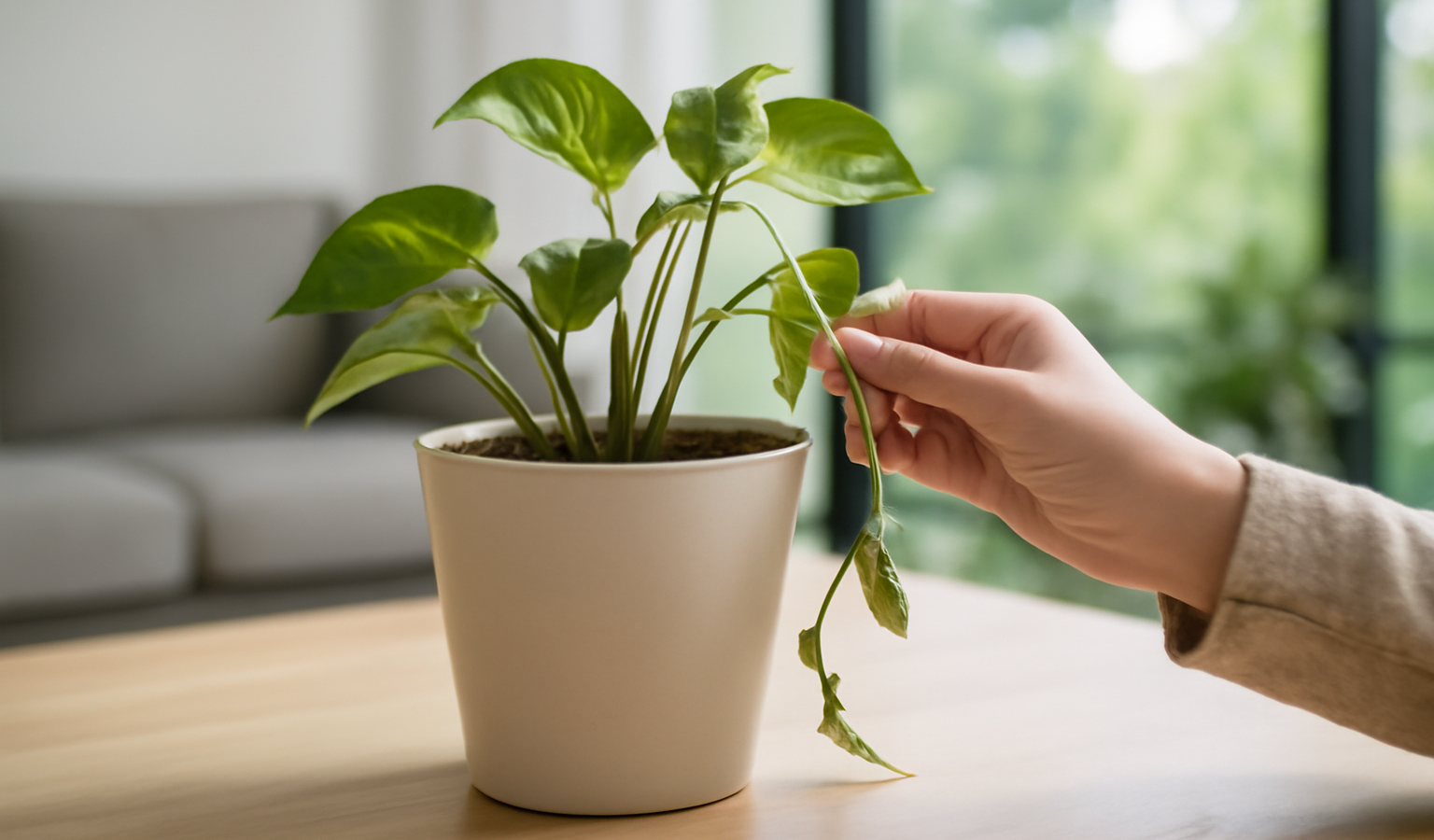
Pothos has a reputation as the plant you can’t kill, and that reputation is mostly earned. But “won’t die” and “will grow” are two different things. A pothos can sit in a corner for eight months looking exactly the same – same vine length, same leaf count – while staying perfectly green and healthy. It isn’t dying. It just isn’t doing anything. That stalled state is the most common complaint I hear about this plant, and the good news is that it’s almost always traceable to one of a handful of fixable causes. The plant is telling you something about its conditions; you just have to read it. Below are the five reasons a pothos stops growing, how to confirm which one you’re dealing with, and exactly what to change.
Key Takeaways
- Low light keeps a pothos alive but barely growing – move it to bright indirect light to see new vines, and give variegated types even more.
- Growth naturally slows or stops below about 65°F and during short winter days; this is normal and reverses in spring.
- Overwatering causes root rot that quietly stalls growth; let the top 1-2 inches of soil dry before watering again.
- A pothos that’s been in the same pot for 2+ years is likely root-bound and out of nutrients – repot and start feeding.
- Check the undersides of leaves for spider mites and the stem joints for mealybugs; a recently moved plant may also just be adjusting.
Cause 1: Not Enough Light
This is the single most common reason a pothos stalls. Pothos tolerate low light – that’s why they survive in office cubicles and windowless bathrooms – but tolerating and thriving aren’t the same thing. In genuinely dim conditions the plant essentially idles. It keeps its existing leaves green to avoid wasting energy, but it doesn’t have the light budget to build new ones. People see the healthy green and assume light is fine. It usually isn’t.
How to diagnose
Look at three things. First, leaf spacing: when a pothos grows in too little light, the gaps between leaves along the vine stretch out (this is called etiolation) and the new leaves come in smaller than the old ones. Long bare stem with tiny far-apart leaves means it’s reaching for light it can’t find. Second, your placement: if the plant sits more than 6-8 feet from a window, or near a north-facing window with no direct sky view, that’s often too dark for active growth. Third, do a shadow test at midday – hold your hand a foot above the plant. A soft, fuzzy shadow means decent indirect light; no visible shadow at all means it’s too dark to grow.
How to fix
Move it to bright indirect light. The sweet spot is a few feet back from an east- or west-facing window, or just out of the direct beam of a south window. You want plenty of bright ambient light without harsh midday sun hitting the leaves directly, since that can scorch them. If you have a variegated pothos – Marble Queen, Golden, Snow Queen, anything with white or pale-yellow patches – it needs noticeably more light than an all-green type, because the non-green parts of the leaf can’t photosynthesize and the plant has to make up the difference. Variegated plants in low light not only stop growing, they often revert to plain green to survive. If you don’t have a good window, a basic LED grow light running 10-12 hours a day will do the job. Give the plant 2-4 weeks after the move; pothos respond to better light by pushing out a new growing tip within a few weeks.
Cause 2: Winter Dormancy and Cold Temperatures
If your pothos grew all summer and then went quiet around October or November, you probably don’t have a problem at all – you have a season. Pothos is a tropical plant, and like most houseplants it slows down dramatically when days get short and temperatures drop. Growth naturally crawls below about 65°F, and the low light of winter compounds it. This is the cause people most often misdiagnose, tearing apart a perfectly healthy root ball in December looking for a problem that doesn’t exist.
How to diagnose
Timing is the giveaway. If the stall started in fall and the plant otherwise looks fine – firm leaves, good color, no pests, soil drying at a normal rate – it’s seasonal. Check temperature too: a thermometer near the plant reading consistently in the low 60s or below, especially overnight, confirms it. Watch for cold spots you might not think about – a leaf or vine resting against a single-pane window in winter, a spot near an exterior door that gets a draft, or an air-conditioning vent blowing directly on it in summer. Cold drafts can stall a plant even when the room average seems fine.
How to fix
For genuine winter dormancy, the fix is patience and restraint. Don’t fertilize a dormant plant – it isn’t using the nutrients and the salts just build up in the soil. Cut back on water, because a plant that isn’t growing drinks much less and stays wet longer (this is exactly when winter overwatering kills pothos). Keep it in the brightest spot you have through the dark months. Then, when daylight lengthens and temperatures climb back into the 70s in spring, it’ll wake up on its own and start growing again. For cold drafts specifically, just move the plant: keep it away from icy windows, exterior doors, and HVAC vents. Pothos are happiest between roughly 70 and 85°F.
Cause 3: Watering Problems
Watering is where good intentions do the most damage. Overwatering is by far the more common mistake, and it stalls growth in a sneaky way: chronically soggy soil suffocates the roots and invites root rot. Rotted roots can’t move water or nutrients up to the leaves, so the plant stops growing long before it shows obvious distress on top. The other side of the coin – chronic underwatering – is less common with pothos but does happen, especially with plants kept too dry on purpose by nervous waterers. Either extreme shuts growth down.
How to diagnose
Stick a finger 2 inches into the soil. If it’s wet days after watering, or the pot feels heavy and the soil stays dark and dense, you’re overwatering. Other overwatering tells: yellowing leaves (especially lower, older ones), a few mushy black-edged leaves, soft mushy stems at the base, or a sour smell from the soil. If you suspect rot, slide the plant out of the pot and look at the roots – healthy pothos roots are firm and white to light tan; rotted roots are brown or black, mushy, and slip apart between your fingers. Underwatering looks different: the soil pulls away from the sides of the pot, leaves go limp and curl, and crispy brown edges appear. A pothos that wilts and then springs back fast after watering has been too dry.
How to fix
The rule for pothos is simple: let the top 1-2 inches of soil dry out between waterings, then water thoroughly until it runs out the drainage holes, and dump whatever collects in the saucer. Never let the pot sit in standing water. If you’re dealing with root rot, take the plant out, rinse the roots, and trim away every mushy brown root with clean scissors. Repot into fresh, well-draining potting mix in a pot with drainage holes – the same size or slightly smaller, since an oversized pot holds too much wet soil around damaged roots. For chronic underwatering, just water more consistently; if the soil has gotten so dry it repels water and the liquid runs straight through, bottom-water by setting the pot in a few inches of water for 20-30 minutes to rehydrate the whole root ball. Make sure every pot you use has a drainage hole. This is non-negotiable for pothos.
Cause 4: Root-Bound, Depleted Soil, or No Nutrients
Plants in pots live in a closed system. They use up the nutrients in their soil, and the roots eventually fill the available space and have nowhere left to go. A pothos that hasn’t been repotted or fed in a couple of years can grind to a halt simply because it’s run out of room and food. The plant is healthy, the light is fine, the watering is on point – but it’s living in exhausted dirt inside a pot full of nothing but roots.
How to diagnose
Check the bottom of the pot first – roots circling out of the drainage holes, or a tightly wound mat of roots when you slide the plant out, means it’s root-bound. Other signs: the soil dries out within a day or two of watering (because there’s more root than soil to hold moisture), the plant seems to barely take in water, or the soil level has dropped and the surface looks compacted and crusty. Then ask yourself the honest question: when did you last repot, and when did you last fertilize? If the answer to either is “I don’t remember” or “more than a year ago,” depleted soil is a strong suspect.
How to fix
Repot into a container one size up – just 1-2 inches larger in diameter, no more, because too big a jump leaves excess wet soil that invites the rot problem from Cause 3. Use fresh, well-draining potting mix and gently loosen the outer roots if they’re tightly circled. Spring is the ideal time, right as the plant is entering its growing season. If you don’t want to repot yet, you can refresh the top inch or two of soil and start feeding. During the growing season (spring through early fall), feed with a balanced houseplant fertilizer diluted to about half strength roughly once a month – pothos aren’t heavy feeders, and overfertilizing burns the roots and causes brown leaf tips. For more on getting the timing and dilution right, see our guide on how to fertilize houseplants. Stop feeding in winter when the plant is resting.
Cause 5: Pests or Recent Stress
Pothos are pretty pest-resistant, but they’re not immune, and a quiet infestation will absolutely stall growth as the bugs drain the plant’s energy. The two to watch for are spider mites and mealybugs. Separately, a pothos that recently came home from the store, got moved to a new room, or was just repotted may simply be acclimating – plants pause growth while they adjust to a change in light, humidity, or temperature, and that pause can last a few weeks.
How to diagnose
Inspect the plant closely, ideally with a magnifier. Spider mites are tiny – look for fine webbing in the leaf joints and on the undersides of leaves, plus faint yellow stippling or speckling across the leaf surface; they thrive in hot, dry indoor air. Mealybugs are easier to spot: small white cottony tufts tucked into the stem joints and where leaves meet the vine. If you find either, you’ve got your answer. For the stress angle, think back: did anything change in the last month or two – a new home, a different window, a repot, a big temperature swing? If a previously growing plant stalled right after a move and you find no pests, it’s probably just adjusting.
How to fix
For pests, isolate the plant immediately so they don’t spread to your other houseplants. Wipe down the leaves – tops and bottoms – and treat with insecticidal soap or a neem oil solution, repeating every 5-7 days for several weeks to catch newly hatched bugs, since one treatment never gets them all. For spider mites specifically, raising humidity and rinsing the foliage in the shower helps knock the population down. For mealybugs, you can dab individual clusters with a cotton swab dipped in rubbing alcohol. For a stressed or newly acclimating plant, the fix is mostly to leave it alone: give it stable conditions – consistent light, no drafts, normal watering – and don’t repot or fertilize while it’s settling in. It’ll resume growing once it’s comfortable.
How to Get Your Pothos Growing Fast
Once you’ve found and fixed the cause, you can stack the conditions in your favor to get fast, vigorous growth. Start with light: bright indirect light is the biggest lever you have, and moving a pothos from a dim corner to a bright window is the change that most often turns a stalled plant into a vining machine within a month. Keep it warm and stable, ideally 70-85°F, away from cold windows and vents.
Water on the dry-down rhythm – top 1-2 inches dry, then a thorough soak – and never let it sit in water. During the growing season, feed at half strength about monthly. Give the roots room with a fresh pot every couple of years. And don’t overlook pruning: cutting back leggy vines just above a leaf node forces the plant to branch and produces a fuller, bushier plant rather than a few long bare strands. Those trimmings root easily in water, so you get free plants out of the deal. If you’re working through problems on other plants too, our plants and flowers hub covers troubleshooting across the board, and the same diagnostic mindset applies to outdoor herbs – see why mint turns brown for a parallel example of reading a plant’s signals.
Frequently Asked Questions
How long does it take for a pothos to start growing again after I fix the problem?
Usually 2-4 weeks during the growing season. After moving a plant to better light or repotting it, watch for a new growing tip to emerge at the end of a vine. If it’s winter, expect little to no new growth until spring no matter what you change.
Is my pothos dead if it hasn’t grown in months?
Almost certainly not. Pothos are extremely durable and a months-long stall is far more likely to be low light, winter dormancy, or root-bound soil than death. As long as the leaves are firm and green and the roots are white and firm, the plant is alive and just waiting on better conditions.
How often should I water a pothos that isn’t growing?
Go by the soil, not a schedule. Let the top 1-2 inches dry out, then water thoroughly. A non-growing plant uses far less water, so you’ll water less often – often every 1-2 weeks, and even less in winter. When in doubt, wait; pothos handle being slightly too dry far better than being too wet.
Why is my pothos growing long vines but no new leaves, or tiny leaves?
That’s classic low-light stretching. The plant is reaching for light, spacing its leaves far apart and making them small to conserve energy. Move it to brighter indirect light and the new leaves will come in larger and closer together. Pruning the leggy vines also encourages fuller growth.
Does a pothos grow faster in water or soil?
Pothos root and grow readily in water, which is great for propagation, but for long-term vigorous growth soil generally wins because it supplies nutrients that plain water lacks. If you keep a pothos in water permanently, add a few drops of diluted fertilizer periodically and change the water regularly to keep it growing.