

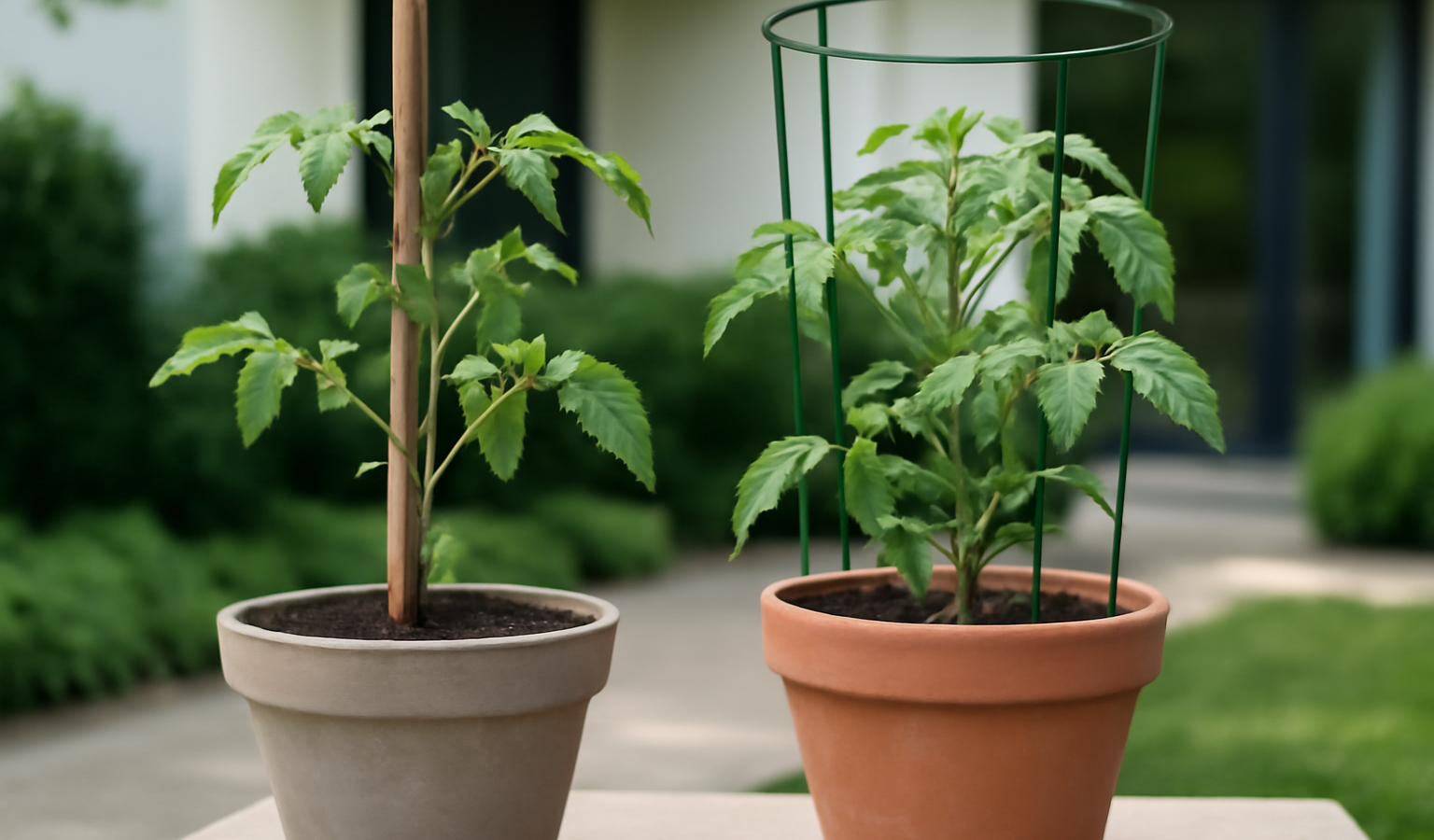
Here is the short answer: staking ties a plant to one or more upright supports and works best for single-stem or indeterminate growers you actively prune, while caging surrounds the plant with a wire structure it grows up through and works best for bushy, determinate growers you mostly leave alone. Staking gives you better airflow and easier spraying at the cost of more tying and pruning labor; caging gives you a hands-off season and higher per-plant yield at the cost of bulkier storage and harder reach into the middle of the plant. Neither is universally “better” — the right choice depends on the plant’s growth habit and how much fiddling you want to do.
In this guide
This decision comes up most often with tomatoes, where the gap between an indeterminate vine that wants to sprawl 8 feet and a compact determinate bush that tops out at 4 feet is huge. But the same logic applies to peppers, tomatillos, and a whole list of tall flowers that flop without help: peonies, dahlias, delphiniums, gladiolus, and many tall perennials. A peony loaded with rain-soaked blooms behaves a lot like a tomato laden with fruit — gravity wins unless you intervene before the plant gets heavy.
The biggest mistake gardeners make is choosing support too late. Both staking and caging want to go in at or near planting time, when you can drive a stake or drop a cage without disturbing roots. Wait until the plant is already leaning and you are doing damage control, threading floppy stems through a cage or wrenching them upright against a stake. Decide your method early, match it to the plant, and the rest of the season gets a lot easier.
Key Takeaways
- Stake indeterminate tomatoes, dahlias, delphiniums, and single-stem cut flowers you prune to one or two leaders.
- Cage determinate tomatoes, peppers, tomatillos, and bushy plants you do not want to prune.
- Use a 6–8 ft stake driven 8–12 inches deep, and tie loosely every 8–12 inches with soft twine in a figure-8.
- Skip flimsy cone cages — a 5–6 ft concrete-reinforcing-wire (CRW) cage holds a full fruit load and lasts decades.
- Install either support at planting time; retrofitting a leaning, heavy plant causes root and stem damage.
| Feature | Staking | Caging |
|---|---|---|
| Best for | Single-stem / indeterminate, pruned plants | Bushy / determinate, unpruned plants |
| Pruning required | Yes — prune to 1–2 leaders, remove suckers | Little to none |
| Space used | Narrow footprint (~12 in) | Wider footprint (18–24 in diameter) |
| Setup effort | Low to set, ongoing tying all season | Higher to set, then mostly hands-off |
| Cost | Low ($2–6 per stake) | Higher ($8–20 per sturdy cage) |
| Air circulation | Excellent — open, sprayable canopy | Good outside, denser interior |
| Harvest access | Easy — fruit on visible leaders | Harder to reach plant center |
| Best plants | Indeterminate tomatoes, dahlias, delphiniums, gladiolus | Determinate tomatoes, peppers, tomatillos, peonies |
Staking
Staking means driving a single upright support into the ground next to the plant and tying the main stem to it as the plant grows. Use a stout stake — a 1-inch hardwood stake, a metal T-post, or a length of rebar — that stands 6 to 8 feet above ground for tall indeterminate tomatoes. Drive it 8 to 12 inches into the soil at planting time, positioned 2 to 4 inches from the stem so you can tie without crowding the roots. A stake that wobbles when you push it is not deep enough; a fully fruited indeterminate vine in August is surprisingly heavy and will pull a shallow stake right over.
As the plant climbs, tie it loosely every 8 to 12 inches using soft ties, garden twine, or strips of old T-shirt. The trick is the figure-8: loop the tie around the stake, cross it, then loop around the stem so a soft cushion of material sits between stem and stake. Never cinch the tie tight against the stem — leave room for the stalk to thicken, or you will girdle it by midsummer. Staking only works well if you also prune. For indeterminate tomatoes, that means pinching suckers to keep the plant to one or two main leaders so all that energy goes up the stake instead of sideways into a tangle.
Staking shines with single-stem growers: indeterminate tomatoes pruned to leaders, plus dahlias, delphiniums, gladiolus, and tall single-stem cut flowers that snap in wind. The payoff is airflow. An open, pruned, staked plant dries fast after rain and is easy to spray top to bottom, which cuts down on fungal problems like early blight and septoria. The downside is labor — you are pruning suckers and adding ties every week or two — and total yield per plant is usually lower than a sprawling caged plant simply because you have removed so much growth.
Caging
Caging means setting a wire structure over or around the plant early in the season and letting it fill in with little or no pruning. The plant leans on the wire grid from the inside, so you skip almost all the tying. The single most important caging decision is which cage. Skip the flimsy galvanized cone cages sold at most stores — they are too short, too narrow, and tip over the moment a determinate tomato sets a real fruit load. Instead, build cages from concrete-reinforcing wire (CRW), the heavy 6-inch-mesh roll used for slabs. A 5-to-6-foot-tall CRW cylinder roughly 18 to 24 inches in diameter holds a fully loaded plant, lasts decades, and the 6-inch openings are wide enough to reach your hand through to harvest.
Set the cage over the seedling at planting, push the bottom legs a few inches into the soil, and anchor it. Because a tall cage full of foliage acts like a sail, drive a stake or two alongside and zip-tie the cage to them — an unanchored cage will blow flat in a summer thunderstorm and take the plant with it. After that, caging is genuinely low-effort: you might tuck a stray branch back inside now and then, but there is no weekly tying ritual.
Caging is the right call for determinate tomatoes that grow as compact bushes, plus peppers, tomatillos, and grow-through situations like peonies and bushy dahlias supported by a grid ring. The advantages are low labor, strong support for a heavy fruit load, and higher yield per plant since you are not pruning growth away. The trade-offs: sturdy cages are bulky and awkward to store over winter, the dense interior is harder to reach and inspect for pests, and tall cages must be anchored or they topple in wind.
Other support options
Staking and caging are not the only choices. The Florida weave (basket weave) is the go-to for rows of tomatoes or peppers: drive a T-post every two plants, then run twine down one side of the row and back up the other at each height level, sandwiching the plants between strands. It is fast to install for many plants and very cheap, though it needs new string lines added every 8 to 10 inches of growth. Trellises and string-down systems work well in tunnels and raised beds, where you clip a single-leader vine to a vertical string and lower it as it grows. For flowers, peony grow-through rings and linking grid stakes let bushy perennials grow up through a grid that disappears under the foliage, and single ring stakes corral one floppy clump like a peony or aster with a hoop and a post. Pick the system that matches your plant count: weave and trellis for rows, cages and rings for individual specimens.
Which support is best for your plant
Start with one question: does this plant get pruned? If yes, stake it. Indeterminate tomatoes pruned to one or two leaders belong on a tall stake or a string. Dahlias grown for cut flowers, delphiniums, and gladiolus are tall, single-stemmed, and brittle — stake each stem or clump individually. If the plant is bushy and you would rather not prune, cage it. Determinate tomatoes set their whole crop on a compact frame and resent pruning, so a sturdy CRW cage is ideal. Peppers and tomatillos are brittle-branched bushes that snap under fruit weight; a cage cradles the whole plant without tying.
Flowers split along the same line. A peony is a low, wide, heavy-headed bush — a grow-through ring or cage installed in early spring, before the shoots are 8 inches tall, catches the floppy blooms perfectly. A tall cut-flower dahlia you disbud for big single blooms is more of a staking job. If you are unsure why a tall perennial keeps flopping, the problem is often timing rather than method — see our guide on why coneflowers droop for the same dynamics in a smaller perennial. And if a peony is leaning but never opening, support is not your only issue; check why peonies fail to bloom.
The verdict
There is no single winner — there is a right tool for each plant. Stake when you want airflow, easy spraying, and clean harvest access, and you are willing to prune and tie: indeterminate tomatoes, dahlias, delphiniums, and single-stem cut flowers. Cage when you want a low-labor season and maximum yield from bushy plants you would rather not touch: determinate tomatoes, peppers, tomatillos, and grow-through flowers. If you only remember one rule, remember that quality and timing beat method every time. A sturdy 5–6 ft CRW cage anchored at planting outperforms a flimsy cone cage, and a stake driven a foot deep at transplant outperforms one jammed in next to a heavy August vine. Match the support to the plant’s habit, install it early, and you will spend the rest of the summer harvesting instead of rescuing flopped plants. Browse more growing guides in our plants and flowers hub.
Frequently Asked Questions
Should I stake or cage indeterminate tomatoes?
Stake them. Indeterminate tomatoes grow as long vines that you prune to one or two leaders, and a tall stake or string keeps that single leader upright with great airflow. Most cages are too short to contain a 7–8 ft indeterminate vine, so it flops over the top by midsummer.
Are store-bought cone tomato cages any good?
Generally no. The galvanized cone cages sold at most garden centers are too short and too flimsy for a real fruit load and tip over once the plant fills out. Build cages from concrete-reinforcing wire (CRW) instead — a 5–6 ft cylinder lasts for decades and actually holds the weight.
How deep should I drive a tomato stake?
Drive a 6–8 ft stake at least 8–12 inches into the soil, deeper in loose or sandy ground. The stake should not wobble when you push on it, because a fully fruited indeterminate vine in late summer is heavy enough to pull a shallow stake over in wind.
What is the best support for peonies?
A grow-through ring or grid cage installed in early spring, before the shoots reach about 8 inches, is ideal for peonies. The foliage grows up through the grid and hides it, while the ring catches the heavy, rain-soaked blooms that would otherwise flop to the ground.
Does caging or staking give a higher yield?
Caging usually gives a higher yield per plant because you leave most of the growth in place rather than pruning it away. Staking trades some total yield for better airflow, easier spraying, and lower disease pressure, which can mean cleaner, more reliable fruit even if the count is lower.