

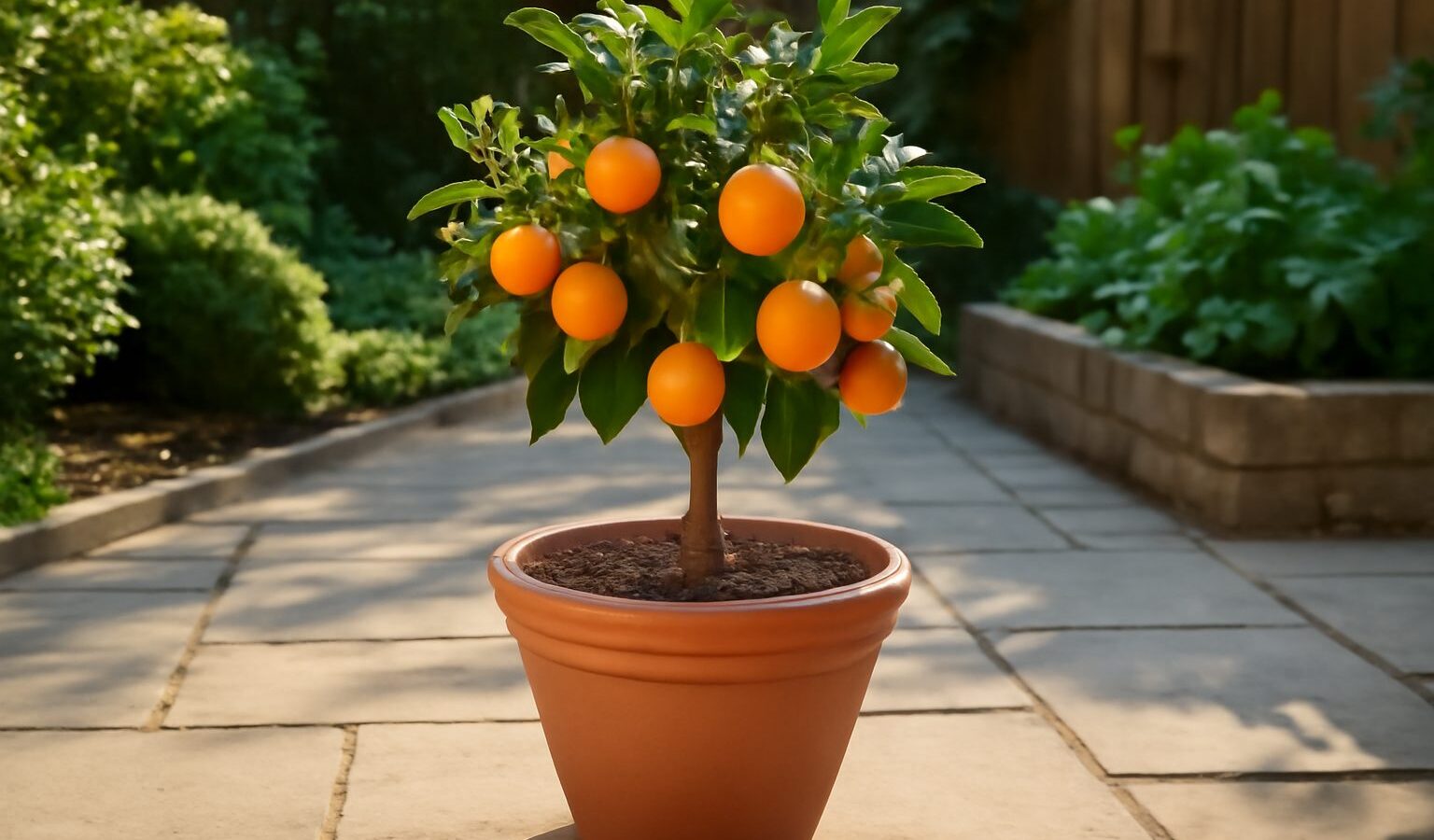
You don’t need an orchard to grow your own fruit — a big pot on a sunny patio or balcony will do. Dwarf and genetic-dwarf fruit trees were bred for exactly this, staying small enough to live their whole lives in a container while still producing real, full-size fruit. Growing in pots also gives you control a garden can’t: you can wheel a fig into the garage before a hard freeze, position a peach for maximum sun, and grow a citrus tree in a climate that would kill it in the ground. The trade-off is that a potted tree depends entirely on you for water, food, and winter protection. This guide covers choosing the right variety, sizing the pot, mixing the soil, and the watering, feeding, pruning, and overwintering routine that keeps a container fruit tree productive for years.
Key Takeaways
- Choose dwarf or genetic-dwarf varieties on dwarfing rootstock — figs, citrus, columnar apples, dwarf peaches, and self-pollinating types are the easiest in pots.
- Start in a pot at least 18–24 inches wide (15–25 gallons) and pot up gradually; a too-big pot stays soggy and rots roots.
- Use a free-draining mix — quality potting soil cut with bark, perlite, or grit — never heavy garden soil, and make sure the pot has large drainage holes.
- Water deeply and often (frequently daily in summer heat), and feed regularly through the growing season because nutrients flush out of pots fast.
- Overwinter according to the tree: hardy types need root insulation; tender citrus and figs need to move into a garage, shed, or indoors before hard frost.
Best Fruit Trees for Containers
Success starts with choosing a tree that wants to stay small. The key is dwarfing rootstock or naturally compact “genetic dwarf” varieties — a standard tree forced into a pot will struggle. Equally important, pick self-pollinating (self-fertile) varieties so a single tree sets fruit without a partner, unless you have room for two.
- Figs — arguably the best beginner container fruit. They love having their roots restricted, fruit on a small tree, and varieties like ‘Brown Turkey’, ‘Chicago Hardy’, and ‘Petite Negra’ thrive in pots.
- Citrus — Meyer lemon, calamondin, kumquat, and ‘Improved Meyer’ are self-fertile, evergreen, and ideal for pots in cold climates because they come indoors for winter.
- Columnar and dwarf apples — columnar (“Urban” or “Colonnade” type) apples grow as a single narrow stem; dwarf apples on M27 or M9 rootstock stay small. Many apples need a pollination partner, so choose self-fertile types or grow two.
- Genetic-dwarf peaches and nectarines — varieties like ‘Bonanza’ and ‘Pix Zee’ top out around 4–6 feet, are self-fertile, and crop heavily for their size.
- Cherries, plums, and pears on dwarfing rootstock — choose self-fertile cultivars (e.g., ‘Stella’ cherry) on dwarfing rootstock such as Gisela for cherries or Pixy for plums.
If you’re new to container fruit, start with a fig or a Meyer lemon — both are forgiving and rewarding.
Pot Size and Type
Right-sizing the pot matters more than almost anything else. A young dwarf tree should start in a container roughly 16 to 18 inches in diameter, then be potted up every couple of years into the next size, finishing in a final pot around 18 to 24 inches wide and deep — roughly 15 to 25 gallons. Don’t jump a small tree straight into a huge pot: the large volume of mix stays wet and the roots, unable to use all that water, rot. Width matters as much as depth because fruit-tree roots spread.
For material, glazed ceramic, plastic, and wood hold moisture better than unglazed terracotta, which wicks water away fast and dries out quickly in summer — a real liability for a thirsty fruit tree. Whatever you choose, it must have large drainage holes; drill more if needed. Set the pot on feet or a few stones so the holes never sit in a saucer of standing water. If you’ll move the tree for winter, put it on a sturdy wheeled plant caddy from the start — a 25-gallon pot full of wet mix is brutally heavy.
The Right Potting Mix
Never fill a pot with garden soil — it compacts into an airless, poorly draining brick. Use a high-quality potting mix amended for drainage and structure. A reliable blend is roughly two-thirds quality potting soil to one-third coarse material — composted bark, perlite, or horticultural grit — which gives the open, free-draining-but-moisture-retentive structure fruit-tree roots need. A handful of slow-release granular fertilizer or some worm castings mixed in at planting gives the tree a running start. For acid-loving fruits like citrus, use a mix on the slightly acidic side; for blueberries (which also do beautifully in pots) you’d switch to a dedicated ericaceous/acidic mix entirely — see our companion guide on how to grow blueberries in pots.
Planting and Positioning
Plant so the tree sits at the same depth it was in its nursery pot — never bury the graft union (the swollen joint low on the trunk), which should stay a couple of inches above the soil line. Add a layer of crocks or coarse gravel only if your drainage holes are small; otherwise just fill with mix, firm gently, and water in well. Leave an inch or two of space between the soil surface and the pot rim so water doesn’t sheet straight over the edge. Then placement: nearly all fruit trees demand full sun — at least 6 to 8 hours daily — to ripen fruit, so put the pot in the sunniest, most sheltered spot you have. A south- or west-facing wall that radiates stored heat is ideal, especially for heat-lovers like figs and peaches.
Watering
Watering is where most potted fruit trees are won or lost. A container has a tiny soil reservoir compared to open ground, so it dries out fast — in midsummer heat a fruiting tree in a 20-gallon pot may need watering once or even twice a day. Water deeply each time, until it runs freely from the drainage holes, rather than giving frequent sips that only wet the surface. Check moisture by pushing a finger 2 inches into the mix; water when that depth feels dry. Consistency matters especially during fruit development — erratic watering causes fruit to split, drop, or develop blossom-end problems. A simple drip line on a timer takes the daily worry out of summer, and a 2-inch mulch of bark or gravel on the soil surface slows evaporation considerably. In winter, dormant trees need far less — just enough to keep the rootball from drying out completely.
Feeding
Because frequent watering constantly flushes nutrients out of the pot, container fruit trees need regular feeding that a garden tree wouldn’t. Start in early spring as growth resumes. A balanced slow-release granular fertilizer worked into the surface gives a season-long baseline; supplement during the growing season with a liquid feed every couple of weeks. Once trees set fruit, shift to a higher-potassium feed (a tomato-type fertilizer works well) to support flowering and fruiting rather than just leafy growth. Citrus are heavy feeders and benefit from a dedicated citrus fertilizer containing trace elements. Stop feeding by late summer / early fall so the tree isn’t pushing soft new growth into winter, which is vulnerable to frost.
Pruning and Repotting
Prune container fruit trees to keep them compact, open, and productive. The main aims are to maintain a manageable size, open the center so light and air reach the fruit, and remove dead, crossing, or weak growth. Most deciduous fruit trees are pruned in late winter while dormant; stone fruits like cherries and plums are better pruned in summer to reduce disease risk. Every 2 to 3 years, refresh the tree: either pot up one size, or — once it’s in its final pot — slide it out, trim the outer inch of roots and any circling roots, and repot into fresh mix. This root pruning prevents the tree becoming pot-bound and keeps it vigorous. For broader small-space growing techniques, the Urban Gardening section has plenty of companion projects.
Overwintering
Winter is the make-or-break season, and the strategy depends entirely on the tree. A potted root system is far more exposed to cold than the same tree in the ground, because the soil mass that buffers temperature is so small — roots can freeze in a pot at temperatures the tree would shrug off if planted out.
- Hardy deciduous trees (apple, pear, hardy fig, cherry, plum): they need winter chill to fruit, so leave them outdoors, but protect the roots. Cluster pots together against a sheltered wall, wrap the containers in burlap, bubble wrap, or hessian, or sink the pots into the ground or a mulch pile for the season. The goal is insulating the roots, not the top.
- Tender evergreens (citrus): move them indoors or into a frost-free greenhouse or sunroom before the first hard frost. They want a bright, cool spot (around 50–60°F) and much less water while growth slows. Return them outdoors after the last frost, hardening off gradually.
- Borderline figs in cold zones: move into an unheated garage, shed, or basement once dormant and leafless; keep the mix barely moist and bring back out in spring.
Whatever the type, ease off feeding and watering as growth slows, and never let a dormant pot sit in waterlogged mix through freeze-thaw cycles — that combination of cold and saturation kills more potted trees than cold alone.
Frequently Asked Questions
What size pot does a container fruit tree need?
Start a young dwarf tree in a 16–18 inch pot and pot up gradually to a final container about 18–24 inches wide and deep, roughly 15–25 gallons. Avoid putting a small tree straight into a very large pot, because the excess wet mix can rot the roots.
Which fruit trees grow best in pots?
Figs and citrus (especially Meyer lemon) are the easiest, along with genetic-dwarf peaches and nectarines, columnar and dwarf apples, and self-fertile cherries and plums on dwarfing rootstock. Choose self-pollinating varieties on dwarfing rootstock so a single small tree sets fruit.
How often should I water a fruit tree in a container?
Deeply and often — in summer heat a fruiting tree may need water once or twice a day. Water until it runs from the drainage holes, and check by pushing a finger 2 inches into the mix; water when that depth feels dry. A drip timer and surface mulch make summer watering far easier.
Do I need to bring container fruit trees indoors for winter?
It depends on the tree. Hardy deciduous trees stay outdoors but need their roots insulated (wrap or cluster the pots). Tender citrus must come into a bright, cool, frost-free space before hard frost. Borderline figs go dormant in an unheated garage or shed. The roots in a pot are far more cold-exposed than in the ground.
How long do fruit trees live in containers?
Many years — often a decade or more — if you repot or root-prune every 2 to 3 years, feed regularly, water consistently, and prune to keep the tree compact and open. Neglecting repotting eventually leaves the tree pot-bound and declining, so refreshing the roots and mix is the key to longevity.