

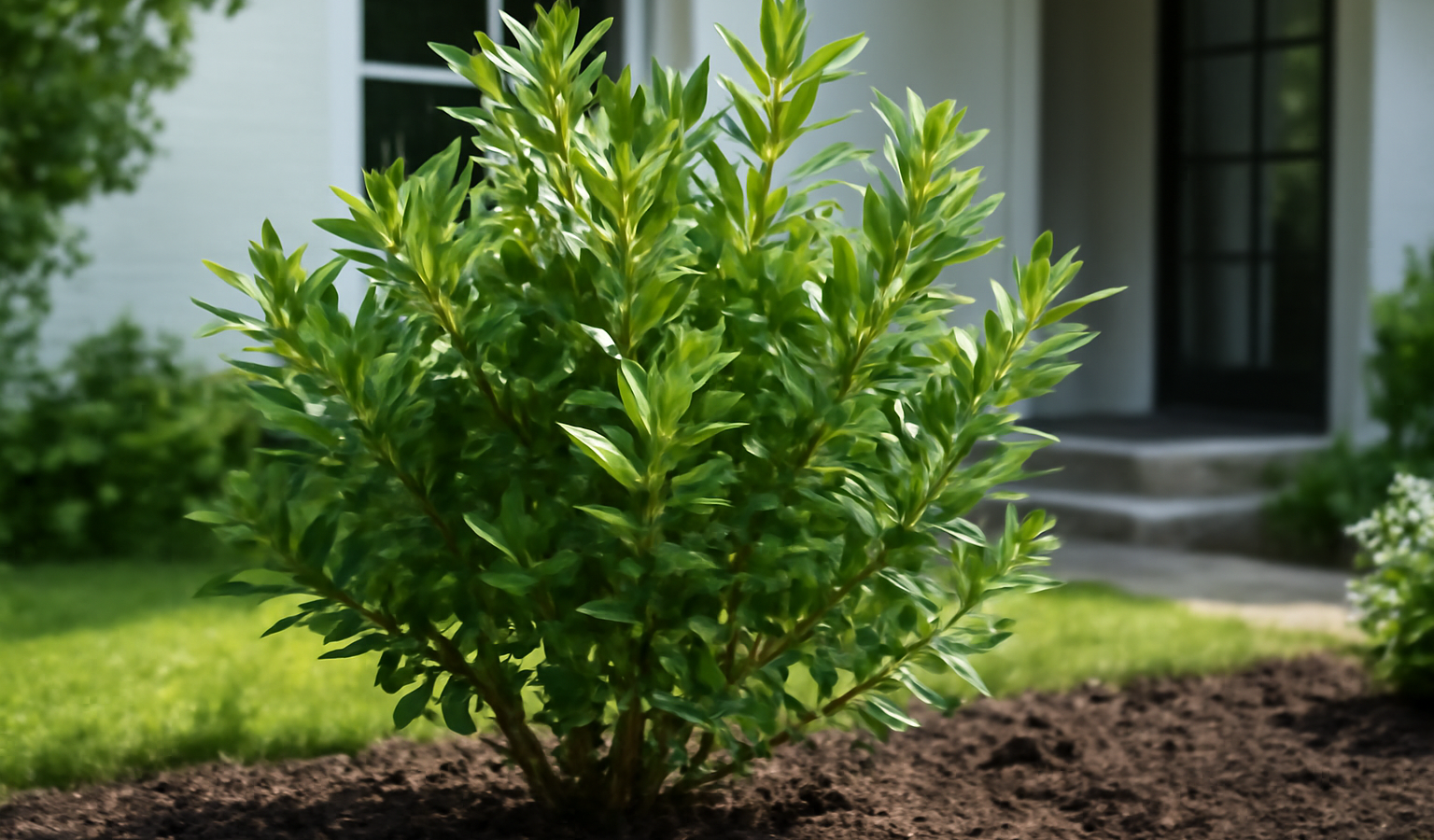
Northern bayberry (Morella pensylvanica, formerly Myrica pensylvanica) is one of the most useful, low-maintenance native shrubs you can plant for a tough spot. It shrugs off salt spray, poor sandy soil, road salt, drought, and coastal wind, all while fixing its own nitrogen and feeding overwintering birds with its waxy gray-blue berries. The aromatic foliage releases a clean, spicy scent when crushed, and the same wax that coats the fruit is the original source of bayberry candles. If you have a difficult site — a seaside lot, a dry bank, a hellstrip, or a windswept property line — bayberry is a near-foolproof choice. This guide covers hardiness zones, soil, planting, the male/female pollination quirk that catches new growers out, watering, pruning, and how to keep this enthusiastic spreader in bounds.
In this guide
Key Takeaways
- Hardy in USDA zones 3 to 7, northern bayberry tolerates salt, wind, drought and poor sandy soil.
- It is semi-evergreen in the South and deciduous in the North, growing 5 to 10 feet tall and wide.
- Plants are dioecious: you need both a male and a female shrub for the waxy berries to form.
- It fixes its own nitrogen, so it thrives in lean, infertile soil without feeding.
- Best planted in full sun to part shade in spring or fall; tolerates wet and dry ground alike.
- It suckers and spreads to form colonies — ideal for screening and bank stabilization, but contain it in small beds.
- Pruning is minimal; shear lightly in late winter only if you want a denser, more formal shape.
Is Bayberry Right for Your Garden?
Northern bayberry is a rounded, multi-stemmed deciduous-to-semievergreen shrub that typically reaches 5 to 10 feet tall with an equal spread. In the warmer end of its range it holds much of its leathery dark-green foliage through winter; in colder northern gardens it drops most leaves but keeps an attractive twiggy structure. The leaves are 2 to 4 inches long, glossy, and intensely aromatic when bruised. On female plants, clusters of small grayish-white berries coated in pale wax cling tightly to the stems from late summer well into winter, providing food for yellow-rumped warblers, tree swallows, and other birds.
What makes bayberry special is its toughness. It is one of the few attractive shrubs that genuinely thrives in pure beach sand, withstands direct salt spray, and tolerates both flooding and drought. Because it forms a symbiotic relationship with nitrogen-fixing actinobacteria in its roots, it actually improves poor soil over time. Use it as an informal hedge, a coastal windbreak, an erosion-control planting on a slope, or a backdrop in a native or wildlife garden. If you garden in a tougher microclimate, it pairs well with other resilient natives — see our broader notes in the Plants & Flowers hub for companions.
Hardiness Zones and Climate
Northern bayberry is reliably hardy in USDA zones 3 through 7, with some success into zone 8 in cooler coastal pockets. Its native range hugs the eastern seaboard from Newfoundland down to North Carolina and inland around the Great Lakes, which tells you everything about its preferences: cool to temperate climates, sandy or rocky soils, and exposure to wind and salt. In the Deep South and hot interior West it struggles, where the closely related southern wax myrtle (Morella cerifera) is the better evergreen substitute for zones 7 to 10.
Because it evolved on exposed coastlines and barren glacial soils, bayberry does not need pampering. It handles winter cold to roughly -30°F, sustained ocean wind, and the salt-laden air that scorches less rugged shrubs. The one climate it dislikes is prolonged tropical heat and humidity, which can lead to leaf problems and a short-lived plant.
Soil and Site Requirements
Soil is where bayberry truly shines, because it asks for so little. It prefers acidic, sandy, infertile soil with a pH between 4.0 and 6.5, the same lean, lime-free conditions that suit blueberries and azaleas. That said, it adapts to a remarkable range, including heavier loams, dry rocky banks, and periodically wet, boggy ground. The only soil it genuinely resents is heavy, compacted, poorly drained clay that stays waterlogged year-round.
Light and Exposure
Plant bayberry in full sun to partial shade. It flowers and fruits most heavily, and stays densest, in at least six hours of direct sun. In shade it grows looser and more open, with sparser berries, but it still survives. Its tolerance for exposed, windy, salt-sprayed sites is among the best of any landscape shrub, which is why it is a staple of seaside and roadside plantings where road salt would kill most alternatives.
How to Plant Bayberry
The best planting windows are early spring after the soil thaws or early fall, giving roots time to establish before stress sets in. Bayberry is most often sold as a container-grown shrub; balled-and-burlapped plants transplant less reliably because the root system resents disturbance. Space plants 4 to 6 feet apart for a continuous informal hedge, or up to 8 feet apart as freestanding specimens.
- Dig a hole two to three times as wide as the root ball but no deeper than the root ball is tall.
- Tease apart any circling roots, then set the plant so the top of the root ball sits slightly above grade.
- Backfill with the native soil — do not amend heavily, since bayberry prefers lean ground and over-rich backfill discourages root spread.
- Water in thoroughly to settle the soil and eliminate air pockets.
- Mulch with 2 to 3 inches of pine bark or shredded leaves, kept a few inches back from the stems.
Skip fertilizer entirely at planting. Bayberry fixes its own nitrogen and feeding usually does more harm than good, producing weak, leggy growth.
The Male and Female Plant Problem
Here is the single most important thing to understand before you buy: bayberry is dioecious, meaning individual plants are either male or female. Only female plants produce the prized waxy berries, and they will only do so if a male plant grows nearby to pollinate them. If you buy one shrub and it turns out to be male, you will never see fruit; if you buy a single female with no male in the neighborhood, the same is true.
For dependable berries, plant several shrubs together so you get at least one male among the group, or buy named female cultivars alongside a known male pollinator. One male can pollinate several females within roughly 100 feet. In coastal areas wild bayberry may already grow nearby, supplying pollen on its own. If berries are not your goal — say you only want the foliage, screening, and salt tolerance — then the male/female distinction does not matter and any plant will do.
Watering and Feeding
Water newly planted bayberry deeply once or twice a week through the first growing season, providing about an inch of water at a time and letting the surface dry between soakings. After the first year, established plants are highly drought-tolerant and rarely need supplemental water except during prolonged dry spells. Their nitrogen-fixing roots make them genuinely self-sufficient in poor soil.
Feeding is almost never necessary and is often counterproductive. Excess nitrogen pushes soft growth, reduces fruiting, and can make the shrub floppy. If your soil is exceptionally poor and growth seems stalled after two seasons, a single light application of a balanced acid-forming fertilizer in early spring is plenty. The same “lean is keen” logic that governs tough natives also applies to many drought-adapted plants in the low-water landscaping playbook.
Pruning and Shaping
Bayberry needs very little pruning. Its naturally rounded, dense habit looks good with no intervention, which is part of its appeal. If you want a tidier or more formal hedge, shear lightly in late winter to early spring before new growth emerges; this also encourages denser branching. Remove any dead, damaged, or crossing stems at the same time. Because berries form on the previous season’s wood, heavy shearing can reduce fruiting, so prune female plants conservatively if you value the berries.
Older shrubs can be rejuvenated by cutting one-third of the oldest stems to the ground over three successive years, or by hard-renewal pruning the whole plant back to 12 inches in late winter — it resprouts vigorously from the base. Wear gloves and clean tools, but disease is rarely an issue with this resilient native.
Controlling Spread and Propagation
Bayberry spreads by underground suckers, gradually forming a thicket or colony. On a slope, seaside bank, or large naturalized area this is a feature, not a bug — it stabilizes soil and fills space. In a tidy bed it can become a nuisance, sending up shoots a few feet from the parent plant. Control it by slicing through wandering suckers with a sharp spade each spring, or install a root barrier to confine the colony. You can also dig and replant rooted suckers in fall to propagate new plants for free.
Seed propagation is slow because the waxy coating inhibits germination; the wax must be removed and the seed cold-stratified for two to three months. For most gardeners, transplanting suckers or layering low branches is far easier than starting from seed.
Pests, Problems and Uses
Northern bayberry is refreshingly trouble-free. It has no serious insect or disease problems, is rarely browsed by deer thanks to its aromatic foliage, and resists the salt and pollution that damage fussier shrubs. The most common complaint — no berries — almost always traces back to the male/female pollination issue rather than any cultural problem. Occasionally a chlorotic yellowing appears in soil that is too alkaline; lower the pH with elemental sulfur if needed.
Beyond the landscape, the wax-coated berries are the traditional source of bayberry candle wax, historically boiled off the fruit to make fragrant, clean-burning candles. The dried leaves can be used sparingly like bay leaves to flavor soups and stews, though they are removed before serving. Combined with its wildlife value and bulletproof toughness, bayberry earns its place in any difficult site.
Frequently Asked Questions
How fast does northern bayberry grow?
It grows at a moderate rate of about 1 to 2 feet per year in good conditions, reaching its mature 5- to 10-foot size in roughly five to seven years. Growth is faster in full sun with adequate moisture and slower in shade or very dry soil.
Why does my bayberry have no berries?
Almost always because of the male/female plant issue. Only female plants fruit, and only when a male grows nearby to pollinate them. Plant several shrubs together, or add a known male pollinator within about 100 feet of your females.
Is bayberry deer resistant?
Yes. The aromatic, slightly resinous foliage is unpalatable to deer, which usually leave it alone except in cases of extreme food scarcity. This makes it a reliable choice for properties with heavy deer pressure.
Can bayberry grow in wet soil?
Yes, it is unusually adaptable. It tolerates periodically wet, boggy ground as well as dry sandy soil, which is rare among shrubs. The only soil it dislikes is permanently waterlogged, compacted clay.
How do I keep bayberry from spreading?
Cut through underground suckers with a sharp spade each spring, or install a vertical root barrier around the planting. In large naturalized areas, simply let it colonize — its spreading habit is excellent for erosion control and screening.