

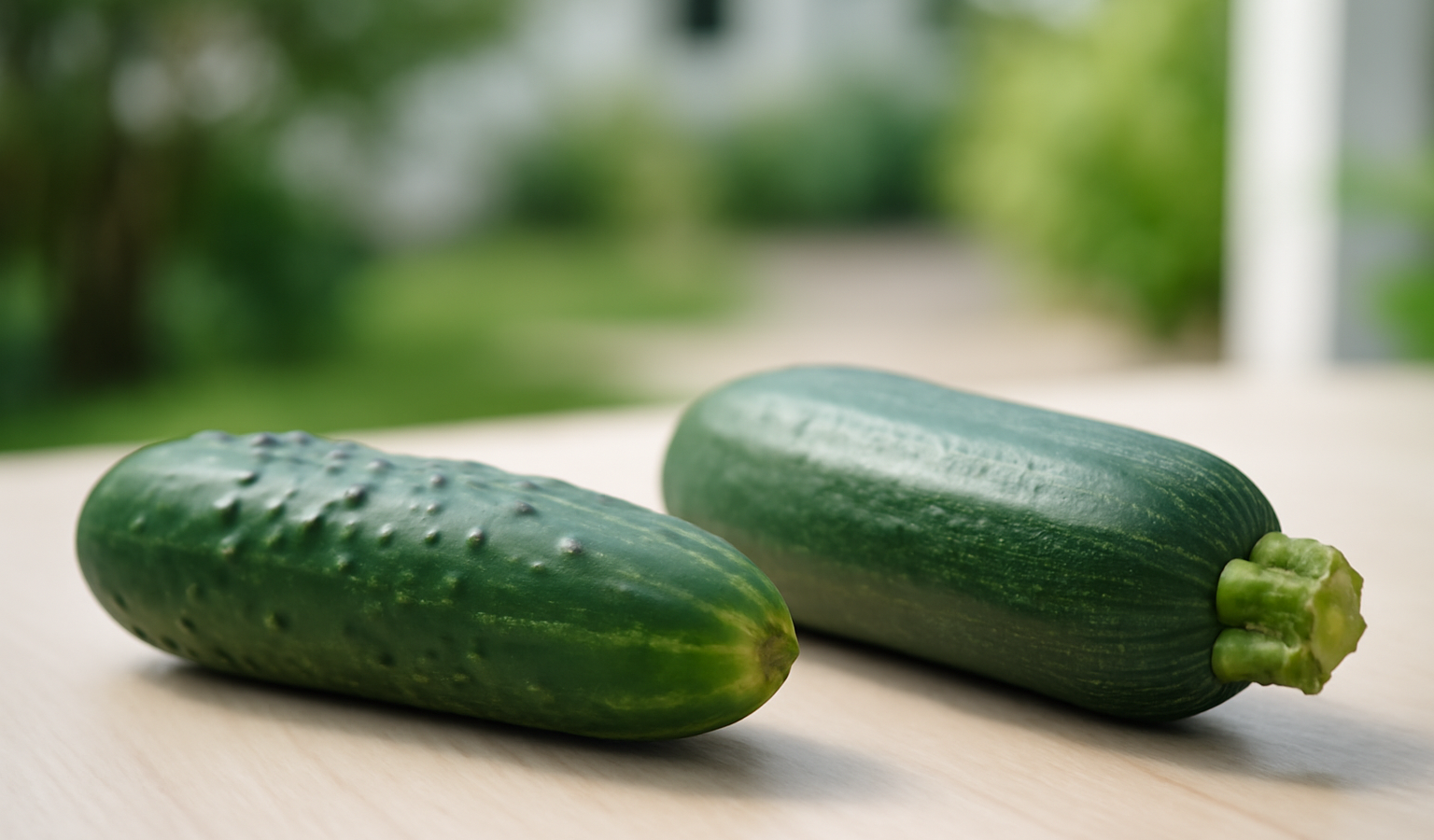
At a glance, a cucumber and a zucchini look almost like twins — both are long, green, cylindrical, and about the same size on the counter. But they belong to different plants, taste completely different, and grow in very different ways. Cucumbers (Cucumis sativus) are vining vegetables eaten raw and crisp, with a cool, watery, mild flavor. Zucchini (Cucurbita pepo) is a type of summer squash, almost always cooked, with a tender, slightly sweet, vegetal taste. The quickest way to tell them apart in the kitchen: cucumber skin is cool, smooth, and often waxy, while zucchini skin is dull, dry, and faintly ribbed near the stem. This guide covers every reliable difference — in appearance, flavor, nutrition, and especially in the garden, where these two plants need very different handling.
Key Takeaways
- Cucumber (Cucumis sativus) is a cool, crisp, raw-eaten vegetable; zucchini (Cucurbita pepo) is a summer squash that is almost always cooked.
- Cucumber skin feels cool, smooth, and waxy; zucchini skin is dry, dull, and slightly ridged near the stem.
- Cucumbers grow on climbing vines that love a trellis; zucchini grows on a large, bushy, sprawling plant.
- Cut a slice: cucumber flesh is pale, very watery, with soft seeds in a central ring; zucchini flesh is denser, whiter, and drier.
- Both are warm-season crops, but zucchini is famously prolific — a few plants can overwhelm a household.
Cucumber vs Zucchini at a Glance
| Factor | Cucumber | Zucchini |
|---|---|---|
| Botanical name | Cucumis sativus | Cucurbita pepo |
| Plant type | Climbing vine | Bushy summer squash |
| Skin texture | Smooth, cool, often waxy | Dull, dry, faintly ribbed |
| Flesh | Pale, very watery, soft seeds | Denser, whiter, drier |
| Flavor | Cool, mild, refreshing | Mild, slightly sweet, vegetal |
| Typical use | Eaten raw — salads, pickles | Cooked — sautéed, grilled, baked |
| Days to harvest | 50–70 days | 45–60 days |
| Yield | Steady and generous | Extremely prolific |
Cucumber: The Cool, Crisp Vine
Cucumbers are members of the gourd family grown for their refreshing, high-water-content fruit — roughly 95 percent water, which is exactly why they taste so cooling. The flavor is mild and clean, almost neutral, which makes cucumbers the backbone of salads, tzatziki, infused water, and of course pickles. They are eaten raw far more often than cooked, and their thin skin and soft seeds are usually edible without any preparation. Inside, the flesh is pale, glassy, and watery, with a ring of soft, small seeds running through the center.
There are two broad cucumber types worth knowing. Slicing cucumbers (like Marketmore and Straight Eight) are longer, smoother, and grown for fresh eating. Pickling cucumbers (like Boston Pickling and National Pickling) are shorter, bumpier, and bred to stay crisp in brine. There are also burpless, Persian, and English varieties bred for thinner skins and fewer seeds. Whatever the type, cucumber skin has a distinctive cool, smooth, sometimes waxy feel — grocery cucumbers are often coated with edible wax to extend shelf life, which is the single easiest way to distinguish them from zucchini on a store shelf.
Growing Cucumbers
Cucumbers are warm-season climbers. Direct-sow seeds after the soil reaches 65 to 70°F, or transplant carefully since they dislike root disturbance. The single best thing you can do for cucumbers is give them a trellis: vertical growing keeps the fruit straight and clean, improves airflow to fight powdery mildew, saves space, and makes harvesting easy. Plants need full sun, consistent moisture (inconsistent watering causes bitter, misshapen fruit), and rich soil. Most varieties mature in 50 to 70 days. Harvest slicers at 6 to 8 inches and picklers at 2 to 4 inches, and pick often — leaving overgrown cucumbers on the vine signals the plant to stop producing. Vertical cucumbers are a natural fit for small plots, so they feature heavily in our small-space and container growing guides.
Zucchini: The Prolific Summer Squash
Zucchini is a summer squash, harvested young while the skin is still tender and edible. Unlike cucumbers, zucchini is almost always cooked — raw zucchini is edible but bland and a little squeaky, while cooking transforms it into something tender, mildly sweet, and versatile. It sautés, grills, roasts, spiralizes into “zoodles,” and bakes into breads and muffins. The flesh is denser, whiter, and drier than a cucumber’s, and the seeds are barely noticeable in a young fruit. That lower water content is exactly why zucchini holds up to heat while cucumber turns to mush.
Zucchini’s defining trait, for better and worse, is its productivity. A single healthy plant can produce dozens of fruit over a season, and they grow shockingly fast — a finger-sized zucchini can become a baseball bat in a few days of inattention. Gardeners joke about leaving surplus zucchini on neighbors’ porches in August, and it is only half a joke. The plant itself is large and bushy rather than vining, with big lobed leaves, hollow stems, and prominent yellow flowers (the male blossoms are edible and prized for stuffing and frying).
Growing Zucchini
Like cucumbers, zucchini is a warm-season crop that needs full sun, fertile soil, and steady water, and it resents cold soil — wait until nights stay above 55°F. But the growth habit is the big difference: zucchini forms a sprawling bush 2 to 3 feet wide, not a climbing vine, so it cannot be trellised the same way and needs generous spacing (2 to 3 feet between plants). It matures fast, often ready to harvest in 45 to 60 days, and you should pick fruit at 6 to 8 inches for the best texture and to keep the plant producing. Two plants are plenty for most families. Watch for powdery mildew, squash vine borers, and squash bugs, and hand-pollinate the flowers if fruit is forming but rotting at the tip. Because the plants are big and hungry, zucchini does well in roomy raised beds where you can enrich the soil and give them space to sprawl.
How to Tell Them Apart
When you are holding both vegetables and not sure which is which, run through these quick checks.
- Touch the skin: Cucumber feels cool, smooth, and possibly waxy. Zucchini feels dry, dull, and slightly ridged or rough near the stem end.
- Look at the ends: Zucchini usually has a hard, woody, sometimes star-shaped stem scar; cucumber ends are smoother and more rounded.
- Cut a slice: Cucumber flesh is pale, translucent, and watery with an obvious ring of soft seeds. Zucchini flesh is whiter, denser, drier, and the seeds are tiny and barely visible in a young fruit.
- Bend test (firmness): Cucumbers are firmer and crunchier raw; zucchini is slightly softer and snaps less crisply.
- Taste raw: Cucumber is cool, juicy, and refreshing. Raw zucchini is drier, blander, and a bit grassy.
Nutrition and Kitchen Use
Both are low-calorie, high-water vegetables, but they are not interchangeable in cooking. Cucumber’s high water content makes it perfect raw and a poor choice for sautéing — heat it and it weeps and collapses. Zucchini’s denser flesh is built for cooking and absorbs flavors beautifully, but it can turn watery if overcooked or if you salt it without draining. Nutritionally they are similar: both are mostly water, low in calories, and offer modest amounts of vitamin C, potassium, and fiber, with zucchini edging ahead slightly on vitamins because it is technically a more mature fruit. In a recipe, do not swap one for the other expecting the same result — a cucumber will not behave like zucchini in a stir-fry, and zucchini will not deliver cucumber’s cooling crunch in a Greek salad.
The Verdict
Cucumbers and zucchini look alike but live in completely different culinary and horticultural worlds. Choose cucumber for cool, crisp, raw eating — salads, pickles, sandwiches, and refreshing summer dishes — and grow it vertically on a trellis to keep the fruit straight and the foliage healthy. Choose zucchini for cooking — sautéing, grilling, roasting, and baking — and give the big bushy plant plenty of room, then brace yourself for an avalanche of fruit. The fastest way to tell them apart is the skin (cool and waxy versus dry and ribbed) and a cross-section (watery with a seed ring versus dense and dry). Grow both and you will have the raw and the cooked ends of the summer-vegetable spectrum covered, with two plants that share a family but almost nothing else on the plate.
Frequently Asked Questions
Are cucumber and zucchini related?
They are in the same gourd family (Cucurbitaceae) but are different plants. Cucumber is Cucumis sativus and zucchini is Cucurbita pepo, a summer squash. Their similar shape is coincidental; their flavor, texture, and growth habits are quite different.
What’s the easiest way to tell a cucumber from a zucchini?
Feel the skin and look at the cut end. Cucumber skin is cool, smooth, and often waxy, with watery flesh and a ring of soft seeds. Zucchini skin is dry, dull, and slightly ribbed, with denser, drier, whiter flesh and barely visible seeds.
Can I substitute zucchini for cucumber, or vice versa?
Not really. Cucumber’s high water content makes it ideal raw but poor for cooking, while zucchini is built for cooking and bland when raw. Swapping one for the other changes both the texture and the result of a dish.
Why does my zucchini plant produce so much?
Zucchini is naturally one of the most prolific garden vegetables, and frequent harvesting encourages even more fruit. Picking zucchini young at 6 to 8 inches keeps the plant producing; two plants are usually enough to supply an entire household through summer.
Do cucumbers and zucchini grow the same way?
No. Cucumbers are climbing vines that thrive on a trellis, while zucchini forms a large sprawling bush that needs ground space. Both are warm-season crops needing full sun, rich soil, and steady water, but their support and spacing requirements differ significantly.