

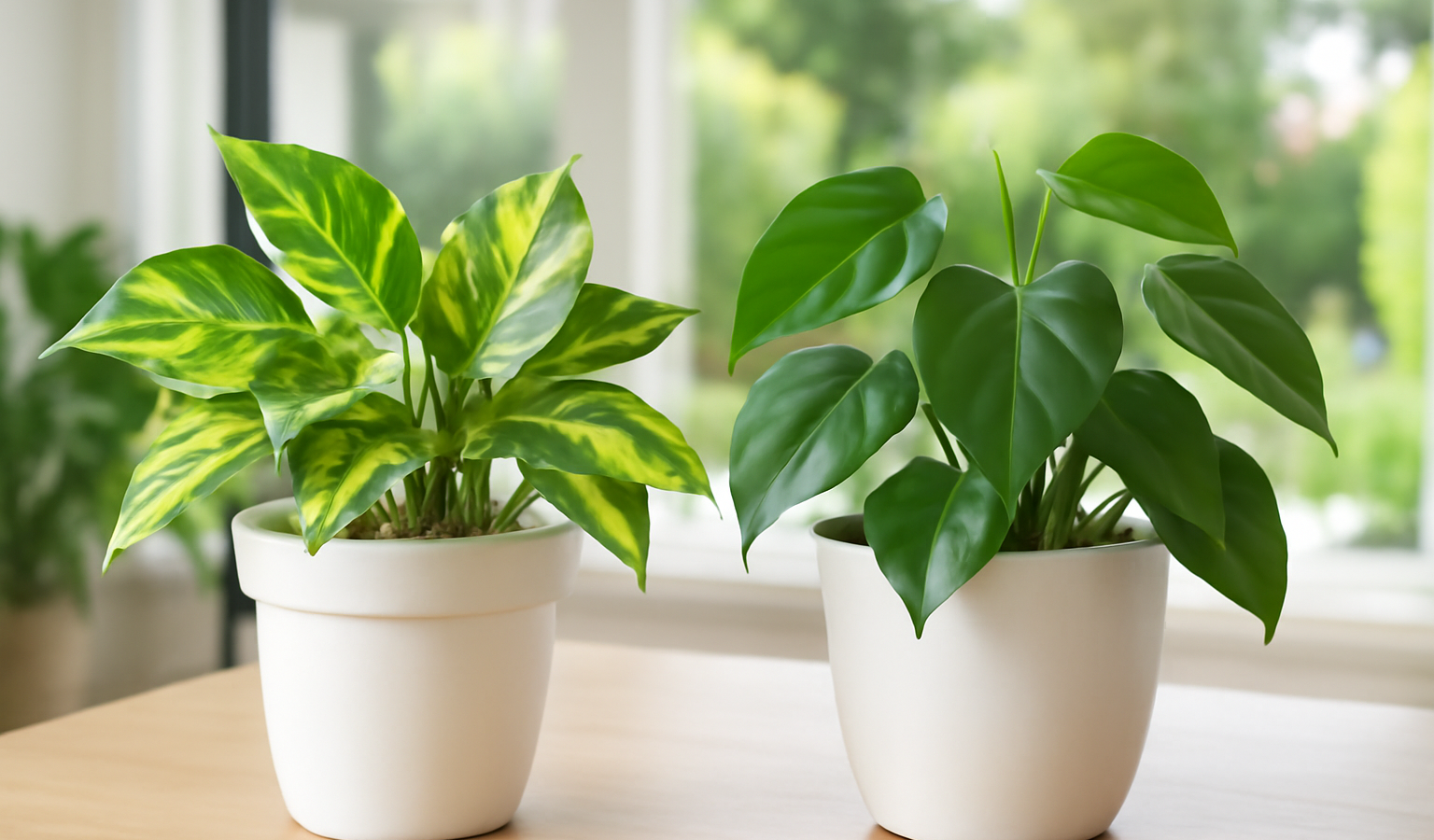
The fastest way to tell pothos from philodendron is to look at the leaf and the stem joint where it attaches. Pothos leaves are thicker, slightly stiff and waxy, with a subtle ridged or quilted texture, and the petiole (the stalk connecting leaf to vine) is grooved, almost like a celery stalk. Heartleaf philodendron leaves are thinner, softer, and more matte, with a smoother, rounded petiole. Watch new growth and you’ll be certain: a philodendron pushes out each new leaf wrapped in a thin papery sheath called a cataphyll, which dries and falls away, while a pothos simply unfurls a new leaf straight out of the previous one with no sheath at all. These two trailing tropicals get mixed up constantly in garden centers and even in big-box plant tags, partly because both are heart-leaved climbers from the arum family (Araceae) that tolerate the same low-effort indoor care. But they are different genera entirely — pothos is Epipremnum aureum, and the common trailing philodendron is Philodendron hederaceum — and once you know the tells, you’ll never confuse them again. This guide walks through every reliable difference, variety by variety, plus the small care distinctions that matter.
Key Takeaways
- Leaf texture: Pothos leaves are thick, waxy, and slightly stiff with a quilted feel; philodendron leaves are thinner, softer, and more matte.
- Petiole: Pothos has a grooved, indented petiole; philodendron’s petiole is rounded and smooth.
- New growth: Philodendron unfurls new leaves from a papery cataphyll sheath that later dries up; pothos has no cataphyll — new leaves emerge directly from the prior leaf.
- Aerial roots: Pothos has one stubby nub per node; philodendron often pushes out several thinner aerial roots per node.
- Shape: Heartleaf philodendron leaves are evenly heart-shaped and symmetrical; pothos leaves are often slightly asymmetrical with a flatter base.
- Both are toxic to cats and dogs (calcium oxalate crystals), thrive in bright indirect light, and root easily in water — so propagation is nearly identical.
| Feature | Pothos (Epipremnum aureum) | Heartleaf Philodendron (Philodendron hederaceum) |
|---|---|---|
| Leaf texture | Thick, waxy, slightly stiff, faintly quilted | Thin, soft, matte, smooth |
| Leaf shape | Heart-shaped but often asymmetrical, flatter base | Evenly symmetrical, deep heart shape, pointed tip |
| Petiole (leaf stalk) | Grooved/indented along its length | Rounded and smooth |
| New growth | Unfurls from previous leaf; no sheath | Emerges from a papery cataphyll that dries and drops |
| New leaf color | Pale green, opens flat fairly quickly | Often brownish, pinkish, or bronze before greening |
| Aerial roots | One short, thick nub per node | Multiple thinner aerial roots per node |
| Common varieties | Golden, Marble Queen, Neon, Jade, Pearls and Jade | Heartleaf (green), Brasil, Micans, Lemon Lime |
| Light tolerance | Very adaptable; tolerates lower light but variegation fades | Slightly more shade-tolerant; holds color in lower light |
| Toxic to pets | Yes (calcium oxalate) | Yes (calcium oxalate) |
Pothos: How to Identify It
Pick up a pothos leaf and the first thing you notice is heft. The leaves are noticeably thick and waxy, with a slightly stiff, leathery feel and a subtle ridged or quilted surface texture that catches the light. Hold it flat and the leaf tends to be a touch asymmetrical — one side of the heart shape often runs a little longer or wider than the other, and the base where it meets the petiole is comparatively flat rather than deeply lobed. The overall silhouette reads as heart-shaped, but it’s a slightly lopsided, broad heart rather than a perfectly mirrored one.
The single most reliable structural clue is the petiole, the stalk that joins each leaf to the main vine. On a pothos, the petiole has a distinct groove or indentation running along its length, so in cross-section it looks like a shallow celery channel rather than a smooth round rod. Combine that with how new growth behaves: a pothos has no cataphyll. Each new leaf simply pushes out of the most recent leaf and unfurls, pale green, opening to flat fairly quickly. There’s no thin papery wrapper, no dried sheath left clinging to the stem. At each node along the vine you’ll also find a single short, stubby aerial root — a thick little nub the plant uses to grip surfaces in the wild and to anchor cuttings. One chunky nub per node, not a cluster of fine ones.
Common pothos varieties
Golden pothos is the classic — green leaves splashed with buttery yellow variegation. Marble Queen is heavily marbled in creamy white and green, slower-growing because it has less chlorophyll. Neon pothos is a striking solid chartreuse with no variegation at all, brightest on new growth in good light. Jade pothos is plain deep green, and Pearls and Jade is a compact cultivar with white-edged, speckled leaves. A useful rule: the more white or cream in the variegation, the more light the plant needs to keep it. Variegated pothos parked in a dim corner will gradually revert to greener leaves. If you’re choosing a low-light spot, a solid green or Neon variety will hold up better than a heavily white-marbled one. For more on growing the lime-green cultivar specifically, see our guide on how to care for a neon pothos.
Philodendron: How to Identify It
The common trailing philodendron — usually sold simply as “heartleaf philodendron” — has leaves that feel altogether softer and thinner than a pothos. Run a leaf between your fingers and it’s pliable, almost delicate, with a matte to slightly glossy finish rather than the thick wax of a pothos. The shape is a cleaner, more symmetrical heart: deeply lobed at the base where the two rounded shoulders meet the stalk, tapering to a fine point at the tip, and evenly balanced from side to side. New leaves frequently emerge in warm tones — brownish, bronze, pinkish, or coppery — before maturing to deep green, which is a charming tell in its own right because pothos new leaves open plain pale green.
The decisive identifier, though, is the cataphyll. As a philodendron grows, each new leaf is produced inside a thin, papery protective sheath. The fresh leaf unfurls out of this cataphyll, and the spent sheath then dries to a translucent, straw-like ribbon that clings to the stem before eventually dropping off. If you see those dried papery remnants at the nodes, you’re looking at a philodendron — pothos never produces them. The petiole is rounded and smooth, with no celery groove, and at each node you’ll typically find several thinner aerial roots rather than the pothos’s single stubby nub. Put those three together — soft thin leaves, cataphylls, smooth round petiole — and identification is essentially foolproof.
Common philodendron varieties
The plain green heartleaf (Philodendron hederaceum) is the workhorse, prized for trailing gracefully in low light. Philodendron Brasil is the same species with a bold lime-and-dark-green variegated stripe down the center of each leaf — frequently mistaken for a variegated pothos, but the soft thin leaf and cataphylls give it away. Micans is the velvet-leaved form, with a deep bronze-green, fuzzy, almost iridescent surface that no pothos has. Lemon Lime philodendron is a solid bright chartreuse that looks superficially like Neon pothos but, again, betrays itself with thinner leaves and a smooth petiole. Note that the large, deeply cut “split-leaf philodendron” sold as a floor plant is a different beast entirely — and it’s actually a Monstera in most cases, which we untangle in our comparison of monstera vs split-leaf philodendron.
Care Differences Between Pothos and Philodendron
Here’s the reassuring part: their care is about 90% identical, which is exactly why they get grown — and confused — interchangeably. Both are forgiving tropical aroids that ask for the same basics. But there are a few small distinctions worth knowing if you want either plant to truly thrive rather than merely survive.
Light
Both prefer bright, indirect light — think an east-facing window, or a few feet back from a brighter south or west window where direct sun can’t scorch the leaves. In foot-candle terms, both are happiest in roughly the 200–500 foot-candle range, and both will limp along at far lower light than most houseplants tolerate. The practical difference is in shade tolerance and variegation. Heartleaf philodendron is marginally more shade-tolerant and holds its leaf color reasonably well in dim spots. Pothos also survives low light, but any white or yellow variegation will steadily fade toward solid green as the plant prioritizes chlorophyll. Neither will keep good leaf size or vine spacing in deep shade — they get leggy with widely spaced, smaller leaves. If a vine starts stretching with big gaps between leaves, it’s telling you to move it brighter.
Water and soil
Both want a chunky, well-draining potting mix and a pot with a drainage hole, and both prefer to dry out partway between waterings. The reliable approach for either plant is to water thoroughly when the top 1–2 inches of soil feel dry, then let excess drain fully. In a warm, bright spot that often works out to roughly once a week, stretching to every 10–14 days in winter or lower light — but always check the soil rather than the calendar. Both are far more often killed by overwatering and soggy roots than by neglect; pothos in particular is famous for bouncing back from a deep wilt the moment you water it. Yellowing lower leaves usually signal too much water; crispy brown edges and wilting between drinks signal too little or too dry an environment. Average household humidity is fine for both, though philodendron, especially the velvety Micans, appreciates a bit more.
Temperature, feeding, and toxicity
Both are true tropicals that prefer temperatures between about 65°F and 85°F and should be kept away from cold drafts and anything below roughly 55°F. Feed lightly during the growing season — a balanced, diluted houseplant fertilizer every four to six weeks in spring and summer is plenty; both grow slowly enough that heavy feeding mostly produces salt buildup. Crucially, both pothos and philodendron are toxic to cats, dogs, and humans if chewed, thanks to insoluble calcium oxalate crystals that cause oral irritation, drooling, and swelling. Keep trailing vines out of reach of curious pets and children. Browse more low-maintenance trailing options and care basics on our plants and flowers hub.
Propagation: Nearly Identical
If you can propagate one, you can propagate the other — the method is the same. Cut a healthy stem segment just below a node (the bump on the vine where a leaf and aerial root emerge), making sure each cutting has at least one node and ideally two or three leaves. Drop the cut end in a glass of room-temperature water with the node submerged and the leaves above the surface, set it in bright indirect light, and refresh the water every few days. Roots typically appear within two to four weeks; once they’re an inch or two long, pot the cutting into moist soil. Because the node is where roots form, the node is non-negotiable — a leaf with no node will never root. Both root reliably this way, which is why these two are the classic “first plant” gifts passed hand to hand. For the full step-by-step method that works on both, see our guide to propagating houseplants in water.
The Verdict: Which Should You Choose?
For identification, trust the trio of tells in this order: check the petiole (grooved = pothos, smooth and round = philodendron), watch the new growth (papery cataphyll sheath = philodendron, bare unfurling leaf = pothos), and feel the leaf (thick and waxy = pothos, thin and soft = philodendron). Any one of those is usually enough; all three together leave no doubt.
For choosing which to grow, it comes down to small preferences rather than difficulty, because both are genuinely beginner-proof. Reach for a pothos if you want the most bulletproof, drought-forgiving option, faster lush growth in good light, and a wide range of dramatic variegation patterns — it’s the better pick for a forgetful waterer or a bright room. Reach for a philodendron if your spot is on the dimmer side, since it tolerates lower light without fading as badly, or if you’re drawn to the softer foliage, the warm-toned new leaves, or specialty textures like the velvet of Micans. Honestly, most plant lovers end up growing both, and there’s no wrong answer — they’re two of the easiest, most rewarding houseplants you can own, and now you can finally tell them apart.
Frequently Asked Questions
Is a pothos a type of philodendron?
No. Despite the similar heart-shaped leaves and identical care, they are different genera in the arum family. Pothos is Epipremnum aureum and the common trailing philodendron is Philodendron hederaceum. The “pothos” name persists from an older, now-corrected botanical classification, which is part of why the confusion is so common.
What is the single fastest way to tell them apart?
Look at the petiole, the stalk connecting each leaf to the vine. A pothos petiole has a distinct groove or indentation running along it, like a shallow celery channel. A philodendron petiole is smooth and rounded. If you can also catch new growth, a philodendron unfurls its leaf from a papery cataphyll sheath while a pothos has no sheath at all.
Are pothos and philodendron toxic to cats and dogs?
Yes, both are toxic to cats, dogs, and humans if chewed or swallowed. They contain insoluble calcium oxalate crystals that cause mouth and throat irritation, drooling, and swelling. They’re rarely fatal but genuinely unpleasant, so hang or place the vines well out of reach of pets and small children.
Is the Philodendron Brasil just a variegated pothos?
No, though it’s the most commonly confused pair. Philodendron Brasil has a lime-and-green stripe down soft, thin leaves and produces cataphylls and a smooth petiole. A variegated pothos like Golden or Marble Queen has thicker, waxier leaves, a grooved petiole, and no cataphylls. Feel the leaf and check the petiole to be sure.
Which one is easier to grow for a beginner?
Both are excellent beginner plants and equally hard to kill. Pothos has a slight edge for sheer drought tolerance and faster growth in bright light, making it ideal for forgetful waterers. Philodendron edges ahead in dimmer rooms because it holds its leaf color better in low light. For most people the choice is purely about looks and the spot you have.