

The best lawn fertilizer is the one that matches your grass type, the season and the job you need done. A cool-season bluegrass lawn in fall wants a different bag than a Bermuda lawn in June, and a freshly seeded patch wants something else again. Picking the wrong product does more than waste money: extra nitrogen at the wrong time feeds weeds and disease and washes into storm drains. This guide compares current Amazon lawn fertilizer listings, from all-purpose granular feeds and fall winterizers to starter fertilizers, weed and feed, and hose-end liquids, and explains how to read the label so each bag goes where it will do the most good.
Part of our Lawn Care guide →
In this guide
As an Amazon Associate we earn from qualifying purchases.
How we compared: we compared 15 current Amazon lawn fertilizer listings on what each listing states: NPK analysis, coverage per bag or bottle, application timing, grass-type restrictions and any added weed control or iron. We set aside two general garden fertilizers that came up in the same searches. We did not test or handle the products, and availability changes, so check the label on the listing before you buy.
Quick picks
| Product | Best for | Key features | Buy |
|---|---|---|---|
| Scotts Turf Builder Lawn Food | Best overall |
| Buy now →Check current price |
| Scotts WinterGuard Fall Lawn Food | Best fall feeding |
| Buy now →Check current price |
| Scotts Southern Lawn Food | Best for southern grasses |
| Buy now →Check current price |
| Scotts Starter Food for New Grass | Best for new seed and sod |
| Buy now →Check current price |
| Scotts Weed and Feed5 | Best weed and feed |
| Buy now →Check current price |
| Simple Lawn Solutions 16-4-8 | Best balanced liquid |
| Buy now →Check current price |
| Scotts Liquid Green Max | Best quick green-up |
| Buy now →Check current price |
Prices change often; check Amazon for today’s price. As an Amazon Associate we earn from qualifying purchases.
Free, no-obligation quote · Connect with a local pro
The best lawn fertilizers, compared
1. Scotts Turf Builder Lawn Food (12.5 lb) — Best overall

An all-season granular lawn food for any grass type. The 12.5 lb bag covers 5,000 sq ft; a 37.5 lb bag covers 15,000.
Check price on AmazonWhy we like it
- Labeled for any grass type
- Apply in spring, summer or fall
- Goes on a wet or dry lawn
- Pesticide-free, so no grass-type restrictions
- Same formula comes in a 15,000 sq ft bag
| Specification | Details |
|---|---|
| Form | Granular, spreader applied |
| NPK | Not stated in listing |
| Coverage | 5,000 sq ft per 12.5 lb bag |
| Timing | Spring, summer or fall |
| Grass types | Any |
| Weed control | None; pesticide-free |
Scotts Turf Builder Lawn Food 22305 — granular, any grass, spring to fall, 12.5 lb covers 5,000 sq ft.
The most flexible granular feed on the shelf
Ten of the 15 products we compared are granular, and most are built for one moment: fall, new seed, southern grass or weed season. Turf Builder Lawn Food is the generalist. The listing says it works on any grass type, goes down in spring, summer or fall, and can be applied to a wet or dry lawn. Because it carries no herbicide, it has none of the grass-type restrictions that come with the weed and feed bags, which matters if your lawn includes St. Augustine or centipede.
It is also the easiest to size. The 12.5-pound bag covers 5,000 square feet, the size of a typical suburban front and back lawn, and the same product is listed in a 37.5-pound bag for 15,000 square feet. Buying one bag that matches your lawn means less leftover fertilizer sitting in the garage.
The drawback is that neither Turf Builder listing states the NPK analysis or how much of the nitrogen is slow-release. Only 6 of the 15 listings we compared print an NPK figure in the listing itself. Read the guaranteed analysis on the bag before you set your spreader, and if you need to correct a known phosphorus or potassium shortfall from a soil test, choose a product that states its numbers.
Pros
- Any grass type, three seasons
- No herbicide restrictions
- Two bag sizes for small and large lawns
Cons
- NPK not stated in the listing
- Slow-release share not stated
- Requires a spreader
Check Scotts Turf Builder Lawn Food price on Amazon
2. Scotts Turf Builder WinterGuard Fall Lawn Food — Best fall feeding
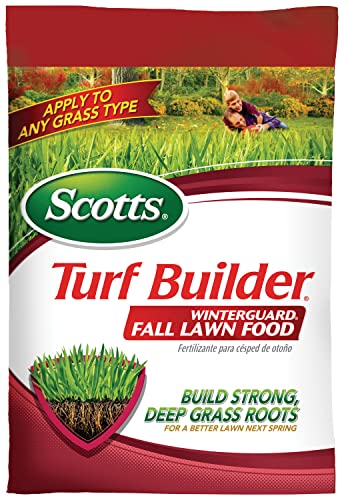
A fall lawn food meant to help grass recover from summer stress and build roots before winter. 10 lb covers 4,000 sq ft.
Check price on AmazonWhy we like it
- Built for the most important feeding of the year
- Aimed at recovery from summer heat and drought
- Any grass type, wet or dry lawn
- Small 4,000 sq ft bag limits waste
| Specification | Details |
|---|---|
| Form | Granular |
| NPK | Not stated in listing |
| Coverage | 4,000 sq ft per 10 lb bag |
| Timing | Fall |
| Grass types | Any |
Scotts WinterGuard Fall Lawn Food 22342 — granular fall feed, any grass, 10 lb covers 4,000 sq ft.
The only fall-specific feed on the shelf without herbicide
Two listings are WinterGuard fall products. The other is the Fall Weed and Feed3, which adds broadleaf weed killer and can only go on seven named grass types. This plain fall lawn food is the one to choose if you do not have a weed problem, or if you would rather spot-treat weeds than spread herbicide across the whole yard.
Fall is when cool-season lawns get the most out of fertilizer. Purdue Extension’s guidance for established lawns is to fertilize lightly in spring and early summer, little or not at all in summer, and heavily in fall, because heavy spring nitrogen pushes leaf growth at the expense of roots. The EPA’s yard guidance makes the same point from the runoff side: apply fertilizer near the period of maximum uptake, which is spring and fall in cool climates. If you have bluegrass, fescue or ryegrass, this is the bag that matters most.
For warm-season grasses such as Bermuda or zoysia, which slow down and go dormant in fall, a late-fall nitrogen feeding is less useful; those lawns are better fed from late spring through summer. The listing does not state its NPK analysis, and Illinois Extension notes that winterizer products are typically high in nitrogen and potassium.
Pros
- Right timing for cool-season lawns
- No herbicide
- Small bag suits small lawns
Cons
- NPK not stated
- Less useful on warm-season grass
- Needs a second bag above 4,000 sq ft
Check Scotts WinterGuard Fall Lawn Food price on Amazon
3. Scotts Turf Builder Southern Lawn Food — Best for southern grasses

A pesticide-free granular lawn food formulated for southern grass types. The 14.06 lb bag covers 5,000 sq ft.
Check price on AmazonWhy we like it
- Formulated specifically for southern lawns
- All-in-one particles for even nutrient spread
- Pesticide-free; re-enter the lawn after application
- Feeds through spring, summer and fall
| Specification | Details |
|---|---|
| Form | Granular, all-in-one particles |
| NPK | Not stated in listing |
| Coverage | 5,000 sq ft per 14.06 lb bag |
| Timing | Growing season; water in lightly for faster results |
| Grass types | Southern grass types |
Scotts Southern Lawn Food 23405B — granular, southern grasses, pesticide-free, 14.06 lb covers 5,000 sq ft.
The only granular lawn food here formulated for southern turf
Of the 15 listings, this is the only one built for southern grasses. That matters in the Gulf states and Southeast, where St. Augustine, centipede and Bahia lawns dominate and several popular products do not fit. The Weed and Feed5 listing, for example, says not to use it on St. Augustine, including Floratam, and the granular Green Max listing notes it is not sold in Florida.
The listing says the all-in-one particles help build deep roots to stand up to heat and drought, and that a light watering after application speeds results. Because it is pesticide-free, there is no grass-type exclusion list and you can walk on the lawn after application.
As with the other Turf Builder bags, the NPK and slow-release share are not in the listing. Warm-season grasses want most of their nitrogen while actively growing, from late spring into summer, so time this bag to your green-up rather than the first warm day of March. For a deeper look at St. Augustine specifically, see our St. Augustine fertilizer guide.
Pros
- Made for southern grass types
- Pesticide-free, no exclusion list
- Single-particle formula
Cons
- NPK not stated
- Not the right choice for northern lawns
- Specific southern grasses not named
Check Scotts Southern Lawn Food price on Amazon
4. Scotts Turf Builder Starter Food for New Grass — Best for new seed and sod
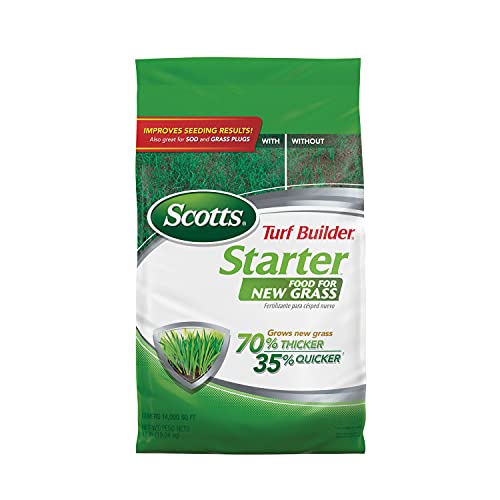
A 24-25-4 starter fertilizer for new seed, sod and plugs. The 42 lb bag covers 14,000 sq ft.
Check price on AmazonWhy we like it
- Stated 24-25-4 analysis, high in phosphorus
- For new seed, sod and grass plugs
- Any grass type
- Large bag covers 14,000 sq ft
| Specification | Details |
|---|---|
| Form | Granular |
| NPK | 24-25-4 |
| Coverage | 14,000 sq ft per 42 lb bag |
| Use | Newly seeded lawns, sod, grass plugs |
| Grass types | All |
Scotts Starter Food 21814 — granular 24-25-4, for seed, sod and plugs, 42 lb covers 14,000 sq ft.
The highest-phosphorus granular feed we compared
Three listings target new lawns: this granular starter, Scotts’ Liquid Starter Lawn Food (7-12-15) and Triple Action Built for Seeding, which adds a crabgrass and dandelion preventer. This bag is the one that states a clear, high-phosphorus analysis, 24-25-4, and it is the one to use when you seed a bare area, lay sod, or renovate a whole lawn. Phosphorus supports early root growth, and new seedlings have almost no root system to find it on their own.
Scotts claims new grass grows 70 percent thicker and 35 percent quicker than unfed grass. That is the brand’s comparison, not an independent result, but the logic of feeding seedlings at planting is sound. Illinois Extension notes that starter fertilizers are high in phosphorus by design, and that many soils already hold enough, so a soil test tells you whether you need one.
Use it only for establishment. A 24-25-4 product used as a routine feed adds phosphorus your soil does not need, which can wash into lakes and streams. The 42-pound bag covers 14,000 square feet, so for a small overseeding job, the 1,000 sq ft Triple Action bag or the liquid starter is a better size. Our starter fertilizer guide goes deeper.
Pros
- Clear 24-25-4 analysis
- Works for seed, sod and plugs
- Large coverage per bag
Cons
- Not for routine feeding
- Excess phosphorus can wash into waterways
- Oversized for small patch jobs
Check Scotts Starter Food for New Grass price on Amazon
5. Scotts Turf Builder Weed and Feed5 — Best weed and feed

A granular weed killer plus lawn fertilizer for over 50 listed weeds, on seven named grass types. Covers 12,000 sq ft.
Check price on AmazonWhy we like it
- Controls over 50 listed broadleaf weeds
- Names the seven grasses it is safe on
- Clear temperature window, 60 to 90 F
- Label limits use to twice a year
| Specification | Details |
|---|---|
| Form | Granular, applied to a wet lawn |
| Weeds | Over 50 listed, including clover, dandelion, plantain |
| Safe on | Bahia, Bermuda, bluegrass, centipede, fescue, rye, zoysia |
| Do not use on | St. Augustine, dichondra, lippia, carpetgrass, bentgrass |
| Coverage | 12,000 sq ft per 33.95 lb bag |
| NPK | Not stated in listing |
Scotts Weed and Feed5 25023 — granular, 50+ listed weeds, 7 grass types, max 2x per year, 33.95 lb covers 12,000 sq ft.
The weed and feed listing with the clearest instructions
Four of the 15 listings include weed control: Weed and Feed5, Weed and Feed3, WinterGuard Fall Weed and Feed3, and Triple Action for new lawns. Weed and Feed5 is our pick because its listing tells you what you need to apply it safely: a wet lawn, weeds actively growing, daytime temperatures consistently between 60 and 90 degrees, no more than twice a year, and the exact grasses it can and cannot go on. The Weed and Feed3 listing, the larger 15,000 sq ft bag, leads with marketing claims and leaves the grass list off.
Weed and feed products are a convenience with a cost. Illinois Extension calls them products that compromise the ideal timing of either the fertilizer or the herbicide, because the best time to kill weeds and the best time to feed are not always the same. It also spreads herbicide over the whole lawn when you may have weeds in only a few spots. If you have scattered dandelions, spot-spraying and a plain fertilizer is often the better plan; if clover and dandelions are everywhere, this saves a step.
Check your grass before buying. The listing excludes St. Augustine, which rules it out for much of the Southeast. Keep it off vegetable beds and flower borders, and sweep granules off paving back onto the lawn. To identify what you are fighting first, see our lawn weed identification guide.
Pros
- Feeds and controls broadleaf weeds in one pass
- Explicit grass and temperature rules
- 12,000 sq ft per bag
Cons
- Not for St. Augustine and several other grasses
- Herbicide goes on the whole lawn
- Timing compromise between feeding and weeding
Check Scotts Weed and Feed5 price on Amazon
6. Simple Lawn Solutions 16-4-8 Liquid Lawn Food — Best balanced liquid

A 16-4-8 liquid lawn fertilizer with seaweed and fish, in a ready-to-use 32 oz hose-end sprayer.
Check price on AmazonWhy we like it
- Full 16-4-8 NPK breakdown in the listing
- Seaweed and fish emulsion added
- Ready-to-use hose-end sprayer
- Names ten warm- and cool-season grasses
| Specification | Details |
|---|---|
| Form | Liquid concentrate, hose-end sprayer |
| NPK | 16-4-8 |
| Extras | Seaweed and fish |
| Size | 32 oz |
| Coverage | Not stated in listing |
| Made in | United States |
Simple Lawn Solutions 16-4-8 — liquid, seaweed and fish, 32 oz hose-end sprayer, any grass type.
The only complete N-P-K liquid aimed at established lawns
Five of the 15 listings are liquids. Two Scotts liquids are nitrogen-heavy with no phosphorus (29-0-3 and 29-0-0), the Scotts liquid starter is a 7-12-15 for seedlings, and the other Simple Lawn Solutions bottle is straight potassium (0-0-25). This 16-4-8 is the only liquid on the shelf that delivers all three major nutrients in a ratio meant for routine feeding. The listing explains each number, which makes it a good teaching label for anyone new to fertilizer math.
The listing names Bermuda, St. Augustine, zoysia, buffalo, centipede, Bahia, fescue, ryegrass and Kentucky bluegrass, so it fits mixed or southern lawns that the weed and feed bags exclude. Liquids act quickly through leaves and roots, which suits a pre-event boost, a lawn recovering from stress, or a gardener who would rather not buy a spreader.
The weakness is coverage: the listing does not say how many square feet a bottle treats, so you cannot compare value or plan how many bottles you need. Liquids also feed for a shorter window than slow-release granules, so expect to reapply more often. If your soil test shows adequate phosphorus, one of the zero-phosphorus liquids may be the better fit. Our liquid lawn fertilizer guide compares more options.
Pros
- Clear, balanced 16-4-8 analysis
- No spreader needed
- Works on warm- and cool-season grasses
Cons
- Coverage per bottle not stated
- Shorter feeding window than granules
- Contains phosphorus, which some lawns do not need
Check Simple Lawn Solutions 16-4-8 price on Amazon
7. Scotts Liquid Green Max Lawn Food — Best quick green-up

A 29-0-0 liquid nitrogen feed with iron in a reusable hose-end bottle. Treats 2,000 sq ft in about 10 minutes.
Check price on AmazonWhy we like it
- 29-0-0 nitrogen with added iron
- Listing claims deep green in about 3 days
- Treats 2,000 sq ft in about 10 minutes
- Translucent bottle shows how much you have used
| Specification | Details |
|---|---|
| Form | Liquid, hose-end applicator |
| NPK | 29-0-0 plus iron |
| Coverage | 2,000 sq ft per 32 fl oz bottle |
| Grass types | Any |
| Refills | Reusable applicator; refills sold separately |
Scotts Liquid Green Max 3302105 — liquid 29-0-0 plus iron, any grass, 32 fl oz covers 2,000 sq ft.
One of only two iron-boosted products on the shelf
Two listings add iron: this liquid and the granular Green Max. Iron darkens grass color quickly without pushing as much growth as extra nitrogen would, which is why both listings claim deep greening in about three days. The liquid version states its analysis (29-0-0) and its coverage (2,000 square feet in about ten minutes), while the granular listing states neither NPK nor slow-release share, so this is the one we would pick for a small lawn or a quick fix before a party.
It contains no phosphorus or potassium, so it is a color and growth product, not a complete feed. Use it as a supplement between granular feedings, not as your whole program. Quick-release nitrogen also carries more burn risk in hot weather; Purdue Extension notes that quick-release forms are inexpensive but may burn leaf blades if applied improperly, so stick to the label rate and avoid spraying in midday heat.
At 2,000 square feet per bottle, larger lawns will go through several bottles per feeding. Scotts’ 29-0-3 Turf Builder Liquid Lawn Food is a near twin without the iron, if you want a little potassium instead of the color boost.
Pros
- Fast color from nitrogen plus iron
- Stated coverage and analysis
- No spreader needed
Cons
- Nitrogen only, not a complete feed
- Small coverage per bottle
- Higher burn risk in heat
Check Scotts Liquid Green Max price on Amazon
Free, no-obligation quote · Connect with a local pro
How to choose a lawn fertilizer
Read the three numbers
Every fertilizer label carries an N-P-K analysis, such as 24-25-4: the percentage by weight of nitrogen, phosphorus (as P2O5) and potassium (as K2O). Nitrogen drives growth and color and is the nutrient lawns use most. Illinois Extension suggests about one pound of actual nitrogen per 1,000 square feet per application and recommends ratios around 3:0:2 or 4:0:2 for established lawns. The math is simple: a 25 percent nitrogen product needs 4 pounds of product to supply 1 pound of nitrogen over 1,000 square feet. If a listing does not print the analysis, read it off the bag before you set your spreader.
Quick-release vs. slow-release nitrogen
Quick-release nitrogen greens a lawn in a week or less but is easier to over-apply and more likely to burn. Slow-release forms, labeled as coated, sulfur-coated urea, methylene urea or water-insoluble nitrogen (WIN), respond over three to ten weeks and rarely burn, according to Purdue Extension. Most quality granular products blend the two. Favor slow-release if you are new to lawn care or feeding in warm weather.
Granular vs. liquid
Granular products are the backbone of most lawn programs: they cover large areas evenly, feed longer and cost less per pound of nitrogen. You need a spreader to apply them; see our fertilizer spreader guide if you do not own one. Liquids hook to a hose, act fast and suit small lawns or quick boosts, but they feed for a shorter time and usually cover less per container.
Match the season to your grass
Cool-season grasses (Kentucky bluegrass, fescues, ryegrass) get the most benefit from fall feeding, with lighter feedings in spring. Warm-season grasses (Bermuda, zoysia, St. Augustine, centipede) want their nitrogen from late spring through summer while they are actively growing. Feeding a dormant lawn wastes product and invites runoff.
Test before you guess
A soil test tells you pH and whether phosphorus and potassium are actually short. Many lawns already have enough phosphorus, and some states and towns restrict phosphorus on established turf, so check local rules. Soil tests through your county extension office are inexpensive and take the guesswork out of choosing an analysis. If you are weighing compost against bagged fertilizer, our compost vs. fertilizer comparison explains how the two work together.
Apply it without polluting
The EPA’s advice for homeowners is straightforward: apply fertilizer only when needed and at the recommended amount, skip applications before windy or rainy days, keep it away from waterways, and fill spreaders on a hard surface so spills are easy to sweep up. Blow or sweep stray granules off driveways and sidewalks back onto the grass, since anything left on pavement washes straight to the storm drain. Return clippings to the lawn; Purdue notes that removing them means more fertilizer is needed.
When a pro makes sense
A four-step program is manageable for most homeowners, but if you have a large property, a weed problem across the whole lawn, or a lawn that stays thin no matter what you feed it, a lawn care company can soil-test, calibrate equipment and time applications for you. You can compare local crews through our lawn and landscaping services directory, and our lawn care guide covers the mowing and watering that make any fertilizer work better.
Rather hire a lawn pro?
Don’t want to do it yourself? Compare free, no-obligation quotes from vetted local lawn care pros near you.
Frequently asked questions
How often should a lawn be fertilized?
Most lawns do well with two to four feedings per growing season. Cool-season lawns get the heaviest feeding in fall and lighter ones in spring; warm-season lawns are fed mainly from late spring through summer. Follow the label rate and use slow-release products to space feedings further apart.
What NPK ratio is best for an established lawn?
Nitrogen should be the largest number. Illinois Extension recommends ratios around 3:0:2 or 4:0:2 for established lawns, with phosphorus only where a soil test shows a need. Save high-phosphorus starter products such as 24-25-4 for new seed and sod.
Should fertilizer be watered in?
For plain granular fertilizer, a light watering afterward moves granules off the blades and into the soil. Weed and feed is different: the Scotts listings say to apply it to a wet lawn so the granules stick to weed leaves, so read the label for how long to wait before watering or mowing.
Can too much fertilizer hurt the lawn?
Yes. Over-applying quick-release nitrogen, especially in hot weather, can burn grass and leave yellow or brown streaks. Excess nitrogen also drives soft top growth that invites disease and insects, and what the lawn cannot use runs off into waterways. Stick to the label rate and calibrate your spreader.
Is weed and feed a good idea?
It saves a step when broadleaf weeds are spread across the whole lawn. The trade-off is timing and coverage: the best time to feed and the best time to control weeds do not always match, and you spread herbicide everywhere. For scattered weeds, a plain fertilizer plus spot treatment is usually better.
References
- University of Illinois Extension, Fertilizing Your Lawn
- Purdue University Cooperative Extension Service, Fertilizing Established Lawns (AY-22)
- U.S. Environmental Protection Agency, Nutrient Pollution: What You Can Do in Your Yard