


Poa annua, or annual bluegrass, is the light-green clumpy grass that pops up in fall, throws white seed heads in spring and dies in the first heat of summer, leaving bare patches behind. Controlling it comes down to two jobs. First, prevent it: a pre-emergent such as prodiamine applied in late summer or early fall stops the seeds before they sprout, and that works in both cool- and warm-season lawns. Second, kill what got through, which is much easier in warm-season grass, where selective post-emergents such as rimsulfuron/metsulfuron (Negate) and sulfosulfuron (Sertay) are labeled for poa. Below are six poa annua-labeled products from current Amazon listings, plus the timing and resistance details that make or break a poa program.
In this guide
- Our Top Poa Annua Picks at a Glance
- 1. Yard Mastery Prodiamine 65 WDG Packets — Best Pre-Emergent for Any Lawn
- 2. Quali-Pro Negate 37WG — Best Post-Emergent for Warm-Season Lawns
- 3. Atticus Sertay (Sulfosulfuron) — Best Poa and Sedge Combo
- 4. Yard Mastery 0-0-7 Granular Prodiamine — Best Granular Fall Preventer
- 5. Quali-Pro Prodiamine 65 WDG — Best Bulk Sprayable Preventer
- 6. Scotts Halts Crabgrass & Grassy Weed Preventer — Best Easy-to-Find Preventer
- Poa Annua Control by Lawn Type
- Timing and Resistance
- Follow the Label
- Frequently Asked Questions
Disclosure: Urban Lotus Project is reader-supported. As an Amazon Associate we earn from qualifying purchases, at no extra cost to you.
How we compared: we compared 6 current Amazon listings that name Poa annua or annual bluegrass, on what each listing states (active ingredient, pre or post-emergent action, turf types and coverage). We did not test or handle the products, and availability changes.
Key Takeaways
- Prevention is the main tool: apply a pre-emergent in late summer or early fall, then often a second application 8 to 10 weeks later, per Clemson Extension.
- Clemson’s timing cue is when daytime highs drop to about 75°F for four consecutive days.
- Negate and Sertay kill emerged poa in established warm-season turf; most cool-season lawns rely on prevention and turf health.
- Poa can develop resistance to prodiamine-type (Group 1) pre-emergents; rotate modes of action.
- Pre-emergents stop grass seed too. Do not apply where you plan to overseed, and follow label waiting periods.
Our Top Poa Annua Picks at a Glance
| Product | Best for | Key features | Buy |
|---|---|---|---|
| Yard Mastery Prodiamine 65 WDG Packets | Best pre-emergent for any lawn |
| Buy now →Check current price |
| Quali-Pro Negate 37WG | Best post-emergent, warm-season |
| Buy now →Check current price |
| Atticus Sertay | Best poa and sedge combo |
| Buy now →Check current price |
| Yard Mastery 0-0-7 Prodiamine | Best granular fall preventer |
| Buy now →Check current price |
| Quali-Pro Prodiamine 65 WDG | Best bulk sprayable preventer |
| Buy now →Check current price |
| Scotts Halts | Best easy-to-find preventer |
| Buy now →Check current price |
Prices change often; check Amazon for today’s price. As an Amazon Associate we earn from qualifying purchases.
For the full cultural side of poa control, including mowing, watering and aeration, see our step-by-step guide on how to get rid of poa annua. This article stays on the products. For year-round lawn planning, start with the lawn care guide.
1. Yard Mastery Prodiamine 65 WDG Packets — Best Pre-Emergent for Any Lawn

Six pre-measured 20 g prodiamine packets, each treating 4,000 sq ft; labeled for cool- and warm-season lawns.
Check price on AmazonWhy We Like It
- No scale needed: one packet per 4,000 sq ft
- Names Poa annua among the targets
- Labeled for ten cool and warm-season grasses
- Clear watering-in instructions
| Specification | Details |
|---|---|
| Active ingredient | Prodiamine 65% |
| Form | Water-dispersible granule, 20 g packets |
| Coverage | 4,000 sq ft per packet; 24,000 sq ft per pouch of 6 |
| Turf | Kentucky bluegrass, ryegrass, tall and fine fescue, buffalograss, Bermuda, Zoysia, St. Augustine, centipede, bahia |
| Activation | At least 1/2 in rain or irrigation within 14 days |
| Sales limits | Not sold in AK, CA, HI, NY or OR |
Yard Mastery Prodiamine 65 WDG Packets — compressed specs
The hardest part of using a concentrated pre-emergent is measuring a few grams accurately. Yard Mastery removes that step by splitting prodiamine 65 WDG into 20-gram packets, each enough for 4,000 square feet. Drop a packet into the sprayer, add water, agitate and spray. The listing is unusually complete: it names Poa annua alongside crabgrass, goosegrass, henbit, chickweed and spurge; states plainly that it will not control emerged weeds; and tells you to activate it with at least half an inch of rain or irrigation within 14 days, before weed seeds germinate.
It also lists both cool-season grasses (Kentucky bluegrass, perennial ryegrass, tall and fine fescue) and warm-season grasses (Bermuda, Zoysia, St. Augustine, centipede, bahia), which makes it the most broadly useful poa tool on the shelf. Rates and maximum annual amounts vary by turf species, so read the label for yours. For poa, the listing’s timing is late summer or fall; for crabgrass, spring before soil reaches 55°F.
Pros
- Pre-measured, no scale
- Cool and warm-season labeled
- Detailed, honest listing
Cons
- Requires a sprayer
- Not sold in five states
- Prevents only; no post-emergent action
Check Yard Mastery Prodiamine 65 WDG Packets price on Amazon
2. Quali-Pro Negate 37WG — Best Post-Emergent for Warm-Season Lawns

Rimsulfuron plus metsulfuron for poa annua, poa trivialis and broadleaf weeds in established warm-season turf.
Check price on AmazonWhy We Like It
- Kills emerged poa annua and poa trivialis
- Also hits clover, henbit, chickweed and wild onion
- Residential lawns listed as a use site
- Low-odor formulation
| Specification | Details |
|---|---|
| Active ingredients | Rimsulfuron 16.67%, metsulfuron methyl 20% |
| Form | Water-dispersible granule |
| Size | 1.5 oz |
| Action | Post-emergent sulfonylurea |
| Turf | Established warm-season turfgrass |
| Coverage | Not stated in listing; see label |
Quali-Pro Negate 37WG — compressed specs
When poa is already up in a Bermuda or Zoysia lawn, Negate is one of the few products that can take it out selectively. It combines two sulfonylurea herbicides, rimsulfuron and metsulfuron, and lists poa annua and poa trivialis along with ryegrass, bentgrass, clovers, dandelion, henbit, chickweed, wild onion, wild garlic and spurge. That broad list makes it a strong late-winter cleanup product for dormant or semi-dormant warm-season lawns full of winter weeds.
It is labeled for established warm-season turf, and it lists ryegrass and bentgrass as targets, so keep it off cool-season lawns and do not use it on a lawn overseeded with ryegrass you want to keep. Check the label for which warm-season species are covered. Because it is a sulfonylurea, rotate with other modes of action to slow resistance. The tiny 1.5 oz container treats a lot of area, so precise measuring is essential.
Pros
- Kills emerged poa selectively
- Broad winter-weed list
- Concentrated
Cons
- Warm-season turf only
- Kills overseeded ryegrass
- Needs careful measuring
Check Quali-Pro Negate 37WG price on Amazon
3. Atticus Sertay (Sulfosulfuron) — Best Poa and Sedge Combo

75 percent sulfosulfuron for poa annua, nutsedge, kyllinga, dallisgrass and more in Southern lawns.
Check price on AmazonWhy We Like It
- Lists Poa annua and sedges on one product
- Spring, summer or fall use on young weeds
- Can be used around woody ornamentals per label
- Clear tips for best poa results
| Specification | Details |
|---|---|
| Active ingredient | Sulfosulfuron 75% |
| Size | 1.25 oz |
| Action | Selective post-emergent |
| Turf | Warm-season (Southern) lawns |
| Results | Visible in 3 to 4 weeks on poa |
| Rain-free period | 2 hours |
Atticus Sertay — compressed specs
Sertay is sulfosulfuron, the same active ingredient as the long-standing Certainty, packaged by Atticus for Southern lawns. Its listing covers poa annua, nutsedge, kyllinga, dallisgrass, clover and Johnsongrass, which makes it a two-season product: sedges in summer, poa in fall and early spring. The listing gives specific advice for poa: apply in warm, moist conditions to young, actively growing plants before they tiller, and do not apply if rain or irrigation is expected within two hours.
Young poa is the key phrase. Mature, seeding clumps are much harder to kill with any post-emergent, so time Sertay for late fall or the first mild weeks of late winter. The listing also notes use ahead of overseeding perennial ryegrass in fall, per label timing. Like Negate, it is a warm-season-turf product and an ALS-type herbicide, so plan rotations.
Pros
- Poa and sedge control
- Flexible seasons
- Ornamental bed use per label
Cons
- Best on young poa only
- Slow visible results
- Warm-season lawns only
Check Atticus Sertay price on Amazon
4. Yard Mastery 0-0-7 Granular Prodiamine — Best Granular Fall Preventer

0.37 percent prodiamine on a 0-0-7 base, for spring crabgrass and fall poa annua; 6,000 sq ft per 18 lb bag.
Check price on AmazonWhy We Like It
- Spreader application, no sprayer
- Fall poa annua prevention stated
- Rate printed on the listing
- Potassium base suits fall
| Specification | Details |
|---|---|
| Active ingredient | Prodiamine 0.37% |
| Fertilizer | 0-0-7 |
| Coverage | 6,000 sq ft at 3 lb per 1,000 sq ft |
| Turf | Bahia, centipede, Bermuda, Zoysia, St. Augustine, seashore paspalum, tall fescue |
| Shipping limits | Not to AK, HI, ME or NY |
Yard Mastery 0-0-7 Prodiamine — compressed specs
For homeowners who would rather push a spreader than mix a sprayer, this granular prodiamine targets crabgrass in spring and poa annua in fall, by the listing’s own description. The rate is printed in the title, 3 pounds per 1,000 square feet, and the 0-0-7 base adds potassium without nitrogen, a sensible fall pairing for warm-season grass heading into dormancy.
Clemson Extension advises watering granular pre-emergents in after applying at the label rate. Note the listed grasses: tall fescue is included but Kentucky bluegrass and ryegrass are not named in the listing, so cool-season lawn owners with those grasses should check the label or use the WDG packets above. Our sibling roundup of the best pre-emergent herbicides compares more granular options.
Pros
- Easy spreader application
- Stated fall poa use
- Many warm-season grasses
Cons
- Kentucky bluegrass not named in listing
- More product per square foot than WDG
- Shipping restrictions
Check Yard Mastery 0-0-7 Prodiamine price on Amazon
5. Quali-Pro Prodiamine 65 WDG — Best Bulk Sprayable Preventer
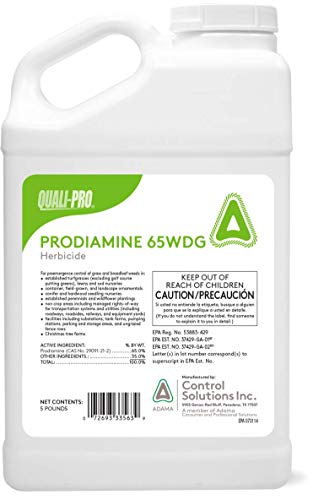
5 lb bottle of 65 percent prodiamine WDG listing annual bluegrass, henbit, chickweed and spurge; spring and fall use.
Check price on AmazonWhy We Like It
- Names annual bluegrass (Poa annua)
- Large supply for big lawns or multiple seasons
- Tank-mixes with fertilizer and iron
| Specification | Details |
|---|---|
| Active ingredient | Prodiamine 65% |
| Form | Water-dispersible granule |
| Size | 5 lb bottle |
| Listed weeds | Annual bluegrass, henbit, knotweed, chickweed, spurge, foxtail, goosegrass |
| Coverage | Not stated in listing; see label |
Quali-Pro Prodiamine 65 WDG — compressed specs
This is the same active ingredient as the Yard Mastery packets in a 5-pound bottle, the format lawn professionals buy. It lists annual bluegrass first among its target weeds and is labeled for spring and fall use. For a large property, or a homeowner who applies in both spring and fall every year, a bottle lasts many seasons.
The downside is measuring: you will need a gram scale and a calibrated sprayer to hit the label rate. Stored correctly, it keeps well, but buy only what you will realistically use.
Pros
- Large quantity
- Poa listed
- Tank-mix friendly
Cons
- Requires a scale
- Coverage not in listing
- Overkill for small lawns
Check Quali-Pro Prodiamine 65 WDG price on Amazon
6. Scotts Halts Crabgrass & Grassy Weed Preventer — Best Easy-to-Find Preventer

Fertilizer-free granular preventer; fall application prevents poa annua, henbit and chickweed. Covers 5,000 sq ft.
Check price on AmazonWhy We Like It
- Fall use prevents poa annua, per listing
- No fertilizer, so timing is flexible
- Sold widely in stores
| Specification | Details |
|---|---|
| Active ingredient | Not stated in listing; check the bag |
| Size | 10.06 lb |
| Coverage | Up to 5,000 sq ft |
| Timing | Fall for poa annua and winter weeds; spring for crabgrass |
| Weather | Rain or freezing after application stated not to affect it |
Scotts Halts — compressed specs
Halts is the simplest route for homeowners who want to stop poa without ordering professional products. The listing says a fall application prevents winter weeds such as poa annua, henbit and chickweed, and that rain, snow or freezing weather after application will not affect performance. It contains no fertilizer, so it can go down whenever the timing is right for poa, regardless of your feeding schedule.
The listing does not name its active ingredient, which matters for resistance planning, so read the bag. Coverage of 5,000 square feet per 10-pound bag is less than the Yard Mastery granular.
Pros
- Widely available
- Fertilizer-free
- Simple instructions
Cons
- Active ingredient not in listing
- Smaller coverage
- Prevention only
Check Scotts Halts price on Amazon
Poa Annua Control by Lawn Type
Warm-season lawns (Bermuda, Zoysia, St. Augustine, centipede)
You have the most options. Apply a pre-emergent in late summer to early fall and, for most products, again 8 to 10 weeks later. Clean up survivors with a labeled post-emergent such as Negate or Sertay while the poa is young. Clemson Extension’s annual bluegrass factsheet also lists atrazine for St. Augustine and centipede lawns and imazaquin for post-emergence control in established warm-season grasses, and glyphosate for spot treatment only, since it is non-selective.
Cool-season lawns (Kentucky bluegrass, tall fescue, ryegrass)
Selective post-emergent options are limited, so prevention and turf density carry most of the load. A fall prodiamine application labeled for your grass helps, but it conflicts with fall overseeding; Clemson advises not overseeding tall fescue in the fall after a fall pre-emergent. Mowing higher, avoiding overwatering and relieving compaction make the lawn less hospitable to poa. Our guide on when to apply pre-emergent helps you choose between prevention and seeding in a given season.
Timing and Resistance
- Fall timing: Clemson recommends applying pre-emergents in late summer or early fall when daytime highs drop to about 75°F for four consecutive days.
- Second application: most products need another fall application 8 to 10 weeks later; check the label for residual length.
- Water in: apply granules at the label rate and water them in.
- Rotate modes of action: Clemson warns poa may develop resistance to Group 1 pre-emergents (benefin, dithiopyr, oryzalin, pendimethalin, prodiamine, trifluralin) and recommends alternating with Group 2 products such as indaziflam, where labeled for your grass. Rotate post-emergents too.
- New lawns: Clemson advises waiting six months after establishing a lawn from seed, sod, sprigs or plugs before applying pre-emergents.
Follow the Label
Several products here are professional-grade concentrates sold in small containers, which makes label rates critical. The EPA’s introduction to pesticide labels states that it is a violation of federal law to use a pesticide in a manner inconsistent with its labeling, and that the label defines where, how, how much and how often you may apply it. Confirm your grass species is listed, measure carefully, wear the protective equipment the label specifies, and observe re-entry and reseeding intervals. Some products cannot be sold in certain states; respect those limits.
Frequently Asked Questions
What kills poa annua but not grass?
In established warm-season lawns, selective post-emergents labeled for poa, such as Negate (rimsulfuron plus metsulfuron) and Sertay (sulfosulfuron), can kill it without harming the turf when used as directed. In cool-season lawns, selective options are limited, so prevention is the main approach.
When should I apply pre-emergent for poa annua?
In late summer or early fall, before poa germinates. Clemson Extension uses daytime highs dropping to about 75°F for four consecutive days as the cue, with a second application 8 to 10 weeks later for most products.
Can I overseed after applying prodiamine?
Not right away. Prodiamine stops grass seed from germinating. Wait the interval on the label before seeding, or skip the pre-emergent in areas you plan to overseed.
Why does poa annua keep coming back?
Poa produces large amounts of seed and thrives in compacted, overwatered, thin turf. Missed fall pre-emergent timing, herbicide resistance and bare spots all let it return. Combine prevention with better turf density.
Does Halts prevent poa annua?
The Scotts Halts listing states that a fall application prevents winter weeds including poa annua, henbit and chickweed. Check the bag for the active ingredient and timing.