

St. Augustine grass is hungry for nitrogen during the warm months and quick to turn pale yellow when it runs short of iron, especially on the alkaline, sandy soils common along the Gulf Coast and in Florida. The best St. Augustine fertilizer feeds steadily with slow-release nitrogen, keeps phosphorus low or zero unless a soil test shows a need, and adds iron for color without forcing a flush of soft growth that invites chinch bugs and large patch. Below are seven current listings that fit those needs, from a 50-pound iron-rich bag for big lawns to a liquid for quick touch-ups and a St. Augustine-safe weed and feed.
Part of our Lawn Care guide →
In this guide
- Our Top Picks at a Glance
- 1. Lesco St. Augustine Lawn 24-2-11 — Best Overall for Big Lawns
- 2. Sunniland St. Augustine 20-0-6 — Best Phosphorus-Free Slow Release
- 3. Pennington Full Season 32-0-5 — Best One-and-Done Feeding
- 4. Scotts Turf Builder Southern Lawn Food — Best Easy-to-Find Option
- 5. TPS Nutrients St Augustine Liquid Fertilizer — Best Liquid for St. Augustine
- 6. Simple Lawn Solutions 16-4-8 — Best Liquid with Fish and Seaweed
- 7. Fertilome St. Augustine Weed and Feed 15-0-4 — Best Weed and Feed
- What to Look for in a St. Augustine Fertilizer
- When and How to Fertilize St. Augustine
- Frequently Asked Questions
As an Amazon Associate we earn from qualifying purchases. This page contains affiliate links at no extra cost to you.
How we compared: we reviewed 13 current Amazon listings for St. Augustine lawn fertilizer and chose seven based on what each listing states (analysis, nitrogen release, iron, coverage and grass compatibility). We did not test or handle the products, and availability changes.
Key Takeaways
- Look for a high first number (nitrogen), a zero or low middle number (phosphorus) and a moderate last number (potassium), such as 20-0-6, 24-2-11 or 32-0-5.
- Slow-release nitrogen feeds evenly and reduces the risk of burn, runoff and disease flare-ups.
- Iron greens St. Augustine without extra top growth and helps correct yellowing on high-pH soils.
- Feed from full spring green-up through early fall; skip winter feeding and check local Florida summer fertilizer ordinances.
- Only use weed and feed products whose labels list St. Augustine; many broadleaf herbicides injure it.
Our Top Picks at a Glance
| Product | Best for | Key features | Buy |
|---|---|---|---|
| Lesco St. Augustine 24-2-11 | Best overall for big lawns |
| Buy now →Check current price |
| Sunniland St. Augustine 20-0-6 | Best phosphorus-free slow release |
| Buy now →Check current price |
| Pennington Full Season 32-0-5 | Best one-and-done feeding |
| Buy now →Check current price |
| Scotts Turf Builder Southern | Best easy-to-find option |
| Buy now →Check current price |
| TPS St Augustine Liquid | Best liquid for St. Augustine |
| Buy now →Check current price |
| Simple Lawn Solutions 16-4-8 | Best liquid with fish and seaweed |
| Buy now →Check current price |
| Fertilome St. Augustine Weed and Feed | Best weed and feed |
| Buy now →Check current price |
Prices change often; check Amazon for today’s price. As an Amazon Associate we earn from qualifying purchases.
1. Lesco St. Augustine Lawn 24-2-11 — Best Overall for Big Lawns
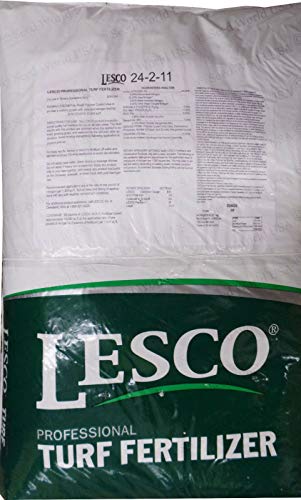
A St. Augustine blend with 6% iron in a 50 lb bag rated for 12,000 sq ft.
Check price on AmazonWhy We Like It
- Formulated specifically for St. Augustine lawns
- Highest stated iron content on our list
- Low phosphorus, solid potassium for stress tolerance
- Large bag covers 12,000 sq ft per listing
| Specification | Details |
|---|---|
| Analysis (N-P-K) | 24-2-11 |
| Iron | 6% |
| Bag size | 50 lb |
| Coverage | 12,000 sq ft |
| Nitrogen release type | not stated in listing |
| Form | Granular |
Lesco 24-2-11 — compressed specs
Of the listings we compared, this is the most complete St. Augustine-specific granular blend. The 24-2-11 ratio puts nitrogen first, keeps phosphorus minimal and carries enough potassium to help the turf handle heat, drought and wear. The 6% iron is the highest iron figure among the seven picks, which matters if your lawn yellows between the blades every summer on alkaline or sandy soil. At the stated coverage, one bag delivers roughly 1 pound of nitrogen per 1,000 square feet, in line with a single typical St. Augustine feeding.
The listing is thin: it does not say what share of the nitrogen is slow-release, and a 50-pound bag is a lot to store for a small yard. If you have a compact lawn or want documented slow-release nitrogen, the Sunniland or Pennington picks below are better fits.
Pros
- St. Augustine-specific formula
- 6% iron for deep color
- Covers large lawns from one bag
Cons
- Slow-release share not stated
- Heavy 50 lb bag
- Contains a little phosphorus
Check Lesco St. Augustine 24-2-11 price on Amazon
2. Sunniland St. Augustine 20-0-6 — Best Phosphorus-Free Slow Release
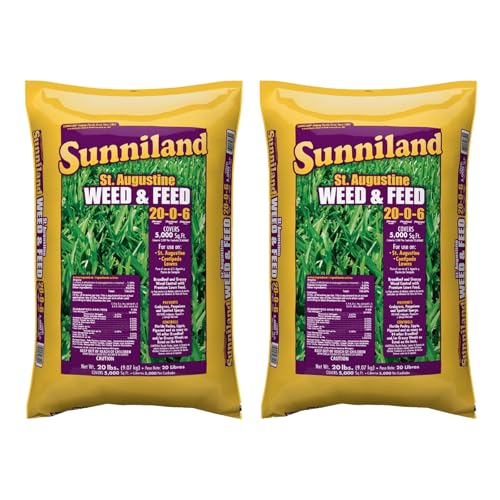
Phosphorus-free 20-0-6 with 50% slow-release nitrogen, sold as two 20 lb bags.
Check price on AmazonWhy We Like It
- Zero phosphorus suits Florida-style fertilizer rules
- Half the nitrogen is slow-release
- Made for St. Augustine turf
- Two-pack covers multiple feedings
| Specification | Details |
|---|---|
| Analysis (N-P-K) | 20-0-6 |
| Slow-release nitrogen | 50% |
| Package | Two 20 lb bags |
| Coverage | Up to 5,000 sq ft per bag |
| Iron | not stated in listing |
| Form | Granular, broadcast or drop spreader |
Sunniland 20-0-6 — compressed specs
This 20-0-6 reads like it was built around Florida lawns: no phosphorus, half of the nitrogen in slow-release form, and potassium for stress tolerance. Phosphorus-free fertilizer is the default choice on most established St. Augustine lawns in Florida unless a soil test shows a deficiency, and the slow-release portion keeps feeding through summer rains instead of washing out in one storm. At the stated coverage, each bag supplies about 0.8 pound of nitrogen per 1,000 square feet — a moderate rate that is easy on the grass.
Compared with the Lesco blend, you give up the stated iron but gain documented slow-release nitrogen and zero phosphorus. If your lawn tends to yellow, pair it with a separate iron product in midsummer.
Pros
- No phosphorus
- 50% slow-release nitrogen
- Two bags for two feedings on a 5,000 sq ft lawn
Cons
- No iron listed
- Two-pack is more than a small yard needs
- Iron must be added separately
Check Sunniland St. Augustine 20-0-6 price on Amazon
3. Pennington Full Season 32-0-5 — Best One-and-Done Feeding
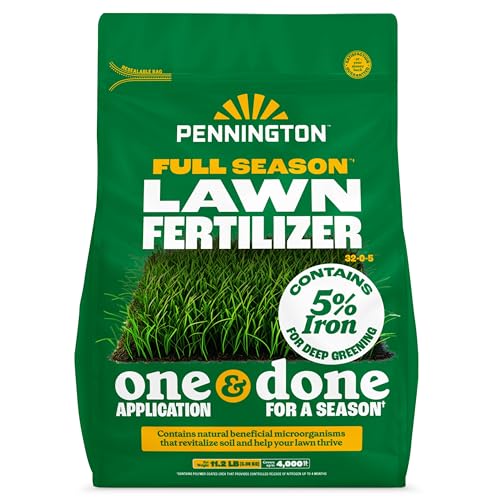
Polymer-coated urea releases nitrogen for up to 4 months, with 5% iron and soil microbes.
Check price on AmazonWhy We Like It
- Polymer-coated nitrogen lasts up to four months
- 5% iron for deep greening
- Zero phosphorus
- Fewer trips with the spreader
| Specification | Details |
|---|---|
| Analysis (N-P-K) | 32-0-5 |
| Nitrogen source | Polymer-coated urea, up to 4 months |
| Iron | 5% |
| Extras | Beneficial soil microorganisms |
| Bag weight | 11.2 lb |
| Coverage | not stated in listing |
Pennington Full Season 32-0-5 — compressed specs
If you only want to fertilize once or twice a year, this is the pick. Polymer-coated urea releases nitrogen gradually, and the listing says one application feeds for up to four months, so a late-spring application can carry a St. Augustine lawn through much of the summer. It is also one of only two picks with a stated iron content, and like Sunniland it contains no phosphorus.
It is a general lawn fertilizer rather than a St. Augustine-specific blend, and the listing does not state coverage, so read the bag for the spreader setting. The listing notes it is not available in Hawaii or South Dakota.
Pros
- Long-lasting controlled-release nitrogen
- Contains 5% iron
- Phosphorus-free
Cons
- Coverage not stated in listing
- Not St. Augustine-specific
- Not sold in Hawaii or South Dakota
Check Pennington Full Season 32-0-5 price on Amazon
4. Scotts Turf Builder Southern Lawn Food — Best Easy-to-Find Option

A pesticide-free Scotts lawn food formulated for Southern grasses, covering 5,000 sq ft per bag.
Check price on AmazonWhy We Like It
- Formulated for Southern grass types
- Pesticide-free, pets and people can re-enter
- Apply in spring, summer or fall
- Sized for a typical 5,000 sq ft lawn
| Specification | Details |
|---|---|
| Analysis (N-P-K) | not stated in listing |
| Bag weight | 14.06 lb |
| Coverage | 5,000 sq ft |
| Application season | Spring, summer or fall |
| Herbicide | None (pesticide-free) |
Scotts Turf Builder Southern Lawn Food — compressed specs
Scotts’ Southern formula is the straightforward choice if you want a familiar product in a homeowner-size bag. The listing says it is made for Southern grasses, contains no pesticides, and can be applied any time in the growing season, with a light watering-in for faster results. One bag is sized for 5,000 square feet, which is a common suburban lawn.
The drawback is that the listing does not give the N-P-K analysis or slow-release share, so check the bag label for phosphorus content if you live in Florida or near water. Compared with Sunniland or Lesco, it is a general Southern-lawn food rather than a St. Augustine-specific blend.
Pros
- Widely recognized brand
- No herbicide in the bag
- Homeowner-friendly bag size
Cons
- N-P-K not stated in listing
- No iron listed
- Not St. Augustine-specific
Check Scotts Turf Builder Southern price on Amazon
5. TPS Nutrients St Augustine Liquid Fertilizer — Best Liquid for St. Augustine
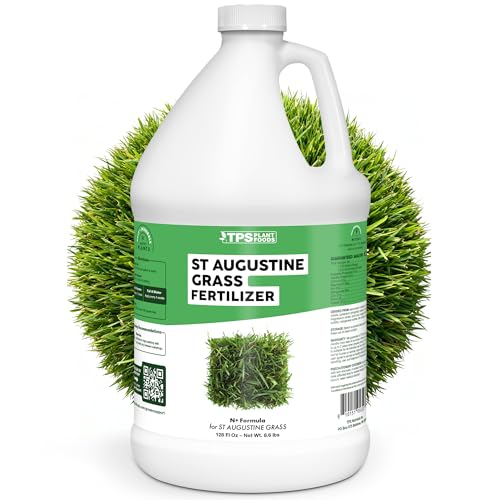
A high-nitrogen liquid concentrate labeled for St. Augustine, made in the USA, in a 1-gallon jug.
Check price on AmazonWhy We Like It
- Labeled specifically for St. Augustine grass
- Fast-absorbing liquid for quick greening
- Also listed in 32 oz and 8 oz sizes
- Made in the USA
| Specification | Details |
|---|---|
| Form | Liquid concentrate |
| Size | 1 gallon (128 oz) |
| Analysis (N-P-K) | not stated in listing; described as high nitrogen |
| Coverage | not stated in listing |
| Made in | USA |
TPS Nutrients St Augustine liquid — compressed specs
Liquid fertilizer is the fastest way to green up a pale St. Augustine lawn or feed a small yard without a spreader. This TPS concentrate is one of the few liquids labeled for St. Augustine by name, and the listing describes it as a high-nitrogen formula that supports new runners and color. The shelf also carries 32-ounce and 8-ounce versions of the same product, so you can match the jug to your lawn size.
Liquids feed quickly but do not last as long as slow-release granules, so expect to reapply more often. The listing does not state the analysis or coverage, which makes it harder to calculate your nitrogen rate. For more liquid options, see our roundup of the best liquid lawn fertilizers.
Pros
- St. Augustine-specific label
- Quick greening
- Three sizes available
Cons
- N-P-K not stated in listing
- Coverage not stated
- Shorter feeding than granules
Check TPS St Augustine Liquid price on Amazon
6. Simple Lawn Solutions 16-4-8 — Best Liquid with Fish and Seaweed

A 16-4-8 liquid with seaweed and fish in a ready-to-use sprayer, labeled for St. Augustine.
Check price on AmazonWhy We Like It
- Clearly stated 16-4-8 analysis
- Seaweed and fish emulsion added
- Ready-to-use sprayer bottle
- Lists St. Augustine among compatible grasses
| Specification | Details |
|---|---|
| Analysis (N-P-K) | 16-4-8 |
| Extras | Seaweed and fish |
| Size | 32 oz |
| Applicator | Ready-to-use sprayer |
| Grass types | All listed types, including St. Augustine and Florida Palmetto |
| Coverage | not stated in listing |
Simple Lawn Solutions 16-4-8 — compressed specs
Unlike the TPS liquid, this listing gives a full 16-4-8 analysis, so you know exactly what you are putting down. The seaweed and fish emulsion adds organic matter, and the ready-to-use sprayer suits spring and summer touch-ups between granular feedings. The listing names St. Augustine and Florida Palmetto among the compatible grasses.
It contains 4% phosphorus, so it is less suited to Florida lawns where phosphorus is restricted without a soil test. A 32-ounce bottle also goes quickly on a large lawn — this is a supplement, not your main feeding.
Pros
- Full analysis on the label
- Organic seaweed and fish additions
- Ready-to-use, no measuring
Cons
- Contains phosphorus
- Small bottle for large lawns
- No iron listed
Check Simple Lawn Solutions 16-4-8 price on Amazon
7. Fertilome St. Augustine Weed and Feed 15-0-4 — Best Weed and Feed

A 15-0-4 fertilizer with atrazine for pre- and post-emergent weed control on St. Augustine lawns.
Check price on AmazonWhy We Like It
- Herbicide chosen for St. Augustine tolerance
- Controls existing and germinating weeds
- Phosphorus-free 15-0-4 feeding
- Also labeled for centipede and zoysia
| Specification | Details |
|---|---|
| Analysis (N-P-K) | 15-0-4 |
| Active herbicide | Atrazine |
| Weed control | Pre- and post-emergent |
| Bag weight | 12.8 lb |
| Compatible grasses | St. Augustine, centipede, zoysia; not Bermuda |
| Coverage | varies, see label |
Fertilome St. Augustine Weed and Feed — compressed specs
Many weed and feed products contain 2,4-D or similar herbicides that can injure St. Augustine, which is why this one stands out. It pairs a phosphorus-free 15-0-4 fertilizer with atrazine, a herbicide widely used on St. Augustine and centipede lawns, giving you both pre-emergent and post-emergent control of listed weeds. The listing recommends an early-spring application.
Do not use it on Bermuda or any cool-season grass, and follow the label closely around trees, shrubs and garden beds. Atrazine labels generally restrict use on newly sodded or stressed lawns and during hot weather, so read the label’s temperature guidance before applying. If you do not have a weed problem, a straight fertilizer is the better choice.
Pros
- St. Augustine-safe herbicide
- Pre- and post-emergent control
- No phosphorus
Cons
- Kills Bermuda and cool-season grass
- Herbicide caution near ornamentals
- Coverage only on the label
Check Fertilome St. Augustine Weed and Feed price on Amazon
What to Look for in a St. Augustine Fertilizer
Nitrogen first, and mostly slow-release
St. Augustine is a warm-season grass that grows hard from late spring through summer. Nitrogen drives that growth and color. University extension guidance in the Southeast generally recommends no more than about 1 pound of nitrogen per 1,000 square feet in a single application, with total yearly amounts varying by region and length of the growing season. Slow-release sources (polymer-coated urea, sulfur-coated urea or similar) deliver that nitrogen gradually, which keeps growth even and reduces leaching in sandy soil.
Low or zero phosphorus
Most established Gulf Coast and Florida soils already hold enough phosphorus, and excess phosphorus washing into lakes and canals fuels algae blooms. Florida rules limit phosphorus in lawn fertilizer unless a soil test shows a need, and many Florida counties and cities also have summer rainy-season bans on nitrogen and phosphorus. Phosphorus-free bags such as 20-0-6 or 32-0-5 are the safe default; get a soil test before adding phosphorus.
Potassium and iron
Potassium helps turf handle heat, drought and wear. Iron is the key micronutrient for St. Augustine: on alkaline soils (common near the coast, on limestone and in Texas), the grass struggles to take up iron and the blades yellow between the veins. A fertilizer with iron, or a separate iron application in summer, restores deep green color without pushing extra top growth.
Granular vs. liquid
Granular, slow-release products are the backbone of a St. Augustine program because they feed for weeks or months per application. Liquids act faster and are handy for small lawns or a quick color boost, but they need more frequent reapplication. Use a good broadcast spreader for granules — see our picks of the best fertilizer spreaders — and overlap passes slightly to avoid stripes.
Weed and feed caution
Check that any combination product lists St. Augustine on its label. Several common lawn herbicides damage it, and weed and feed applied over tree and shrub roots can injure ornamentals. If weeds are scattered, spot-treat instead and fertilize separately.
When and How to Fertilize St. Augustine
- Wait until the lawn is fully green and actively growing in spring (often April in the Gulf states, earlier in South Florida) — feeding during green-up wastes fertilizer on weeds and can encourage large patch.
- Feed every six to ten weeks with slow-release fertilizer through summer, or rely on a long-release product to cover more of the season.
- Make the last nitrogen feeding about six to eight weeks before your average first frost; potassium-heavy fall feedings help winter hardiness.
- Water in lightly after applying granules, and sweep granules off sidewalks and driveways back onto the lawn.
- Avoid heavy nitrogen in midsummer heat; lush growth attracts chinch bugs and gray leaf spot.
For mowing heights, watering and pest control, see our full guide to St. Augustine grass care; for a broader feeding calendar, our lawn care guide covers every major grass type. If you have a mixed lawn or cool-season grass, our roundup of the best lawn fertilizers covers general-purpose options.
Frequently Asked Questions
What is the best N-P-K ratio for St. Augustine grass?
A high-nitrogen, low- or zero-phosphorus blend with moderate potassium works best, such as 20-0-6, 24-2-11 or 32-0-5. Unless a soil test shows a phosphorus deficiency, skip phosphorus, especially in Florida.
How often should I fertilize St. Augustine grass?
Typically every six to ten weeks during the active growing season with slow-release granules, or less often with long-release products. Start after full spring green-up and stop six to eight weeks before your first frost. Follow local ordinances for summer feeding.
Why is my St. Augustine turning yellow?
Common causes are iron deficiency on alkaline soil (yellow between green veins), nitrogen deficiency (overall pale color), overwatering, or chinch bug damage in hot, dry spots. An iron-containing fertilizer or iron supplement often fixes the first; check for chinch bugs before adding more nitrogen.
Can I use weed and feed on St. Augustine?
Only products labeled for St. Augustine, such as atrazine-based weed and feed. Many standard weed and feed products contain herbicides that injure it. Avoid applying during hot weather or on newly laid sod, and follow the label.
Is liquid or granular fertilizer better for St. Augustine?
Granular slow-release fertilizer is better for regular feeding because it lasts longer and is easier to apply at a measured rate. Liquids are useful for quick greening, small lawns or supplemental feeding between granular applications.