

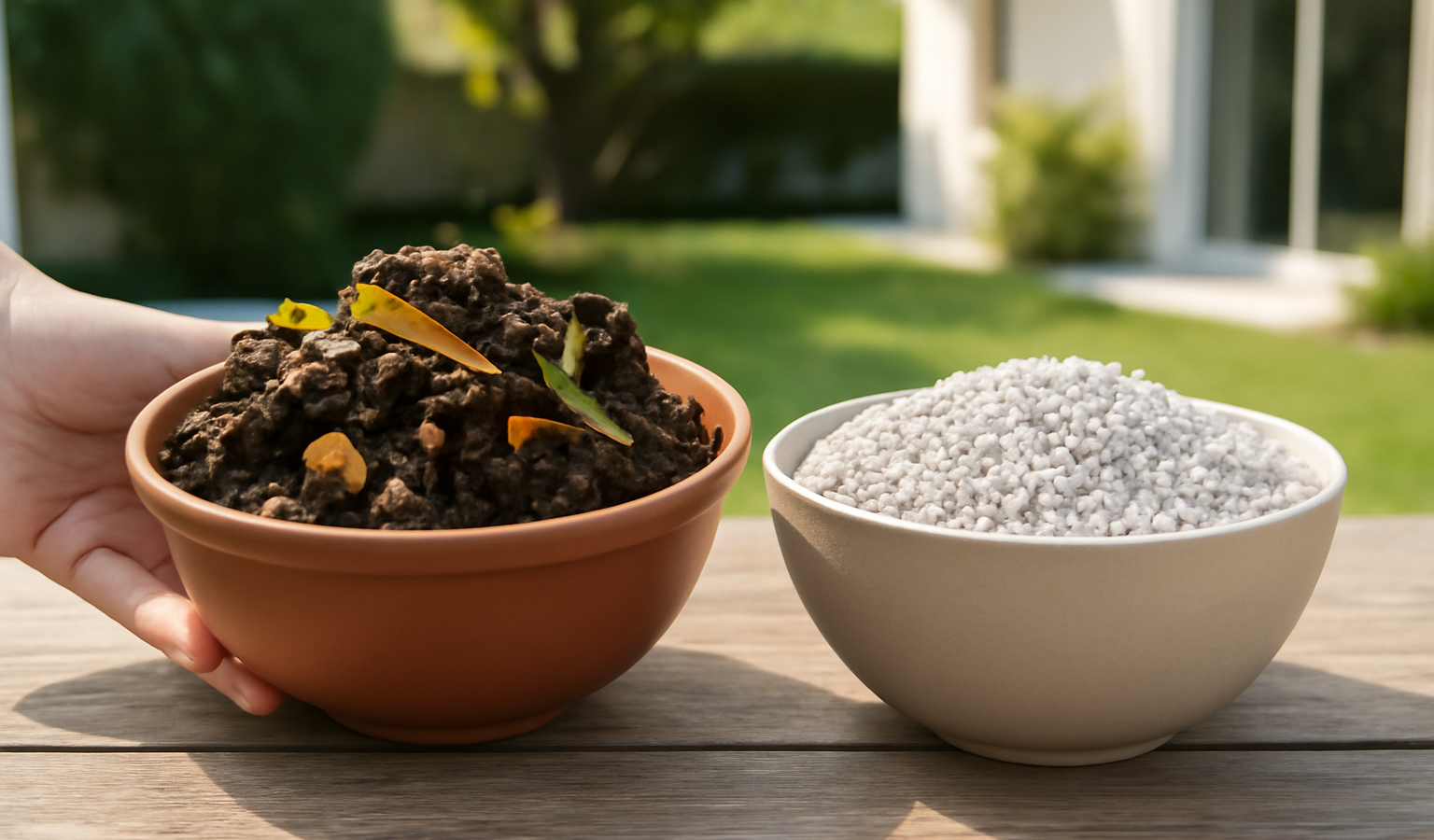
Gardeners use “compost” and “fertilizer” almost interchangeably, but they do fundamentally different jobs. Compost feeds the soil; fertilizer feeds the plant. One is a slow, soil-building amendment full of organic matter and microbes; the other is a concentrated dose of specific nutrients ready for roots to absorb. Confusing the two leads to predictable mistakes — dumping fertilizer on lifeless dirt and wondering why nothing thrives, or relying on compost alone and watching hungry tomatoes stall. This guide breaks down exactly what each one is, how they work, what nutrients they deliver, and — most usefully — how to use them together so your garden has both healthy living soil and the nutrients plants need to produce.
Key Takeaways
- Compost feeds the soil; fertilizer feeds the plant. Compost is a slow-release soil builder; fertilizer is a fast, targeted nutrient source.
- Nutrient strength differs hugely: compost is low and balanced (often around 1-1-1 NPK); fertilizers are concentrated (e.g. 10-10-10 or higher).
- Compost improves soil structure — adding organic matter, holding water, and feeding microbes — while fertilizer does nothing for soil health.
- Fertilizer acts fast and can fix a specific deficiency in days; compost works over months and years.
- The best gardens use both: compost as the foundation, fertilizer to top up demand from heavy feeders.
Compost vs Fertilizer at a Glance
| Factor | Compost | Fertilizer |
|---|---|---|
| Primary job | Feeds and builds the soil | Feeds the plant directly |
| What it is | Decomposed organic matter | Concentrated nutrients (organic or synthetic) |
| Nutrient strength | Low, balanced (~1-1-1 NPK) | High, often targeted (e.g. 10-10-10) |
| Release speed | Slow — weeks to years | Fast — days to weeks (synthetic) |
| Soil structure | Greatly improves it | No benefit; can harm with overuse |
| Microbial life | Feeds and adds microbes | Neutral; synthetic salts can suppress |
| Risk of burn | Very low | High if over-applied |
| Cost | Cheap or free (DIY) | Moderate; recurring |
| Best use | Building soil, every bed, every year | Boosting heavy feeders, fixing deficiencies |
Compost: Feeding the Soil
Compost is decomposed organic matter — kitchen scraps, leaves, grass clippings, manure — broken down by microbes into a dark, crumbly, earthy-smelling material. Its job is not to deliver a punch of nutrients but to improve the soil itself. When you work compost into a bed, you are adding organic matter that loosens compacted clay, helps sandy soil hold water, and creates the crumbly structure roots love. Just as importantly, compost is alive: it teems with bacteria, fungi, and other organisms that cycle nutrients, fight disease, and make existing soil nutrients available to plants.
Compost does contain nutrients, but at low, gentle concentrations — typically around 1-1-1 on the NPK scale, plus a broad range of micronutrients. Because those nutrients are bound up in organic matter, they release slowly as microbes break them down, feeding plants steadily over months and years rather than all at once. That slow release is why you essentially cannot burn plants with compost the way you can with fertilizer, and why compost is the safe, foundational amendment for every bed.
What compost does and doesn’t do
Compost’s strength is the long game: better soil structure, more water retention, healthier microbial life, and a slow trickle of balanced nutrition. Apply a 1- to 2-inch layer over beds once or twice a year — in spring before planting and again in fall — and work it into the top few inches, or simply leave it on top as the worms pull it down. Its limitation is that it is not a quick fix. If a plant is showing an acute nutrient deficiency mid-season, compost alone is too slow and too dilute to correct it fast. For that, you reach for fertilizer. Compost pairs naturally with mulching too — see how organic mulch and soil amendments work together in our mulch vs rock comparison.
Fertilizer: Feeding the Plant
Fertilizer is a concentrated source of plant nutrients, designed to be absorbed by roots quickly. Every fertilizer label carries three numbers — the NPK ratio — showing the percentage of nitrogen (N) for leafy green growth, phosphorus (P) for roots and blooms, and potassium (K) for overall vigor and stress resistance. A balanced 10-10-10 supplies equal amounts; a high-nitrogen 30-0-4 pushes lawn growth; a bloom formula like 10-30-20 favors flowers and fruit. Because these nutrients are concentrated and readily available, fertilizer acts fast — a deficiency can visibly improve within days.
Fertilizers come in two broad camps. Synthetic (mineral) fertilizers are highly concentrated and fast-acting, ideal for a quick correction but easy to over-apply. Organic fertilizers — blood meal, bone meal, fish emulsion, composted manure blends — are gentler and release more slowly as soil organisms process them, sitting somewhere between synthetic fertilizer and compost in speed. Both deliver targeted nutrition that compost simply cannot match in concentration.
The risks of fertilizer
Fertilizer’s speed is also its danger. Over-applying — especially synthetic types — delivers a salt overload that scorches roots and foliage, a problem gardeners call fertilizer burn, showing up as browned, crispy leaf edges. Excess nitrogen pushes lush leafy growth at the expense of flowers and fruit, so an over-fertilized tomato becomes a leafy bush with few tomatoes. Fertilizer also does nothing for soil health; relying on it alone leaves you with chemically “fed” plants growing in lifeless, structureless dirt that gets worse each year. And because nutrients are so mobile, over-application washes into waterways and causes pollution. Always follow label rates, and feed heavy demanders like roses and vegetables on a schedule — our guide to roses not blooming covers how feeding mistakes stall flowering.
The Key Difference: Soil vs Plant
The cleanest way to remember the distinction: compost is a long-term investment in your soil, while fertilizer is a short-term meal for your plants. Compost slowly transforms dead dirt into living, water-holding, nutrient-cycling soil that supports plants year after year. Fertilizer delivers a precise, immediate dose of the specific nutrients a plant needs right now. Compost asks “is my soil healthy?” Fertilizer asks “does this plant have enough nitrogen, phosphorus, and potassium today?”
This is why the two are not really competitors — they solve different problems. A garden built only on fertilizer has hungry-fed plants in degrading soil. A garden built only on compost has wonderful soil but may leave heavy feeders short of nutrients during peak demand. The strongest gardens use compost to build the foundation and fertilizer to top up where specific plants need more than the soil can supply.
Which Should You Use?
For most gardeners the honest answer is both, but the right emphasis depends on your situation.
Reach for compost when…
- You are building or improving soil — every bed benefits from a yearly compost top-up.
- Your soil is compacted, sandy, or low in organic matter and needs structure and water retention.
- You want a safe, slow, balanced feed with no risk of burning plants.
- You are gardening organically and want to support soil microbial life.
- You have access to free or cheap compost from a bin or municipal source.
Reach for fertilizer when…
- You need to correct a visible deficiency quickly mid-season.
- You are feeding heavy feeders — tomatoes, corn, roses, lawns — that demand more than soil supplies.
- You are growing in containers, where nutrients leach out fast and compost alone runs short.
- You want a targeted NPK ratio to push blooms, fruit, or leafy growth.
- You need results in days rather than months.
The proven routine for most gardens: lay down compost as the base each spring and fall to keep the soil alive and rich, then add fertilizer through the growing season for hungry crops and any plant showing a deficiency. Compost makes the fertilizer work better by keeping the soil able to hold and cycle those nutrients. For more on feeding specific plants and beds, browse our outdoor living guides.
Frequently Asked Questions
Can compost replace fertilizer entirely?
For light feeders and well-established soil, often yes — rich compost supplies a slow, balanced trickle of nutrients that many plants find sufficient. But heavy feeders like tomatoes, corn, and roses, and any plant in a container, frequently need more nitrogen, phosphorus, or potassium than compost alone provides at peak demand. In those cases compost builds the soil while fertilizer fills the gap.
What do the three numbers on fertilizer mean?
They are the NPK ratio: the percentage of nitrogen (N), phosphorus (P), and potassium (K). Nitrogen drives leafy green growth, phosphorus supports roots and blooms, and potassium boosts overall vigor and stress tolerance. A 10-10-10 is balanced; a high-first-number product pushes foliage; a high-middle-number product favors flowers and fruit. Match the ratio to what your plant needs most.
Will compost burn my plants like fertilizer can?
Almost never. Finished compost releases its low, balanced nutrients slowly through microbial activity, so there is no salt spike to scorch roots or foliage. The main caution is using unfinished, still-decomposing compost, which can rob nitrogen temporarily and may carry weed seeds. Use fully matured, dark, crumbly compost and you can apply it generously without any burn risk.
How often should I add compost versus fertilizer?
Add a 1–2 inch layer of compost once or twice a year, typically in spring before planting and again in fall to rebuild soil over winter. Fertilizer is applied more frequently during the growing season — often every few weeks for heavy feeders and containers — following the product’s label rates. Compost is the steady foundation; fertilizer is the in-season top-up.
Is organic fertilizer the same as compost?
No. Organic fertilizers like blood meal, bone meal, and fish emulsion are concentrated nutrient sources that feed plants more directly, though they release slower than synthetic types. Compost is decomposed organic matter whose main role is improving soil structure and microbial life, with only mild, balanced nutrition. Organic fertilizer sits between compost and synthetic fertilizer in both concentration and speed.