

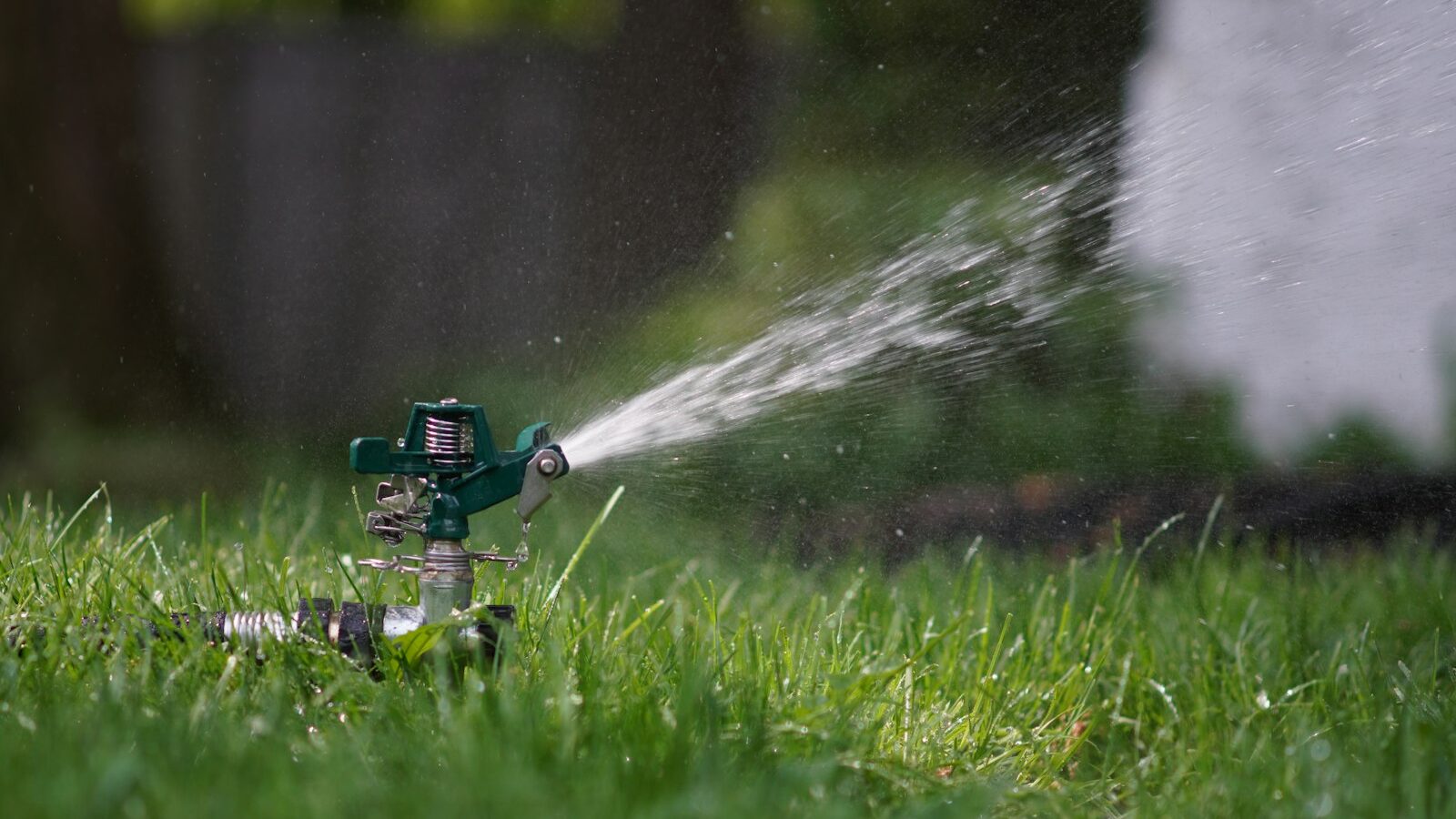
The right lawn sprinkler is the difference between a green, even lawn and a patchwork of dry spots and puddles. The catch is that no single sprinkler does it all: an oscillating head that pampers a rectangular front yard is useless on a half-acre back lot, and the brass impact head that throws water 40 feet will drench your neighbor’s fence if your yard is small and oddly shaped. Below are seven sprinklers we recommend for 2026, organized so you can match the tool to your yard rather than chase a one-size-fits-all winner.
As an Amazon Associate we earn from qualifying purchases.
Our top picks
- Best overall oscillating: Melnor XT Turbo Oscillating Sprinkler
- Best impact / pulsating: Rain Bird 25PJDAC Brass Impact Sprinkler
- Best for large lawns: Orbit 56667 Zinc Impact Sprinkler on Tripod
- Best walking / traveling: Nelson 1865 Rain Train Traveling Sprinkler
- Best smart / timer: Orbit B-hyve Smart Hose Faucet Timer
- Best for small / odd-shaped yards: Gilmour Adjustable Circular Swivel Sprinkler
- Best budget: Eden 96213 Essential Oscillating Sprinkler
| Model | Type | Coverage | Best for |
|---|---|---|---|
| Melnor XT Turbo | Oscillating | Up to ~4,500 sq ft | Rectangular lawns, all-around use |
| Rain Bird 25PJDAC | Impact (brass) | 20–41 ft radius | Durability, full or partial circles |
| Orbit 56667 Tripod | Impact on tripod | Up to ~5,000 sq ft | Large lawns, tall grass & gardens |
| Nelson 1865 Rain Train | Traveling / walking | Up to 13,500 sq ft | Big or long lawns, hands-off watering |
| Orbit B-hyve | Smart hose timer | Pairs with any sprinkler | Automated, weather-based scheduling |
| Gilmour Circular Swivel | Stationary circular | Adjustable, up to ~45 ft circle | Small, round or odd-shaped areas |
| Eden 96213 | Oscillating | Up to 3,600 sq ft | Budget-minded homeowners |
The 7 best lawn sprinklers for 2026
Melnor XT Turbo Oscillating Sprinkler — best overall oscillating
If you have a typical rectangular lawn and want one sprinkler that simply works, the Melnor XT Turbo is the easiest recommendation we can make. Its rectangular oscillating head carries 20 precision rubber nozzles that spread water in a soft, even sheet rather than the harsh stripes cheaper oscillators leave behind. Two sets of sliding levers in the center of the bar let you dial the width of the spray from about 10 feet up to roughly 20 feet, so you can water a narrow side strip or the full breadth of a yard without soaking the driveway.
Length is just as adjustable: twisting the yellow ring at the end of the bar shortens or lengthens the throw from about 20 feet out to nearly 50 feet. In our reading of testing notes, the Melnor stayed firmly planted even at full pressure thanks to its wide, weighted base, and the included nozzle-cleaning tool plus a metal filter washer in the hose fitting keep it spraying cleanly season after season. For most homeowners this is the sprinkler to buy first.
Pros
- Even, gentle coverage from 20 precision nozzles
- Independent width and length adjustment
- Heavy base stays put at high pressure
- Includes cleaning tool and inlet filter washer
Cons
- Rectangular pattern wastes water on round or irregular yards
- Oscillating spray loses range on low water pressure
Rain Bird 25PJDAC Brass Impact Sprinkler — best impact / pulsating
The Rain Bird 25PJDAC is the sprinkler you buy once and hand down to the next owner of your house. This is a classic brass impact head — the same basic design you see on golf courses, ball fields, and professional landscape installs — and its all-metal construction shrugs off UV, grit, and years of use that crack plastic heads in a season or two. It throws water in a pulsing, far-reaching arc from roughly 20 feet out to about 41 feet, depending on pressure.
What makes it a workhorse is the adjustable rotation: a pair of trip collars on the head let you set anything from a narrow part-circle (handy for watering along a fence or bed without spraying the house) up to a full 360-degree rotation. It mounts on a standard threaded base or pipe riser, so you can stake it low for turf or raise it on a riser to clear taller plants. If you value durability and reach over set-and-forget convenience, nothing in this list outlasts a brass impact head.
Pros
- All-brass build lasts for decades
- Long throw of up to roughly 41 feet
- Adjustable from narrow part-circle to full circle
- Mounts on standard bases and risers
Cons
- Head only — you supply a base or spike
- Needs decent water pressure to reach full range
- Pulsing stream can be heavy on delicate seedlings
Orbit 56667 Zinc Impact Sprinkler on Tripod — best for large lawns
For a big lawn, the limiting factor with most sprinklers is height: a head sitting in the grass gets blocked by the very turf and plants you are trying to water. The Orbit 56667 solves that with an adjustable tripod stand that lifts a zinc impact head well above ground level, so the pulsing stream clears tall grass, vegetable rows, and flower beds to reach the far corners of the yard. From a single position it covers up to roughly 5,000 square feet with a 360-degree rotating head.
The tripod legs telescope and lock, letting you raise the head to clear obstacles or drop it low for open turf, and the metal impact head adjusts from part-circle to full-circle just like a staked impact sprinkler. It is the natural pick if you are watering a large open lawn, a new sod install, or a garden where a low oscillating head simply cannot throw far enough. For sprawling properties, pair it with a traveling sprinkler (below) so you are not constantly dragging hose.
Pros
- Tripod height clears tall grass and plants
- Up to ~5,000 sq ft from one spot
- Full part-circle to full-circle adjustment
- Telescoping legs lock at multiple heights
Cons
- Tall stance can tip on uneven or windy ground
- Overkill for small yards
- Needs good pressure to hit full coverage
Nelson 1865 Rain Train Traveling Sprinkler — best walking / traveling
If dragging a sprinkler around a big lawn every twenty minutes sounds exhausting, a traveling sprinkler does the walking for you. The Nelson Rain Train is a cast-iron tractor-style sprinkler that uses the pressure of your own hose as fuel: it drives slowly along the path the hose lays out, spraying as it goes, and shuts the water off automatically when it reaches the end. Lay the hose in the pattern you want watered and the Rain Train follows it like a track.
It travels up to 200 feet and covers as much as 13,500 square feet in a single run, with adjustable aluminum spray arms that throw a circle anywhere from about 15 to 55 feet in diameter. Three speed settings — high, low, and neutral — let you control how much water lands per pass, and the corrosion-resistant cast-iron body is built to survive years outdoors. For large or long lawns, this is the closest you get to an in-ground system without trenching, and the automatic shutoff means you can start it and walk away.
Pros
- Waters up to 13,500 sq ft hands-free
- Follows the hose path you set
- Automatic shutoff prevents waste and flooding
- Durable cast-iron body with three speeds
Cons
- Heavy and bulky to store
- Needs a fairly flat, obstacle-free path
- More expensive than a basic sprinkler
Orbit B-hyve Smart Hose Faucet Timer — best smart / timer
The smartest sprinkler upgrade often isn’t the sprinkler at all — it’s the timer in front of it. The Orbit B-hyve screws onto your spigot, your existing sprinkler attaches to it, and from there you schedule watering from your phone over Bluetooth or, with the Wi-Fi hub, from anywhere. The standout feature is weather intelligence: the B-hyve pulls local forecast and evapotranspiration data and skips or shortens runs when rain is coming, which in testing trimmed water use by roughly a third compared with a fixed schedule.
The free app walks you through a setup wizard that builds a schedule around your soil type, sun exposure, and slope, so you are not guessing at run times. It is available in single- and multi-port versions if you want to run more than one zone, and it works with whatever sprinkler you already own — oscillating, impact, or traveling. If consistent, water-smart watering matters more to you than babysitting a hose bib, this is the piece that ties your whole setup together. For the bigger picture on efficient watering, see our guide to drip vs sprinkler irrigation.
Pros
- Weather-based skipping saves real water
- Bluetooth control, plus Wi-Fi with the hub
- Guided app scheduling for soil and slope
- Works with any hose-end sprinkler
Cons
- Remote access needs the separate Wi-Fi hub
- Battery-powered — you must swap cells periodically
- App can feel busy for simple needs
Gilmour Adjustable Circular Swivel Sprinkler — best for small / odd-shaped yards
Oscillating and impact sprinklers throw water in shapes that fight against small, curved, or irregular yards. The Gilmour Adjustable Circular Swivel sprays a clean circular or partial-circle pattern instead, which suits round lawns, planting beds, and the awkward nooks other sprinklers either miss or overshoot. A distance-control knob on top lets you shrink the throw radius for a tight bed or open it up to nearly a 45-foot circle for a small open lawn — no swapping nozzles required.
Because the head swivels, you can aim the pattern precisely and avoid soaking the patio, sidewalk, or your neighbor’s hedge. The metal spray insert is durable, and the low profile means it disappears into a bed rather than looming over it. It will not water a big rectangular lawn efficiently — that is what the Melnor is for — but for a courtyard, a side yard, or a cluster of raised beds, this is the most precise and least wasteful pick on the list.
Pros
- Circular pattern suits round and odd yards
- Distance knob shrinks the throw without nozzle swaps
- Swivel head aims spray precisely
- Durable metal spray insert, low profile
Cons
- Inefficient on large rectangular lawns
- Smaller maximum coverage than oscillating heads
Eden 96213 Essential Oscillating Sprinkler — best budget
You do not need to spend a lot to get even, reliable coverage. The Eden 96213 is an oscillating sprinkler that covers up to 3,600 square feet with 16 precision nozzles, and it routinely earns praise for delivering coverage that rivals sprinklers costing twice as much. Sliding tabs adjust the spray pattern and a water-flow control knob changes the range, so it handles a modest lawn or a flower bed without drowning the edges.
A weighted base keeps it stable, stainless-steel inlet filters trap grit before it clogs the nozzles, and many versions ship with a quick-connect fitting to speed up hose changes. The sweet spot for a quality oscillating sprinkler runs roughly $30 to $45, and the Eden sits right in it — durable enough to last multiple seasons while costing far less than premium models. If you want one dependable sprinkler without overthinking it, this is the value pick. Round out your kit with our roundup of essential garden tools.
Pros
- Strong coverage for the price — up to 3,600 sq ft
- Adjustable pattern and flow control
- Weighted base and stainless-steel filters
- Often includes a quick-connect fitting
Cons
- Mostly plastic build — less rugged than brass
- Coverage trails larger premium oscillators
Free, no-obligation quote · Connect with a local pro
How to choose a lawn sprinkler
Oscillating vs. impact vs. rotary
Oscillating sprinklers sweep a fan of water back and forth across a rectangular area. They give the gentlest, most even coverage and are the default choice for square or rectangular lawns — but they waste water on round or irregular shapes and lose range when water pressure drops. Impact (pulsating) sprinklers shoot a single rotating stream that pulses outward, reaching far and standing up to wind better than any other type; they are the right call for large lawns, slopes, and anywhere you need 40-plus feet of throw, though the heavy stream can be rough on seedlings. Rotary and stationary sprinklers spray in fixed circular or multi-arm patterns; small rotary heads and circular swivel models excel in tight, curved, or odd-shaped spaces where the other two types overshoot.
Coverage and range
Measure your lawn before you buy. Match the sprinkler’s stated coverage to your actual area and shape: a 3,600-square-foot oscillator is plenty for a typical front yard, while a half-acre back lot wants an impact head on a tripod or a traveling sprinkler. Remember that manufacturer coverage figures assume good pressure — expect real-world numbers to come in a bit lower. For irregular yards, prioritize adjustability (sliding tabs, distance knobs, part-circle settings) over raw maximum range.
Water pressure
Every spec above assumes adequate household water pressure, typically 40 to 60 PSI. If your pressure is low, oscillating sprinklers suffer the most — the fan collapses and the throw shortens dramatically — while impact heads tolerate lower pressure better and still reach decent distance. If you run a long hose or several sprinklers at once, pressure at the nozzle drops further, so size down your expectations or split watering into zones.
Timers and automation
A hose-end timer turns any sprinkler into a set-and-forget system. Mechanical timers simply shut water off after a set duration; smart timers like the Orbit B-hyve add app scheduling and weather-based skipping that can cut water use meaningfully. Watering deeply and less often grows healthier roots than frequent shallow sprinkles — and consistent watering pairs naturally with a sensible mowing routine, which we cover in how often to mow your lawn.
Frequently asked questions
Which type of sprinkler is best for my lawn?
Match the type to your yard. Rectangular and square lawns do best with an oscillating sprinkler like the Melnor XT Turbo. Large or sloped lawns want an impact sprinkler — on a tripod for extra reach — or a traveling sprinkler. Small, round, or oddly shaped areas are best served by a stationary or circular swivel sprinkler that you can dial in precisely.
How much water pressure do I need?
Most hose-end sprinklers are designed around 40 to 60 PSI. Oscillating models are the most pressure-sensitive and will lose range and pattern quality on low pressure, while impact sprinklers tolerate lower pressure better. Running a long hose or multiple sprinklers at once reduces pressure at the nozzle, so plan to water in zones if your reach falls short.
How long should I run a sprinkler?
Most lawns need about one to one and a half inches of water per week, including rainfall. Rather than a quick daily sprinkle, water deeply two or three times a week to encourage deep roots. Set out a few tuna cans to measure how long your sprinkler takes to deliver about an inch, then use that as your run time — a smart timer can automate it from there.
Are smart sprinkler timers worth it?
For most homeowners, yes. A smart timer like the Orbit B-hyve schedules watering automatically and skips runs when rain is forecast, which testing shows can cut outdoor water use by roughly a third. It also spares you from forgetting a running sprinkler. If you only water occasionally by hand, a simple mechanical timer may be enough.
Do I need different sprinklers for grass and garden beds?
Often it helps. Oscillating and impact sprinklers cover turf well but can be wasteful and heavy-handed over delicate beds. For planting beds and vegetables, a low circular swivel sprinkler or a drip system delivers water more gently and precisely. Many gardeners keep one sprinkler for the lawn and a separate, gentler option for beds — or run both off a single smart timer.
Rather hire a lawn pro?
Don’t want to do it yourself? Compare free, no-obligation quotes from vetted local lawn care pros near you.