

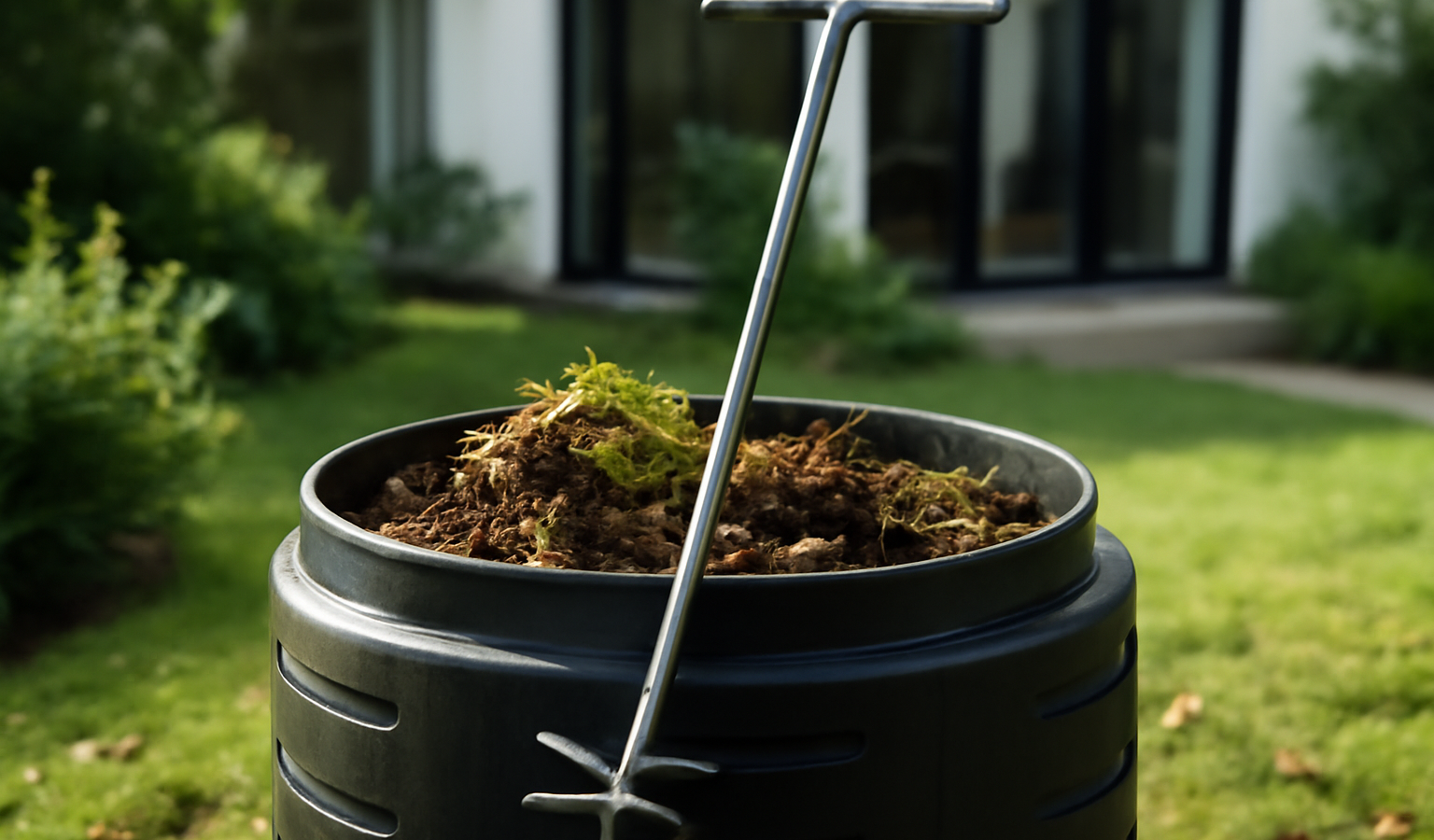
A compost pile only breaks down fast when oxygen can reach the microbes doing the work. Starve a pile of air and it goes anaerobic: slimy, sour-smelling, and slow. The fix is mechanical, and it does not have to mean wrestling a garden fork through a tangled, root-bound heap twice a week. A purpose-built compost aerator drives a shaft to the bottom of the pile and either folds wings open or pulls a plug of material toward the surface, lifting compacted layers and pulling fresh air down behind it. The right tool turns a 15-minute chore into a two-minute one, and it is the single cheapest way to cut your finished-compost timeline from six months to six weeks.
As an Amazon Associate we earn from qualifying purchases. This page contains affiliate links at no extra cost to you.
I have aerated compost in everything from a 3-foot wire ring to a 65-gallon dual-chamber tumbler, and the tool that works beautifully in one setup is useless in another. A corkscrew auger that bites perfectly into a loose, leafy pile binds up and snaps in a dense, wet, grass-heavy heap. A plunger-style wing aerator that flies through soft material struggles when you hit a slab of matted cardboard. So this roundup is organized by what you actually have in the yard, not by a single “best overall” pick that pretends every pile is the same. Below you will find seven aerators and turners I would actually recommend, each matched to a pile type, a body type, and a budget.
Key Takeaways
- Wing/plunger aerators (Lotech-style) are the best all-rounders for open bins and wire rings: push down, pull up, the wings fold and grab.
- Corkscrew augers excel in loose, dry, leafy piles and tight wire bins where a wide-wing tool will not fit, but they bind in wet grass.
- Tumbler users usually need a turner only for stubborn clumps; a compact aerator beats a full-size one inside a drum.
- Look for a 36-inch-plus shaft for standing bins, a powder-coated or stainless finish to resist the acids in active compost, and a real cushioned T- or D-handle.
- Match the tool to your pile: dense, wet, nitrogen-heavy piles favor heavy-gauge wings; airy, brown-heavy piles favor a fast corkscrew.
- Aerate the center of a hot pile every 3–5 days; a finished, cool pile rarely needs it.
| Product | Best For | Key Spec |
|---|---|---|
| Lotech Products Compost Aerator | Best overall, open bins & rings | ~36 in, folding twin wings, US-made |
| Yard Butler ICA-36 Twist Aerator | Tight wire bins, leafy piles | 36 in corkscrew, powder-coated steel |
| Bosmere Compost Aerator (Wing) | Budget wing aerator | ~36 in, folding wings, coated steel |
| Garden Weasel Compost Aerator | Quick single-hand jabs | ~36 in plunger, wide spread wings |
| Joseph Bentley Stainless Aerator | Rust resistance, longevity | Stainless shaft, hardwood T-handle |
| Redmon Compost Aerator (Mixer) | Tumblers & small batch bins | ~30 in, compact wings, light alloy |
| Walensee Heavy-Duty Steel Aerator | Dense, wet, large piles | Heavy-gauge wings, 37 in, ergonomic grip |
1. Lotech Products Compost Aerator — Best Overall
If you only want one tool and have a standard open bin, a wire ring, or a 3-bay pallet system, the Lotech Products Compost Aerator is the one I reach for first. It is a roughly 36-inch zinc-plated steel shaft with two spring-loaded wings near the tip. You push the closed wings straight down through the pile, and as you pull the shaft back up the wings fold outward and bite a generous bite of material, lifting and folding it instead of just poking a hole. The action genuinely moves the pile, which is the whole point — a hole-poker aerates a thin column, while this folds layers over each other.
It is made in the USA, the welds are clean, and the handle is a simple straight bar that gives you two-hand leverage. After several seasons mine shows surface rust but no structural wear, which is about all you can ask of carbon steel living in an acidic, wet pile. The honest weakness is the wings: in a really matted, soaking-wet grass clipping layer they can hang up, and you occasionally have to work the shaft up and down to clear them.
Pros
- Folding wings actually lift and turn material, not just poke holes
- US-made with solid welds and a thick shaft
- Fits open bins, wire rings and pallet bays
- Two-hand straight handle gives good leverage
Cons
- Wings can hang up in soaking wet grass mats
- Carbon steel surface-rusts over time
- Too wide for very narrow tumbler openings
2. Yard Butler ICA-36 Twist Compost Aerator
The Yard Butler ICA-36 is a corkscrew, and it is the tool I hand to anyone composting in a tight wire bin or a leaf-heavy pile where a wing aerator simply will not open. You set the auger tip on top, twist the T-handle clockwise as you press, and the spiral threads itself down to the bottom. Pull it straight back up and it brings a core of material with it, opening a channel and fluffing the surrounding mass. Because it works by rotation rather than spreading wings, it fits into narrow bins and around the wire of a ring where a 12-inch wing spread would jam.
It is powder-coated steel with a comfortable handle, and the 36-inch length is enough for a standing bin without bending over too far. Where it shines is dry, brown, airy material — shredded leaves, straw, garden trimmings. Where it fights you is wet grass: the auger binds, and you end up twisting hard against a plug of compacted clippings. Keep your browns and greens balanced and it stays easy.
Pros
- Corkscrew fits narrow bins and around wire rings
- Powder-coated finish resists compost acids well
- Twisting action is easy on the back and shoulders
- Excellent in dry, leafy, brown-heavy piles
Cons
- Binds and twists hard in wet, matted grass clippings
- Lifts less material per stroke than a wing tool
- Auger can pick up wiry stems and roots
3. Bosmere Compost Aerator — Best Budget Wing Tool
The Bosmere wing aerator covers the same job as the Lotech for noticeably less money. It is a roughly 36-inch coated-steel shaft with two folding paddles at the tip that open on the upstroke. For a gardener turning one or two medium bins, it does everything you need: drive it down, pull it up, fold the pile. The handle is a straightforward loop or T depending on the run, and it is light enough that an afternoon of aerating will not wreck your shoulders.
The trade-off for the price is gauge. The steel is thinner than premium tools, so I would not lean my full weight on it to pry up a buried slab of cardboard, and the coating chips at the wing pivots where it flexes most. Treat it as a regular-use aerator for normal kitchen-and-yard compost rather than a pry bar and it lasts several seasons. For a first composter who is not sure they will stick with it, this is the smart entry point.
Pros
- Wing action at a lower price than premium models
- Light and easy to swing for a full session
- Good fit for one or two standard bins
- Folds flat for hanging storage
Cons
- Thinner steel than premium tools — do not pry with it
- Coating chips at the wing pivots over time
- Not ideal for very large or dense piles
4. Garden Weasel Compost Aerator
The Garden Weasel aerator is the plunger-style tool you can use with one hand if you have to, which sounds minor until you are standing on uneven ground holding a bin lid in the other hand. It is about 36 inches with a pair of wide-spread wings that snap open on the pull. The spread is generous, so each stroke grabs a satisfying amount of material, and the spring tension is light enough that the wings open reliably even in loose piles where heavier wings sometimes stay closed.
Garden Weasel’s build is decent for the category — coated steel, a comfortable grip — though like most wing tools the moving joint is the wear point and benefits from an occasional wipe-down and a drop of oil. The wide spread that makes it efficient also makes it the wrong choice for a narrow tumbler hatch; this is a tool for open bins and rings where the wings have room to fly. For quick, frequent jab-and-lift aeration between full turns, it is a pleasure.
Pros
- Wide wing spread grabs a lot per stroke
- Light spring opens the wings reliably in loose piles
- Manageable with one hand for quick aeration
- Comfortable grip for repeated jabs
Cons
- Wide spread will not fit a tumbler hatch
- Wing joint needs occasional cleaning and oil
- Light wings can struggle in very dense, wet mats
5. Joseph Bentley Stainless Steel Compost Aerator
Compost is mildly acidic and permanently wet, which is exactly the environment that eats carbon-steel tools alive. If you want an aerator you can leave leaning against the bin for a decade and not think about, the Joseph Bentley stainless model is the answer. The shaft and wings are stainless, so they shrug off the rust that pits cheaper tools, and the handle is turned hardwood with a traditional T grip that feels good in the hand and does not get slick when wet.
It is a wing-style aerator in use, so the technique is the same push-down, pull-up, fold-the-pile motion as the Lotech. You pay a premium for the stainless and the wooden handle, and the wing spread is moderate rather than aggressive, so it lifts a bit less per stroke than the widest tools. But for a gardener who values a tool that ages gracefully and looks the part hanging in the shed, it is worth the spend. The hardwood handle will outlast you if you keep it out of standing water.
Pros
- Stainless shaft and wings resist rust indefinitely
- Hardwood T-handle is comfortable and grippy when wet
- Clean, durable construction built to last
- Same effective fold-and-lift wing action
Cons
- Premium price for the stainless build
- Moderate wing spread lifts less than the widest tools
- Wooden handle needs to stay out of standing water
6. Redmon Compost Aerator / Mixer — Best for Tumblers
Tumbler owners are in a different situation. The drum does most of the turning when you spin it, so what you actually need is a shorter tool to break up the clumps that ride around the chamber without mixing — and to mix small batch bins where a full-length aerator is overkill. The Redmon aerator is shorter (around 30 inches) and lighter, with a compact wing set that fits through a tumbler’s loading hatch and reaches into the corners a spinning drum never quite touches.
Inside a 50- to 65-gallon dual-chamber tumbler, I use it to stab and fold the wet ball that forms after a heavy kitchen-scrap load, then close up and spin. It is also handy for a small countertop-fed worm-adjacent bin or a half-full starter pile where a 36-inch tool just bottoms out against the base. The light alloy build keeps weight down, which is the whole point of a compact tool, but it also means it is not the one for prying apart a dense outdoor heap — that is a job for the heavy wing tools.
Pros
- Compact wings fit through a tumbler loading hatch
- Shorter length suits small batch bins and starter piles
- Light and easy to maneuver in tight spaces
- Breaks up the wet clumps a spinning drum misses
Cons
- Too short for standing ground bins and rings
- Light alloy is not for prying dense outdoor heaps
- Smaller wings move less material per stroke
7. Walensee Heavy-Duty Steel Compost Aerator — Best for Dense Piles
When your compost is big, wet, and nitrogen-heavy — think a 4-foot pile fed with grass clippings, kitchen waste, and chicken-coop bedding — light tools surrender. This is where a heavy-gauge wing aerator earns its keep. The Walensee uses a thicker shaft and stouter wings than the budget models, with an ergonomic grip that lets you put real force behind each downstroke. At roughly 37 inches it reaches the core of a tall standing pile, and the heavier wings hold their bite through matted layers instead of flexing or folding shut.
The price of all that strength is weight: it is the most tiring tool here to swing for a long session, and you feel it in your shoulders after a big pile. The wings also need the room of an open bin or ring to deploy fully. But if your problem has always been that ordinary aerators stall halfway down a dense heap, this is the one that pushes through. Pair it with a balanced browns-to-greens ratio so the pile does not turn into a solid anaerobic brick in the first place, and you will not need its muscle as often as you fear.
Pros
- Heavy-gauge shaft and wings power through dense, wet piles
- Long enough to reach the core of a tall standing heap
- Ergonomic grip for forceful downstrokes
- Wings hold their bite in matted layers
Cons
- Heaviest tool here — tiring over a long session
- Needs an open bin or ring for the wings to deploy
- Overkill for small, airy, well-balanced piles
How to Choose a Compost Aerator
Match the mechanism to your pile. Wing or plunger aerators fold and lift large bites and are the best all-rounders for open bins, wire rings, and pallet bays. Corkscrew augers thread into tight spaces and excel in dry, leafy material but bind in wet grass. Compact aerators are for tumblers and small batch bins. If your pile is consistently dense, wet, and grass-heavy, lean toward heavy-gauge wings; if it is airy and brown-dominated, a corkscrew is faster.
Get the length right. For a standing ground bin or a 3-foot-plus pile, you want a 36-inch or longer shaft so you reach the hot core without bending double. For a tumbler, a 30-inch tool fits the hatch and reaches the corners. Too long inside a drum just bottoms out and frustrates you.
Look at the finish and the welds. Compost is acidic and wet, so untreated carbon steel rusts. Powder-coated steel resists it well at a reasonable price; stainless resists it indefinitely at a premium. Either way, inspect the wing pivots and welds — those are the failure points. A drop of oil on the moving joint a couple of times a season keeps a wing aerator working smoothly for years.
Mind the handle and the technique. A cushioned T- or D-handle saves your palms over a long aeration session. Aerate the center of a hot, active pile every three to five days during peak decomposition; once the pile cools and finishes, it needs little to no aeration. And remember that no tool fixes a badly built pile — keep roughly two to three parts dry browns to one part wet greens by volume, and aeration stays easy. For more on building a heap that breaks down fast, see our guide on how to prepare soil for planting, and browse the full Tools & Gear hub for related buying guides.
Frequently Asked Questions
How often should I aerate my compost pile?
During active, hot decomposition, aerate the center every three to five days to keep oxygen flowing to the microbes. As the pile cools and the material darkens and finishes, you can stop — a mature, curing pile needs little to no aeration. If the pile starts to smell sour or sulfurous, that is a sign it has gone anaerobic and needs aerating immediately.
Is a compost aerator better than a garden fork?
For most home bins, yes. A purpose-built aerator drives a thin shaft to the core and lifts a column of material with minimal effort, while a fork forces you to dig out and re-pile the whole heap. A fork still wins when you want to completely tear down and rebuild a pile, but for routine oxygenation between turns, an aerator is faster and far easier on your back.
Why does my aerator keep getting stuck in the pile?
Almost always because the pile is too wet and too high in nitrogen — usually a thick mat of fresh grass clippings. Wet grass compacts into a dense, oxygen-starved layer that binds both wings and augers. Mix in more dry browns (shredded leaves, straw, cardboard) to open up the structure, and the tool will move freely again.
Can I use a compost aerator in a tumbler?
You can, but use a compact one. A full 36-inch wing tool will not fit through most tumbler hatches and its wings have no room to open. A shorter, narrower aerator slips through the hatch to break up the wet clumps that ride around the drum without mixing. After breaking up the clumps, close the hatch and give the drum a few spins.
Do compost aerators rust?
Carbon-steel tools will surface-rust over time because compost is wet and mildly acidic, though that rarely affects function for years. Powder-coated steel holds up much better, and stainless steel resists rust almost indefinitely. Whatever you buy, rinse it after heavy use, store it dry, and put a drop of oil on the wing pivots a couple of times a season.