

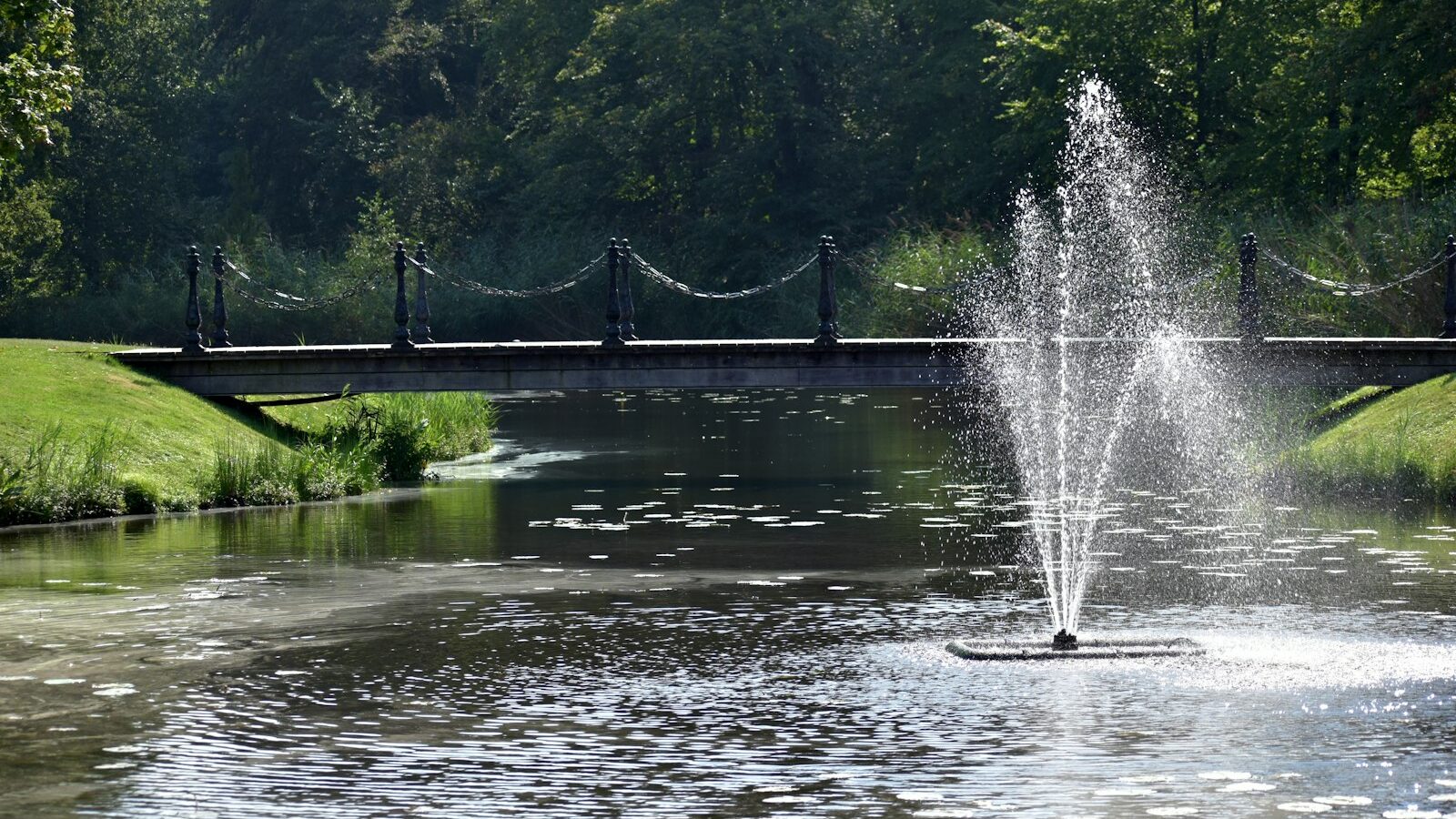
A pond without moving air is a pond on a slow slide toward green water, fish kills, and muck on the bottom. Aeration fixes the root cause: it pushes oxygen into the water column and keeps it circulating so the entire pond stays alive instead of just the top few inches. Whether you keep koi in a 1,500-gallon backyard pool or manage a half-acre farm pond, the right aerator prevents summer fish kills, breaks up winter ice, and starves the algae that feed on stagnant, low-oxygen water.
The trouble is that “pond aerator” covers three very different machines. A diffused-air (subsurface) system sits on the bank and pumps air through a hose to a diffuser plate on the bottom. A surface aerator or fountain floats on top and flings water into the air. A solar or windmill unit runs off-grid where no outlet exists. Below are seven units we’d actually recommend, grouped so you can match the machine to your pond’s depth, size, and power situation. We list real models with honest trade-offs, plus a buyer’s guide and FAQ at the end.
As an Amazon Associate we earn from qualifying purchases. This page contains affiliate links at no extra cost to you.
Key Takeaways
- Depth decides the type. Ponds 6 ft or deeper need diffused-air (bottom) aeration; shallow ponds under about 6 ft do fine with surface aerators or fountains.
- Match the pump to the pond, not the price. A diffuser system sized for a quarter-acre will barely ripple a one-acre pond — undersizing is the most common mistake.
- Diffused air is the most efficient. Air pumps move far more oxygen per watt than surface paddles or fountains, and they run quietly on the bank instead of in the water.
- Off-grid? Go solar or windmill. No outlet within reach means a battery-backed solar aerator or a wind-driven diaphragm pump, accepting that output drops on calm, cloudy days.
- Aeration is year-round. The same system that prevents summer fish kills keeps an open hole in winter ice so toxic gases can escape.
| Model | Best For | Key Spec |
|---|---|---|
| Airmax PondSeries PS20 | Ponds up to ~1/2 acre, deep | 2-diffuser, ~2.3 CFM linear pump |
| Hiblow HP-80 | DIY diffused builds | 80 LPM, ~71W, linear diaphragm |
| Kasco 2400VFX Surface Aerator | Shallow ponds, fast turnover | 1/2 HP, 120V, floating |
| Aquascape Pond Air 4 | Small koi/garden ponds | 4-outlet, ~1,800 cu in/min |
| Solariver Solar Aerator Kit | Off-grid small ponds | Solar + battery, dual air stones |
| VEVOR Windmill Aerator | Remote farm ponds, no power | Wind-driven diaphragm, ~tall tower |
| Tetra Pond Air Pump 6500 | Budget small-pond backup | ~360 GPH air, dual outlet |
1. Airmax PondSeries PS20 — Best Overall for Deep Ponds
The Airmax PS20 is a complete diffused-air kit built around a rocking-piston compressor that pushes roughly 2.3 CFM through two membrane diffuser plates. It’s rated for ponds up to about half an acre and depths from 6 to 50 feet, which covers the overwhelming majority of farm and estate ponds where surface units simply can’t reach the bottom. The cabinet is a weatherproof post-mount enclosure with a cooling fan, so the noisy part lives on the bank, not in the water.
What sets a bottom-diffuser system apart is how it circulates the entire water column. Air released near the bottom lifts cold, oxygen-starved water to the surface where it gasses off and re-oxygenates, eliminating the thermal stratification that causes late-summer turnover fish kills. The PS20 is more system than a 1,000-gallon koi pond needs, but for anything pushing toward an acre it’s the unit we’d buy first.
Pros
- Complete kit — compressor, cabinet, weighted hose and diffusers all included
- Reaches the bottom of deep ponds where fountains can’t help
- Quiet bank-mounted operation; nothing visible in the water but a boil of bubbles
- Rocking-piston compressor is field-rebuildable rather than disposable
Cons
- Premium price compared with a simple air-stone setup
- Piston compressors run warmer and draw more than a linear diaphragm pump
- Overkill for small garden or koi ponds
2. Hiblow HP-80 — Best Compressor for a DIY Build
If you’d rather assemble your own diffused system, the Hiblow HP-80 is the linear-diaphragm air pump most pond builders standardize on. It moves about 80 liters per minute while drawing only ~71 watts, which is remarkably efficient for the output, and it’s whisper-quiet — quiet enough to sit in a garage or a vented box near the house without anyone noticing. Pair it with weighted air hose and one or two membrane diffuser plates and you have a professional-grade system at a component price.
The HP-80 is rated for ponds in the quarter- to half-acre range depending on depth and how many diffusers you run. Its real strength is longevity: the diaphragm and rebuild kits are cheap and swappable in 20 minutes, so a single pump can run for a decade. The catch is that you’re buying a component, not a kit — you supply the hose, diffusers, and weatherproof housing yourself.
Pros
- Excellent air output per watt — about 80 LPM on ~71W
- Extremely quiet linear-diaphragm design
- Cheap, easy diaphragm rebuild kits for long service life
- Industry-standard, so parts and diffusers are easy to source
Cons
- Pump only — no hose, diffusers, or enclosure included
- Needs a weatherproof, ventilated housing you build or buy
- Linear pumps don’t like high back-pressure from very deep diffusers
Free, no-obligation quote · Connect with a local pro
3. Kasco 2400VFX — Best Surface Aerator for Shallow Ponds
Some ponds are simply too shallow for bottom diffusers. In a pond under about 6 feet deep, a diffuser can’t develop enough lift to circulate the column, and that’s where a floating surface aerator like the Kasco 2400VFX earns its keep. This 1/2 HP, 120-volt floating unit draws water from just below the surface and slings it into the air in a coarse spray, creating both aeration and water movement that discourages mosquitoes and surface scum.
Surface aerators move a lot of water fast, so they’re excellent for shallow, wide ponds and for adding visible motion. The 2400VFX runs on a standard 120V circuit and is light enough to deploy by hand. The trade-offs are real, though: it agitates only the upper layer, so a deep pond stays stratified below it, and the motor lives in the water, which means more maintenance than a bank-mounted compressor.
Pros
- Strong surface agitation ideal for shallow ponds under ~6 ft
- Runs on a standard 120V outlet — no special wiring
- Visible water movement deters mosquitoes and surface algae mats
- Lightweight and quick to deploy
Cons
- Only aerates the top layer — won’t fix deep-pond stratification
- Motor sits in the water, so more maintenance and freeze risk
- Higher running wattage than a diffused-air pump of similar coverage
4. Aquascape Pond Air 4 — Best for Small Koi & Garden Ponds
Not everyone is aerating a farm pond. For a backyard koi or water-garden pond up to a couple thousand gallons, the Aquascape Pond Air 4 is a tidy, four-outlet diaphragm pump that moves around 1,800 cubic inches of air per minute. It ships with four weighted air stones and check valves, so you can spread aeration across the pond — one stone in each lobe of an irregular shape, for instance — rather than relying on a single boil.
This is also the unit we recommend most often for winter. Drop one air stone just below the ice line and it keeps a hole open so toxic gases escape and fish survive the cold. It’s quiet, sips electricity, and is small enough to hide behind a rock or in a skimmer box. It is not, however, a circulation device for a large or deep pond — think of it as targeted oxygen for small water features and overwintering.
Pros
- Four outlets with stones and check valves included
- Excellent for winter ice holes and koi-pond oxygen
- Very low power draw and quiet operation
- Compact and easy to conceal
Cons
- Too small to circulate large or deep ponds
- Air stones clog over time and need periodic cleaning or replacement
- Diaphragm output drops noticeably with diffuser depth
5. Solariver Solar Aerator Kit — Best Off-Grid Small-Pond Option
When there’s no outlet within reach of the pond, solar is the first place to look for small water bodies. The Solariver solar aerator kit pairs a solar panel with a battery and a low-draw air pump driving dual air stones, so it keeps running into the evening and through short cloudy spells instead of cutting out the instant a cloud passes. For livestock ponds, remote garden ponds, or any spot where running a buried cable is impractical, it’s a clean way to add dissolved oxygen without an electrician.
Set expectations honestly: solar air output is modest, so this is right for small and shallow ponds, not for circulating a deep acre-pond. Cloudy, short winter days reduce runtime, and the battery is a wear item you’ll replace every few years. Within those limits, it’s the most practical off-grid choice for a small pond and far cheaper to install than trenching power.
Pros
- No electrician or buried cable — ideal for remote ponds
- Battery backup keeps it running past sunset and through brief clouds
- Dual air stones spread oxygen across a small pond
- Negligible running cost once installed
Cons
- Modest output — small, shallow ponds only
- Runtime drops on cloudy days and short winter daylight
- Battery is a consumable that needs periodic replacement
6. VEVOR Windmill Aerator — Best for Remote Farm Ponds
On a windy rural site with no power, a windmill aerator is the classic answer. The VEVOR windmill aerator uses a tall steel tower and multi-blade fan to drive a diaphragm air pump mechanically — no electricity, no solar panels, no battery. As long as the wind blows, it pushes air down a hose to a bottom diffuser, and farm ponds in open country usually get enough breeze to keep one working most of the time.
The appeal is zero running cost and total independence from the grid. The honest limitation is the obvious one: no wind, no air. On a dead-calm summer afternoon — exactly when oxygen demand peaks — output can fall to nothing, so it’s best treated as primary aeration on consistently breezy sites or as a supplement elsewhere. Assembly is a real project (the tower is tall and needs solid anchoring), and the moving linkage wants periodic lubrication.
Pros
- Completely off-grid — no electricity or solar needed
- Zero running cost on a windy site
- Drives a true bottom diffuser for deep-water circulation
- Doubles as a rural landscape feature
Cons
- No wind means no aeration — unreliable on calm days
- Tall tower requires careful assembly and solid anchoring
- Mechanical linkage needs periodic lubrication and inspection
Free, no-obligation quote · Connect with a local pro
7. Tetra Pond Air Pump 6500 — Best Budget Backup
For a small pond on a tight budget — or as an emergency backup to keep on the shelf — the Tetra Pond Air Pump 6500 is hard to beat on price. This dual-outlet diaphragm pump pushes roughly 360 GPH of air and is rated for small ponds up to a few hundred gallons. It’s plug-and-play with stones and tubing, and it’s the kind of unit you keep around to run during a summer heatwave or a power-recovery emergency when oxygen suddenly crashes.
Don’t expect commercial durability at this price. The diaphragms are not as robust as a Hiblow’s, and there’s no battery or weatherproof enclosure. But for a small ornamental pond, a stock tank, or as a cheap insurance pump, it delivers genuine oxygen for very little money — and that’s exactly what a budget pick should do.
Pros
- Very affordable — easy to keep one as a backup
- Dual outlets with stones and tubing for small ponds
- Plug-and-play, no assembly required
- Great emergency oxygen during heatwaves or outages
Cons
- Light-duty diaphragms wear faster than commercial pumps
- Small-pond capacity only — no real circulation power
- No weatherproofing; keep it sheltered and dry
How to Choose a Pond Aerator
Start with depth. This single number decides the whole category. Ponds 6 feet deep or more need diffused-air (bottom) aeration to circulate the cold, oxygen-poor water near the floor. Shallow ponds under about 6 feet can’t develop enough bubble lift for a diffuser to work, so a surface aerator or fountain is the right tool. Get this wrong and you’ll buy a system that physically can’t do the job.
Then size to surface area. Aerators are rated by acreage or gallons. Undersizing is the most common mistake — a system built for a quarter-acre will barely stir a full acre, leaving dead zones where fish die and muck accumulates. When you’re between sizes, go up. Multiple diffusers spread across a large pond beat one big boil in the middle.
Check your power situation. A 120V outlet within reach opens up the efficient diffused-air and surface options. No power means solar (small ponds) or windmill (breezy rural sites). Factor running cost too: diffused-air linear pumps like the Hiblow move the most oxygen per watt, while surface paddles and fountains draw more for the same coverage.
Think about the whole year. The same system that prevents summer fish kills should keep a hole open in winter ice so trapped gases escape. For diffused systems in cold climates, move the diffuser to a shelf at mid-depth in winter so you don’t supercool the bottom where fish overwinter. If you’re building or renovating the pond itself, our guide to building a natural clay pond pairs well with planning aeration from the start, and shading strategies in how to shade a pond to reduce algae tackle the same green-water problem from the other direction.
Frequently Asked Questions
Do I need a bottom diffuser or a surface aerator?
It comes down to depth. Ponds 6 feet or deeper need a diffused-air (bottom) system to circulate the whole water column and prevent stratification. Ponds shallower than about 6 feet can’t generate enough bubble lift for a diffuser, so a floating surface aerator or fountain is the better choice.
Should I run my pond aerator 24/7?
In most ponds, yes — continuous aeration keeps dissolved oxygen stable and prevents the overnight oxygen sags that cause fish kills. The main exception is a brand-new diffused system in a mucky pond, which some people ramp up gradually over a week or two to avoid stirring up too much sediment and oxygen-robbing decay at once.
Will an aerator clear up my green, algae-filled water?
Indirectly. Aeration won’t filter out algae, but by oxygenating the water and circulating it, it shifts conditions away from the stagnant, low-oxygen state algae love and supports the beneficial bacteria that consume excess nutrients. Combined with shade and nutrient control, it’s a major part of a clear-water strategy.
Can I leave my aerator running through winter?
Yes, and you should — it keeps an open hole in the ice so toxic gases from decomposition can escape, which protects overwintering fish. In cold climates, raise a bottom diffuser to mid-depth for winter so you don’t chill the deepest water where fish shelter.
How much does it cost to run a pond aerator?
Far less than most people expect. An efficient linear diaphragm pump drawing around 70 watts costs only a few dollars a month to run continuously. Surface aerators and fountains use more power, while solar and windmill units have essentially zero running cost after purchase.
The right pond aerator is the one matched to your pond’s depth, size, and power access — not the most expensive or the cheapest on the shelf. For most deep ponds the diffused-air route wins on efficiency and results; shallow ponds do better with surface motion; and off-grid sites lean on solar or wind. Pick the category first, size up rather than down, and run it year-round.
Rather hire a pro?
Prefer to skip the DIY and have it done right? Compare free, no-obligation quotes from vetted local landscaping pros near you.