

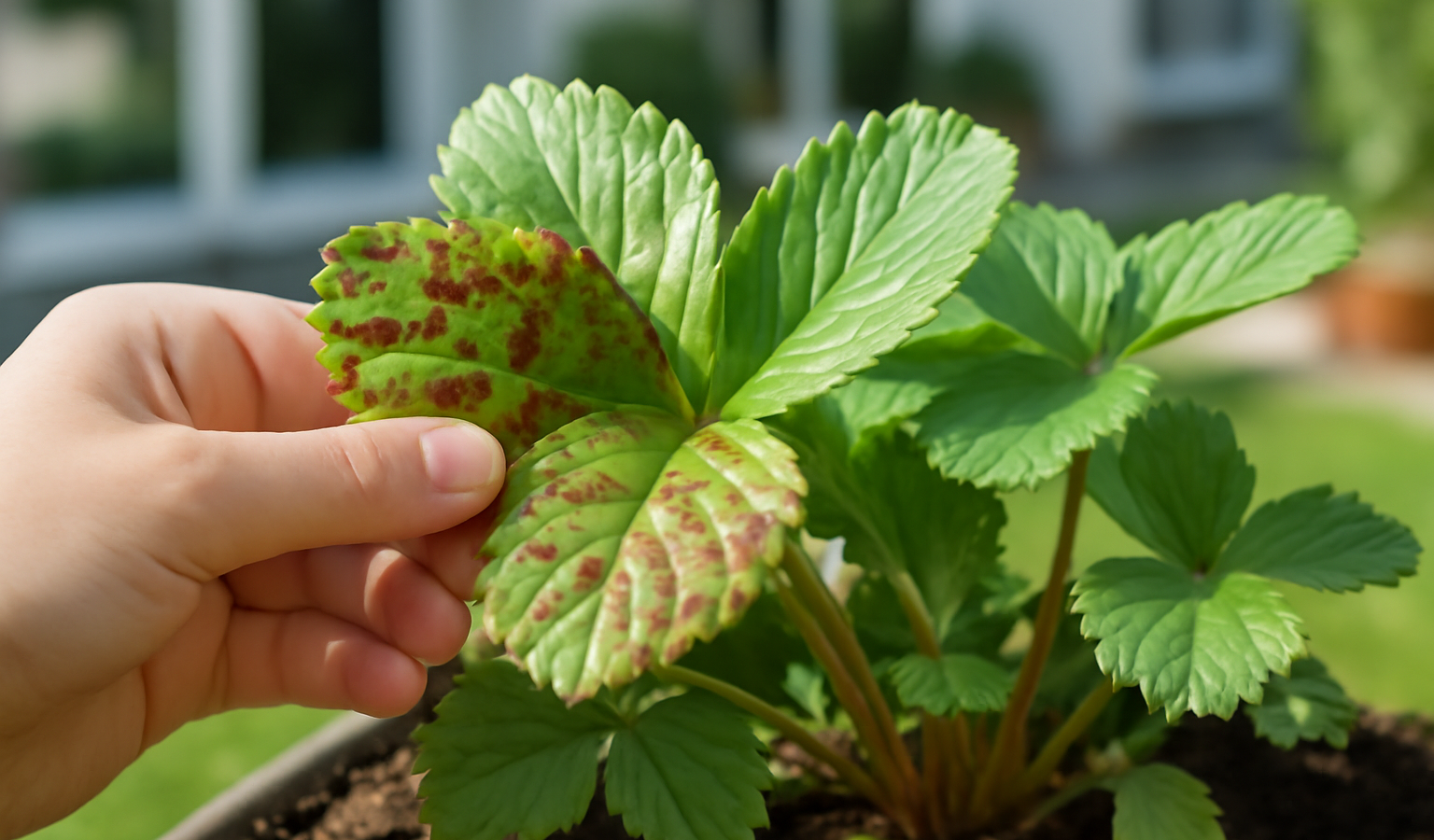
Spots on strawberry leaves are almost always a sign of fungal disease, and three closely related foliar diseases account for the vast majority of cases: common leaf spot, leaf scorch, and leaf blight. All three thrive in the warm, wet, humid conditions that strawberries also love, all three overwinter in old infected foliage, and all three are far easier to prevent than to cure. The differences in how their spots look, purple-bordered tan centers, irregular purple blotches, or large V-shaped lesions, point you to the specific disease, but the management is broadly similar. This troubleshooting guide explains how to identify what is spotting your strawberry leaves, distinguishes the three main fungal diseases from a couple of look-alikes, and gives you a practical treatment and prevention program to keep your plants productive and your berries clean.
Key Takeaways
- Spotted strawberry leaves are usually one of three fungal diseases: common leaf spot, leaf scorch, or leaf blight.
- Common leaf spot makes small spots with tan-to-gray centers and distinct purple-red borders; leaf scorch makes irregular dark-purple blotches with no clear pale center; leaf blight makes large V-shaped or angular brown lesions.
- All three overwinter in old infected leaves, so removing dead foliage and renovating beds after harvest is central to control.
- Wet leaves drive infection; improve airflow, avoid overhead watering, and space plants well to keep foliage dry.
- Resistant varieties plus sanitation and good airflow usually control these diseases with little or no spraying.
Identify the Spots: The Three Main Diseases
Start by examining the spots closely, because their appearance separates the three diseases. Common leaf spot (caused by Mycosphaerella fragariae) produces small, round spots, roughly an eighth of an inch, with tan, gray, or whitish centers surrounded by a sharp purple-to-reddish border, giving a “bird’s-eye” look; the dead center may eventually drop out. Leaf scorch (caused by Diplocarpon earlianum) makes numerous small, irregular dark-purple to brownish blotches that, unlike leaf spot, lack a distinct pale center; as they multiply, the whole leaf can take on a scorched, reddish-purple, dried appearance. Leaf blight (caused by Phomopsis obscurans) makes larger lesions, often reddish-brown and V-shaped or wedge-shaped, frequently starting at the leaf margin or tip, with a darker center and lighter outer zone, and it tends to show up later in the season on older leaves.
Rule out look-alikes. Leaf spot from environmental or nutrient issues tends to be uniform, lacks the sharp purple border, and is not progressive. Powdery mildew shows as a white powdery coating with upward leaf curling and purplish blotches, not defined spots. Insect or chemical injury is irregular and not spreading plant-to-plant. If the spots have purple borders with pale centers, think common leaf spot; solid purple blotches, leaf scorch; large V-shaped marginal lesions, leaf blight.
Cause 1: Common Leaf Spot
Diagnose: Common leaf spot is the most widespread strawberry leaf disease. The fungus overwinters in old infected leaves and, in warm wet spring weather, releases spores that splash and blow onto new foliage. The signature symptom is the bird’s-eye spot: small round lesions with pale tan-to-gray centers and crisp purple-red margins, scattered across the upper leaf surface. In severe cases the spots coalesce, leaves yellow and die, and the disease can spot fruit (as “black seed” lesions) and weaken the plant’s vigor and yield. It is worst in dense, poorly ventilated beds and in long stretches of leaf-wetting weather, and it builds year over year in matted-row plantings if old foliage is never removed.
Fix: Attack the overwintering source and keep foliage dry. The most powerful tool for June-bearing strawberries is post-harvest renovation: mow or shear off the old foliage to about an inch above the crowns right after the last harvest, rake it up, and remove it, which strips out the disease inoculum and forces clean new growth. Improve airflow by thinning crowded plants and controlling runner density, and water at the base with drip or soaker hoses rather than overhead so leaves dry fast. Where pressure is high, a protective fungicide (such as copper-based products or a labeled garden fungicide) applied to new spring growth helps, following label intervals. Best of all, plant resistant varieties, many modern cultivars carry strong leaf-spot resistance and need little spraying.
Cause 2: Leaf Scorch
Diagnose: Leaf scorch is closely related to common leaf spot and shares its biology, overwintering in old leaves and spreading via splashing spores in warm, wet weather, but its spots look different. Instead of pale-centered bird’s-eye spots, leaf scorch makes numerous small, irregular, dark purple to dark brown blotches with no distinct lighter center. As infection intensifies, the spots merge and the leaf edges and surfaces take on a dried, reddish-purple, scorched look, hence the name, and severely affected leaves curl and die. The disease can also spread to leaf stalks, runners, flower stems, and fruit caps, and a heavy infection on flower stalks can reduce fruit set. Like its cousin, it is favored by dense plantings and prolonged leaf wetness, and it worsens in beds where old foliage accumulates.
Fix: The management mirrors common leaf spot, because the cultural drivers are identical. Renovate June-bearing beds promptly after harvest by mowing off and removing old foliage, which is the single most effective step against both diseases. Space and thin plants for airflow, control runners, and water at the base to minimize leaf wetness. Remove and destroy badly infected leaves and avoid working among wet plants, which spreads spores on hands and tools. Protective fungicides on new spring growth help in high-pressure situations, applied per label. And again, resistant cultivars are the most durable defense, choose varieties listed as resistant to leaf scorch when establishing or replanting a bed.
Cause 3: Leaf Blight (and Look-Alikes)
Diagnose: Leaf blight tends to appear later in the season, often on older, mature leaves and especially on stressed or aging plants. Its lesions are larger than the other two, typically reddish-brown to dark brown, often V-shaped or wedge-shaped with the point aimed inward from the leaf margin or tip, sometimes with a target-like zoning of darker and lighter brown. Severe blight can kill large sections of leaf and weaken plants going into winter. Two non-disease look-alikes worth ruling out: environmental scorch from drought, salt, or fertilizer burn produces uniform marginal browning without the purple borders or zoned lesions of the fungal diseases, and nutrient deficiency (such as potassium) can brown leaf margins evenly. The presence of defined, zoned, or purple-bordered spots distinguishes the fungal diseases from these abiotic problems.
Fix: Leaf blight responds to the same sanitation and airflow program. Remove old and heavily infected leaves, renovate beds after harvest, and keep plants vigorous and unstressed, since blight hits aging and weakened plants hardest, so good watering, feeding, and bed renewal matter. Avoid overhead watering and overcrowding. For the abiotic look-alikes, correct the underlying stress: water deeply and consistently during dry spells, mulch to buffer moisture, flush salts if fertilizer burn is suspected, and feed based on a soil test rather than guessing. A healthy, well-spaced, well-watered planting resists all three fungal diseases and shrugs off minor leaf damage. For a related diagnostic on tree foliage, see our guide on curling peach leaves.
Why Wet Leaves Are the Common Thread
All three strawberry leaf diseases share one driver: free moisture on the foliage. Their spores need a film of water to germinate and infect, so every prolonged wetting event, rain, heavy dew, fog, or overhead irrigation, is an infection opportunity, especially in the warm temperatures of late spring and summer. The longer leaves stay wet, the more infection occurs. That single fact explains why the most effective controls all aim at keeping leaves dry and reducing the spore supply: base watering instead of overhead, generous spacing and runner control for airflow, full-sun siting so foliage dries fast, and removal of old infected leaves that harbor overwintering spores. Reduce leaf wetness duration and inoculum, and you cut infections dramatically without reaching for a sprayer.
This is also why matted-row strawberry beds that are never renovated turn into disease factories: years of accumulated old foliage hold huge spore loads, and the dense, humid canopy stays wet for hours. Renovating June-bearing beds annually, and thinning everbearing and day-neutral plantings to keep them open, breaks that cycle. For variety choices that affect both productivity and disease load, see our comparison of June-bearing versus everbearing strawberries.
A Season-Long Strawberry Leaf Program
Keeping strawberry leaves clean is a year-round rhythm of sanitation, airflow, smart watering, and resistant varieties. In early spring, remove any old dead leaves left from winter before new growth emerges, and start with good spacing. Through the growing season, water at the base in the morning so any splash dries quickly, control runner density so the bed stays open and breezy, and scout for the first spots so you can pull affected leaves before disease builds. Right after the last harvest of June-bearing beds, renovate: mow off the foliage, rake and remove it, narrow the rows, thin the plants, and let clean new growth come in, this is the keystone step that strips out the disease inoculum for all three pathogens. Keep plants vigorous with appropriate feeding and consistent moisture, and where pressure is high apply protective fungicides to new growth per label. Above all, plant disease-resistant cultivars from the start. Follow this program and your strawberries will carry healthy green foliage and abundant clean fruit. For more berry and plant care, browse the Plants & Flowers hub.
Frequently Asked Questions
How do I tell strawberry leaf spot from leaf scorch?
Common leaf spot makes small round spots with pale tan-to-gray centers and sharp purple-red borders (a bird’s-eye look). Leaf scorch makes irregular solid dark-purple blotches with no pale center, and severely affected leaves take on a dried, scorched, reddish-purple appearance.
Will spotted leaves ruin my strawberry harvest?
Light infection mostly affects appearance, but heavy disease causes leaves to yellow and die, weakens the plant, reduces vigor and yield, and in bad cases spots the fruit or flower stalks. Controlling it protects both the foliage and the crop.
What is the single best way to control strawberry leaf diseases?
Post-harvest renovation of June-bearing beds, mowing off and removing all old foliage right after the last harvest, is the most effective step. It strips out the overwintering spores of all three main diseases and forces clean new growth.
Should I spray fungicide on spotted strawberry leaves?
Fungicide is a last resort, not a first one. Sanitation, airflow, base watering, and resistant varieties control these diseases for most home growers. Where pressure is high, protective fungicides applied to new spring growth help, but they protect new leaves rather than curing existing spots.
Can overhead watering cause spotted strawberry leaves?
Yes. All three fungal diseases need wet leaves to infect, and overhead watering keeps foliage wet far longer than needed. Switch to drip or soaker hoses at the base, water in the morning, and space plants for airflow so leaves dry quickly and infections drop sharply.