

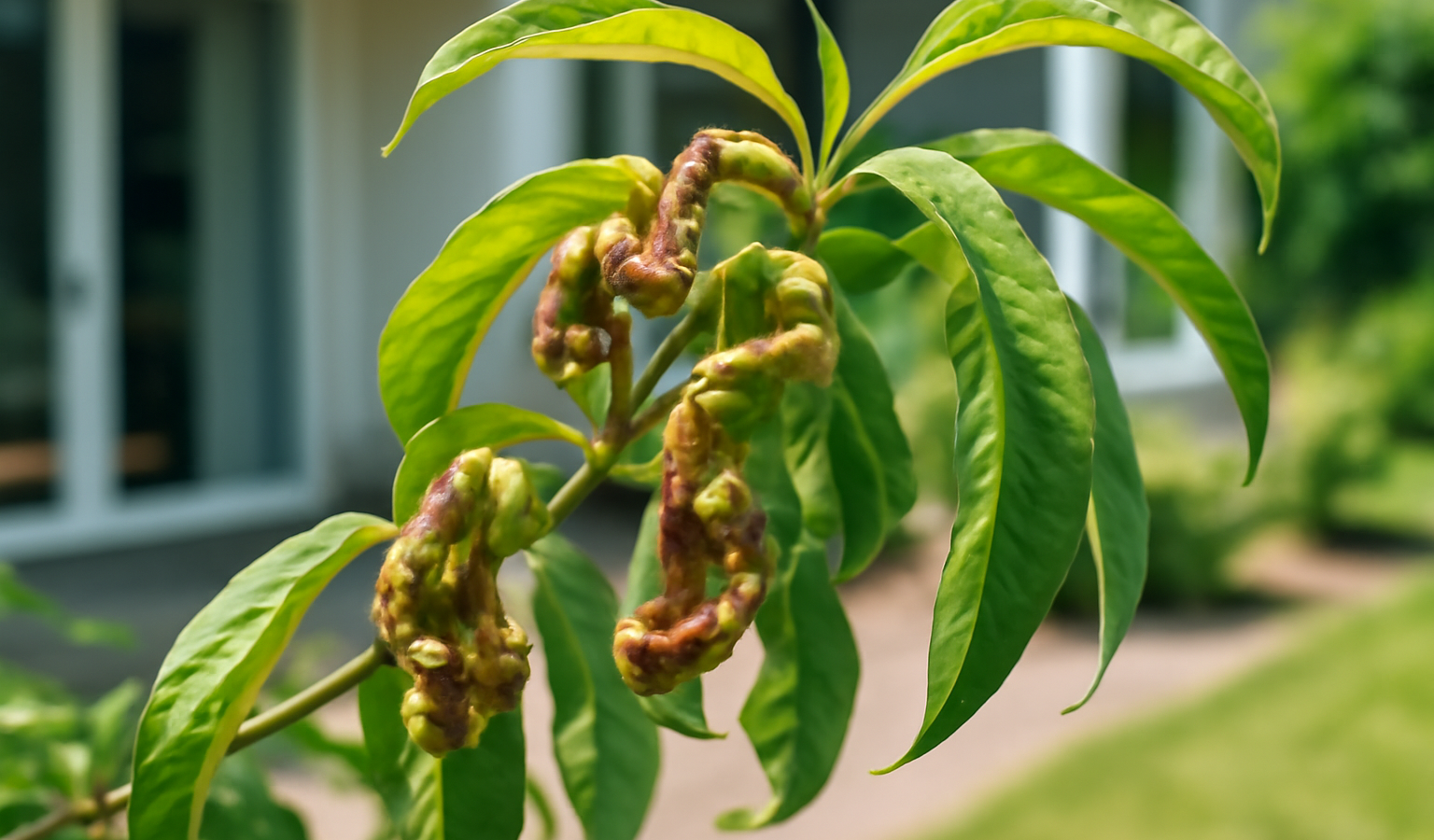
Thick, puckered, reddish, curling peach leaves in spring are the unmistakable signature of peach leaf curl, one of the most common and recognizable diseases of peach and nectarine trees. It is a fungal infection, and it carries a frustrating quirk: by the time you see the distorted leaves, it is too late to treat the tree that season, because the only effective control is a fungicide applied while the tree is dormant, before the buds open. The fungus infects the emerging leaves in cool, wet spring weather, causing them to thicken, blister, curl, and discolor, and severe cases defoliate the tree and weaken next year’s crop. The good news is that peach leaf curl is highly preventable with a single well-timed dormant spray. This guide explains how to diagnose leaf curl, distinguishes it from a few look-alikes, and lays out exactly how and when to treat and prevent it.
Key Takeaways
- Curling peach leaves are almost always peach leaf curl, a fungal disease caused by Taphrina deformans.
- Infected leaves thicken, pucker, blister, and turn red or purple before curling and dropping; severe defoliation weakens the tree and cuts next year’s fruit.
- The fungus infects buds in cool, wet weather as they swell in late winter and early spring, so the disease is set long before you see symptoms.
- The only effective control is a fungicide (copper or chlorothalonil) applied during dormancy, in late fall after leaf drop and/or just before bud swell, never after leaves emerge.
- Once leaves are curled there is no in-season cure; keep the tree healthy and plan a properly timed dormant spray for next year.
Identify Peach Leaf Curl
Peach leaf curl is easy to recognize once you know it. In spring, as new leaves emerge, infected leaves become thickened and puckered, with the affected areas swelling and blistering so the leaf curls and distorts. The puckered tissue turns shades of red, pink, or purple, and as the disease progresses a whitish-gray powdery bloom (the fungal spores) may coat the surface. Eventually the distorted leaves yellow or brown, shrivel, and drop, and the tree pushes out a second flush of (usually normal) leaves, but the energy cost of replacing a whole canopy weakens it. Severe infections can also distort shoots and even the fruit, which may develop reddish, wart-like, corky patches. The disease affects peaches and nectarines specifically.
Rule out look-alikes. Aphid feeding curls and distorts new leaves too, but aphid-curled leaves stay green (or yellow), are not thickened and blistered, and you will find the insects and sticky honeydew on the undersides. Herbicide drift (especially from growth-regulator weed killers) causes cupping, twisting, and strapping of leaves but lacks the red puckered blistering. Drought, heat, or wind stress can roll or curl leaves but without thickening or color change. The combination of thickened, blistered, reddish-purple, puckered leaves in cool spring weather is diagnostic for peach leaf curl.
Cause: Peach Leaf Curl Fungus (and Its Timing)
Diagnose: Peach leaf curl is caused by the fungus Taphrina deformans. Understanding its life cycle is the key to controlling it, because the timing is everything. The fungal spores overwinter on the tree’s surface, in bark crevices and around the buds. In late winter and early spring, as buds swell and begin to open, cool and wet weather, roughly 48 to 70°F with rain or prolonged wetness, lets the spores germinate and infect the emerging leaf tissue. That infection happens silently, inside the swelling buds and just-emerging leaves, well before any symptom is visible. By the time you see thickened, curled, reddened leaves a few weeks later, the infection occurred during the earlier wet, cool window. This is why spraying after symptoms appear does nothing: the damage is already done, and the fungus is now inside the leaf. Cool, wet springs produce severe outbreaks; warm, dry springs may pass with little curl.
Fix: The control is a dormant fungicide spray applied before the buds open, when the fungus is still exposed on the tree’s surface. The standard treatment is a fixed-copper fungicide (copper-based products) or chlorothalonil, applied to thoroughly coat all twigs, branches, and buds. Timing is critical: spray in late fall after the leaves have dropped (around 90% leaf fall), and/or in late winter to early spring just before the buds begin to swell, but never after green tissue shows. In regions with wet winters or heavy disease pressure, applying both a fall and a late-winter spray gives the best protection. Coverage must be complete, the spray works by forming a protective film over the buds and bark, so any missed area can still get infected. There is no effective in-season treatment once leaves have emerged and curled.
What to Do When Leaves Are Already Curled
Diagnose: If you are reading this in spring with a tree full of curled, blistered leaves, the season’s infection is finished and cannot be reversed. The tree will typically shed the diseased leaves and produce a healthy second flush, so the immediate damage often looks worse than the long-term outcome. The real concern with a heavy infection is the energy drain of regrowing the canopy, which can reduce that year’s fruit size and quality and weaken the tree going into next season, and repeated severe years can seriously decline a tree’s health and productivity.
Fix: Focus on supporting the tree’s recovery and preparing for next year. Do not spray fungicide now, it will not help the curled leaves. Instead, keep the tree well-watered and lightly fed so it can push out a strong second flush of leaves and recover its vigor. If the infection is severe and the tree set a heavy crop, thin the fruit so the weakened tree is not overburdened, which preserves its energy. Rake up and remove fallen diseased leaves to reduce the spore load, though sanitation alone will not control the disease. Then mark your calendar: the genuine fix is the dormant spray you will apply this coming fall after leaf drop and again before bud swell next late winter. One properly timed dormant spray usually prevents the disease entirely.
Prevention: It’s All About Dormant Timing
Diagnose: The reason peach leaf curl frustrates so many growers is that the intuitive response, see disease, spray disease, is exactly backwards for this pathogen. Because infection happens inside swelling buds during cool wet weather and symptoms appear weeks later, prevention must be scheduled by the calendar and bud stage, not triggered by symptoms. Growers who spray on a fixed dormant schedule rarely see leaf curl; growers who wait for symptoms see it every year.
Fix: Build dormant spraying into your routine. Each year, apply a fixed-copper or chlorothalonil fungicide once in late fall right after leaf drop, and again in late winter just before the buds swell, ensuring complete coverage of all bark and buds (a spreader-sticker helps the spray adhere through winter rains). Time the late-winter application before any green shows, watching the buds rather than the calendar, since timing shifts with your climate. Beyond spraying, choose leaf-curl-resistant peach and nectarine varieties when planting new trees, as several resistant cultivars exist and dramatically reduce the problem. Keep the tree vigorous with good siting in full sun, proper pruning for airflow, balanced feeding, and consistent water, since a healthy tree recovers from any breakthrough infection more readily. For related fruit-tree diagnostics, see our guide on why a pear tree won’t fruit.
Why the Weather Matters So Much
Peach leaf curl is intensely weather-driven, and recognizing that helps you anticipate bad years. The fungus needs cool temperatures and wet conditions during the bud-swell-to-leaf-emergence window to infect, so a spring that is cold and rainy as the buds open produces heavy disease, while a warm, dry spring may see almost none even on an unsprayed tree. This is why the disease seems to come and go from year to year, and why growers in mild, wet-winter climates (like the Pacific Northwest and parts of the Southeast) battle it hardest. You cannot control the weather, but you can guarantee protection by spraying during dormancy regardless of the forecast, since you cannot predict in fall or midwinter how wet the coming spring will be. Treating it as a routine annual dormant task, like an insurance policy, is far cheaper than losing a canopy.
It also helps to understand that the dormant spray protects the buds and bark surface where the spores overwinter, forming a barrier the spores cannot penetrate when they try to germinate in spring. That is why coverage must be thorough and why the timing must precede bud swell, once the leaf tissue emerges, the fungus is inside it and beyond the reach of any home fungicide. For more fruit-tree care, browse the Plants & Flowers hub.
A Year-Round Peach Leaf Curl Plan
Beating peach leaf curl comes down to a simple annual rhythm anchored on dormant spraying. In late fall, once roughly 90% of the leaves have dropped, apply a thorough fixed-copper or chlorothalonil spray to coat all bark and buds. In late winter or very early spring, before any buds swell or show green, apply a second dormant spray for full protection, especially in wet-winter regions. During the growing season, keep the tree vigorous with full sun, good pruning for airflow, consistent water, and balanced feeding, and rake up any diseased leaves to reduce spore load. If a wet spring still produces some curl, do not panic or spray, support the tree’s recovery with water and light feeding, thin a heavy crop, and rely on this fall’s dormant spray to prevent a repeat. When planting new trees, choose leaf-curl-resistant varieties to make the whole job easier. Follow this calendar and your peaches will leaf out clean, green, and flat every spring. For more fruit-growing help, visit the Plants & Flowers hub.
Frequently Asked Questions
What causes peach leaves to curl, thicken, and turn red?
Peach leaf curl, a fungal disease caused by Taphrina deformans. The fungus infects emerging leaves in cool, wet spring weather, causing them to thicken, pucker, blister, and turn red or purple before curling and dropping. It affects peaches and nectarines.
Can I spray to fix peach leaf curl once I see it?
No. By the time leaves are curled, the infection already happened inside the buds during earlier cool, wet weather, and the fungus is inside the leaf where home fungicides can’t reach. There is no in-season cure; the fix is a dormant spray applied before the buds open.
When should I spray for peach leaf curl?
During dormancy, when the fungus is exposed on the bark and buds. Spray a fixed-copper or chlorothalonil fungicide in late fall after leaf drop and/or in late winter just before bud swell, before any green shows. In wet-winter areas, both a fall and late-winter spray give the best protection.
Will peach leaf curl kill my tree?
A single bad year rarely kills a tree, it sheds the diseased leaves and grows a healthy second flush, though the energy cost can reduce that year’s crop. But repeated severe infections weaken the tree over time, so an annual dormant spray is well worth it.
Are there peach varieties resistant to leaf curl?
Yes. Several leaf-curl-resistant peach and nectarine cultivars exist and dramatically reduce the problem, making them a smart choice when planting new trees, especially in cool, wet-winter climates. Resistant varieties still benefit from a dormant spray in high-pressure areas.