

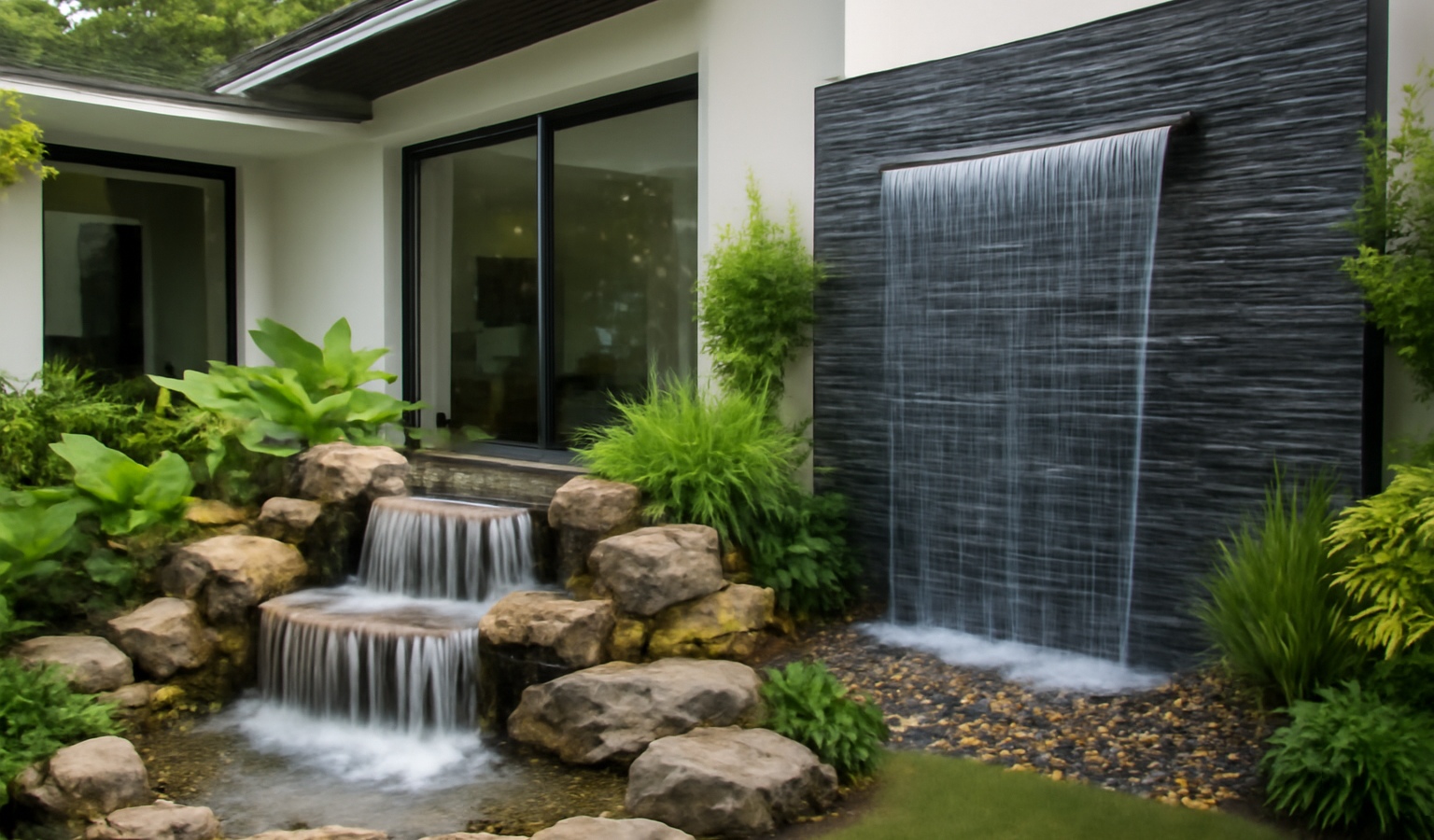
A pondless waterfall gives you the sound and movement of flowing water without an open pool to maintain or worry about. For Singapore homes, that combination is hard to beat: it is child-safe, low maintenance, and fits everywhere from a condo entrance to a landed driveway. The water tumbles over rocks or down a glass water wall, then disappears into a hidden gravel reservoir to be pumped up and recirculated. This guide covers how these features work, what they cost in SGD, the feng shui appeal, and how to keep them running through our monsoon season.
Key takeaways
- A pondless waterfall has no open water, making it the safest choice for homes with young children or elderly family members.
- Water recirculates from a hidden underground reservoir, so maintenance is far lower than a fish pond.
- Compact water walls and bubbling features suit condo entrances and small courtyards where a full pond would not fit.
- Expect SGD bands of roughly S$2,000 for a small bubbling urn to S$15,000-plus for a large landscaped waterfall.
- Flowing water carries strong feng shui appeal, and a sealed reservoir avoids the stagnant-water and mosquito worries of still features.
What is a pondless waterfall or water wall?
A pondless feature is exactly what it sounds like: moving water with no visible standing pool. Water spills over a waterfall, down a vertical water wall, or bubbles up through a stone or urn, then drains into a reservoir hidden beneath gravel or a grate at the base. A submerged pump sends it back up to start the cycle again, so the water you see is constantly recirculating rather than collecting in an open basin.
The family covers a few popular styles. A pondless waterfall mimics a natural rocky cascade and suits landed gardens. A water wall, often a sheet of water running down glass, stone or stainless steel, gives a clean architectural look that works beautifully at condo and townhouse entrances. Bubbling urns and drilled boulders are the most compact option, ideal for a balcony, courtyard or a narrow side of the house. All three share the same hidden-reservoir principle, which is what makes them so low maintenance.
Why pondless features suit Singapore homes
The biggest draw is safety. With no open water, there is nothing for a toddler to fall into, which is a genuine concern for families and a common reason buyers rule out a traditional pond. The reservoir sits below ground and is covered, so the visible surface is just rock, gravel or a thin sheet of moving water. That makes a pondless feature an easy yes for homes with young children or elderly residents.
The second draw is low maintenance. Without fish to feed or a large body of water to balance, upkeep is mostly topping up for evaporation, occasional pump checks and the odd reservoir clean. There is no filtration system to nurse and no fish stock at risk during a hot spell, which removes most of the work that makes fish ponds demanding in our climate. For busy condo owners in particular, that lighter commitment is the deciding factor.
Finally, the compact formats fit Singapore’s space realities. A bubbling urn or slim water wall needs only a small footprint, so it works at an HDB ground-floor unit’s patch, a condo entrance lobby, or the tight frontage of a terrace house where a full pond would be impossible. If you want inspiration for shapes and placements, our pond design ideas for Singapore guide shows how water features are styled for local homes.
How much do pondless waterfalls cost in Singapore?
Cost depends mainly on size, materials and how much landscaping surrounds the feature. A small self-contained bubbling urn is the cheapest entry point, while a large naturalistic waterfall built into a landed garden, or a tall bespoke glass water wall, sits at the top of the range. The table below gives realistic SGD bands for typical Singapore installations.
| Feature type / size | Typical SGD range |
|---|---|
| Small bubbling urn or drilled boulder (condo, balcony) | S$2,000 – S$4,500 |
| Compact water wall (stone, glass or steel sheet) | S$4,000 – S$9,000 |
| Medium pondless waterfall (landed garden feature) | S$8,000 – S$15,000 |
| Large landscaped waterfall with rockwork and lighting | S$15,000 – S$30,000+ |
| Tall bespoke architectural water wall | S$12,000 – S$25,000+ |
| Monthly running and upkeep cost | S$20 – S$60 / month |
These figures cover design, the reservoir, pump, plumbing, the visible feature and basic surrounding landscaping. Lighting, premium stone or glass, and integrated planting push the price up. Running costs are low because there is no UV unit or aeration to power, only the recirculating pump, and a sensibly sized energy-efficient pump keeps the impact on your SP bill modest. For a tailored figure on your space, see our pond and water feature installation service.
Feng shui and flowing water
Many Singapore homeowners choose a water feature partly for feng shui, where water represents wealth and gentle movement is thought to attract and circulate prosperity. A pondless waterfall or water wall fits this beautifully because the water is always flowing, which classical practice considers more auspicious than a still surface. Positioning the feature near the main entrance, with water appearing to flow towards the home rather than away from it, is a common guideline.
There is also a practical overlap that pondless features handle neatly. Stagnant water is considered inauspicious and, in our climate, is also a real mosquito and hygiene concern. Because a pondless feature keeps water moving and stores the rest in a sealed reservoir, it sidesteps both worries at once. For a deeper look at placement, the five elements and what to avoid, our guide to water feature feng shui in Singapore covers the principles in detail.
How the reservoir and pump work
Understanding the mechanics helps you judge a quote and avoid problems later. Beneath the visible rocks or grate sits a reservoir, either an excavated pit lined and filled with gravel, or a moulded basin, which holds the working volume of water. A submersible pump in the reservoir drives water up through a pipe to the top of the waterfall or the head of the water wall, and gravity returns it down through the rocks and back into the reservoir. Nothing is on show except the moving water.
Pump sizing is the detail that makes or breaks the look. Too weak and a water wall trickles unevenly; too strong and a small feature splashes water out of the catchment. A competent installer matches the pump’s flow rate to the height and width of the feature, and sizes the reservoir to hold enough water that the pump never runs dry between top-ups. Because the pump runs continuously, an energy-efficient model is worth the small premium over the years it operates.
The reservoir also needs an accessible top-up point and a way to check the water level, since evaporation in our heat is steady. A simple auto-fill valve is a popular upgrade that removes the manual topping-up chore entirely.
Monsoon overflow and upkeep
The one design point unique to our climate is heavy rain. A pondless reservoir can fill and overflow during a monsoon downpour, so it needs an overflow or drainage route that sends excess water safely away rather than letting it pool around the feature or wash debris into the reservoir. A good installer plans this overflow into the build and keeps it clear of the property’s own drainage so it complies with BCA and PUB drainage expectations. Done well, a storm is a non-event; done badly, it leaves a muddy mess at the base.
Day-to-day upkeep is light. Top up the reservoir for evaporation, keep leaves and debris off the feature so they do not clog the pump, and clean the reservoir and pump every few months to clear sediment. A little algae or mineral film on the rocks or glass is normal in our sun and wipes off easily, and adding a pond-safe water treatment keeps the recirculating water clear. With moving water and a sealed reservoir, mosquitoes are not the concern they are with neglected open water, provided the pump keeps running.
That low-fuss reality is why so many Singapore households land on a pondless feature: the calming sound and feng shui flow of water, without the safety, maintenance and monsoon headaches of an open pond.
Frequently asked questions
Are pondless waterfalls safe for young children?
Yes, that is their main advantage. With no open standing water and the reservoir hidden below a covered grate or gravel, there is nothing for a child to fall into. The visible surface is just rock or a thin sheet of moving water, making it a popular choice for family homes.
How much does a pondless water feature cost in Singapore?
A small bubbling urn starts around S$2,000 to S$4,500, a compact water wall runs S$4,000 to S$9,000, and a large landscaped waterfall can reach S$15,000 to S$30,000 or more. Running costs are low, typically S$20 to S$60 a month, since only the pump draws power.
Do pondless waterfalls breed mosquitoes?
They are far lower risk than still water because the pump keeps the visible water moving and the rest sits in a sealed reservoir. As long as the pump runs continuously and debris is kept clear, an Aedes mosquito has no still surface to breed on.
What happens to a pondless feature during heavy rain?
A well-built feature includes an overflow or drainage route that carries excess rainwater safely away during a monsoon downpour, in line with BCA and PUB drainage expectations. Poorly planned ones can overflow and pool at the base, so confirm the installer has designed for storms.
How much maintenance does a water wall need?
Very little. Top up the reservoir for evaporation, keep leaves off the feature, wipe occasional algae or mineral film from the surface, and clean the reservoir and pump every few months. An auto-fill valve can remove the topping-up chore altogether.
Featured project by Gensou Aquascaping
Get free water feature quotes in Singapore
Tell us about your space and we’ll match you with vetted local water feature specialists island-wide. Free, no obligation.