

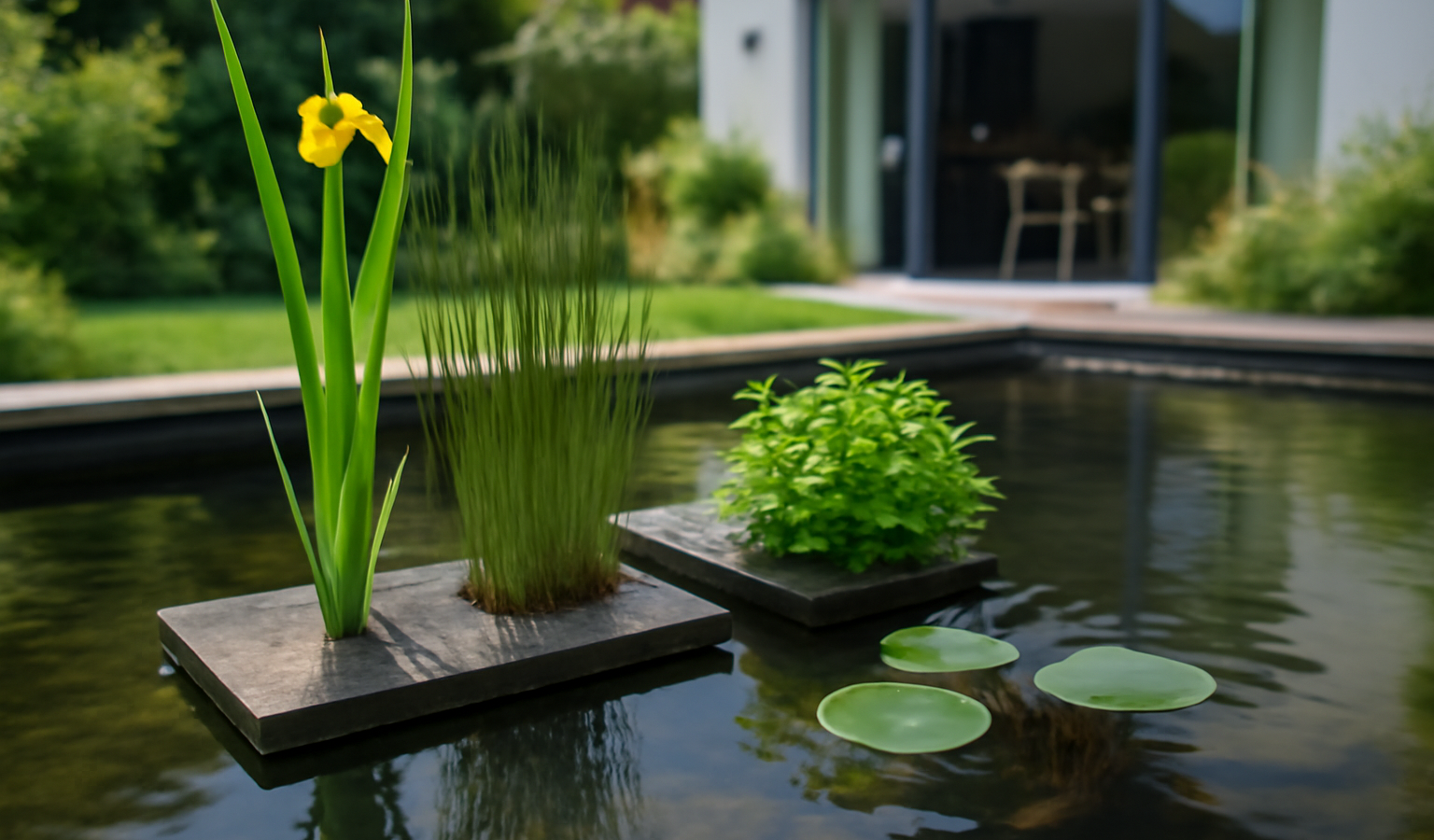
Marginal pond plants are the ones that grow in the shallow water around the rim of a pond, with their roots submerged and their stems and leaves standing above the surface. They are the single most useful group of plants you can add to a water garden: they soften the hard edge of a liner, shade and cool the water, soak up the dissolved nutrients that would otherwise feed algae, and give frogs, dragonflies, and birds a place to climb out, perch, and shelter. Get the depth right and most marginals are close to foolproof. Get it wrong and they either drown or dry out within a few weeks. This guide covers exactly how deep to plant each type, how to use the marginal shelf, which baskets and soil to use, the best species by USDA zone, and how to keep the vigorous spreaders from swallowing the whole pond.
Key Takeaways
- Marginals live in shallow water — typically 0 to 12 inches over the crown, on a planting shelf around the pond edge.
- Match the plant to the water depth. Bog-edge species want 0–2 inches; true marginals want 2–6 inches; deeper marginals tolerate up to 12 inches.
- Plant in mesh aquatic baskets with heavy clay loam (not bagged potting mix) topped with gravel to keep soil and fish from clouding the water.
- Aim for 30–50% surface and edge coverage — enough leaf cover to starve algae without choking the open water.
- Contain the thugs. Reedmace, sweet flag, and mint-family marginals will take over; use baskets, root barriers, and spring division to control them.
- Divide every 2–3 years in spring to keep plants vigorous and stop baskets becoming pot-bound.
What Are Marginal Pond Plants?
Pond plants fall into four broad groups, and it helps to know where marginals sit. Submerged oxygenators (like hornwort and elodea) live entirely underwater and keep the water clear. Deep-water aquatics such as waterlilies root in the deep zone and float their leaves on the surface. Floating plants (water lettuce, frogbit) drift untethered. Marginals — sometimes called bog or emergent plants — root in the shallow margins and grow up out of the water, which is where the name comes from.
The defining feature is that the roots and crown sit in saturated soil or standing water, while the growing shoots are in the air. That amphibious habit is why they are so productive: they have unlimited water at the root and full sun on the leaves, so they grow fast and pull a huge volume of nitrogen and phosphate out of the water as they do. In a pond plagued by green water or string algae, a generous band of marginals is often the cheapest, most permanent fix because it removes the nutrients the algae depends on.
They serve a structural role too. A bare liner edge looks artificial and offers nothing to wildlife. A planted margin blurs the line between water and land, gives emerging insects a ladder out of the water, hides the pump and skimmer, and provides nesting cover for birds and amphibians. If you are also adding a gently sloped pebble beach for wildlife access, the marginal plants are what finish the transition from open water to dry ground.
Planting Depth: The One Thing That Matters Most
Every marginal plant has a preferred water depth, measured from the surface of the water down to the top of the soil in the pot (the crown). Nurseries usually print this on the label, and ignoring it is the number-one reason marginals fail. Too deep and the crown suffocates or rots; too shallow and the soil dries out and the plant scorches. Here is how the depths break down.
Bog and damp-edge plants: 0 to 2 inches
These want their feet wet but their crown at or just below the waterline — think of the boggy ground right at the pond’s rim. Marsh marigold (Caltha palustris), water forget-me-not, and most moisture-loving irises sit here. Set the basket so the soil surface is level with the water or no more than two inches under it.
True marginals: 2 to 6 inches
This is the workhorse zone and where most marginals are happiest. Pickerel weed, arrowhead, flowering rush, sweet flag, and lobelia all thrive with 2 to 6 inches of water over the crown. The standard marginal shelf is built at this depth for exactly this reason.
Deeper marginals: 6 to 12 inches
A handful of taller, robust marginals tolerate deeper placement — reedmace (cattail), bulrush, and water plantain will take 6 to 12 inches over the crown. Use these at the deeper outside edge of the shelf or on a lower step. Few marginals are happy below about 12 inches; past that you are into waterlily territory.
A practical trick: stand new baskets on bricks or upturned pots to raise them to the correct depth, then lower them step by step as the plant establishes and grows taller. This stops a small plug being drowned before it can put up leaves.
The Marginal Shelf
A marginal shelf is a flat ledge built into the pond about 9 to 12 inches below the waterline and 10 to 16 inches wide, running around part or all of the perimeter. It is the dedicated home for marginal baskets, and if you are digging a pond from scratch it is worth designing in deliberately rather than leaving it to chance.
The shelf depth of 9 to 12 inches works because a standard aquatic basket is roughly 7 to 9 inches tall. Stand a basket on a 9-inch shelf and the soil surface ends up 2 to 5 inches below the water — squarely in the true-marginal sweet spot. For shallower bog-edge plants, raise the basket on a brick; for deeper ones, the outside lip of the shelf or a slightly lower step gives the extra depth.
If your pond is already built without a proper shelf, you have options. You can stack bricks, paving slabs, or upturned plastic crates on the pond floor to create platforms at the right height. You can also build a planted shelf outside the liner as a separate bog garden fed by pond water. In a flexible-liner pond, make sure the shelf is wide and level enough that baskets cannot slide off into the deep zone — a gentle inward tilt or a retaining lip of rocks helps. North-facing shelves get less sun, so place sun-loving flowering marginals on the sunniest edge and reserve the shadier sections for foliage plants like sweet flag or hostas at the very rim.
Baskets, Soil, and Planting Method
Most pond keepers grow marginals in mesh aquatic baskets rather than planting directly into a soil layer. Baskets keep the plant where you put it, make division easy, stop vigorous species spreading, and let you lift plants out for winter or maintenance. Choose a basket sized to the plant: a 1-litre basket for small plugs, a 3-litre for established marginals, and broad 5–10-litre baskets or planting bags for big spreaders like reedmace.
Use the right soil
Do not use standard bagged potting compost. It is full of peat, perlite, and slow-release fertilizer — the perlite floats out and clouds the water, and the fertilizer dumps nutrients straight into the pond and triggers an algae bloom. Instead use a heavy clay-loam garden soil or a purpose-made aquatic compost. The clay holds nutrients in place and stays put. If you only have light soil, mix in some clay or buy aquatic soil specifically.
Line, plant, and top with gravel
For fine-mesh baskets you can plant straight in; for coarse mesh, line the basket with hessian or a square of permeable membrane to stop soil washing out. Set the plant at the same depth it grew in its nursery pot, firm the soil, then top the surface with a 1–2 inch layer of washed pea gravel. The gravel is important: it stops fish (especially koi and goldfish) rooting in the soil and muddying the water, and it keeps the soil from floating up when you lower the basket in. Soak the planted basket thoroughly before lowering it slowly into the pond so air escapes rather than belching mud into the water.
Feed sparingly. Marginals draw most of what they need from the pond water, so heavy feeding just feeds algae. If a plant is genuinely struggling, push a single aquatic plant fertilizer tablet into the soil in late spring — never sprinkle granular fertilizer that dissolves into the water column.
Best Marginal Pond Plants by USDA Zone
These are reliable, widely available marginals with their planting depth and hardiness. Pick a mix of heights, leaf shapes, and bloom times so the margin looks good from spring through fall.
- Pickerel weed (Pontederia cordata) — zones 3–10. Glossy heart-shaped leaves and blue flower spikes from midsummer; bees love it. Depth 2–6 in. A near-perfect all-rounder.
- Arrowhead (Sagittaria latifolia) — zones 4–10. Striking arrow-shaped leaves, white flowers. Depth 2–6 in. Vigorous but manageable in a basket.
- Marsh marigold (Caltha palustris) — zones 3–7. Bright yellow buttercup flowers in early spring, one of the first to bloom. Depth 0–2 in.
- Blue flag iris (Iris versicolor) and yellow flag (Iris pseudacorus) — zones 3–9. Sword foliage and showy flowers. Depth 2–4 in. Note: yellow flag is invasive in many US states — choose native blue flag instead.
- Sweet flag (Acorus calamus / A. gramineus) — zones 4–10. Grassy, often variegated foliage; tough and shade-tolerant. Depth 2–4 in.
- Flowering rush (Butomus umbellatus) — zones 4–9. Rush-like leaves and pink umbel flowers. Depth 2–5 in. (Invasive in parts of the upper Midwest — check locally.)
- Cardinal flower (Lobelia cardinalis) — zones 3–9. Brilliant red spikes that hummingbirds chase. Depth 0–2 in.
- Water plantain (Alisma plantago-aquatica) — zones 5–9. Airy clouds of tiny flowers. Depth 2–6 in.
- Reedmace / cattail (Typha latifolia, or dwarf T. minima) — zones 3–10. Classic brown seed heads and vertical structure. Depth 6–12 in. Use the dwarf form in small ponds.
- Bog bean (Menyanthes trifoliata) — zones 3–7. Fringed white star flowers, scrambling habit good for hiding edges. Depth 2–4 in.
For year-round structure, combine an upright (pickerel weed or iris), a horizontal scrambler (bog bean or water forget-me-not), and a grassy accent (sweet flag). If you want help choosing companion species for the deeper water, the Water Gardens & Ponds hub has guides on waterlilies and oxygenators.
Containment: Keeping the Thugs in Check
Some marginals are beautiful and some are bullies — and a few are both. The classic offenders are reedmace/cattail, the mint relatives (water mint, watercress), yellow flag iris, and any creeping rush. Left in open soil, they send runners or rhizomes laterally and can colonize an entire margin in two seasons, crowding out everything else and even puncturing thin liners with their roots.
- Always basket the vigorous ones. A solid-sided container (or a mesh basket lined so roots cannot escape through the mesh) physically stops lateral spread.
- Check labels for “invasive.” Yellow flag iris, flowering rush, and water hyacinth are banned or restricted in parts of the US. Choose native alternatives where flagged, and never dump pond plants in natural waterways.
- Divide every 2–3 years in spring. Lift the basket, slice the rootball into chunks with an old knife or spade, replant the healthiest outer pieces, and compost the woody center. This keeps plants vigorous and prevents baskets bursting.
- Use a root barrier if you grow marginals directly in a planting shelf without baskets — a buried vertical liner or barrier strip keeps runners on their own side.
- Cut back in fall, not too hard. Leave hollow stems standing over winter for overwintering insects; tidy them in early spring before new growth starts.
The goal is balance. You want enough marginal cover — roughly 30 to 50% of the surface and edge — to shade the water and starve algae, but not so much that the pond turns into a swamp with no open water for reflections, fish, or visiting birds. Annual division and basketing are how you hold that line.
Seasonal Care at a Glance
Spring: divide congested clumps, repot into fresh soil, and add new plants once frost danger passes and water warms above about 50°F. Summer: deadhead spent flowers, thin floating spread, and remove yellowing leaves. Fall: cut back tender top growth after the first frost but leave hollow stems for wildlife; move tender marginals to the deeper, frost-free zone or a frost-free spot. Winter: hardy marginals stay put; in zones 3–5, ensure baskets sit below the ice line or move them deeper so the crown doesn’t freeze solid.
Frequently Asked Questions
How deep should marginal pond plants be planted?
Measure from the water surface down to the top of the soil in the pot. Bog-edge plants want 0–2 inches over the crown, most true marginals want 2–6 inches, and a few robust ones (cattail, bulrush) tolerate 6–12 inches. Always check the plant’s label and use bricks under the basket to fine-tune the depth.
Can I grow marginal plants without a marginal shelf?
Yes. Stack bricks, paving slabs, or upturned crates on the pond floor to lift baskets to the right depth, or build a separate bog garden alongside the pond. The shelf just makes it tidier — what matters is getting the crown sitting at the correct water depth.
What soil should I use for pond plants?
Use heavy clay-loam garden soil or a dedicated aquatic compost — never standard potting mix. Potting mix floats, clouds the water, and its fertilizer feeds algae. Top each basket with 1–2 inches of washed pea gravel to keep soil and fish from muddying the pond.
Do marginal plants help control algae?
Significantly. Marginals are fast-growing and pull large amounts of nitrogen and phosphate out of the water — the same nutrients algae feed on. Covering 30–50% of the surface and edge with plants is one of the most effective long-term ways to keep a pond clear.
How often should I divide marginal pond plants?
Every 2 to 3 years in spring. Lift the basket, cut the rootball into sections, replant the vigorous outer pieces in fresh soil, and discard the old woody center. Division keeps plants healthy, prevents baskets bursting, and stops vigorous species taking over the margin.
Marginals reward a little planning up front. Build or improvise a shelf at the right depth, plant into baskets of clay loam topped with gravel, match each species to its preferred depth, and keep the spreaders contained with annual division. Do that and you’ll have a planted margin that clears the water, hides the hardware, and pulls in frogs, dragonflies, and birds for years with almost no ongoing work.