

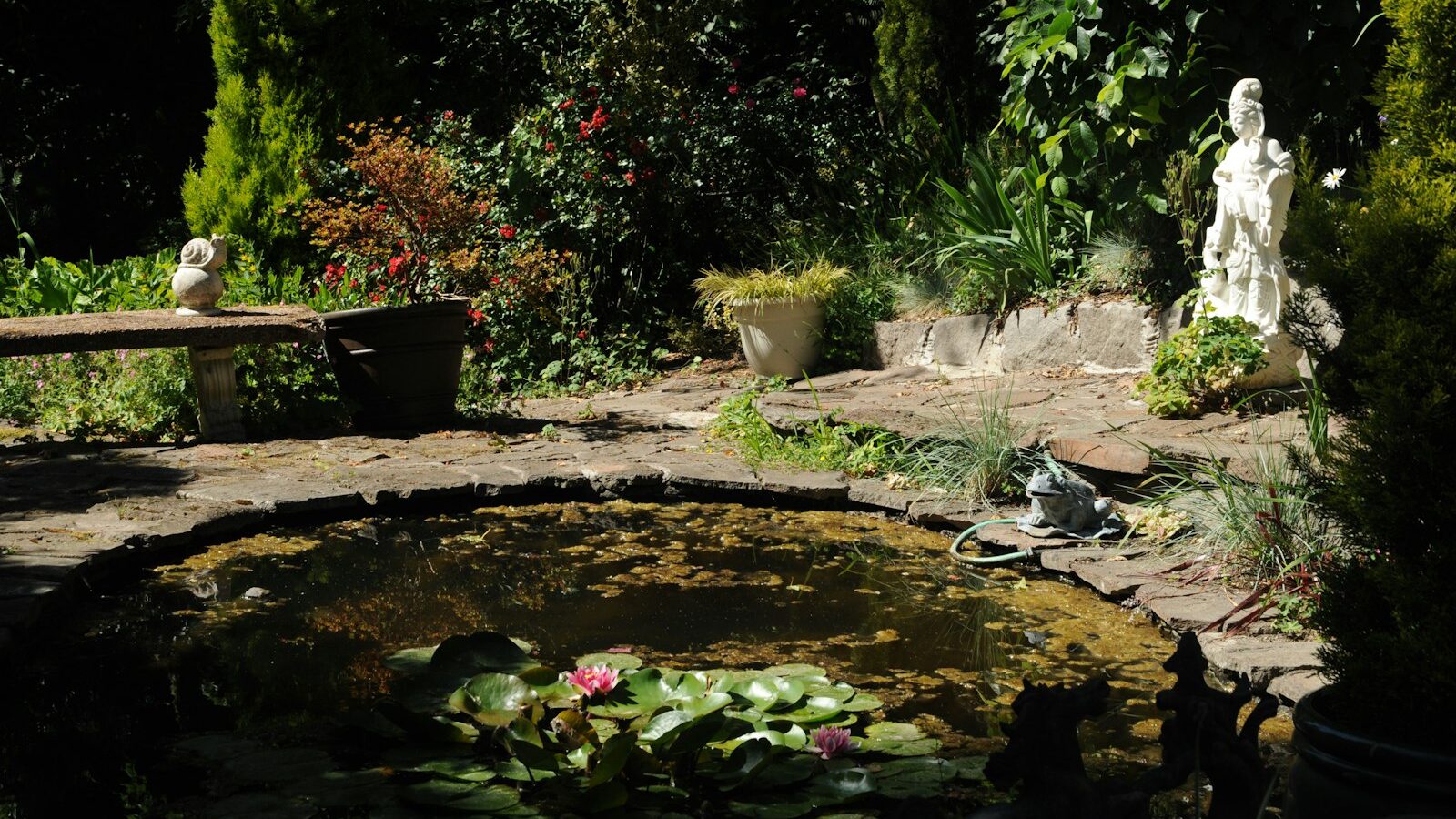
A pond liner is the waterproof foundation that decides whether your water garden holds water for two seasons or two decades. Get the material, thickness, and size right and you’ll rarely think about it again; get them wrong and you’re draining, patching, and re-digging. Below we compare seven of the most popular pond liners on the market, from flexible 45-mil EPDM rubber to budget reinforced PVC and rigid preformed shells, plus a practical guide to choosing and sizing the right one for your build.
Some links in this article are affiliate links. As an Amazon Associate we earn from qualifying purchases, at no extra cost to you.
Key takeaways
- 45-mil EPDM rubber is the all-round favorite for backyard ponds: flexible, fish-safe, UV-stable, and long-lived around curved, natural shapes.
- Reinforced PVC is the budget choice for small ponds and water features, while RPE is lighter and tougher for large or rocky sites.
- Preformed rigid shells are the fastest install for small ponds but lock you into a fixed shape and size.
- Always pair a flexible liner with underlayment, and size it as pond length (or width) plus twice the depth plus about 2 feet of overlap.
| Liner | Best for | Material | |
|---|---|---|---|
| Firestone / Elevate PondGard | Most backyard & koi ponds | 45-mil EPDM rubber | Check price |
| Aquascape EPDM Pond Liner | DIYers wanting a full system | 45-mil EPDM rubber | Check price |
| Anjon LifeGuard EPDM | Koi & fish-safe priority | 45-mil EPDM rubber | Check price |
| Aquascape RPE Pond Liner | Large & rocky sites | Reinforced polyethylene (RPE) | Check price |
| TotalPond Pond Liner | Small ponds on a budget | Reinforced PVC | Check price |
| Beckett PVC Pond Liner | First-time small water features | PVC | Check price |
| Algreen Avonlea Preformed Pond | Fastest small-pond install | Rigid molded plastic | Check price |
The best pond liners reviewed
1. Firestone / Elevate PondGard — Best overall
PondGard is the liner most people picture when they think of pond rubber, and for good reason. Now sold under the Elevate brand (formerly Firestone), this 45-mil EPDM sheet has been the professional standard for water gardens for decades, trusted in everything from small backyard pools to large koi ponds and commercial features. EPDM stays flexible across a wide temperature range, conforms easily to curves and shelves, and resists UV degradation and ozone, which is what gives it such a long real-world service life. It’s also formulated to be fish- and plant-safe once installed. The main trade-offs are weight, since a large sheet is genuinely heavy to drag into place, and a higher price per square foot than PVC. If you want one liner that will outlast the rest of your build, this is the default pick.
Pros
- Proven, long-lived 45-mil EPDM with strong UV and ozone resistance
- Very flexible, conforming to curves, shelves, and irregular shapes
- Fish- and plant-safe once installed
Cons
- Heavy, so large sheets are a two-person job
- Higher cost per square foot than PVC
2. Aquascape EPDM Pond Liner — Best for a full DIY system
Aquascape built its reputation around the water gardening and landscaping community, and its 45-mil EPDM liner slots neatly into a wider ecosystem of skimmers, spillways, pumps, and filters from the same brand. For a DIYer who wants components that are designed to work together, plus the installation videos and guides Aquascape is known for, that integration is a real advantage over buying a bare sheet of rubber. The liner itself shares the core EPDM strengths: flexibility around natural shapes, UV stability, and fish-safe construction backed by a long manufacturer guarantee. Performance is very close to PondGard, so the deciding factor is usually whether you’re building around Aquascape’s accessory range.
Pros
- Pairs with a full lineup of matching skimmers, pumps, and spillways
- Strong DIY support with guides and installation videos
- Flexible, fish-safe 45-mil EPDM with a long guarantee
Cons
- Premium pricing similar to other top EPDM liners
- Heavy to handle in larger pre-cut sizes
3. Anjon LifeGuard EPDM — Best for fish-safe koi ponds
Anjon’s LifeGuard EPDM liner leans hard into one promise: being exceptionally safe for aquatic life. The brand puts extra emphasis on quality control to reassure buyers the material is free of contaminants that could leach into the water, which has made it a favorite among serious koi keepers, aquaculturists, and anyone building a natural swimming pond or wildlife habitat. Mechanically it’s another flexible 45-mil EPDM sheet with the durability and UV resistance you expect from the category, so you aren’t giving up longevity for that peace of mind. If your stocking plans are ambitious or you simply want to minimize any risk to sensitive fish, LifeGuard is a sensible choice.
Pros
- Strong focus on fish-safe, contaminant-free material
- Reassuring choice for koi, natural swim ponds, and wildlife habitats
- Durable, flexible 45-mil EPDM construction
Cons
- Premium price in line with other top EPDM brands
- Heavy and bulky in large pre-cut panels
4. Aquascape RPE Pond Liner — Best for large or rocky ponds
RPE stands for reinforced polyethylene, a blend of LDPE and HDPE layers with a reinforcing scrim that delivers excellent puncture and tear resistance at a fraction of EPDM’s weight. That weight advantage is the headline: a large RPE sheet can weigh far less than the equivalent EPDM, making it dramatically easier to ship, carry, and position over big ponds, which is exactly where rubber becomes a back-breaking logistics problem. The toughness also makes RPE a smart pick for rocky or root-prone sites where puncture risk is high. The trade-off is flexibility: RPE is stiffer than EPDM and doesn’t drape into tight curves and folds as gracefully, so it shines on larger, simpler shapes rather than small ornamental ponds with lots of contours.
Pros
- Far lighter than EPDM, so large sheets are easier to handle
- Excellent puncture and tear resistance for rocky sites
- Lower shipping cost and a long service life when protected
Cons
- Stiffer than EPDM, so it’s harder to fit tight curves
- Better suited to larger, simpler pond shapes
5. TotalPond Pond Liner — Best budget for small ponds
TotalPond’s reinforced PVC liner is aimed squarely at small ponds, container water gardens, and simple features where a full EPDM sheet would be overkill. At 14.5 mil it’s much thinner than rubber, but a polyester mesh weave sandwiched between the PVC layers adds tear strength and a measure of puncture resistance that thin unreinforced sheets lack. It’s lightweight, easy to fold and tuck into a small excavation, UV- and tear-resistant, and priced low enough to make experimenting with a first pond painless. Don’t expect it to match EPDM longevity in a large, fish-heavy build, but for a modestly sized garden pond it’s a practical, affordable starting point.
Pros
- Affordable, reinforced PVC with a polyester mesh weave
- Lightweight and easy to install in small excavations
- UV- and tear-resistant for the price point
Cons
- Thinner than EPDM, so less suited to large koi ponds
- Shorter expected lifespan than rubber liners
6. Beckett PVC Pond Liner — Best for first-time builders
The Beckett Corporation’s lightweight PVC liner is a friendly entry point for anyone setting up a small garden pond for the first time. It’s a thin, flexible sheet that’s easy to maneuver and conform to a modest excavation, and the material is UV- and ice-resistant as well as safe for fish and plants. Beckett backs it with a long manufacturer’s warranty, which is reassuring at this price level. As with any thin PVC liner, the limits are scale and ultimate lifespan: it’s ideal for compact ponds and simple features rather than deep, heavily stocked koi systems, but for learning the ropes without a big investment it does the job well.
Pros
- Inexpensive and easy to handle for beginners
- UV- and ice-resistant, safe for fish and plants
- Backed by a long manufacturer’s warranty
Cons
- Thin PVC is best kept to small, simple ponds
- Less durable long term than EPDM or RPE
7. Algreen Avonlea Preformed Pond — Best for the fastest install
If digging and fitting a flexible liner sounds like too much work, a preformed rigid pond is the shortcut. The Algreen Avonlea is a molded shell that you drop into a matching hole, level, and backfill, with the whole process boiling down to a handful of steps and no folds or wrinkles to fuss over. It’s made from UV-stabilized, non-toxic recycled plastic built to resist chipping, cracking, and fading through the seasons. The catch is inherent to the format: you’re locked into a fixed shape and a modest volume, so there’s no customizing the outline or going larger later. For a quick, tidy ornamental pond or a contained water feature, though, nothing installs faster.
Pros
- Fastest, simplest install with no liner folding
- UV-stabilized, non-toxic recycled plastic resists cracking and fading
- Tidy, ready-made shape ideal for small ornamental ponds
Cons
- Fixed shape and limited volume with no customization
- Not suitable for large or deep koi ponds
Free, no-obligation quote · Connect with a local pro
How to choose a pond liner
EPDM vs PVC vs RPE vs preformed
The material you choose sets the ceiling for durability, flexibility, and price. Each type has a clear sweet spot:
- EPDM rubber: the all-rounder. Highly flexible, UV-stable, fish-safe, and long-lived, which makes it the default for most backyard and koi ponds with curves and shelves. The downsides are weight and cost.
- PVC: the budget option. Thin, lightweight, and inexpensive, best for small ponds and simple features. Reinforced PVC with a mesh weave is noticeably tougher than plain PVC.
- RPE (reinforced polyethylene): light and very puncture-resistant, ideal for large or rocky ponds where handling weight and tear risk matter most. Stiffer, so less ideal for tight contours.
- Preformed rigid shells: the fastest install, but you’re locked into a fixed shape and small volume. Great for quick ornamental ponds, not for large custom builds.
Mil thickness and durability
Thickness is measured in mils (thousandths of an inch). For flexible liners, 45-mil EPDM is the widely accepted standard for backyard ponds, balancing puncture resistance with workable flexibility. Thinner PVC liners in the 14-20 mil range are fine for small, low-stress ponds but are easier to puncture and tend not to last as long. As a rule, the bigger, deeper, or more heavily stocked your pond, the more you’ll appreciate a thicker, tougher liner.
Fish-safe material
If you plan to keep fish, confirm the liner is specifically labeled fish- and plant-safe. Quality EPDM, fish-grade PVC, and RPE liners are formulated not to leach harmful compounds into the water. Avoid using generic construction membranes or roofing rubber that hasn’t been certified for aquatic use, since some contain additives that are toxic to fish. The koi-focused EPDM options above put extra emphasis on this.
Underlayment
Underlayment is a protective fabric layer that sits between the soil and your liner, cushioning it against sharp stones, roots, and settling that would otherwise cause punctures. For flexible EPDM and PVC liners it’s strongly recommended, especially on rocky or root-prone ground. Some RPE liners are tough enough to skip it on smoother sites, but a layer of underlayment is cheap insurance against the worst pond failure of all: a slow leak under a finished, planted pond.
UV and cold resistance
Any liner edge exposed above the waterline takes a beating from sunlight, and freeze-thaw cycles stress the material in winter. EPDM is prized for staying flexible in cold weather and resisting UV and ozone, which is a big part of why it lasts. RPE is UV-stable too, particularly when covered above the waterline. Thinner PVC liners are more vulnerable to becoming brittle over time, so tuck exposed edges under rocks or soil to shield them from direct sun.
How to size your liner
Sizing is simple once you know the formula. For each dimension, take the pond’s length (or width) and add twice the maximum depth, then add roughly 2 feet for overlap so the liner reaches up and over the edge to anchor under your border. The formulas are:
- Liner length = pond length + (2 x depth) + 2 ft overlap
- Liner width = pond width + (2 x depth) + 2 ft overlap
So a pond that’s 8 ft long, 6 ft wide, and 2 ft deep needs a liner about 14 ft x 12 ft (8 + 4 + 2, and 6 + 4 + 2). When in doubt, round up; trimming excess is easy, but a liner that comes up short is unusable. If you’re planning the dig itself, our guide on how to build a backyard pond walks through excavation, shelves, and edging step by step.
Frequently asked questions
What is the best pond liner material?
For most backyard and koi ponds, 45-mil EPDM rubber is the best all-round choice thanks to its flexibility, UV stability, fish safety, and long lifespan. PVC is the budget option for small ponds, RPE wins for large or rocky sites where weight and puncture resistance matter, and preformed shells are best for quick, small installs.
How thick should a pond liner be?
45-mil is the standard thickness for flexible EPDM pond liners and suits most backyard ponds. Thinner PVC liners in the 14-20 mil range are acceptable for small, low-stress ponds, but the larger, deeper, or more heavily stocked your pond, the thicker and tougher the liner should be.
Do I need underlayment under my pond liner?
Yes, in most cases. Underlayment cushions the liner against sharp stones and roots, greatly reducing puncture risk. It’s strongly recommended for EPDM and PVC liners, especially on rocky ground. Some heavy-duty RPE liners can skip it on smooth sites, but it’s cheap protection worth adding.
How do I calculate what size liner I need?
Add twice the pond’s maximum depth plus about 2 feet of overlap to each dimension. Liner length equals pond length + (2 x depth) + 2 ft, and liner width equals pond width + (2 x depth) + 2 ft. Round up when unsure, since excess is easy to trim but a short liner can’t be used.
Are pond liners safe for fish?
Quality EPDM, fish-grade PVC, and RPE liners are formulated to be fish- and plant-safe and won’t leach harmful compounds into the water. Look for liners specifically labeled for aquatic use, and avoid generic roofing rubber or construction membranes, which may contain additives toxic to fish.
How long do pond liners last?
It depends on material and care. Well-installed 45-mil EPDM liners are known for very long service lives, often measured in decades, while RPE also lasts a long time when protected above the waterline. Thinner PVC liners have shorter lifespans. Using underlayment and shielding exposed edges from UV extends any liner’s life.
With the right liner sized and underlaid, the rest of your build comes together quickly. Next, match a circulation pump to your pond volume with our guide to the best pond pumps, and browse more ideas and care tips in our water gardens & ponds section. If you’d rather have the whole thing designed and installed for you, our network of pond installation pros can size the liner, handle the excavation, and seal everything for you.
Rather hire a pro?
Prefer to skip the DIY and have it done right? Compare free, no-obligation quotes from vetted local landscaping pros near you.