

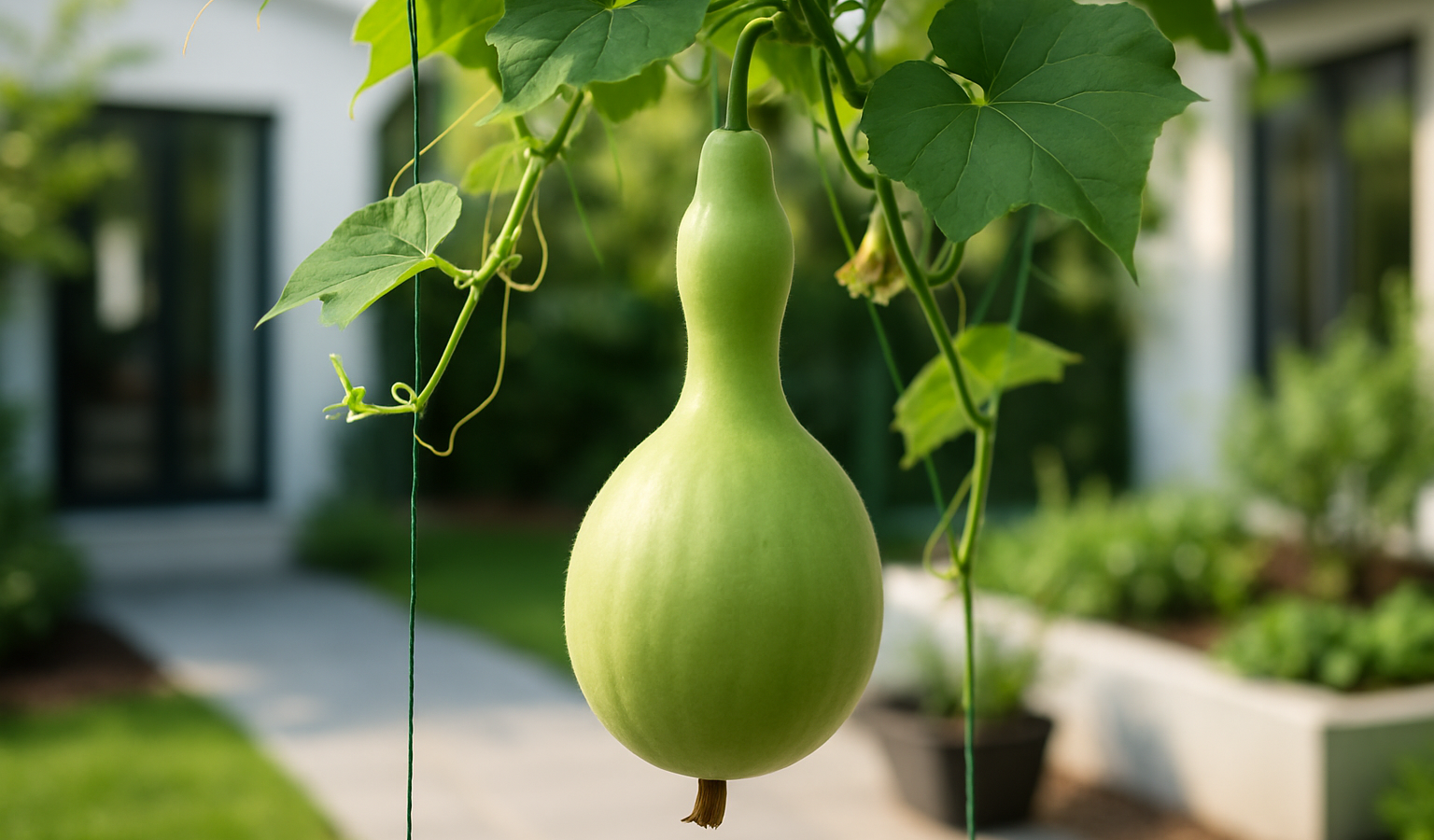
Bottle gourd (Lagenaria siceraria), also called calabash, is one of the oldest cultivated plants on earth, grown for thousands of years on every inhabited continent. It is a dual-purpose crop with a split personality: harvested young and tender, the smooth green fruit is a mild, edible squash used across Asian, African, and Caribbean cooking; left to mature and dry on the vine, the same fruit hardens into a woodlike shell used for bottles, bowls, birdhouses, instruments, and dippers, which is where both names come from.
The plant is a massive, sprawling annual vine with broad, soft, fuzzy leaves and striking white flowers that open in the evening. Given a long, warm season it can run twenty feet or more, and the fruits range from round bottle shapes to dramatically long, slender forms depending on the variety. Because the vine is so vigorous and the mature fruit so heavy, bottle gourd really wants to climb a strong trellis rather than sprawl on the ground.
The two things to know going in: bottle gourd needs a long, warm growing season (often 120-150 days for mature, craft-quality gourds), and you decide its fate at harvest, picking young for the kitchen or leaving it to fully mature and cure for crafts. This guide covers starting seed, trellising the big vine, the unusual night pollination, and both harvest paths.
Key Takeaways
- Bottle gourd is a long-season, heat-loving annual vine; it needs warm soil, full sun, and often 120-150 days for mature gourds, so start seed early in short-season areas.
- The vine is huge and the mature fruit heavy, so grow it on a sturdy, tall trellis or arbor rather than letting it sprawl on the ground.
- Flowers open in the evening and are pollinated by night-flying insects; if fruit fails to set, hand-pollinate at dusk by transferring pollen from male to female flowers.
- Harvest young (under 8-10 inches, skin still soft) for eating, or leave on the vine until the skin hardens and the stem dries, then cure for months to make a craft gourd.
Climate, Timing, and Site
Bottle gourd is a warm-season plant with no tolerance for cold or frost. It needs soil at least 65-70°F to germinate and a long stretch of warm weather to mature, which is why it is most at home in hot-summer regions. If you only want to eat the gourds young, you can manage with a shorter window of around 60-75 days. If you want fully mature, hard-shelled craft gourds, plan on a much longer season, frequently four to five months of frost-free growing, so gardeners in cooler zones should start seeds indoors to get a head start.
Pick a site in full sun with rich, well-drained soil and plenty of room. This is a sprawling, hungry plant, so amend the bed generously with compost or aged manure before planting. Because the vine grows so large, give it a dedicated corner where it can climb a substantial support, near a sunny fence line, over an arbor, or up a heavy-duty trellis.
Starting Bottle Gourd From Seed
Like most gourds, bottle gourd has a hard seed coat that benefits from pre-soaking. Soak seeds in warm water for 24 hours before sowing, and some growers nick the hard edge to speed water uptake. In long-season climates, direct-sow two or three seeds per spot once the soil is reliably warm, then thin to the strongest seedling. In cooler areas, start seeds indoors three to four weeks before your last frost in deep pots, since the vines grow fast and dislike root disturbance.
Sow seeds about an inch deep in warm, moist soil. Bottom heat from a seedling mat (around 75-85°F) gives the fastest, most even germination, typically within one to two weeks. Harden off indoor-started seedlings for several days before transplanting, and set them out only after all frost danger has passed and the soil has warmed. Space plants generously, two to three feet apart along the base of a trellis, because each vine will cover a large area.
Trellising the Vine
A trellis is strongly recommended for bottle gourd, especially for the long-fruited types. Grown on the ground, the fruit develops flat sides where it rests, is prone to rot in damp soil, and gets harder to find in the sea of huge leaves. Trained up a support, the fruit hangs straight and develops its natural shape, stays clean and disease-free, and the long varieties in particular grow remarkably straight and long when allowed to dangle.
Build the support strong. A mature vine loaded with gourds is genuinely heavy, so use a sturdy arbor, a heavy-duty A-frame, cattle panels, or thick wire stretched on solid posts, not flimsy netting. Aim for at least six to seven feet of height so the long fruits have room to hang. As the gourds enlarge, you can support individual heavy fruits with slings made from netting, old fabric, or pantyhose tied to the frame so their weight does not snap the stem. Guide young vines onto the trellis until their tendrils take hold. For more on building robust vertical supports, see our urban gardening hub.
Care and Pollination
Bottle gourd is a thirsty, hungry plant. Water deeply and consistently, especially during hot weather and while fruit is forming, keeping soil evenly moist but not soggy; mulch helps hold moisture and suppress weeds. Feed with compost and a balanced fertilizer as the vine establishes, easing off nitrogen once it starts flowering so the plant puts energy into fruit rather than endless leaves. Pinching the growing tip of the main vine once it is well established encourages side branches, which carry most of the female flowers and therefore more fruit.
The night-flowering quirk
Unlike most squash, bottle gourd flowers open in the late afternoon and evening, and they are white rather than yellow because they are pollinated by night-flying moths rather than daytime bees. The vine bears separate male and female flowers; female flowers have a tiny gourd-shaped swelling at their base. If you notice female flowers shriveling without setting fruit, hand-pollination at dusk solves it: pick a freshly opened male flower, remove the petals, and dab its pollen onto the stigma in the center of each open female flower. Doing this in the evening, when the flowers are fully open, gives the best results.
Pest and disease pressure is similar to other cucurbits: watch for cucumber beetles, squash bugs, aphids, and powdery mildew. Good airflow from trellising, regular inspection, and prompt removal of badly affected leaves keep most problems manageable on these tough, vigorous vines.
Harvesting to Eat Young
For the kitchen, harvest bottle gourd young and tender. Pick the fruit while it is still small and the skin is soft enough to dent with a fingernail, usually when round types are the size of a softball or long types are six to ten inches and still slender. At this stage the flesh is mild, white, and crisp, perfect for stir-fries, stews, and curries, and there are no developed hard seeds. Cut the fruit cleanly from the vine with a sharp knife or shears, leaving a short piece of stem. Harvesting young also keeps the vine producing more, so pick regularly through the season.
Harvesting and Curing for Crafts
To make a hard-shelled craft gourd, do the opposite: leave the fruit on the vine and let it fully mature. As it ripens, the skin loses its soft fuzz and hardens, the green fades toward tan, and the stem where it joins the vine begins to dry and turn brown. Leave the gourd attached as long as possible, ideally until the vine dies back at the end of the season; the longer it ripens on the vine, the better the shell. Harvest before a hard freeze, cutting it with a good length of stem still attached.
Then comes patience. Curing a bottle gourd takes weeks to several months. Set the gourds in a single layer in a dry, airy, protected spot off the ground, turning them occasionally and discarding any that go soft and rot. The surface will get moldy and blotchy during drying, which is normal and can be scrubbed off later. The gourd is fully cured when it becomes lightweight, the shell is hard, and you can hear the dried seeds rattle inside when you shake it. At that point it is ready to be cleaned, sanded, cut, and crafted into a bottle, bowl, or birdhouse. For more unusual crops you can both eat and use, browse the plants and flowers hub.
Frequently Asked Questions
Can you eat bottle gourd, or is it just for crafts?
Both, depending on when you harvest. Picked young while the skin is still soft, bottle gourd is a mild, edible squash used in many Asian, African, and Caribbean dishes. Left on the vine to fully mature and dry, the same fruit hardens into a woodlike shell used for bottles, bowls, and birdhouses. You choose its purpose at harvest.
How long does it take to grow a craft bottle gourd?
A long time. While you can harvest young gourds for eating in about 60-75 days, fully mature craft-quality gourds often need 120-150 frost-free days on the vine, plus several more weeks to months of curing after harvest. Gardeners in cooler climates should start seeds indoors to get the long season these gourds require.
Why do bottle gourd flowers open at night?
Bottle gourd has white flowers that open in the late afternoon and evening because it is pollinated by night-flying moths rather than daytime bees. If fruit is not setting, you can hand-pollinate at dusk by transferring pollen from a freshly opened male flower to each open female flower, which has a tiny gourd at its base.
Does bottle gourd need a trellis?
It strongly benefits from one. The vine is huge and the fruit heavy, so a sturdy, tall trellis or arbor keeps fruit off damp ground, prevents rot and flat sides, improves airflow, and lets long varieties grow straight as they hang. Support individual heavy fruits with cloth slings tied to the frame so their weight does not break the stem.
How do I cure a bottle gourd for crafts?
Harvest the mature gourd with a length of stem after the skin has hardened and the stem has dried. Set it in a single layer in a dry, airy spot off the ground, turning occasionally and discarding any that rot. Surface mold is normal. After weeks to months, the gourd becomes lightweight and hard, and the seeds rattle inside, meaning it is fully cured.