

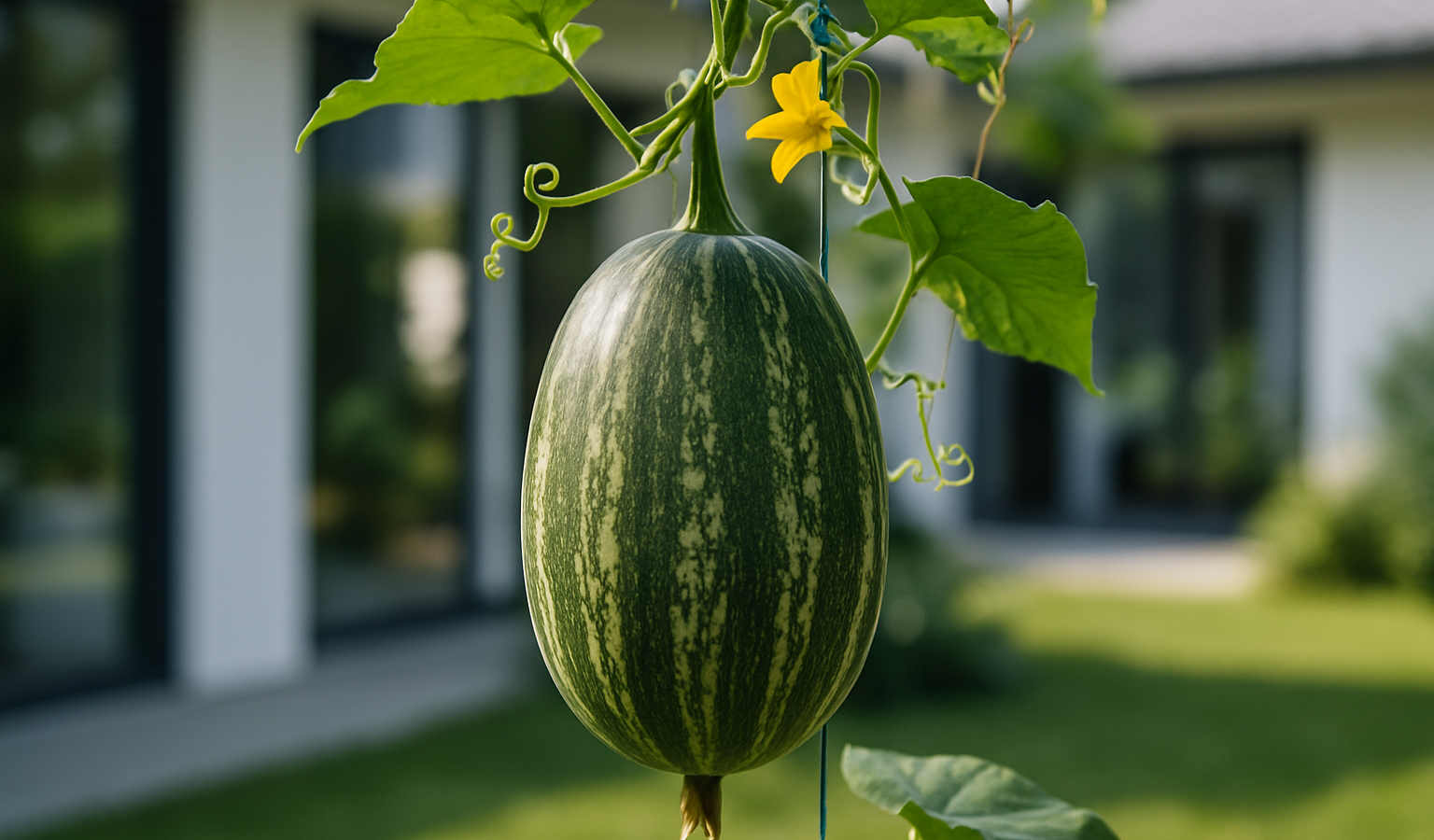
The Malabar gourd, better known as the fig-leaf gourd, is one of the most vigorous and unusual squashes a gardener can grow. Botanically it is Cucurbita ficifolia, named for its broad, fig-shaped, dark green leaves, and it stands apart from familiar pumpkins and zucchini in nearly every way. The vines are enormous and tireless, the fruits are hard-shelled, green-and-white striped, and store for years, the flesh inside is white and stringy (the source of the candy “angel hair” or cabello de ángel), and the seeds are famously jet black rather than the usual cream color.
What really sets it apart is its constitution. Unlike most cucurbits, the fig-leaf gourd is adapted to cool highland climates, tolerates light chill better than other squash, and in frost-free regions it behaves as a short-lived perennial, sprawling and fruiting for several years from the same roots. It is also widely used as a hardy, disease-resistant rootstock for grafting cucumbers and melons. For the home gardener, it is a fascinating, productive, and forgiving plant, provided you give its rampant vines the room they demand.
Key Takeaways
- Malabar gourd (fig-leaf gourd, Cucurbita ficifolia) is an extremely vigorous, sprawling vine that needs lots of space or a strong trellis.
- It is frost-tender but more cold-tolerant than most squash, and in warm, frost-free zones it grows as a short-lived perennial.
- Sow seed after the last frost in warm soil; the long, vining plants need a long, warm growing season to ripen fruit.
- The hard-shelled fruits store for a year or more, and the plant produces distinctive black seeds.
- The stringy white flesh is used for sweets and stews, and the plant is also grown as disease-resistant grafting rootstock.
Understanding the Fig-Leaf Gourd
Before you plant, it helps to know what you are signing up for. This is not a tidy bush squash. A single fig-leaf gourd plant can send out vines 15 to 25 feet long or more, rooting at the nodes as it goes and climbing anything within reach with strong tendrils. In its native Andean and Central American highlands it scrambles up trees and over fences for years on end. The fruits resemble a small striped watermelon, with a hard rind that protects the flesh for an exceptionally long storage life, sometimes years, which made it a valuable keeping crop long before refrigeration.
Because it tolerates cooler conditions than pumpkins or zucchini and resists several soil diseases, commercial growers often graft cucumbers, melons, and other squash onto fig-leaf gourd rootstock to gain vigor and disease resistance. As a home gardener you can simply enjoy it as an ornamental, edible, and long-storing crop in its own right. Just respect its scale: give it a fence line, an arbor, a slope, or an out-of-the-way corner where it can ramble without swallowing your other vegetables.
When and Where to Plant
Despite its cool-tolerance, the fig-leaf gourd is still frost-tender, so seedlings cannot go out until the danger of frost is past and the soil has warmed to around 60°F. It does, however, handle cool nights and chilly spells better than most squash, which is an advantage in cooler-summer climates. The catch is its long season: the vines need many warm weeks to flower and ripen fruit, so in short-season areas start seed indoors two to three weeks before transplanting, or accept that you may grow it mainly for foliage and immature fruit. In USDA zones 9 and warmer where frost is rare, it can overwinter and resprout as a perennial.
Choose a full-sun site with rich, well-drained soil and plenty of horizontal or vertical space. Work in generous compost or aged manure before planting, because these big vines are hungry and reward fertile ground. If you plan to trellis it, build something genuinely sturdy; a flimsy structure will collapse under the weight of mature foliage and fruit. Otherwise, plant it where the vines can sprawl across ground you do not need for anything else, such as the edge of the garden, a bank, or alongside a fence.
How to Sow and Transplant
Like other squash, the fig-leaf gourd is grown from its large (in this case black) seeds, sown about an inch deep. Direct-sow in warm soil after frost, planting two or three seeds per spot and thinning to the strongest seedling, with planting spots set at least 4 to 6 feet apart given the vines’ spread. To gain time in a shorter season, start seeds indoors in roomy pots two to three weeks before your last frost, then harden off and transplant carefully; cucurbits dislike root disturbance, so use biodegradable pots or move the rootball gently.
Germination is quick in warm soil, usually within a week to ten days. Keep young plants evenly moist and protected from cold snaps. Once established and the weather warms, the vines take off rapidly, and from then on the plant is largely self-sufficient. If you started other long-season cucurbits this year, the timing and handling are nearly identical to our guide on growing bottle gourd.
Caring for the Vines
The main job through the season is keeping up with growth and moisture. Water deeply and regularly, especially during flowering and fruit set, since these large plants transpire a lot of water on hot days; deep weekly soakings beat frequent shallow watering. Mulch around the base to conserve moisture and suppress weeds, though the dense canopy soon shades out most competition. A midseason feeding of compost or a balanced fertilizer supports the heavy vegetative load, but go easy on nitrogen once flowering begins so the plant sets fruit rather than just leaves.
The vines produce separate male and female flowers, like other squash, with female flowers recognizable by the tiny gourd-shaped swelling at their base. Bees and other insects handle pollination; if fruit fails to set in a pollinator-poor garden, you can hand-pollinate by transferring pollen from a male flower to a female with a small brush in the morning. To keep a rampant plant in bounds, you can pinch back runaway tips, which also redirects energy into the fruit that has already set. If you are training it up a trellis, support heavy developing fruits in slings made from cloth or netting so their weight does not tear them from the vine.
Harvesting and Storing
You can use fig-leaf gourd at two stages. Young, immature fruits can be cooked like summer squash or zucchini while the rind is still tender. For storage and for the traditional sweets, let the fruits mature fully on the vine until the rind hardens and the characteristic green-and-white striped or mottled pattern develops, usually well into fall. A mature fruit sounds hollow when tapped and resists a fingernail. Cut it from the vine with a few inches of stem attached, handling it carefully to avoid bruising the rind.
Cured, hard-shelled fig-leaf gourds are legendary keepers, storing for many months and often more than a year in a cool, dry, well-ventilated spot. Inside, the white flesh is fibrous and stringy; simmered with sugar it breaks into translucent strands used to make the candied “angel hair” filling found in Spanish and Latin American pastries, and it also goes into soups and stews. Scoop and save a handful of the distinctive black seeds, dry them well, and store them for next year’s planting. For more long-storing harvest crops, browse our plants and flowers hub.
Common Problems
The fig-leaf gourd is notably tougher than most squash, which is exactly why it is used as disease-resistant rootstock; it shrugs off several soil-borne problems that flatten ordinary cucurbits. Still, it can host the usual squash pests such as squash bugs, cucumber beetles, and aphids, so scout and manage them as you would on any squash. The most common gardener complaints are simply space (the vines overrun everything) and season length (fruit fails to ripen before frost in short-summer regions). Plan for the spread, choose your site for a long warm season or perennial growth, and this dramatic, useful gourd will reward you for years.
Frequently Asked Questions
Is Malabar gourd the same as fig-leaf gourd?
Yes. Malabar gourd and fig-leaf gourd are common names for the same plant, Cucurbita ficifolia. The “fig-leaf” name refers to its broad, fig-shaped leaves. It is also known by names like chilacayote and is prized for its hard-shelled, long-storing fruit and distinctive black seeds.
Is the fig-leaf gourd a perennial?
It can be. In frost-free, warm climates (roughly USDA zone 9 and above) it grows as a short-lived perennial, sprawling and fruiting for several years from the same roots. Where winters bring frost, it is killed back and grown as a frost-tender annual instead.
How much space does a Malabar gourd vine need?
A lot. A single plant can send out vines 15 to 25 feet long or more, rooting as it goes. Give it a sturdy trellis, fence, arbor, or an out-of-the-way sprawling area, and space plants at least 4 to 6 feet apart so they do not overrun the rest of the garden.
Why are the seeds black?
The black seed color is a natural and distinguishing trait of Cucurbita ficifolia, unlike the cream or tan seeds of most other squash. Save and dry these black seeds from a fully ripe fruit to plant the following season.
What is the stringy flesh used for?
The white, fibrous flesh separates into translucent strands when cooked with sugar, making the candied “angel hair” (cabello de ángel) filling used in Spanish and Latin American pastries. The flesh also goes into soups and stews, and young immature fruits can be cooked like summer squash.