

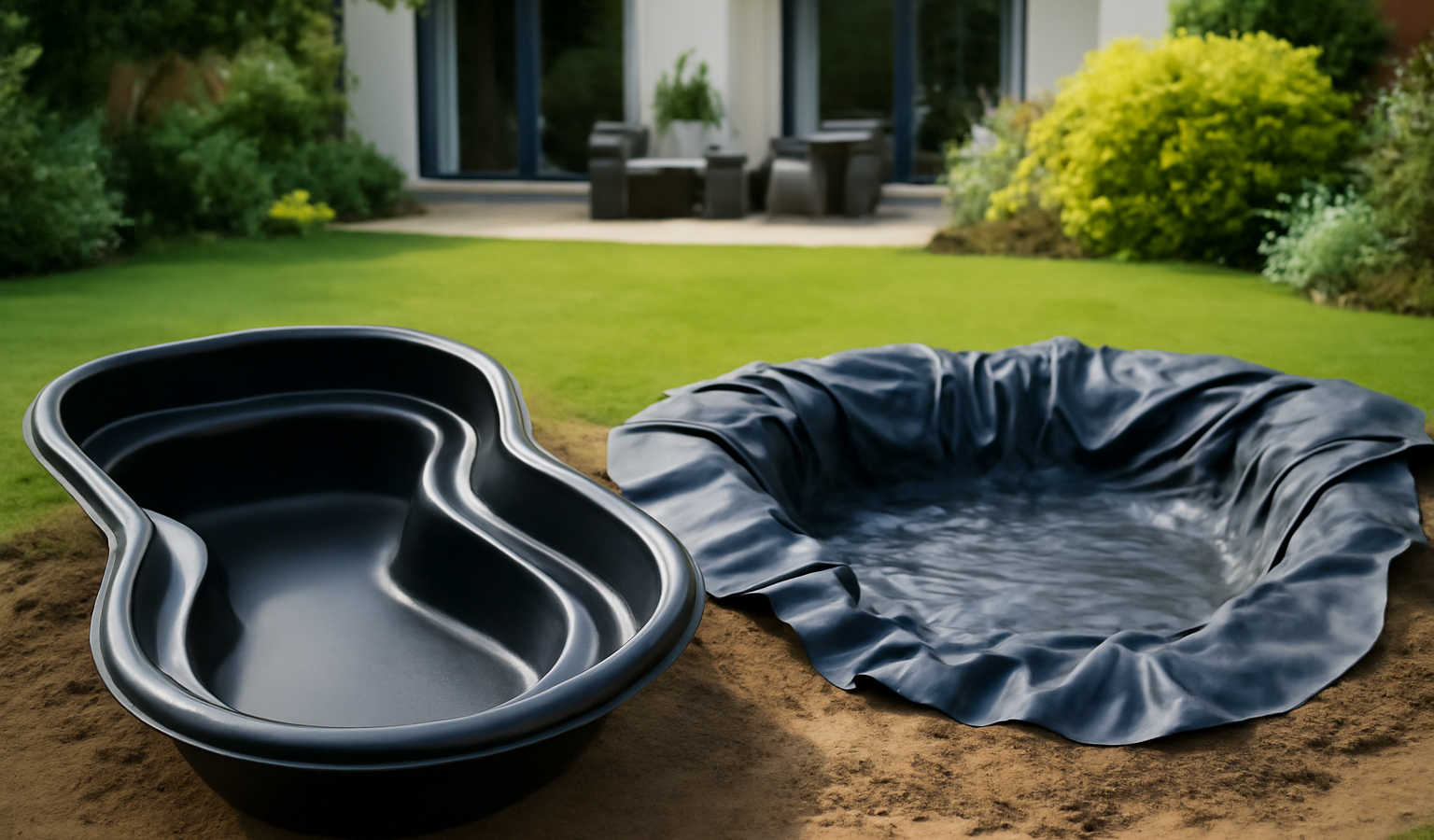
Deciding to add a pond to your garden is the easy part. The first real fork in the road is how to build the basin itself, and it comes down to two options: drop in a rigid preformed shell, or dig a hole and line it with a flexible membrane. Both create a watertight pond, both can support plants and fish, and both are sold side by side at every water-garden supplier — but they lead to very different projects, budgets, and finished ponds. A preformed pond is a molded plastic or fiberglass shell with a fixed shape and depth that you set into an excavation. A liner pond is built by excavating whatever shape you want and draping a flexible rubber or PVC liner into it. The preformed shell is faster and more foolproof but locks you into a small, fixed design. The liner is more work to install correctly but lets you build a pond of almost any size and contour, often at a lower cost per gallon. This guide compares the two on cost, size potential, installation difficulty, durability, and suitability for fish so you can choose the right approach before you pick up a shovel.
Part of our Ponds & Water Gardens guide →
In this guide
Key Takeaways
- Preformed ponds are rigid molded shells — fast and beginner-friendly to install, but fixed in shape, usually small (under ~300 gallons), and shallow.
- Liner ponds use a flexible membrane over any excavated shape — far more flexible in size and design, often cheaper per gallon for large ponds, but harder to install correctly.
- For fish, especially koi, liner ponds win because you can build the depth (24+ inches, ideally 3 feet) and volume they need.
- Use quality 45-mil EPDM rubber liner with an underlayment; it lasts 20+ years and resists punctures far better than cheap PVC.
- Preformed suits small, simple, low-budget projects; liner suits anything large, deep, custom-shaped, or stocked with serious fish.
| Factor | Preformed Pond | Liner Pond |
|---|---|---|
| What it is | Rigid molded plastic/fiberglass shell | Flexible membrane over an excavated hole |
| Size range | Small, typically 50–300 gallons | Any size, hundreds to thousands of gallons |
| Shape & depth | Fixed by the mold; often shallow | Fully custom; can be deep |
| Install difficulty | Easier; leveling the shell is the main challenge | Harder; excavation, underlayment, fitting |
| Cost | Lower upfront for small ponds | Cheaper per gallon at larger sizes |
| Durability | 10–20 yrs; can crack, heave, or warp | 20+ yrs for quality EPDM rubber |
| Best for fish | Goldfish in larger shells; not koi | Koi and goldfish — depth and volume available |
| Repairs | Hard — cracks are tough to fix | Patchable with liner repair kits |
Preformed Ponds: Fast and Foolproof
A preformed pond is a pre-molded basin — usually high-density polyethylene or, at the higher end, fiberglass — with a fixed shape, built-in shelves for marginal plants, and a set depth. Its appeal is simplicity. The shape is decided for you, the structure is rigid, and installation is mostly a matter of digging a hole that matches the shell, leveling it perfectly, and backfilling around the sides. For a first-time pond builder who wants a tidy water feature without engineering a custom excavation, a preformed shell removes a lot of decisions and a lot of room for error.
The single most important and most underestimated step with a preformed pond is leveling. Because the shell is rigid, any unevenness shows immediately as a slanted, exposed lip on the high side, and an unsupported edge can crack under the weight of water. You need to dig a hole slightly larger than the unit, create a firm, level base of compacted sand, set the shell, check level in every direction with a long board and spirit level, and then backfill the gaps with sand or fine soil in stages as you fill the pond with water so the sides are fully supported. Rush the leveling and you will fight the result for the life of the pond.
The real limitations are size and depth. Most preformed ponds top out around 200 to 300 gallons and are fairly shallow, which constrains both what you can plant and what you can stock. Shallow water heats and cools fast and can freeze solid in winter or overheat in summer, stressing fish. Quality varies, too: thin polyethylene shells can warp in the sun before installation, heave with frost, or crack over a decade, and a cracked rigid shell is genuinely difficult to repair. Fiberglass lasts longer but costs considerably more. Preformed ponds are best understood as small, simple, relatively short-to-medium-term features rather than large or fish-serious builds.
Liner Ponds: Flexible and Scalable
A liner pond is built the opposite way: you decide the shape, size, and depth, excavate it, and then drape a single flexible membrane into the hole to hold the water. The liner conforms to whatever you dig, so you are free to create gentle curves, planting shelves at multiple depths, a deep central zone for fish, and a natural irregular outline that looks far less like a piece of plastic dropped in the lawn. This freedom is the whole reason serious water gardeners favor liners — you are not limited by what a factory molded.
The material matters enormously. The standard choice is 45-mil EPDM rubber liner, which is flexible, fish-safe, UV-stable, and lasts well over twenty years; it folds easily into corners and shelves and resists cracking in cold. Cheaper PVC liners cost less but are stiffer, less UV-resistant, and more prone to becoming brittle and failing over time. Whatever liner you choose, lay a protective underlayment — a geotextile fabric or even old carpet — beneath it to cushion against roots and sharp stones, the most common cause of punctures. A well-installed EPDM liner over good underlayment is the most durable basin option on this list, and if it ever does get punctured, it patches readily with a liner repair kit.
The trade-off is labor and care during installation. Excavation is real work, especially for a large or deep pond, and you have to dig clean shelves, remove every sharp stone and root, and fold the liner neatly. Calculating liner size takes a simple formula: length plus twice the maximum depth, by width plus twice the maximum depth, with a couple of feet added all around for overlap. Once filled, the liner edge is hidden under a border of flat stones or plants. It is more involved than dropping in a shell, but the payoff is a pond exactly the size, shape, and depth you want.
Choosing for Plants, Fish, and Budget
If you want fish — especially koi
Fish need volume and depth, and that tilts strongly toward liner ponds. Goldfish can manage in a larger preformed shell, but koi need a minimum of about 24 inches of depth and ideally 3 feet or more, plus hundreds to thousands of gallons of stable water — depth that preformed ponds rarely offer. Deeper water also resists summer overheating and gives fish a refuge that does not freeze solid in winter. If a stocked, healthy fish pond is your goal, build a liner pond sized for the fish, and read up on keeping fish through the cold months in our guide to protecting pond fish in winter.
If you want a small, simple water feature
For a modest patio or border pond with a few marginal plants and maybe a couple of goldfish, a preformed shell is a perfectly sensible, lower-effort choice. The fixed shape and quick install get you water and plants in a weekend, and at small sizes the upfront cost is competitive. Just commit to leveling it properly and accept its depth limits.
If budget per gallon matters
Counterintuitively, liner ponds usually cost less per gallon as the pond grows. A preformed shell’s price climbs steeply with size and the largest units are expensive, whereas a roll of EPDM liner covers a big excavation relatively cheaply. For anything beyond a few hundred gallons, the liner approach almost always delivers more pond for the money — your labor is the trade you make for that savings.
Don’t forget filtration and pumps
Whichever basin you build, a healthy pond with fish needs circulation and filtration. Size a pump to turn over the full pond volume at least once per hour, and add a biological filter scaled to your fish load. Aquatic plants like water lilies and submerged oxygenators help balance the water, shade it against algae, and provide cover. The basin is only the container — the living system is what keeps it clear and healthy.
The Verdict
Choose a preformed pond when you want a small, simple water feature built fast with minimal risk of installation mistakes, you are happy with a fixed shape and modest depth, and you are not planning to keep koi. It is the friendlier project for a beginner and a fair value at small sizes — just level it meticulously and respect its depth limits. Choose a liner pond for anything larger, deeper, custom-shaped, or built to hold serious fish. A quality 45-mil EPDM liner over good underlayment gives you a more durable, more flexible, and ultimately more rewarding pond, usually at a lower cost per gallon, in exchange for more careful excavation. For most gardeners dreaming of a real water garden with depth, lilies, and healthy fish, the liner is worth the extra effort. For a tidy accent pond by the patio, the preformed shell gets you there with less fuss. Match the basin to the pond you actually want, and build it once, properly.
Frequently Asked Questions
Is a preformed or liner pond easier to install?
Preformed ponds are generally easier because the shape is fixed and installation mostly involves digging a matching hole, leveling the shell perfectly, and backfilling. Liner ponds require excavating a custom shape, laying underlayment, fitting the liner neatly, and edging it — more steps and more skill. The trade-off is that liners give you far more design freedom.
Which pond is better for koi?
A liner pond, by a wide margin. Koi need at least 24 inches of depth — ideally 3 feet or more — and hundreds to thousands of gallons of stable water, which preformed shells rarely provide. The depth also keeps water from overheating in summer or freezing solid in winter. Build a liner pond sized for the fish if koi are your goal.
How long does a pond liner last?
A quality 45-mil EPDM rubber liner lasts well over 20 years and is fish-safe and UV-stable. Cheaper PVC liners are less durable and can become brittle over time. Laying a protective underlayment beneath the liner prevents punctures from roots and stones, and any puncture that does occur can be patched with a liner repair kit.
How do I calculate what size liner I need?
Use this formula: liner length = pond length + (2 × maximum depth) + about 2 feet for overlap; liner width = pond width + (2 × maximum depth) + about 2 feet. The extra footage lets the liner reach the bottom of the deepest point and still overlap the edges, where it gets anchored under border stones.
Why does my preformed pond have an uneven, exposed lip?
Almost always because the shell was not leveled properly during installation. Rigid shells reveal any unevenness as an exposed rim on the high side. The fix is to drain it, reset the shell on a firm, perfectly level sand base, check level in every direction, and backfill the sides with sand in stages as you refill so the edges are fully supported.