


The best microgreen seeds are fresh, untreated, high-germination seeds sold in quantities that match how often you grow. If you are just starting, a variety pack with radish, pea, sunflower and broccoli lets you find out which flavors you like. Once you have favorites, a 1 lb bulk bag of a single crop such as broccoli is far more practical. And if you plan to sprout seeds in a jar and eat them whole, choose seed that is certified organic and tested for pathogens, because raw sprouts carry a real food safety risk. We compared the current Amazon listings and picked seven seed packs that cover each need, using only what each listing states.
In this guide
- Microgreens vs Sprouts: Why It Matters for Seed Choice
- 1. Survival Garden Seeds 10-Variety Pack — Best Variety Pack for Trays
- 2. Organo Republic Broccoli 1 lb — Best Bulk Broccoli
- 3. Sereniseed Organic Salad Mix — Best for Safer Sprouting
- 4. Seedboy Organic Salad Blend — Best Jar Sprouting Blend
- 5. Rainbow Heirloom Superfood Mix — Best Colorful Tray Mix
- 6. Sow Right Superfood Mix Bulk — Best Windowsill Brassica Mix
- 7. Survival Garden Seeds 15-Variety Pack — Widest Flavor Range
- What to Look for in Microgreen Seeds
- Frequently Asked Questions
Disclosure: Urban Lotus Project earns a commission from qualifying Amazon purchases made through links on this page, at no extra cost to you.
How we compared: we compared 12 current Amazon microgreen and sprouting seed listings on what each listing states about varieties, quantity, certification, testing and growing method; we did not test or handle the products, and availability changes.
| Product | Best for | Key features | Buy |
|---|---|---|---|
| Survival Garden Seeds 10-Variety Pack | Best variety pack for trays |
| Buy now →Check current price |
| Organo Republic Broccoli 1 lb | Best bulk broccoli |
| Buy now →Check current price |
| Sereniseed Organic Salad Mix | Best for safer sprouting |
| Buy now →Check current price |
| Seedboy Organic Salad Blend | Best jar sprouting blend |
| Buy now →Check current price |
| Rainbow Heirloom Superfood Mix | Best colorful tray mix |
| Buy now →Check current price |
| Sow Right Superfood Mix Bulk | Best windowsill brassica mix |
| Buy now →Check current price |
| Survival Garden Seeds 15-Variety Pack | Widest flavor range |
| Buy now →Check current price |
Prices change often; check Amazon for today’s price. As an Amazon Associate we earn from qualifying purchases.
Seeds are only half the setup. If you also need trays, lids and media, our guide to the best microgreen growing kits covers complete starter sets, and our vegetable gardening guide covers growing these same crops to full size outdoors.
Microgreens vs Sprouts: Why It Matters for Seed Choice
Sprouts are seeds germinated in water, usually in a jar, and eaten whole, seed and root included, after a few days. Microgreens are grown in soil, coir or a mat under light for one to three weeks and cut above the growing surface. The same seed can often be used for both, and many listings below say so.
The difference matters for safety. The US Food and Drug Administration notes that if just a few harmful bacteria are present on a seed, they can grow to high levels during sprouting, and it advises people more vulnerable to foodborne illness, including young children, older adults, pregnant people and anyone with a weakened immune system, to avoid raw or lightly cooked sprouts of any kind. See the FDA’s guidance on selecting and serving produce safely. If you sprout in jars, favor seed sold specifically for sprouting with pathogen testing stated on the listing, and keep equipment clean.
1. Survival Garden Seeds 10-Variety Pack — Best Variety Pack for Trays

Ten heirloom microgreen seed packets: broccoli, pea, sunflower, radish, kale, arugula, beet, cabbage, buckwheat and alfalfa.
Check price on AmazonWhy We Like It
- Covers the big four: radish, pea, sunflower, broccoli
- Untreated, open-pollinated heirloom seed
- Separate packets make flavor testing easy
- Beginner instructions included
| Specification | Details |
|---|---|
| Varieties | 10: broccoli, pea, sunflower, radish, kale, arugula, beet, cabbage, buckwheat, alfalfa |
| Seed type | Heirloom, non-GMO, untreated, open-pollinated |
| Harvest | 7 to 14 days per listing |
| Includes | Seeds only; no tray or medium |
| Quantity per packet | Not stated in listing |
Survival Garden Seeds 10-variety pack — compressed specs
This is the most useful starter assortment on the shelf because it includes all four of the crops most growers settle on: crunchy pea shoots, nutty sunflower, spicy radish and mild broccoli. It adds beet for color, buckwheat and arugula, and keeps each crop in its own packet so you can sow them separately. That matters, because these crops grow at different speeds; radish is ready long before beet, and sunflower and pea need soaking first.
The listing describes the seed as untreated and open-pollinated, which is what you want for anything you will eat young. Per-packet quantities are not stated, so expect sampler amounts rather than bulk. Once you find a favorite, move to a bulk bag such as the Organo Republic broccoli below.
Pros
- Includes pea and sunflower, often missing from mixes
- Individual packets
- Untreated seed stated
Cons
- Packet sizes not stated
- No tray or medium
- Sampler quantities run out quickly
Check Survival Garden Seeds 10-Variety Pack price on Amazon
2. Organo Republic Broccoli 1 lb — Best Bulk Broccoli

A 1 lb resealable bag of non-GMO heirloom broccoli seed, listed at over 130,000 seeds and enough for up to 30 10x20 trays.
Check price on AmazonWhy We Like It
- Clear tray count for planning
- Works in soil, coir and hydroponics
- Resealable 1 lb bag
- Growing and cooking guides included
| Specification | Details |
|---|---|
| Crop | Broccoli |
| Quantity | 1 lb; over 130,000 seeds per listing |
| Yield guide | Up to 30 standard 10×20 trays |
| Seed type | Non-GMO, heirloom |
| Growing methods | Soil, coconut coir, hydroponic, countertop gardens |
Organo Republic broccoli seed — compressed specs
Broccoli is the most popular single microgreen for good reason: it is mild, grows quickly, and does well in almost any setup. Organo Republic’s listing is helpful for planning because it translates the weight into trays, up to 30 standard 10×20 flats. If you grow a tray a week, that is most of a year of harvests from one bag.
It is pitched for microgreens and for sprouting, and it is made in the USA by a small family-owned business according to the listing. Unlike Sereniseed, the listing does not mention pathogen testing, so we would use it for tray-grown microgreens rather than jar sprouts. Store the bag cool and dry to keep germination high.
Pros
- Large single-crop supply
- Practical tray-count guidance
- Versatile growing methods
Cons
- One crop only
- No pathogen testing stated
- Too much seed for occasional growers
Check Organo Republic Broccoli 1 lb price on Amazon
3. Sereniseed Organic Salad Mix — Best for Safer Sprouting

16 oz of alfalfa, radish, broccoli and red clover seed, certified organic by Oregon Tilth and tested for pathogens per listing.
Check price on AmazonWhy We Like It
- Listing states pathogen testing
- Certified organic by Oregon Tilth
- Germination and purity tested before packing
- Stored in a climate-controlled cooler
| Specification | Details |
|---|---|
| Seeds | Alfalfa, daikon radish, broccoli, red clover |
| Quantity | 16 oz |
| Certification | Organic, Oregon Tilth |
| Testing | Pathogens, germination and purity |
| Source | Sourced in the USA |
Sereniseed salad mix — compressed specs
For jar sprouting, where you eat the whole seed and root raw, Sereniseed’s listing is the most reassuring on the shelf. It is the only pick that explicitly states the seed is tested for pathogens, and it adds organic certification, germination and purity testing, and cold storage. Testing reduces risk but cannot eliminate it, so the FDA’s advice for vulnerable groups still applies.
The four-seed blend is a classic salad sprout mix: mild alfalfa and clover with peppery daikon and broccoli. It also grows well as microgreens on a tray. Nature Jim’s 1 lb organic salad mix on the same shelf offers a very similar blend in a larger bag, though its listing does not mention pathogen testing.
Pros
- Pathogen testing stated
- Certified organic
- Works for sprouts or microgreens
Cons
- No pea or sunflower
- Mixed seeds grow at slightly different rates
- Testing lowers but does not remove risk
Check Sereniseed Organic Salad Mix price on Amazon
4. Seedboy Organic Salad Blend — Best Jar Sprouting Blend

An 8 oz USDA Organic blend of alfalfa, broccoli, radish, mung bean and lentil, listed as making 8 quarts of sprouts.
Check price on AmazonWhy We Like It
- USDA Organic, certified by OTCO
- Grown and packed in the USA
- Mung and lentil add crunch
- Clear soak-and-rinse instructions
| Specification | Details |
|---|---|
| Seeds | Alfalfa, broccoli, radish, mung bean, lentil |
| Quantity | 8 oz; about 8 quarts or 32 servings |
| Certification | USDA Organic (OTCO) |
| Harvest | 5 to 7 days |
| Method | Soak 6 to 8 hours, rinse twice daily |
Seedboy salad blend — compressed specs
Seedboy’s blend is built for the jar, with a mix that gives a hearty, crunchy sprout thanks to the mung beans and lentils alongside the usual alfalfa, broccoli and radish. The listing gives clear instructions and a yield estimate of about 8 quarts from the 8 oz pouch. It describes batch quality testing for purity and cleanliness, though not pathogen testing in the explicit terms Sereniseed uses.
Because the larger legume seeds sprout faster than alfalfa, the blend is best eaten as sprouts rather than grown out as microgreens. A sprouting jar is not included.
Pros
- Certified organic, US grown
- Crunchy, filling blend
- Fast harvest
Cons
- Smaller 8 oz bag
- Better as sprouts than microgreens
- Jar sold separately
Check Seedboy Organic Salad Blend price on Amazon
5. Rainbow Heirloom Superfood Mix — Best Colorful Tray Mix
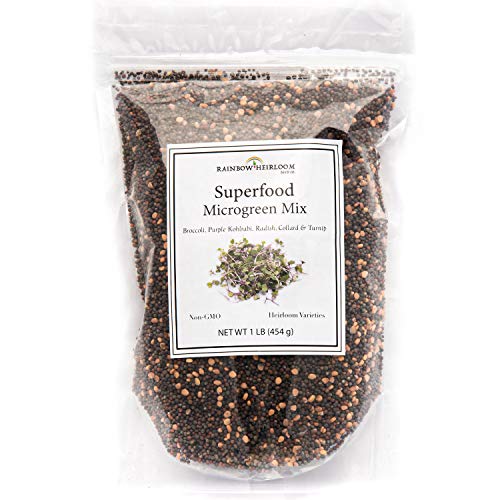
1 lb of named heirloom brassicas: Waltham 29 broccoli, Purple Vienna kohlrabi, Red Arrow radish, collard and turnip.
Check price on AmazonWhy We Like It
- Lists every variety by name
- Purple kohlrabi and red radish add color
- Grown and packed in the USA
- Honest note: designed for trays, not jars
| Specification | Details |
|---|---|
| Varieties | Waltham 29 broccoli, Purple Vienna kohlrabi, Red Arrow radish, Georgia Southern collard, Purple Top turnip |
| Quantity | 1 lb |
| Seed type | Heirloom, non-GMO |
| Method | Microgreen trays with medium |
| Origin | Grown and packed in the USA |
Rainbow Heirloom superfood mix — compressed specs
Rainbow Heirloom’s listing is unusually transparent, naming each variety and its botanical name. All five are brassicas that germinate and grow at similar speeds, so they mature together on one tray, which is what you want from a mix. Purple kohlrabi stems and red-tinged radish make a striking tray.
The listing is clear that this blend is for growing microgreens in a tray with medium and not for jars or countertop sprouters. That is a useful distinction: if you want sprouts, pick Sereniseed or Seedboy instead.
Pros
- Named varieties
- Uniform maturity on one tray
- Bulk 1 lb bag
Cons
- Not for sprouting jars
- All brassicas, so similar flavors
- No organic certification stated
Check Rainbow Heirloom Superfood Mix price on Amazon
6. Sow Right Superfood Mix Bulk — Best Windowsill Brassica Mix

About 7,000 seeds of red cabbage, kale and broccoli in one packet, ready in 8 to 12 days in soil or on a fiber mat.
Check price on AmazonWhy We Like It
- No fertilizer or grow light needed, per listing
- Grows in soil or on a fiber mat
- Germination guarantee offered
- Safe Seed Pledge company
| Specification | Details |
|---|---|
| Seeds | Red cabbage, kale, broccoli |
| Quantity | Minimum 1 oz, about 7,000 seeds |
| Harvest | 8 to 12 days |
| Medium | Thin soil layer or fiber mat |
| Light | Windowsill light sufficient per listing |
Sow Right superfood mix — compressed specs
Sow Right’s bulk packet is a good middle ground between a sampler and a 1 lb bag. The three brassicas grow together and the red cabbage adds purple color. The listing says a windowsill provides enough light, which is true for a short crop harvested at 8 to 12 days, though a grow light gives straighter, greener stems in winter.
Sow Right also sells a three-packet superfood collection and a larger ten-variety collection on the same shelf if you want to try individual crops. Read our guide to how to grow microgreens for seeding density and lighting tips.
Pros
- Simple setup
- Generous seed count for a packet
- Germination promise
Cons
- Smaller than 1 lb bags
- Only three crops
- No sprouting safety testing stated
Check Sow Right Superfood Mix Bulk price on Amazon
7. Survival Garden Seeds 15-Variety Pack — Widest Flavor Range

Fifteen untreated heirloom varieties including cilantro, amaranth, mustard, cress and mung bean, for soil or hydroponics.
Check price on AmazonWhy We Like It
- Fifteen crops, from mild to spicy
- Herb microgreens like cilantro included
- Red amaranth for color
- Detailed instructions on each packet
| Specification | Details |
|---|---|
| Varieties | 15, incl. broccoli, radish, kale, arugula, beet, amaranth, cilantro, mustard, lettuce, cress |
| Seed type | Heirloom, non-GMO, untreated, open-pollinated |
| Methods | Soil or hydroponic |
| Packets | Paper packets with planting and seed-saving info |
| Quantity per packet | Not stated in listing |
Survival Garden Seeds 15-variety pack — compressed specs
If you mainly grow microgreens for flavor and plating, this 15-variety pack offers the broadest palette on the shelf, adding cilantro, amaranth, mustard, lettuce and cress to the usual brassicas. Note that it drops pea and sunflower, which the 10-variety pack includes, so choose based on whether you want shoots or herbs.
Amaranth and cilantro are slower and fussier than radish, so expect a learning curve. If any tray starts to look fuzzy at the base, our guide on why microgreens mold will help you tell harmless root hairs from real mold.
Pros
- Widest variety on the list
- Herb and colorful options
- Untreated seed
Cons
- No pea or sunflower
- Small quantities per crop
- Some varieties are slow or tricky
Check Survival Garden Seeds 15-Variety Pack price on Amazon
What to Look for in Microgreen Seeds
Untreated seed
Garden seed is sometimes coated with fungicide. Never use treated seed for microgreens or sprouts. Look for listings that say untreated, or buy seed sold specifically for microgreens or sprouting.
Germination and freshness
Microgreens are sown densely, so poor germination leaves bare patches and invites mold. Buy from sellers that test germination and store seed cool and dry in an airtight container after opening.
Quantity
A standard 10×20 tray takes a lot of seed: small seeds like broccoli need roughly 1/2 to 1 ounce, while large seeds like peas and sunflowers take several ounces per tray. Samplers are for experimenting; 1 lb bags are for regular growers.
Organic and non-GMO labels
Certified organic seed is grown without synthetic pesticides and is inspected by a certifier. Non-GMO is a separate claim; our explainer on non-GMO seeds covers what those labels mean.
Crop timing
| Crop | Soak first? | Typical harvest | Flavor |
|---|---|---|---|
| Radish | No | About 6 to 10 days | Spicy |
| Broccoli, kale, cabbage | No | About 8 to 12 days | Mild |
| Pea shoots | Yes, 8 to 12 hours | About 10 to 14 days | Sweet, crunchy |
| Sunflower | Yes, 8 to 12 hours | About 8 to 12 days | Nutty |
| Beet, amaranth, cilantro | Sometimes | About 14 to 21 days | Earthy or herbal |
Frequently Asked Questions
Can I use regular garden seeds for microgreens?
Yes, if they are untreated and fresh, but garden packets hold far too few seeds for dense sowing. Bulk microgreen seed is more practical.
What is the easiest microgreen to grow?
Radish and broccoli are the easiest. They germinate fast, need no soaking and are ready in about one to two weeks.
Are microgreens safer than sprouts?
Microgreens are cut above the growing surface and grown with light and airflow, while sprouts are eaten whole after sprouting in water. Use clean seed and equipment for both, and follow FDA advice on raw sprouts for vulnerable groups.
How long do microgreen seeds last?
Stored cool, dry and sealed, many microgreen seeds keep good germination for one to several years, depending on the crop. Test a small batch before sowing a full tray of old seed.
How much seed do I need per tray?
For a 10×20 tray, small seeds such as broccoli need roughly 1/2 to 1 ounce, while peas and sunflowers need several ounces. Follow the seller’s sowing guide.