

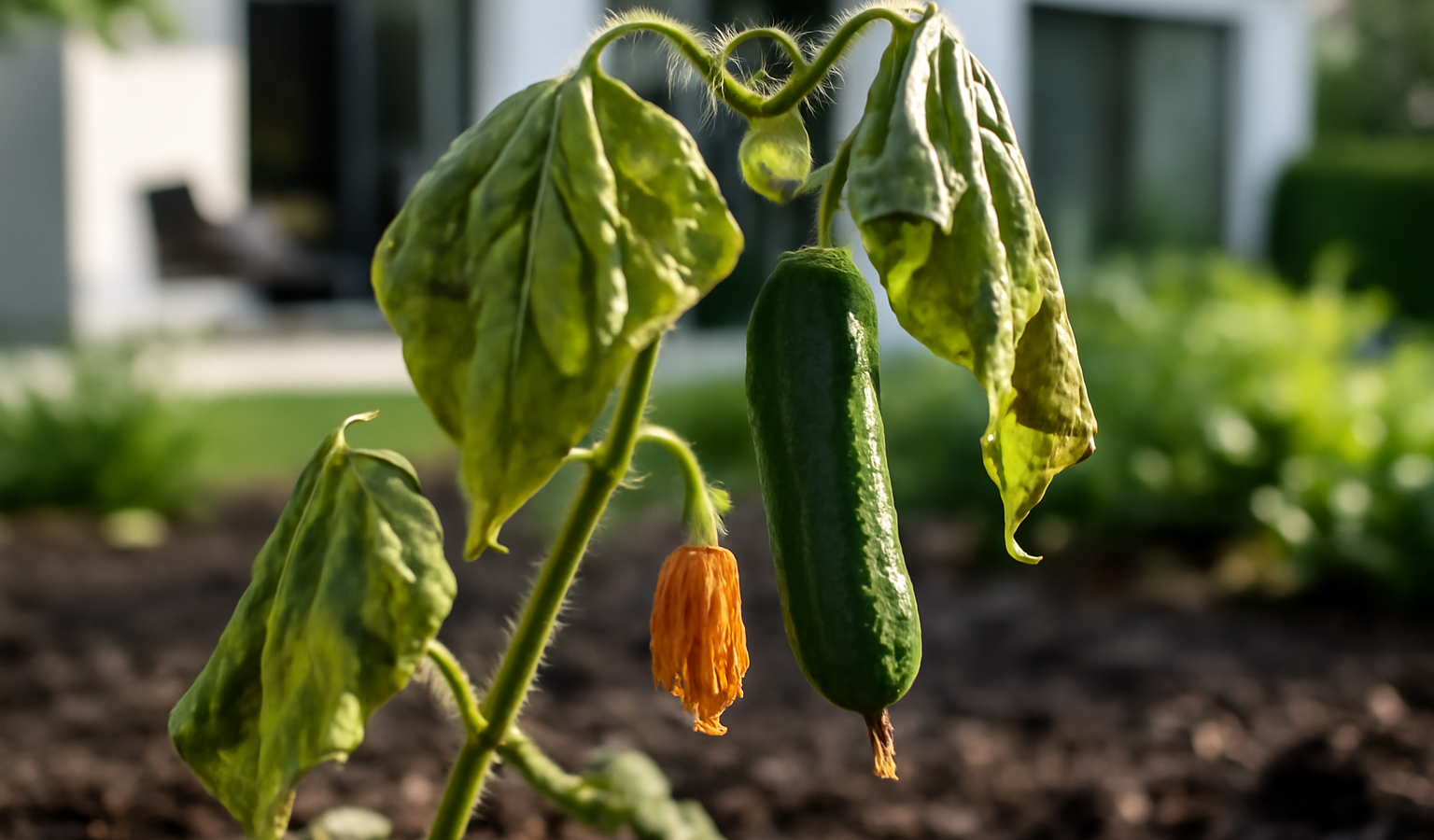
If your cucumber plant is wilting, the first thing to figure out is whether it recovers. A vine that droops in the afternoon heat and perks back up by evening is almost always just thirsty or stressed by the sun, and that is the most common, most harmless reason cucumbers wilt. But a vine that wilts and stays wilted, or collapses one runner at a time and never bounces back, is telling you something is wrong at the root or inside the stem. The two big killers are bacterial wilt, spread by cucumber beetles, and soilborne fungal wilts like Fusarium. There is a fast, free test you can do in 30 seconds to tell those apart, and I will walk you through it below.
Cucumbers are thirsty, fast-growing plants with big leaves and shallow roots, which makes them dramatic wilters. That drama works in your favor as a diagnostic tool: the timing of the wilt, whether it recovers, which leaves are affected, and what the cut stem looks like all point to different causes. Below I cover the six reasons a cucumber plant wilts, in roughly the order you should suspect them, with a clear diagnose step and a fix for each. Run through them top to bottom and you will land on your answer.
Key Takeaways
- Midday wilting that recovers by evening is normal heat stress, not disease. Check soil moisture 2 to 3 inches down before doing anything else.
- Do the stem test: cut a wilted stem, touch the cut sap, and pull your finger away slowly. Sticky white strings that stretch an inch or more mean bacterial wilt, and there is no cure.
- Bacterial wilt is spread by cucumber beetles, so beetle control is wilt prevention. Floating row covers are your strongest tool until flowering.
- Wilting that starts on one side or one runner, with brown streaks inside the stem, points to soilborne Fusarium or Verticillium fungus. Rotate cucurbits out of that bed for three or more years.
- Soggy, poorly drained soil rots roots and causes wilting too. Cucumbers want 1 to 2 inches of water a week, deep and consistent, not constantly waterlogged.
Cause 1: Underwatering and Heat Stress (Start Here)
This is the cause to rule out first because it is by far the most common and the only one that is essentially harmless. Cucumber leaves are large and thin, and on a hot, sunny afternoon they lose water through transpiration faster than the roots can pull it up from the soil. The plant wilts to reduce its exposed surface area and conserve moisture. This is a protective reflex, not a sign of death. If the same plant looks lush and upright again at 7 in the evening or first thing the next morning, you are watching normal heat stress and the plant is fine.
Diagnose
Note the timing. Temporary wilting that appears in the heat of the day, roughly noon to 4 p.m. when temperatures climb above 85 to 90 degrees Fahrenheit, and resolves on its own in the cool of evening is heat stress. Then check the soil, because true underwatering produces the same daytime wilt but the plant struggles to recover even overnight. Push your finger or a trowel 2 to 3 inches down into the root zone. If it comes out dry and dusty at that depth, the plant is genuinely short on water. Soil that is moist and cool 2 to 3 inches down means water is not the limiting factor and you should move on to the next cause. A cheap moisture meter works too, but your finger is free and reliable.
Fix
Water deeply and consistently. Cucumbers need 1 to 2 inches of water per week, and more in the heat of summer or in containers, which dry out fast. The goal is to wet the soil down 6 to 8 inches so roots grow deep rather than staying shallow and vulnerable. Water in the early morning so the plant goes into the heat of the day fully charged and the foliage dries quickly, which discourages fungal disease. Avoid frequent shallow sprinkles, which keep roots near the surface where they bake.
- Lay down 2 to 3 inches of organic mulch, such as straw or shredded leaves, to keep the root zone cool and slow evaporation. This alone can cut your watering needs nearly in half.
- Use drip irrigation or a soaker hose on a timer to deliver even, deep moisture without wetting the leaves.
- For container cucumbers, expect to water once or even twice daily in midsummer, since pots can dry out completely between mornings.
- If only afternoon wilting remains after the soil is consistently moist, accept it. It is cosmetic, and the plant is managing its own water budget.
Cause 2: Bacterial Wilt (The Classic Cucumber Killer)
If your soil is moist and the plant still wilts and does not recover, suspect bacterial wilt. This is the disease that breaks cucumber growers’ hearts. It is caused by the bacterium Erwinia tracheiphila, which is carried and transmitted by cucumber beetles when they feed on the leaves. Once inside, the bacteria multiply in the plant’s vascular system, the internal plumbing that moves water up the stem, and physically clog it. The plant can no longer move water no matter how wet the soil is, so it wilts. There is no cure. A plant with bacterial wilt is lost, and the only question is how fast it goes.
Diagnose
The progression is telling. It usually begins with one leaf or one runner wilting while the rest of the plant looks fine, often the leaf where a beetle fed. Within a few days more leaves and runners collapse, and eventually the whole vine wilts and dies, even with plenty of water. The wilting does not reverse overnight. To confirm it, do the stem test, which is the single most useful diagnostic trick for cucumbers:
- Cut through a wilted stem near the base with a clean, sharp knife.
- Press your thumb or fingertip flat against the freshly cut surface so it contacts the oozing sap.
- Slowly pull your finger straight away from the cut.
- If thin, sticky, white or milky strings stretch out between your finger and the stem, sometimes an inch or more before they snap, that is the bacterial ooze. You have bacterial wilt, confirmed.
Healthy stem sap, or the sap from a fungal-wilt plant, will be watery and will not draw out into those telltale gummy threads. This test is reliable enough that experienced growers rarely need anything more.
Fix
There is no fix for an infected plant. Remove it immediately and destroy it, by bagging it for the trash or burning it where allowed. Do not compost it, because the bacteria can persist. Pulling the plant promptly matters because the cucumber beetles feeding on a sick plant pick up the bacteria and carry it to your healthy plants, so a dying vine is a disease reservoir sitting in your garden.
- Control cucumber beetles aggressively. Since they are the only vector, no beetles means essentially no bacterial wilt. See the beetle section below for tactics.
- Plant resistant or tolerant varieties. Many modern cucumber types carry some resistance, and bitter-free or beetle-resistant cultivars are bothered less.
- Choose vigorous hybrids over heirlooms in regions where beetles and bacterial wilt are a known annual problem.
Cause 3: Fusarium and Verticillium (Soilborne Fungal Wilts)
If the stem test comes back negative, no sticky strings, but the plant is still wilting and dying with moist soil, the culprit is likely a soilborne fungal wilt, most often Fusarium and occasionally Verticillium. These fungi live in the soil, enter through the roots, and grow up into the vascular system, clogging it from the inside much like the bacteria do, but more slowly. They are persistent in soil for years, which is why this problem tends to recur in the same bed.
Diagnose
Fungal wilt typically shows yellowing along with the wilting, and it often starts on one side of the plant or affects the lower and older leaves first before moving up. The yellowing-then-wilting pattern, especially lopsided, is the clue that separates it from bacterial wilt, which tends to wilt green leaves without much yellowing at first. For confirmation, cut the main stem near the base and look at the cross-section. Fungal wilt leaves brown or reddish-brown streaking and discoloration in the vascular ring just under the surface, the tissue that should look clean and pale green or white. That internal browning is the fungus living in the water-conducting tissue.
Fix
There is no mid-season cure. Remove and destroy affected plants the same way you would for bacterial wilt, and do not compost them. The real fight is in prevention for next season, and it centers on the soil.
- Rotate crops. Do not plant cucumbers, melons, squash, or other cucurbits in the same spot for at least 3 years, and longer if you can manage it, to starve the soil fungus of its host.
- Plant resistant varieties. Look for cultivars labeled with disease resistance codes, and choose them if your soil has a known history of wilt.
- Improve drainage and avoid working the soil when it is wet, which spreads spores. Solarizing the bed with clear plastic in peak summer can knock back fungal populations in the top few inches.
- Keep plants vigorous with good nutrition, since healthy, fast-growing roots better resist fungal invasion. For another example of how plant stress shows up in the fruit itself, see how growing conditions affect berry size in our guide on why your strawberries are small.
Cause 4: Cucumber Beetles and Squash Vine Borers
Insects cause wilting two ways: directly, by damaging roots and stems, and indirectly, by spreading disease. Cucumber beetles, both the striped and spotted kinds, are the worst offenders. They chew leaves and stems, feed on roots as larvae, and most importantly they are the living delivery system for the bacterial wilt described above. Squash vine borers are a related menace on the broader cucurbit family. They are less common on true cucumbers than on squash and pumpkins, but they tunnel into the base of stems, and a borer-girdled stem wilts suddenly above the damage.
Diagnose
Look for the beetles themselves, about a quarter inch long, yellow with black stripes or black spots, often clustered in flowers and on the undersides of leaves in the morning. Ragged holes chewed in leaves and scarring on stems are signs of heavy feeding. For vine borers, check the base of a suddenly wilted stem for a small entry hole surrounded by sawdust-like frass, the wet orange-brown excrement they push out as they tunnel. Slit the stem lengthwise above the hole and you may find a fat white grub inside.
Fix
- Cover young plants with floating row covers from transplanting until they begin to flower. This physically blocks beetles and borers during the most vulnerable stage. Remove the covers once flowers open so bees can pollinate.
- Hand-pick beetles in the cool of early morning when they are sluggish, dropping them into soapy water.
- Use yellow sticky traps to monitor and reduce beetle numbers, since they are drawn to yellow.
- For severe infestations, targeted insecticides labeled for cucumber beetles applied in the evening, after bees have stopped foraging, can knock populations down. Always follow the label.
- For vine borers, you can sometimes save a plant by slitting the stem, removing the grub, and burying that section of stem to encourage new rooting.
Cause 5: Root Rot, Overwatering, and Poor Drainage
It feels backward, but too much water causes wilting just like too little. When soil stays soggy, the air pockets roots need to breathe fill with water, the roots suffocate, and opportunistic root-rot fungi move in and turn them to mush. Dead and rotting roots cannot take up water, so the plant wilts even though it is sitting in wet soil. This is common in heavy clay soils, in beds with poor drainage, in low spots that puddle after rain, and in containers without adequate drainage holes.
Diagnose
The combination to watch for is a wilting plant in wet soil, with yellowing that begins on the lower, older leaves. Dig gently at the root zone, or tip a container plant out of its pot. Healthy cucumber roots are firm, pale, and white to cream colored. Rotting roots are brown or black, soft and mushy, and may smell sour or rotten and slip apart when you touch them. If you find that, overwatering or poor drainage is your problem, not disease in the stem.
Fix
- Let the soil dry out before watering again, and then water deeply but less often. Aim for that steady 1 to 2 inches a week rather than a little every day.
- Improve drainage by amending heavy soil with compost, and grow in raised beds or mounded rows where water pools. Cucumbers love rich, well-drained soil.
- Make sure containers have ample drainage holes and never let pots sit in saucers of standing water.
- A plant with extensive root rot may not recover, but catching it early, drying the soil, and improving drainage can save a mildly affected plant.
Cause 6: Transplant Shock
If your cucumber wilted within a day or two of going into the ground, the cause is almost certainly transplant shock, not disease. Cucumbers resent root disturbance, and moving a seedling from the gentle conditions of a tray or greenhouse straight into full sun, wind, and fluctuating soil temperatures is a jolt. The fine feeder roots get damaged in transplanting and cannot immediately supply enough water to the leaves, so the plant wilts while it re-establishes. This is temporary if you handle it right.
Diagnose
The timing gives it away. Wilting that begins immediately after transplanting a young plant, especially one that was not hardened off, with no signs of beetle damage, no internal stem browning, and no negative stem test, is transplant shock. Seedlings moved on a hot, sunny, windy day are the most likely to flop. A plant grown from seed sown directly in the bed will not have this problem.
Fix
- Harden off seedlings before planting by setting them outside for gradually longer periods over 7 to 10 days, so they adjust to sun and wind before the move.
- Transplant in the evening or on an overcast day so the plant has cool, low-stress hours to settle in before facing direct sun.
- Water thoroughly right after planting to settle soil around the roots and remove air pockets.
- Provide temporary shade with a cloth, an upturned basket, or a shade cloth for the first few days, and keep the soil consistently moist. Most plants recover within a few days. Cucumbers grow best when soil temperatures are at least 60 to 70 degrees Fahrenheit, so do not rush transplants into cold spring ground.
Preventing Cucumber Wilt Next Season
Most cucumber wilt is preventable with a handful of habits, and the same practices that stop wilt also produce healthier, more productive vines. Build these into your routine and you will spend far less time diagnosing collapsed plants.
- Control beetles from day one. Since cucumber beetles drive the deadliest wilt, this is the highest-value prevention. Use floating row covers from transplanting until flowering, then remove them so pollinators can reach the blooms. Without pollination you get no fruit, so timing the removal matters.
- Rotate your cucurbits. Move cucumbers, squash, melons, and pumpkins to a new bed each year, with at least a 3-year gap before any cucurbit returns to a bed, to break the life cycle of soilborne fungal wilts.
- Choose resistant varieties. Especially if you have battled wilt before, start with cultivars bred for disease resistance and beetle tolerance. It is the easiest win available.
- Water consistently and deeply. Provide that steady 1 to 2 inches per week. Drip irrigation or a soaker hose keeps moisture even, keeps foliage dry, and prevents both the underwatering and the overwatering extremes that stress plants.
- Mulch and feed. A 2 to 3 inch layer of mulch stabilizes soil moisture and temperature, and steady nutrition keeps plants vigorous enough to shrug off minor stress.
Bolting and premature collapse from heat stress affect plenty of summer crops, not just cucumbers. If you grow cool-season vegetables nearby, you may run into a related heat problem covered in our guide on why your broccoli is bolting. For more growing guides across the garden, browse our Plants & Flowers hub.
Frequently Asked Questions
Will my cucumber plant recover from wilting?
It depends on the cause. If it wilts in the afternoon heat and bounces back by evening, it is fine and will recover daily on its own. If it wilts and stays wilted with moist soil, and the stem test shows sticky white strings, it has bacterial wilt and will not recover. Fungal wilt and severe root rot are also usually fatal mid-season, while transplant shock and simple underwatering are fully recoverable once you correct the cause.
How do I tell bacterial wilt from a fungal wilt?
Cut a wilted stem and do the stem test: touch the cut sap and slowly pull your finger away. Sticky, milky strings that stretch an inch or more mean bacterial wilt. No strings, but brown or reddish streaking inside the stem cross-section and yellowing that starts on one side, points to a soilborne fungal wilt like Fusarium. Bacterial wilt is spread by beetles; fungal wilt comes from the soil.
Why does my cucumber wilt only in the afternoon but look fine in the morning?
That is normal heat stress. On hot, sunny afternoons the large leaves lose water faster than the roots can replace it, so the plant droops to conserve moisture, then recovers in the cool of evening. As long as the soil is moist 2 to 3 inches down, the plant is healthy and you do not need to do anything beyond keeping watering consistent and mulching to cool the roots.
Can I save a cucumber plant with bacterial wilt?
No. There is no cure once the bacteria have clogged the plant’s vascular system. Remove and destroy the infected plant promptly so feeding beetles cannot pick up the bacteria from it and carry it to your healthy plants. Focus your effort on beetle control and resistant varieties to protect the rest of your patch.
How much should I water cucumbers to prevent wilting?
Aim for 1 to 2 inches of water per week, delivered deeply so the soil is moist down 6 to 8 inches, and more often during heat waves or for container plants. Water in the early morning with drip irrigation or a soaker hose to keep foliage dry and discourage disease, and use 2 to 3 inches of mulch to hold moisture. Avoid both bone-dry soil and constantly soggy soil, since each causes wilting.