

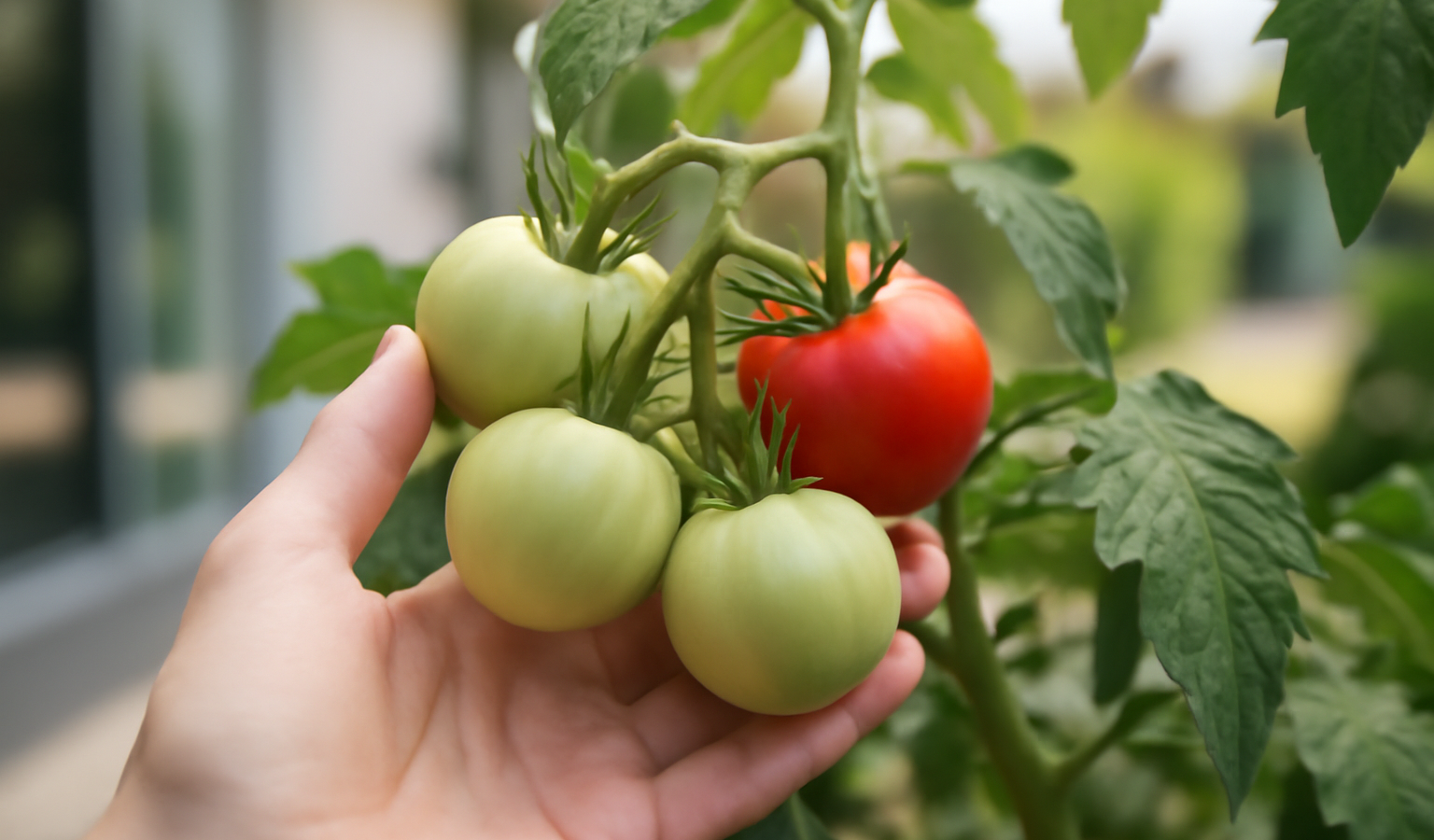
If your tomatoes are not turning red, the single most common reason is temperature: the pigments that make a tomato red, lycopene and carotene, simply stop forming once daytime highs climb above about 85 to 90°F or once nights drop below about 50°F. Tomatoes ripen best in a fairly narrow window, roughly 68 to 77°F, so a heat wave or an early cold snap can freeze fruit in place at the green or pale-orange stage for days or weeks. Heat is not the only culprit, though. Excess nitrogen, a vine carrying too much fruit, and a variety that simply needs more days to mature can all stall ripening. Below you will find the five most likely causes, how to tell them apart, and exactly what to do about each one.
Part of our Vegetable Gardening & Raised Beds guide →
In this guide
- Cause 1: Too much heat is shutting down the red pigment
- Cause 2: The variety simply needs more time to mature
- Cause 3: Too much nitrogen is feeding leaves instead of fruit
- Cause 4: The vine is overcrowded with too much fruit
- Cause 5: Cool temperatures at the end of the season have stalled ripening
- How to prevent slow-ripening tomatoes next time
- Frequently Asked Questions
Key Takeaways
- Tomatoes ripen best at 68 to 77°F; above ~85 to 90°F they stop making the red pigment lycopene and stay green or orange.
- Cool weather below ~50°F at night also halts ripening, so late-season green fruit may never color up outdoors.
- Too much nitrogen pushes leafy growth at the expense of flowering and fruit ripening, even on healthy-looking plants.
- A vine overloaded with fruit ripens slowly; thinning, topping, and reducing water near the end of the season speeds things up.
- Mature green tomatoes will ripen reliably indoors at 65 to 70°F, especially alongside ethylene-producing fruit like a banana or apple.
Cause 1: Too much heat is shutting down the red pigment
This is the number one reason gardeners see big, full-sized tomatoes that stubbornly refuse to turn red in midsummer. A tomato develops its red color from two pigments, lycopene and carotene, and the plant only manufactures them within a comfortable temperature band of roughly 50 to 85°F, with the sweet spot for ripening sitting around 68 to 77°F. When daytime temperatures push past 85 to 90°F, and especially when nights stay above 75°F, lycopene production slows dramatically or stops altogether. The fruit may soften and reach full size, but it locks in at green, yellowish, or a dull orange instead of deep red. This is why tomatoes often seem to stall during the hottest stretch of summer and then ripen in a rush once a cooler week arrives.
How to diagnose it
Check your recent daytime highs and overnight lows. If you have had a run of days above 85 to 90°F, heat is almost certainly the answer, particularly if the fruit is full-sized and mature but only coloring to orange or yellow. A classic tell is fruit that ripens unevenly, with the shoulders near the stem staying hard, green, or yellow while the bottom blushes. That pattern, sometimes called yellow shoulder, is strongly linked to heat and intense sun on the fruit. If the plant otherwise looks healthy and the green fruit is large, you can rule out most other causes and point the finger at temperature.
How to fix it
You cannot lower the air temperature, but you can manage the heat load and harvest smartly. First, do not strip leaves to “let the sun in.” The foliage shades the fruit and protects it from scald; tomatoes ripen from the inside out and do not need direct sun on the skin to turn red. If anything, drape 30 to 50 percent shade cloth over the plants during the worst of a heat wave. Second, pick fruit at the breaker stage, the moment a green tomato shows the first hint of color at the blossom end, and finish ripening it indoors at 65 to 70°F out of direct sun. Tomatoes harvested at breaker ripen to full flavor on the counter and free the plant to push energy into the remaining fruit. Keep watering consistent so heat-stressed plants do not also fight drought.
Cause 2: The variety simply needs more time to mature
Sometimes the plant is doing nothing wrong, it just is not finished yet. Every tomato variety carries a days-to-maturity figure, the number of days from transplant to first ripe fruit, and these range widely. Quick determinate types like Early Girl can ripen in 50 to 60 days, while big beefsteaks and many heirlooms need 80 to 90 days or more. If you planted late, started from a small transplant, or chose a long-season variety, your green fruit may still be on schedule even when it feels like it is taking forever. Large-fruited tomatoes in particular can sit at full green size for two to three weeks before they begin to color, because the plant has to ripen a lot of mass.
How to diagnose it
Find the variety name and look up its days to maturity, then count back to your transplant date. If you are inside that window, patience is the cure. Also look at fruit size: if your tomatoes have only recently reached full size, they are likely in the normal green-mature holding phase and will start to blush soon under reasonable temperatures. A determinate variety sets and ripens most of its crop in a tight two- to three-week window, so a wave of green fruit ripening together is expected behavior rather than a problem. Indeterminate vines, by contrast, ripen a few fruit at a time over a long season.
How to fix it
The fix is mostly planning for next year: in short-season climates, choose early varieties with maturity under 70 days, and start seeds indoors six to eight weeks before your last frost so plants go out at a good size. For this season, make sure the plant is not distracted by new growth it cannot finish. Once you are six to eight weeks from your first expected fall frost, pinch off any new flowers and tiny fruit, since they will not have time to ripen anyway, and let the plant concentrate on the fruit already set. For more on matching crops to your conditions and season length, see the Plants & Flowers hub.
Cause 3: Too much nitrogen is feeding leaves instead of fruit
A tomato plant that looks lush, tall, and dark green but carries little ripening fruit is often the victim of too much nitrogen. Nitrogen drives vegetative growth, leaves, stems, and that vigorous jungle look, but when it is in excess the plant pours its energy into foliage at the expense of flowering and ripening. You can end up with a beautiful green plant and frustratingly slow, sparse fruit. This frequently happens when gardeners use a high-nitrogen lawn fertilizer or compost-rich beds and keep feeding through the season, or when a balanced fertilizer is applied too heavily once fruit has already set.
How to diagnose it
Look at the ratio of leaf to fruit. Excess nitrogen produces thick, deep-green, leathery leaves and a tall plant with strong stems but relatively few flowers and slow-ripening fruit. Review your fertilizer habits: if you have been applying a product with a high first number in its N-P-K ratio, such as a 24-8-16 or a lawn feed, nitrogen overload is likely. Curling or rolling of the lower leaves can also accompany rapid lush growth. If the plant is enormous and green yet your tomatoes refuse to ripen, suspect feeding before you suspect the weather.
How to fix it
Stop applying any nitrogen-heavy fertilizer immediately. Once tomatoes are flowering and setting fruit, switch to a product higher in phosphorus and potassium and lower in nitrogen, the kind often labeled for tomatoes and vegetables, and apply it at the lighter end of the recommended rate. You cannot pull nitrogen back out of the soil quickly, but cutting off the supply lets the plant rebalance over the following weeks. Going forward, get a basic soil test before the season so you feed only what the bed actually needs, and reserve rich, high-nitrogen amendments for leafy crops rather than fruiting ones.
Cause 4: The vine is overcrowded with too much fruit
A single tomato plant has a finite amount of energy to spend, and a vine carrying dozens of fruit at once will ripen each one more slowly than a plant carrying a moderate load. When clusters are packed tightly and the plant is also putting out new growth and new flowers, ripening becomes a bottleneck. Overcrowding between plants makes this worse: when tomatoes are spaced too close, they shade each other, compete for light and nutrients, and trap humidity, all of which slows the ripening process and invites disease. The result is a wall of green fruit that all seems frozen in place.
How to diagnose it
Step back and look at the plant. If it is densely loaded with green fruit, heavily branched, and still flowering vigorously, the plant is spreading its resources too thin. Check spacing too: tomatoes generally want about 18 to 36 inches between plants depending on type, and rows that have grown into a tangled hedge are a sign of overcrowding. If your green tomatoes are full-sized and the weather is in the ripening range yet nothing is coloring, an overloaded, overgrown vine is a likely contributor.
How to fix it
Concentrate the plant’s energy. Late in the season, top the plant by cutting off the growing tips and remove new flowers so no energy goes into fruit that cannot finish. Thin out some of the smallest fruit and prune excess leafy growth and suckers to open the canopy to air and light. On indeterminate vines, removing the topmost clusters lets the plant funnel sugars into the fruit lower down. Slightly reducing water in the final couple of weeks also nudges the plant from growing toward ripening. If you grow the same fix for curling leaves on related plants, the diagnostic logic mirrors our guide on why pepper leaves curl, where overcrowding and stress show up in similar ways.
Cause 5: Cool temperatures at the end of the season have stalled ripening
Just as too much heat halts ripening, so does too much cold. As autumn arrives and nights drop below about 50°F, tomato plants slow their metabolism and ripening grinds to a near stop, even though the green fruit is mature and full-sized. Daytime warmth is no longer enough if nights are chilly, and once the plant is exposed to a light frost the fruit and foliage are damaged. Many gardeners reach the end of the season with a plant full of beautiful green tomatoes that simply will not turn red because the weather has cooled past the ripening threshold.
How to diagnose it
Check the calendar and the overnight lows. If you are within a few weeks of your first fall frost and nights are routinely dipping into the 40s or low 50s°F, cold is the obstacle. The fruit will look mature, sometimes with a faint color change, but progress is stalled and frost is on the horizon. A frost forecast is your signal that the outdoor ripening season is effectively over and you need to act before the cold damages the crop.
How to fix it
Bring the ripening indoors. Pick all mature green tomatoes before the first hard frost, choosing ones that have reached full size and have a glossy rather than dull skin. Ripen them indoors at 65 to 70°F, out of direct sunlight, on a counter or in a paper bag or cardboard box. Tomatoes release ethylene gas as they ripen, so placing them near a ripe banana or apple, both strong ethylene producers, speeds the process. Check every couple of days and pull out any that soften or show spots. You can also pull the entire plant and hang it upside down in a cool, frost-free garage so the fruit continues to ripen on the vine for a week or two.
How to prevent slow-ripening tomatoes next time
Most ripening problems trace back to timing and feeding, so start there. Choose varieties whose days to maturity comfortably fit your growing season, leaning on early types if your summers are short or your falls arrive quickly, and start transplants early enough to go into the ground as sturdy plants. Feed with a balanced or fruit-focused fertilizer rather than a high-nitrogen one once flowering begins, and base your feeding on a soil test instead of guesswork so the plant is encouraged to fruit rather than just grow leaves. Space plants 18 to 36 inches apart and stake or cage them so air and light reach the fruit, which keeps the canopy from becoming an overcrowded ripening bottleneck.
Manage temperature extremes at both ends of the season. During heat waves above 85 to 90°F, use shade cloth and consistent watering, and resist the urge to strip protective leaves. As fall approaches, watch the forecast and harvest mature green fruit before nights settle below 50°F or a frost threatens, then finish ripening indoors at 65 to 70°F. Picking at the breaker stage all season long is a reliable habit: it protects fruit from heat, pests, and cracking, frees the plant to ripen what remains faster, and the tomatoes finish on the counter with full flavor. With the right variety, restrained feeding, good spacing, and smart harvesting, a stalled green crop becomes the exception rather than the rule.
Frequently Asked Questions
How long should it take for green tomatoes to turn red on the vine?
Once a tomato reaches full size and the mature green stage, it usually takes one to three weeks to color up, depending on temperature and variety. In the ideal 68 to 77°F range it happens faster; large beefsteaks and heirlooms sit green longer than small early varieties. If temperatures are above 85°F or below 50°F, ripening can stall indefinitely.
Will green tomatoes ripen if I pick them?
Yes, as long as they are mature, meaning full-sized with a glossy skin and often a pale star at the blossom end. Ripen them indoors at 65 to 70°F out of direct sun, ideally in a bag or box with a ripe banana or apple to supply ethylene. Immature, small, dull-green fruit will not ripen well and is best used in green-tomato recipes.
Does removing leaves help tomatoes turn red faster?
No. Tomatoes ripen from the inside out and do not need direct sun on the skin to turn red. Stripping leaves exposes fruit to sunscald and heat, which can actually slow ripening and cause yellow shoulders. Light pruning of suckers and crowded growth to improve airflow is fine, but keep the leaves that shade your fruit.
Why are my tomatoes turning orange but not red?
Stalling at orange is a classic heat signature. Above roughly 85 to 90°F the plant slows production of lycopene, the pigment responsible for deep red, while carotene, which is more heat tolerant, still forms, leaving fruit yellow-orange. Pick these at the breaker or partly colored stage and finish them indoors at 65 to 70°F to reach full red.
Can too much fertilizer stop tomatoes from ripening?
Yes. Excess nitrogen drives leafy growth at the expense of flowering and ripening, giving you a big green plant with slow or sparse fruit. Once plants flower, stop high-nitrogen feeds and switch to a lower-nitrogen, higher-potassium fertilizer for tomatoes, applied lightly. A soil test before planting helps you avoid overfeeding in the first place.