

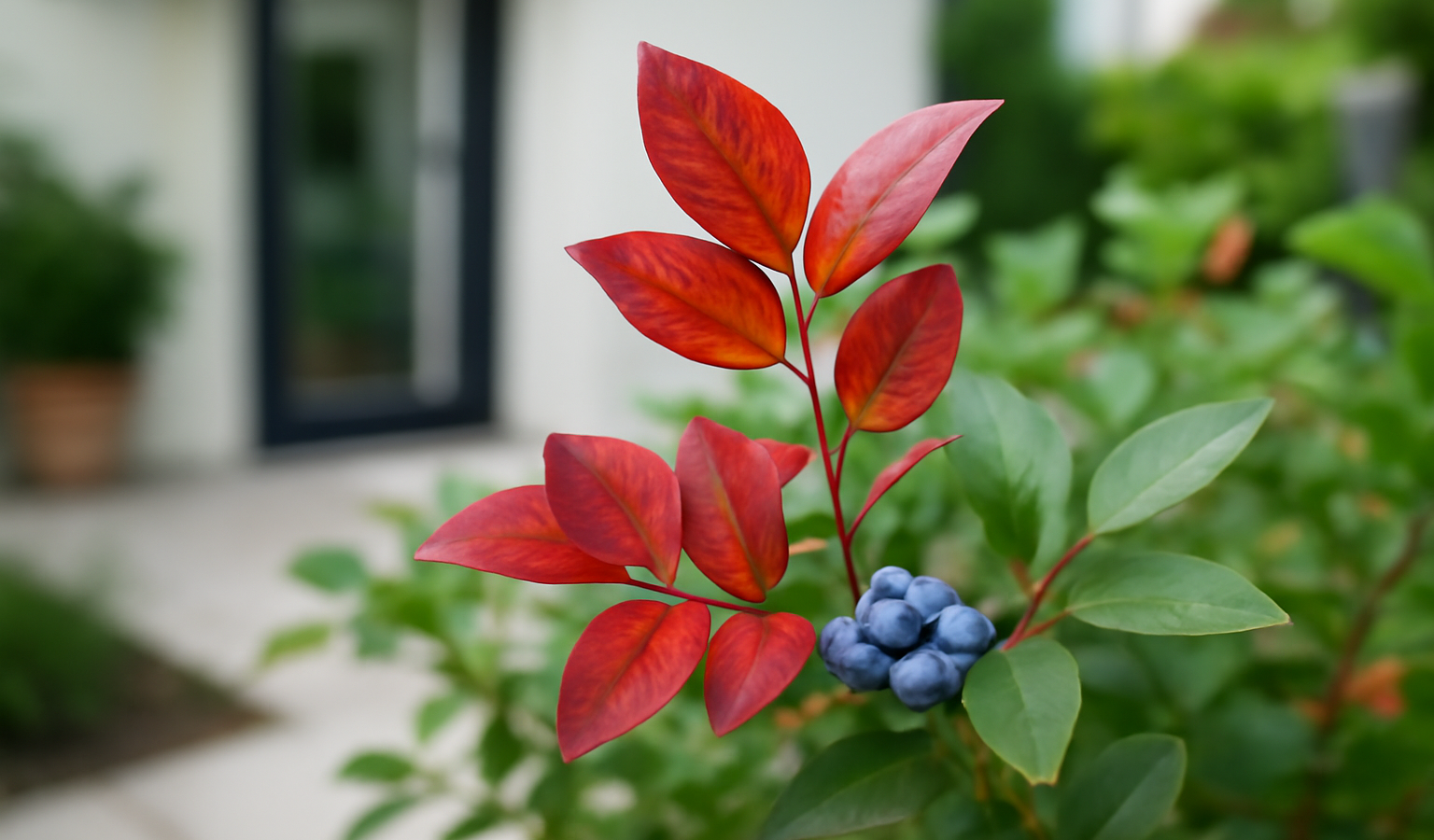
If your blueberry leaves are turning red, the first thing to nail down is the season. In autumn, red and burgundy foliage on a blueberry bush is completely normal and healthy. During the growing season, red leaves usually point to a real problem, and the most common one is soil pH that has crept too high. Blueberries are fussy acid-lovers that need a soil pH between 4.5 and 5.5. When the pH climbs above that range, the plant can no longer pull iron, phosphorus, and other nutrients out of the soil, even when those nutrients are present, and the leaves respond by reddening. Other causes include phosphorus deficiency (often triggered by cold spring soil), nitrogen deficiency, and a handful of diseases. This guide walks through each cause with a clear way to diagnose it and a practical fix.
Key Takeaways
- Red or burgundy leaves in fall are normal, healthy, and need no action. Red leaves during the growing season signal a problem.
- High soil pH is the most common cause. Blueberries need pH 4.5 to 5.5; above that, nutrients get locked out and leaves redden.
- Test your soil pH before doing anything else. Lower pH slowly with elemental sulfur, which takes several months to work.
- Cold spring soil below about 60 degrees Fahrenheit blocks phosphorus uptake, causing reddish-purple leaves that often green up as soil warms.
- Feed blueberries with ammonium sulfate or another ammonium-based, acid-forming fertilizer rather than nitrate forms.
- If reddening comes with stunted growth, dieback, or ringspots, suspect disease such as red ringspot virus or Phytophthora root rot.
First, Rule Out Normal Fall Color
Before you reach for fertilizer or soil amendments, confirm you actually have a problem. Blueberries are deciduous, and in autumn their leaves put on one of the best fall color shows of any edible plant. As days shorten and nights cool, chlorophyll breaks down and anthocyanin pigments take over, turning the foliage brilliant red, scarlet, crimson, and burgundy before the leaves drop for winter. This is exactly what the plant is supposed to do. A bush blazing red in October in zone 5, or November in zone 8, is a healthy bush, not a sick one.
How to diagnose it
Look at three things: timing, distribution, and the plant’s overall vigor. Normal fall reddening happens in autumn, affects the whole plant fairly evenly (all the older leaves shift color together), and the bush is otherwise healthy with no stunting, no dieback, and a normal crop behind it. The leaves redden and then drop, which is the point. Problem reddening, by contrast, shows up during the active growing season from spring through midsummer, often appears on new growth or in patches rather than uniformly, and travels with other symptoms such as weak growth, small leaves, poor fruit set, or thin shoots. If the calendar says fall and the plant looks strong, you are done. Enjoy the color.
How to fix it
There is nothing to fix. Do not fertilize a blueberry in fall to chase the color away, and do not add amendments in response to it. Late-season nitrogen pushes tender growth that winter will kill, so hold off. The leaves will drop naturally, the bush will go dormant, and it will leaf out green again next spring. If anything, fall is a good time to mulch with pine bark, pine needles, or other acidic organic matter to protect the shallow roots over winter. Save your diagnostic energy for reddening that appears during the growing season, which is what the rest of this guide addresses.
Cause 1: Soil pH Too High
This is the single most common reason healthy-looking blueberries start to redden, yellow, and sulk during the growing season. Blueberries evolved in acidic, peaty soils and need a soil pH in the range of 4.5 to 5.5, with 4.8 to 5.2 being the sweet spot. That is far more acidic than most garden soil, which typically sits between 6.0 and 7.5. When the pH is too high, iron and other micronutrients become chemically locked in forms the roots cannot absorb. The plant effectively starves in the middle of plenty. Early symptoms include interveinal yellowing on young leaves (iron chlorosis), and as the stress deepens, leaves turn red, bronze, or purplish, growth slows, and shoot tips can die back. High pH also makes phosphorus less available, which compounds the reddening described in the next section.
How to diagnose it
Test the soil pH. This is non-negotiable and it is the only way to confirm the cause. An inexpensive home test kit or a digital pH meter will get you in the ballpark, but a lab soil test through your county extension office is far more accurate and also tells you your nutrient levels and organic matter. Take a sample from the root zone, about 4 to 8 inches deep, near the base of the affected bush. If the reading comes back above 5.5, you have found at least part of your answer. Also consider your water: if you irrigate with hard, alkaline tap water or well water, the pH around the roots can creep upward over a season or two even if it started fine. Reddening that combines with pale, yellow-between-the-veins new growth is a strong tell for high-pH-driven nutrient lockout.
How to fix it
Lower the pH with elemental sulfur, and be patient, because soil bacteria need warm, moist conditions and several months to convert sulfur into the acid that actually lowers pH. Do not expect overnight results. As a rough starting guide on a loam soil, to drop pH by about one full point apply roughly 1 to 1.5 pounds of elemental sulfur per 100 square feet, which is about 0.15 to 0.25 ounces per square foot. Sandy soils need less; heavy clay soils need more. Always split large amounts into two or three applications spaced a few months apart rather than dumping it all at once, and retest before reapplying. Work the sulfur lightly into the top few inches and water it in. The best time to begin is the season before planting, but for an established bush, apply in early spring and again in late summer, then mulch heavily with acidic pine bark or pine needles. For a faster but shorter-lived correction on an actively suffering plant, soil-applied chelated iron or a fertilizer formulated for acid-loving plants can green it up while the sulfur does the long-term work. Avoid lime, wood ash, and bone meal near blueberries, since all of them raise pH. If you want more background on matching plants to the right soil and conditions, our plants and flowers hub is a good place to start.
Cause 2: Phosphorus Deficiency
Phosphorus deficiency produces a distinctive reddish-purple cast, often most visible on the undersides of leaves and along stems, and it tends to show up on the oldest leaves first because the plant moves phosphorus to new growth when supplies are short. In blueberries, a true shortage of phosphorus in the soil is actually fairly rare. Far more often the deficiency is induced rather than real, meaning the phosphorus is present but the plant cannot take it up. Two conditions cause this: cold spring soil and high pH. When soil temperatures are low, roots are sluggish and phosphorus uptake slows dramatically, which is why you so often see purple-red leaves on blueberries (and corn, and tomatoes) early in spring during a cold snap.
How to diagnose it
Check the timing and the soil temperature. If the reddish-purple coloring appeared on a young plant or on new spring growth during a cold, wet stretch, and especially if it started to improve as the weather warmed, cold-induced phosphorus deficiency is the likely culprit. Phosphorus uptake falls off sharply when soil temperatures drop below roughly 60 degrees Fahrenheit, and gets worse below 50 degrees. Stick a soil thermometer in the root zone in the morning to check. Look for the purple tint concentrating on lower, older leaves and on leaf undersides and stems. If you also have a high pH reading from Cause 1, the phosphorus is likely being locked out chemically rather than missing, so treat the pH problem first. A lab soil test will confirm whether your soil phosphorus is genuinely low.
How to fix it
If the cause is cold soil, the best fix is usually patience plus warmth. The reddening typically fades on its own as soil temperatures rise above 60 degrees and roots wake up. You can speed soil warming by pulling mulch back slightly on cold-but-improving spring days to let the sun hit the soil, then replacing it once things warm. Avoid the temptation to dump high-phosphorus fertilizer on a cold-stressed plant; the problem is uptake, not supply, and excess phosphorus can actually worsen micronutrient availability. If a lab test shows genuinely low phosphorus, correct it gently and only after fixing the pH, since phosphorus is much more available to blueberries in acidic soil. Choose a fertilizer made for acid-loving plants and follow label rates. The reddish-purple symptoms that show up at the wrong time of year, with no cold trigger, are usually downstream of a pH problem, so always loop back to the soil test.
Cause 3: Nitrogen Deficiency
Nitrogen-starved blueberries first show pale, yellowish-green older leaves, but as the deficiency progresses those leaves often develop red, reddish-brown, or burgundy tones, especially around the margins, while the whole plant looks stunted with thin, short shoots and weak growth. Because nitrogen is mobile within the plant, symptoms start on the oldest, lowest leaves and move upward as the plant cannibalizes its reserves to feed new growth. Blueberries are not heavy feeders, but they do have a real and specific nitrogen requirement, and just as importantly they are picky about the form of nitrogen they receive.
How to diagnose it
Look at the pattern and the growth rate. Nitrogen deficiency shows uniform paleness and reddening on the oldest leaves first, combined with overall weak, slow, spindly growth and poor shoot extension over the season. If your bush has put on very little new wood and the older foliage is pale shading to red, nitrogen is a strong candidate. Ask yourself whether the plant has ever been fed, whether heavy rain or sandy soil may have leached nitrogen away, and whether the mulch is robbing nitrogen. Fresh wood chips or sawdust mulch can temporarily tie up soil nitrogen as it decomposes, leaving the plant short. As always, rule out high pH first, because if the pH is wrong the plant cannot use nitrogen efficiently no matter how much you add. The symptom picture overlaps with other yellowing problems; for a sense of how nutrient deficiencies present in other crops, compare the patterns described in our guide to why garlic leaves turn yellow.
How to fix it
Feed with an ammonium-based, acid-forming nitrogen source rather than a nitrate one. This matters a great deal for blueberries. They take up nitrogen efficiently in the ammonium form, and ammonium sulfate is the classic choice because it supplies nitrogen and also gently acidifies the soil, which helps with Cause 1 at the same time. Avoid nitrate fertilizers such as calcium nitrate, which blueberries use poorly and which can nudge the pH up. Apply in spring as growth begins, with a possible light second feeding about six weeks later, and stop all nitrogen by midsummer (roughly July in most zones) so the plant hardens off properly before winter. Follow label rates and err on the light side; over-fertilizing blueberries burns their shallow, fine roots. A typical mature bush needs only a modest amount of nitrogen per year, so resist the urge to overdo it. Water the fertilizer in well, and keep that acidic mulch topped up.
Cause 4: Disease and Root Problems
When reddening comes with symptoms that nutrition cannot explain, such as ringed spots on leaves, dieback of whole canes, wilting despite moist soil, or a plant that collapses over a season or two, look to disease. Two to know are blueberry red ringspot virus and Phytophthora root rot. Red ringspot virus causes distinctive reddish rings or blotches on the upper surface of older leaves, usually appearing in mid to late summer, and over time it weakens the plant and reduces yield. Phytophthora root rot is a soilborne water mold that thrives in poorly drained, waterlogged ground; it rots the fine roots, and the aboveground symptoms are reddening or yellowing of foliage, stunting, wilting, and gradual decline that looks a lot like drought stress even though the soil is wet.
How to diagnose it
Inspect closely and dig if needed. For red ringspot virus, examine the upper surfaces of older leaves for reddish rings, spots, or irregular blotches with somewhat defined edges, distinct from the uniform color shift of a nutrient problem. The pattern is patchy and ring-like rather than even. For Phytophthora, the key clue is reddening or off-color foliage and decline on a plant growing in heavy, wet, or poorly drained soil, or in a low spot that stays soggy. Carefully dig near the root zone: healthy blueberry roots are firm and pale, while Phytophthora-rotted roots are brown, mushy, and sparse, sometimes with a sour smell. Confirm a virus or pathogen with your county extension plant diagnostic lab if the stakes are high, since management differs.
How to fix it
There is no cure for red ringspot virus. Manage it by removing and destroying severely infected bushes to limit spread, controlling the insects that can move some viruses, and planting certified disease-free, virus-tested stock when you replant. For Phytophthora root rot, the fix is fundamentally about drainage and water management. Improve drainage by planting on raised beds or mounds 12 inches or higher, amend heavy soil with coarse organic matter, and never let blueberries sit in standing water. Cut back on irrigation in wet periods. Severely rotted plants rarely recover, so it is often better to replace them and correct the site first; choosing varieties suited to your conditions and starting them right pays off, and our overview of growing healthy plants and flowers covers siting and soil basics that prevent these problems. Fungicides labeled for Phytophthora exist but only work alongside fixing the underlying drainage.
How to Prevent Red Blueberry Leaves
Almost every problem-causing red leaf traces back to soil that is not acidic enough or not draining well, so prevention is mostly about getting the site right and keeping it right. Start with a soil test before you ever plant, and amend the bed to a pH of 4.5 to 5.5 using elemental sulfur applied the season before planting, since it takes months to work. If your native soil is alkaline clay, grow blueberries in raised beds or large containers filled with an acidic mix heavy in peat and pine bark, where you fully control pH and drainage. Retest the pH every year or two, because it tends to creep back up, especially if you irrigate with hard or alkaline water; collecting rainwater for irrigation sidesteps that drift entirely.
Mulch is your best friend here. A 3 to 4 inch layer of pine bark, pine needles, or aged sawdust keeps the shallow roots cool and moist, suppresses weeds, slowly acidifies the soil as it breaks down, and buffers soil temperature so spring phosphorus uptake stays steady. Refresh it each year. For feeding, use an ammonium-based, acid-forming fertilizer such as ammonium sulfate or a product formulated for acid-loving plants, apply it in spring once growth starts, keep the rate modest, and stop by midsummer so the plant hardens off. Skip lime, wood ash, bone meal, and nitrate fertilizers entirely. Water consistently but ensure the soil never stays waterlogged, which is the gateway to Phytophthora. Finally, buy certified disease-free plants and pick varieties matched to your USDA zone and chill requirements. A blueberry planted in the right soil, mulched well, fed lightly with the right fertilizer, and given good drainage will reward you with green summer leaves and, when the season turns, a perfectly healthy show of red fall color you can simply enjoy. The same principle of matching a plant to its conditions applies across the garden, as our guide on why lavender does not flower illustrates with another picky specialist.
Frequently Asked Questions
Is it normal for blueberry leaves to turn red in fall?
Yes. Blueberries are deciduous and naturally turn brilliant red, scarlet, and burgundy in autumn before dropping their leaves. If the color appears in fall, affects the whole plant evenly, and the bush is otherwise healthy, it is completely normal and needs no action.
What pH do blueberries need?
Blueberries need acidic soil with a pH between 4.5 and 5.5, with about 4.8 to 5.2 being ideal. Above 5.5, nutrients like iron and phosphorus get locked out, the plant cannot absorb them, and leaves redden, yellow, and grow poorly. Always test your soil pH before amending.
How do I lower my soil pH for blueberries?
Use elemental sulfur, which soil bacteria convert to acid over several months. As a rough guide on loam, about 1 to 1.5 pounds per 100 square feet lowers pH by roughly one point. Apply in spring and again in late summer, split large amounts, retest before reapplying, and avoid lime and wood ash.
Why are my blueberry leaves reddish-purple in spring?
This is usually cold-induced phosphorus deficiency. When soil temperatures drop below about 60 degrees Fahrenheit, roots cannot take up phosphorus efficiently, causing a reddish-purple tint on older leaves. It typically fades on its own as the soil warms above 60 degrees, so patience is usually the fix.
What fertilizer should I use on blueberries?
Use an ammonium-based, acid-forming fertilizer such as ammonium sulfate, or a product formulated for acid-loving plants. Blueberries use ammonium nitrogen far better than nitrate forms, and ammonium sulfate also gently acidifies the soil. Apply in spring, keep rates modest, and stop feeding by midsummer.