

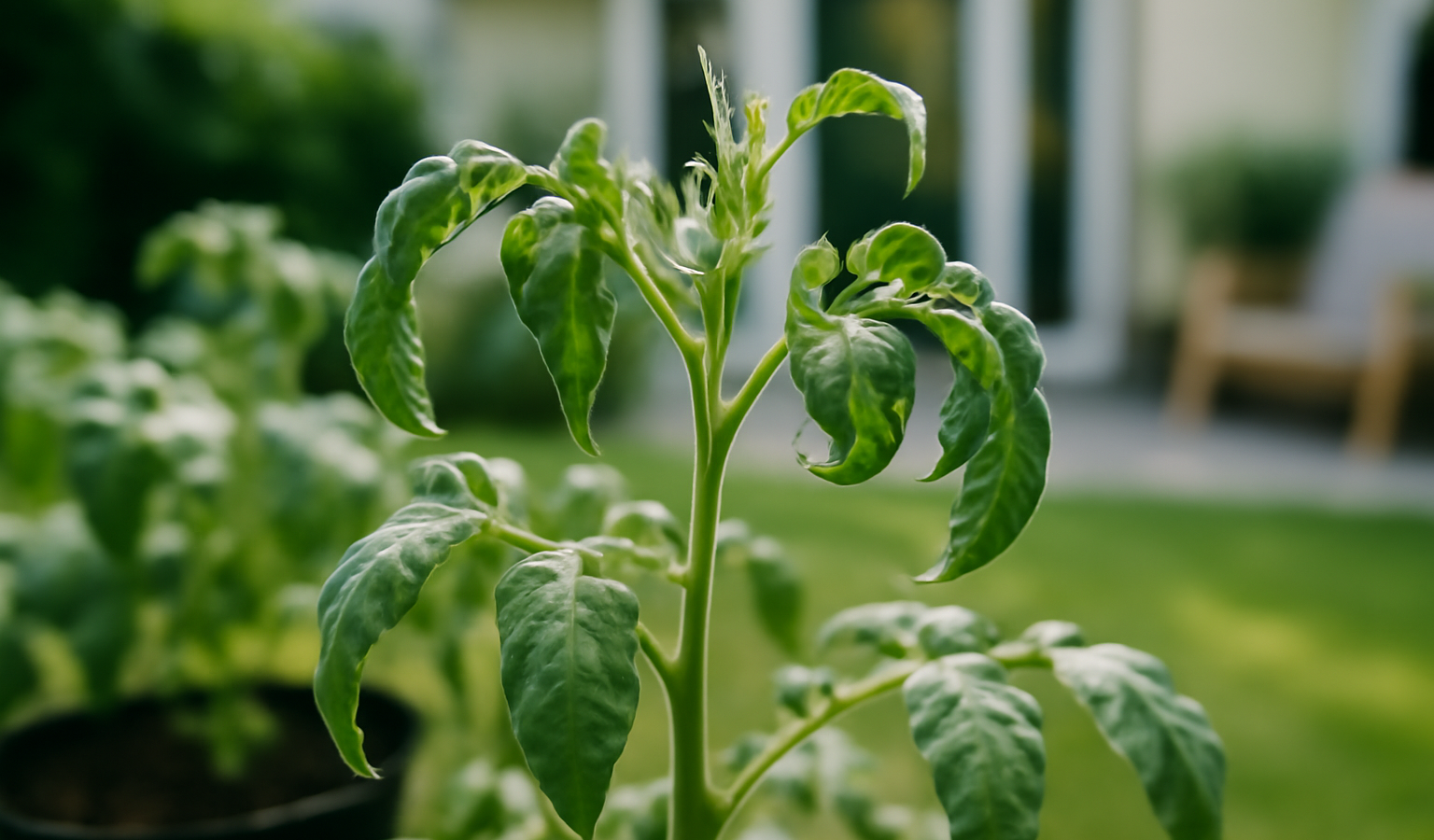
Curling tomato leaves look alarming, but the cause ranges from completely harmless to seriously damaging, and the trick is reading how they curl. Leaves that roll upward and inward but stay green are usually just a stressed plant protecting itself, often nothing to worry about. Leaves that twist, cup downward, turn pale, or distort along with stunted growth point to something worse: herbicide drift, a virus, or pests. Before you reach for any treatment, you need to match the pattern to the cause. This guide walks through the most likely reasons tomato leaves curl, how to diagnose each one, and exactly how to fix or rule it out.
Key Takeaways
- Physiological leaf roll (leaves curl up and inward, stay green) from heat, drought, or heavy pruning is harmless and needs no treatment.
- Inconsistent watering, both over- and under-watering, is the most common avoidable cause; aim for steady, deep moisture.
- Herbicide drift causes twisted, fern-like, downward-cupping new growth, a frequent culprit near lawns treated with weed killer.
- Pests (aphids, whiteflies, broad mites) and viruses (like curly top or leaf curl) cause distorted, discolored, sticky, or mottled leaves.
- Diagnose by which leaves are affected (old vs new), the curl direction, and whether color and growth are normal.
Cause 1: Physiological leaf roll (heat and stress)
This is by far the most common cause and the least concerning. On hot days (above roughly 85°F), during drought, or after a hard pruning, tomato plants roll their older, lower leaves upward and inward, sometimes until they look like cigars. It is a self-defense response: by curling, the leaf reduces the surface area exposed to sun and wind, cutting water loss. Indeterminate and heavily pruned plants are especially prone to it.
How to diagnose
The leaves curl upward, stay firm and green, and the plant is otherwise healthy, still flowering, setting fruit, and pushing normal new growth at the top. It often shows up worst in midsummer heat and may ease in cooler weather. There is no discoloration, no mottling, and no distortion of new leaves.
How to fix
Mostly, leave it alone, the plant is coping and yield is rarely affected. To minimize it, mulch with 2 to 3 inches of straw or shredded bark to keep soil moisture and root temperature steady, water deeply and consistently (see Cause 2), avoid over-pruning suckers, and provide light afternoon shade with shade cloth during extreme heat waves. Container plants roll more because their roots heat up and dry out fast, so up-pot into larger containers and water them more often in summer.
Cause 2: Inconsistent watering
Tomatoes hate a moisture roller coaster. Both extremes cause curling. Underwatering wilts and curls leaves as the plant conserves water; overwatering or poorly drained soil suffocates roots, and stressed roots can no longer move water properly, also causing curl, often with yellowing of the lowest leaves. Erratic watering, bone dry then soaked, is the worst of both worlds and is a leading cause of avoidable curling, plus blossom-end rot and fruit cracking.
How to diagnose
Push a finger 2 to 3 inches into the soil. If it is dust-dry and the plant is wilting and curling, it is thirsty. If it is soggy and the lower leaves are yellowing as well as curling, you are overwatering or the soil drains poorly. Containers that dry out daily in heat are classic underwatering cases.
How to fix
Aim for steady, deep moisture: tomatoes generally want about 1 to 2 inches of water per week, delivered in deep soakings rather than frequent splashes, so roots grow down. Water at the base in the morning, not on the foliage. Mulch heavily to buffer moisture swings. If soil stays soggy, improve drainage by amending with compost and avoid overwatering. A drip system or soaker hose on a timer is the most reliable way to keep moisture even, our comparison of drip irrigation vs soaker hose can help you choose.
Cause 3: Herbicide drift or contamination
Tomatoes are extremely sensitive to growth-regulator herbicides like 2,4-D, dicamba, and aminopyralid, the active ingredients in many lawn weed-and-feed products and broadleaf weed killers. Spray drift from a neighbor’s lawn, vapor on a hot day, or contaminated compost, hay, manure, or grass clippings can all expose the plants. Even tiny amounts cause dramatic, telltale distortion.
How to diagnose
The hallmark is twisted, cupped-downward, fern-like or strap-like new growth at the top of the plant, with stems that may curl or fuse. The damage shows on the newest leaves first (unlike heat roll, which hits older leaves). Suspect it if you recently applied weed killer nearby, used fresh manure or “free” mulch/hay, or a lawn service treated adjacent turf. Often several plants in a row are affected at once.
How to fix
There is no cure once a plant is hit; you can only limit further exposure and hope for outgrowth. Stop using the suspected source immediately. If contaminated compost or mulch is the cause, remove it. Water well to support recovery, mildly affected plants sometimes grow out of it and still produce, while severely distorted plants should be pulled. Prevent it next season: never spray broadleaf herbicide near the garden on warm or windy days, keep weed-and-feed off areas that drain toward beds, and avoid manure or hay from fields treated with persistent herbicides.
Cause 4: Pests
Sap-sucking insects pull fluids and inject saliva that distorts leaves. Aphids cluster on tender new growth and leave sticky honeydew and curled, puckered leaves. Whiteflies (tiny white insects that fly up in a cloud when disturbed) and broad mites cause similar curling and distortion of new growth, broad mites in particular twist and bronze the youngest leaves severely.
How to diagnose
Turn leaves over and inspect the undersides and growing tips with a hand lens. Look for clusters of soft green/black aphids, clouds of whiteflies, sticky shiny honeydew (sometimes with black sooty mold), or, for broad mites, severely twisted, glossy, bronzed new leaves even though you see no obvious bug (mites are nearly microscopic). Ants traveling up the stem often signal an aphid colony.
How to fix
Knock off light aphid and whitefly infestations with a strong jet of water, then treat with insecticidal soap or neem oil, coating the leaf undersides, repeating every 5 to 7 days. Encourage ladybugs and lacewings, which devour aphids. Yellow sticky traps help monitor and reduce whiteflies. Broad mites need a labeled miticide or sulfur; remove and discard the worst-affected growth. Always treat in the evening to avoid leaf burn.
Cause 5: Viral disease
Several viruses cause leaf curl, most notably Tomato Yellow Leaf Curl Virus (spread by whiteflies) and Curly Top Virus (spread by leafhoppers). These are less common than the causes above but far more serious because they are incurable and can spread.
How to diagnose
Look for curling combined with color and growth abnormalities: yellowing leaf margins, upward cupping, mottling or mosaic patterns, stunted bushy growth, and poor or aborted fruit set. Unlike heat roll, the plant clearly declines and does not recover. Viral problems often appear on just one or a few plants while neighbors stay healthy, and they coincide with whitefly or leafhopper activity.
How to fix
There is no cure for a virus-infected plant. Remove and destroy it (do not compost) to protect the rest of the garden, and control the insect vectors (whiteflies, leafhoppers) that spread it. Next season, choose resistant varieties (look for “TYLCV resistant” on the label), use floating row cover early to exclude insects, and keep weeds down since they harbor both viruses and their carriers.
How to prevent curling tomato leaves
Most curling traces back to stress and pests you can manage. Build these habits in and you will rarely see a problem leaf: water deeply and consistently (1–2 inches per week, at the base, on a timer if possible) and mulch with 2–3 inches of straw or shredded bark to hold moisture and moderate root temperature. Keep herbicides far from the garden, never spray broadleaf weed killer nearby on warm or windy days, and avoid manure, hay, or mystery compost that could carry persistent herbicides. Scout weekly, checking leaf undersides and growing tips for aphids, whiteflies, and mites, and treat early with insecticidal soap or neem. Provide afternoon shade during extreme heat, and choose disease-resistant varieties if viruses have hit your garden before. Finally, give plants room and airflow, and do not over-prune indeterminate vines, which stresses them into rolling. For more on healthy tomato growing, including the right type for your space, see our guide to determinate vs indeterminate tomatoes, and browse our plants and flowers section for more troubleshooting help.
Frequently Asked Questions
Are curling tomato leaves always a problem?
No. The most common cause, physiological leaf roll from heat, drought, or heavy pruning, is harmless. If the leaves curl upward but stay firm and green and the plant keeps flowering and growing normally, it is just self-protecting and rarely affects yield. Curling combined with discoloration, distortion, or stunting is the kind to worry about.
How do I tell heat stress from herbicide damage?
Heat roll affects older, lower leaves, which curl upward and stay green. Herbicide damage hits the newest top growth, which twists, cups downward, and grows fern-like or strap-shaped, often with curled or fused stems. If your newest leaves are distorted and you recently used weed killer, manure, or mystery mulch nearby, suspect herbicide contamination.
Will my tomato plant recover from leaf curl?
It depends on the cause. Heat stress and watering issues are fully reversible once conditions stabilize. Mild herbicide exposure may grow out and still fruit, but severe cases will not recover. Pest damage stops once you control the insects. Viral leaf curl is incurable, infected plants should be removed.
Does overwatering cause tomato leaves to curl?
Yes. Overwatering or poorly draining soil suffocates roots, so they can no longer move water properly, and the leaves curl, often along with yellowing of the lowest leaves. Check by feeling the soil 2–3 inches down: soggy soil with yellowing lower leaves points to overwatering, while bone-dry soil with wilting points to underwatering.
What pests make tomato leaves curl?
Sap-sucking pests, mainly aphids, whiteflies, and broad mites, cause curling and distortion, usually on new growth. Check leaf undersides and growing tips for the insects, sticky honeydew, or twisted, bronzed young leaves. Treat with a water blast plus insecticidal soap or neem oil every 5–7 days, applied in the evening to leaf undersides.