Yes, bolted onions are completely safe and still tasty. The only catch is a tough, woody central core created by the flower stalk. Cut that core out and use the surrounding rings as normal in cooking, salads, soups, or pickles. Just do not try to store them, because they rot from the core.
Why did my onion sets bolt but my seed-grown onions did not?
Sets are already a season old and physiologically primed to flower, especially larger sets over 1/2 inch. Seed-grown onions are younger and thinner at transplant, which keeps them below the size threshold needed for cold to trigger flowering. For bolt-resistant crops, grow from seed or choose the smallest sets available.
Does planting onions too early really cause bolting?
Yes, it is the most common trigger. Planting during an early warm spell lets the onion grow past pencil thickness, and then the normal return of cold weather vernalizes the plant, which reads the cold as winter and flowers when it warms again. Plant about 2 to 4 weeks before your average last frost, not earlier.
What temperature causes onions to bolt?
Roughly two or more weeks of temperatures below 45-50°F, applied to a plant that has reached pencil thickness or larger, triggers vernalization and later bolting. Plants thinner than a pencil generally will not respond to the cold. Use floating row cover during forecast cold snaps to keep plants warmer and shorten the exposure.
Can I stop an onion from bolting once the flower stalk appears?
No. Once the stalk forms, the bolt is irreversible and the bulb will stop sizing up. You can snap or cut off the flower stalk to redirect a little energy back into the bulb, but the onion will still form a woody core and will not store. Harvest and use it fresh.
Are bolted onions safe to eat?
Yes, bolted onions are completely safe and still tasty. The only catch is a tough, woody central core created by the flower stalk. Cut that core out and use the surrounding rings as normal in cooking, salads, soups, or pickles. Just do not try to store them, because they rot from the core.
Why did my onion sets bolt but my seed-grown onions did not?
Sets are already a season old and physiologically primed to flower, especially larger sets over 1/2 inch. Seed-grown onions are younger and thinner at transplant, which keeps them below the size threshold needed for cold to trigger flowering. For bolt-resistant crops, grow from seed or choose the smallest sets available.
Does planting onions too early really cause bolting?
Yes, it is the most common trigger. Planting during an early warm spell lets the onion grow past pencil thickness, and then the normal return of cold weather vernalizes the plant, which reads the cold as winter and flowers when it warms again. Plant about 2 to 4 weeks before your average last frost, not earlier.
What temperature causes onions to bolt?
Roughly two or more weeks of temperatures below 45-50°F, applied to a plant that has reached pencil thickness or larger, triggers vernalization and later bolting. Plants thinner than a pencil generally will not respond to the cold. Use floating row cover during forecast cold snaps to keep plants warmer and shorten the exposure.
Frequently Asked Questions
Can I stop an onion from bolting once the flower stalk appears?
No. Once the stalk forms, the bolt is irreversible and the bulb will stop sizing up. You can snap or cut off the flower stalk to redirect a little energy back into the bulb, but the onion will still form a woody core and will not store. Harvest and use it fresh.
Are bolted onions safe to eat?
Yes, bolted onions are completely safe and still tasty. The only catch is a tough, woody central core created by the flower stalk. Cut that core out and use the surrounding rings as normal in cooking, salads, soups, or pickles. Just do not try to store them, because they rot from the core.
Why did my onion sets bolt but my seed-grown onions did not?
Sets are already a season old and physiologically primed to flower, especially larger sets over 1/2 inch. Seed-grown onions are younger and thinner at transplant, which keeps them below the size threshold needed for cold to trigger flowering. For bolt-resistant crops, grow from seed or choose the smallest sets available.
Does planting onions too early really cause bolting?
Yes, it is the most common trigger. Planting during an early warm spell lets the onion grow past pencil thickness, and then the normal return of cold weather vernalizes the plant, which reads the cold as winter and flowers when it warms again. Plant about 2 to 4 weeks before your average last frost, not earlier.
What temperature causes onions to bolt?
Roughly two or more weeks of temperatures below 45-50°F, applied to a plant that has reached pencil thickness or larger, triggers vernalization and later bolting. Plants thinner than a pencil generally will not respond to the cold. Use floating row cover during forecast cold snaps to keep plants warmer and shorten the exposure.
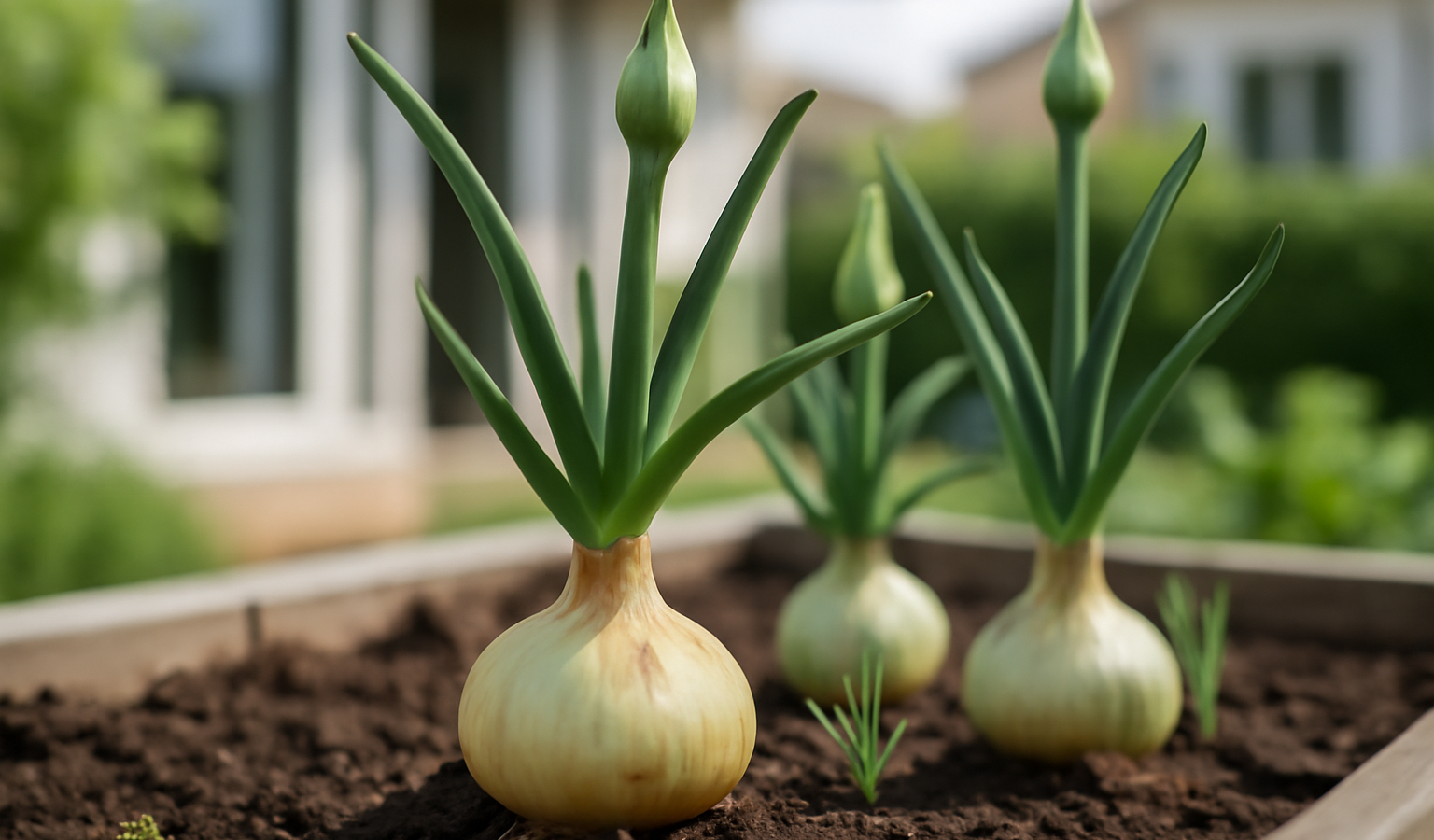
If a stiff flower stalk is shooting up from the center of your onions, the plant has bolted, and the short answer is that something convinced it the growing season was almost over before the bulb had a chance to size up. Onions are biennials. In their natural two-year cycle they grow a bulb the first year, overwinter, and flower the second year to set seed. Bolting is simply that second-year flowering happening early, triggered most often by cold exposure (vernalization), but also by oversized transplants, a long-day or short-day variety planted in the wrong latitude, or sharp drought and heat stress. Once the flower stalk forms, the plant diverts energy from the bulb into the seed head, and the bulb stops growing. You cannot reverse a bolt, but you can salvage the crop and prevent it next season. Below is how to diagnose each cause and what to do about it.
Key Takeaways
Bolting is premature flowering triggered when an onion experiences extended cold (vernalization), usually two or more weeks below 45-50°F after the plant reaches a certain size.
Pencil-thick transplants (about 1/4 to 1/2 inch) are in the danger zone. Plants thinner than a pencil rarely bolt even after a cold snap.
Planting too early in spring, or fall-planting a variety not bred for overwintering, is the single most common mistake behind a bolted bed.
Matching variety to latitude matters: long-day onions for the north, short-day for the south, day-neutral in between. A mismatch stresses the plant and can push it to flower.
Drought and heat stress during bulbing can also trigger bolting, so keep soil evenly moist through late spring and early summer.
A bolted onion will not store. Pull it, cut out the woody core, and use the bulb fresh within a few days.
Cause 1: Cold Vernalization (Planting Too Early or a Cold Snap)
This is the number one reason backyard onions bolt. An onion plant that has reached a certain size and then sits through a stretch of cold weather reads that cold as “winter has passed.” Once the temperature warms again, the plant behaves as if it is in its second year and sends up a flower stalk. The biology has a name: vernalization. The threshold is roughly two or more weeks of temperatures below 45-50°F, and the plant has to be large enough to respond, generally bigger than pencil diameter. This is why an early warm spell that tempts you to plant in February or early March, followed by a normal cold March or April, sets up a textbook bolt. The onion grows during the warm window, gets caught by the return of cold, and flowers as soon as it warms back up in May.
How to diagnose it
Look at the timeline. Did you plant transplants or sets unusually early, then have a cold spell where nights dropped below 45°F for a couple of weeks or more? Did a late frost or an unseasonable cold snap hit after the plants were already established and finger-thick? If your bolted onions were planted from sets (small dry bulbs) rather than seed, suspect this cause first. Sets are already a season old, so they are physiologically primed and far more bolt-prone than seed-grown plants. Also check whether the whole bed bolted at once or just scattered plants. A bed-wide bolt that follows a documented cold period points squarely at vernalization rather than a variety or watering issue, which tend to show up more unevenly.
How to fix it
You cannot un-vernalize a plant that has already bolted, so the fix is about timing for next season. Plant at the right window for your method. From transplants or sets, aim to get them in the ground about 2 to 4 weeks before your average last spring frost, not a month or two earlier during a warm tease. In USDA zones 5-6 that usually means mid to late April; in zones 7-8 it is often March; in zones 9-10 short-day onions go in during fall (October-November) for an early-summer harvest. If you start seed indoors, sow 8 to 10 weeks before transplanting so plants go out young and thin. If an unexpected cold snap is forecast after planting, throw a floating row cover over the bed to keep the plants a few degrees warmer and shorten the cold exposure below the vernalization threshold. Choose sets that are small, ideally under 1/2 inch in diameter, since large sets bolt the most. For diagnosing related cold-and-flowering quirks in alliums, the patterns in this guide on why garlic leaves turn yellow overlap with onion stress responses worth understanding.
Cause 2: Oversized Transplants (The Pencil-Thick Danger Zone)
Size at the moment of cold exposure is what determines whether vernalization actually triggers a bolt. A seedling thinner than a pencil generally cannot be vernalized no matter how cold it gets, while a transplant the thickness of a pencil or larger, roughly 1/4 to 1/2 inch in stem diameter, is fully capable of reading cold and flowering. Growers call this the pencil-thick danger zone for good reason. If you start onions indoors too early and let them get big and lush before transplanting, you hand the plant exactly the size it needs to bolt the first time a cold spell hits the garden. The same logic explains why large onion sets bolt more than small ones: a fat set is essentially an oversized, pre-conditioned plant.
How to diagnose it
Think back to how big the plants or sets were when you set them out. If your indoor-started seedlings were the diameter of a pencil or thicker at transplant, or if you bought jumbo sets, this is a strong suspect, especially in combination with any spring cold. Compare bolted plants to any that did not bolt: often the biggest, most vigorous-looking plants are the ones that flowered, while spindly stragglers sized up into clean bulbs. That counterintuitive pattern, where the healthiest-looking plants bolt and the runts do not, is the signature of the transplant-size cause.
How to fix it
Transplant onions while they are still thin, ideally no thicker than a pencil lead and no taller than a sharp pencil, about 6 inches of top growth, which you can trim back with scissors to a few inches to keep them stocky. Do not panic that small plants look weak; they establish fine and are bolt-resistant precisely because they are below the vernalization-responsive size. If you grow from sets, buy the smallest sets you can find (1/4 to 1/2 inch), and if your sets are a mix, plant the largest ones close together to harvest as green onions in spring and reserve the small ones for bulbing. Time your indoor seed-starting so seedlings are young at transplant: 8 to 10 weeks of indoor growth is plenty. Starting in early winter to get “a head start” almost always backfires by producing transplants that are too big.
Cause 3: Day-Length and Variety Mismatch
Onions form bulbs in response to day length, and there are three categories. Long-day onions (such as Walla Walla, Yellow Sweet Spanish, Copra, and Patterson) need about 14 to 16 hours of daylight to bulb and are bred for northern latitudes, roughly USDA zones 6 and colder or anything north of about 36 degrees latitude. Short-day onions (Texas Early Grano, Granex/Vidalia types, Red Creole, Southern Belle) bulb at 10 to 12 hours and suit the South, roughly zone 7 and warmer. Day-neutral or intermediate types (Candy, Red Candy Apple, Superstar) bulb at 12 to 14 hours and perform across the middle of the country. Plant the wrong type for your latitude and the plant never gets the day-length cue to bulb at the right time. It spends too long in vegetative limbo, accumulates size, and becomes more likely to respond to any cold stress by flowering instead of bulbing. The mismatch itself does not directly cause flowering, but it sets up a stressed, oversized plant that bolts readily.
How to diagnose it
Check the variety name on your seed packet or set label against your latitude. If you are in the North (say, Minnesota or Maine) and planted a short-day Vidalia type, or you are in Georgia or Texas and planted a long-day Walla Walla, you have a mismatch. The tell is usually poor bulbing alongside the bolting, since onions either failed to size up before flowering or never formed a proper bulb at all. If your plants grew big tops, never made a real bulb, and then flowered, variety mismatch belongs high on your list. The patterns mirror other photoperiod-and-maturity timing problems in the garden, like those covered in this guide on why corn fails to produce ears.
How to fix it
Buy the right day-length type for where you live. Northern gardeners should choose long-day or day-neutral varieties; southern gardeners should choose short-day or day-neutral. If you are unsure of your latitude category, day-neutral varieties are the safest hedge because they bulb across a wide band of the country. Order from a seed supplier that lists the day-length type clearly rather than grabbing unlabeled sets from a bin, which are often generic and may not match your region. Getting the variety right also fixes the timing problem, because a correctly matched onion bulbs on schedule and finishes before the heat and stress of midsummer can push it to flower. You can find more on selecting region-appropriate varieties through our Plants & Flowers growing guides.
Cause 4: Drought and Heat Stress
Even a correctly timed, correctly sized, correctly chosen onion can bolt if it goes through a sharp swing in growing conditions during bulbing. Onions have shallow roots, mostly in the top 6 inches of soil, so they dry out fast. A bed that swings from soaked to bone-dry, or a sudden run of 90°F-plus days during late spring, applies the kind of stress that can flip the plant into survival mode, where flowering and setting seed becomes the priority over storing energy in a bulb. This cause is most common in late spring as temperatures climb and rain becomes erratic, and it often compounds the other causes: a plant already nudged toward flowering by a cold snap will tip over the edge when heat and drought arrive.
How to diagnose it
Review your watering and the weather during the weeks before the stalks appeared. Did the bed dry out repeatedly, or did an early heat wave hit while the plants were still bulbing? Stress-induced bolting often shows up alongside other stress symptoms: tip dieback on the leaves, thin necks, and smaller-than-expected bulbs. If the timing and variety were both right and the plants were small at transplant, yet they still bolted after a dry or hot spell, water stress is the most likely trigger. Scattered bolting across a bed that received uneven irrigation (drier at the row ends, for example) also points to moisture stress.
How to fix it
Keep soil consistently moist, never soggy and never bone-dry, through the entire bulbing period from late spring into early summer. Onions want roughly 1 inch of water per week, more during hot, windy weather. Drip irrigation or a soaker hose is ideal because it delivers steady moisture without wetting the foliage. Mulch the bed with 1 to 2 inches of straw or shredded leaves to buffer soil temperature and slow evaporation, which matters more for shallow-rooted onions than for almost any other vegetable. If a heat wave is forecast while plants are bulbing, water deeply the day before and consider light afternoon shade cloth (30-40 percent) over the bed to take the edge off. Steady conditions are the goal; it is the swings, not any single warm day, that trigger stress bolting.
How to Prevent Onion Bolting Next Season
Prevention comes down to controlling the three levers that decide whether an onion flowers: timing, size, and stress. Get all three right and bolting becomes rare.
Plant at the correct window. Resist the early-spring warm tease. Set transplants or sets out about 2 to 4 weeks before your average last frost rather than a month or two earlier. In the Deep South (zones 9-10), plant short-day onions in fall for an early-summer harvest instead of late winter.
Keep transplants small. Transplant at pencil-lead thickness or thinner, and choose sets under 1/2 inch. Small is bolt-resistant; big is bolt-prone. Trim seedling tops to a few inches to keep them stocky rather than tall and stressed.
Match the variety to your latitude. Long-day for the North, short-day for the South, day-neutral in the middle or when unsure. Buy from a supplier that labels day-length type clearly.
Protect against cold snaps. Have floating row cover ready and throw it over the bed when nights are forecast below 45°F for an extended stretch after planting. Shortening the cold exposure can keep plants below the vernalization threshold.
Water steadily and mulch. Aim for even soil moisture (about 1 inch per week) and mulch with straw to buffer temperature and moisture, especially as spring turns to summer.
Prefer seed or small sets over jumbo sets. Seed-grown onions are the least likely to bolt because you control their size, and small sets bolt far less than large ones.
Combine these and you give the plant no reason to think its season is ending early. The onion stays in first-year bulbing mode, sizes up, and finishes before midsummer heat can push it toward flowering.
What to Do Once an Onion Has Bolted
Once you see a flower stalk, accept that the bulb will not get any bigger and will not cure for storage. The plant has redirected its energy, and the stalk creates a woody, hollow core that runs down through the center of the bulb. A bolted onion will rot from that core during storage, so do not put bolted bulbs in your storage stash. They are still perfectly edible, though, so here is how to get the most out of them.
Snap or cut the flower stalk off promptly. Removing the developing seed head as soon as you spot it lets the plant put a little more sizing into the bulb before you harvest. It will not stop the bolt, but it buys marginal bulb growth.
Harvest the bolted onions first. Pull them ahead of the rest of the bed and use them within a few days to a couple of weeks. They do not need curing because you are not storing them.
Cut around the woody core. When you prep the onion in the kitchen, you will find a tough, fibrous central stem. Slice it out and use the surrounding rings, which are still sweet and good for cooking, salads, or pickling.
Use them fresh and cooked. Bolted onions are great chopped into soups, stocks, sautés, and anything where the texture of the outer rings is what matters. Eat the freshest-tasting ones raw soon after pulling.
Save seed if you like. If you let a bolted onion fully flower and the variety is open-pollinated (not a hybrid), you can collect the black seeds from the dried flower head for next year, though most gardeners simply compost the spent plant.
The key mental shift is to separate your bolted onions from your keepers at harvest. Bolted ones go into the kitchen queue right away; clean, unbolted bulbs with thin necks get cured and stored. Treat the bolt as a timing lesson for next season, adjust your planting window and transplant size, and the problem usually disappears.
Frequently Asked Questions
Can I stop an onion from bolting once the flower stalk appears?
No. Once the stalk forms, the bolt is irreversible and the bulb will stop sizing up. You can snap or cut off the flower stalk to redirect a little energy back into the bulb, but the onion will still form a woody core and will not store. Harvest and use it fresh.
Are bolted onions safe to eat?
Yes, bolted onions are completely safe and still tasty. The only catch is a tough, woody central core created by the flower stalk. Cut that core out and use the surrounding rings as normal in cooking, salads, soups, or pickles. Just do not try to store them, because they rot from the core.
Why did my onion sets bolt but my seed-grown onions did not?
Sets are already a season old and physiologically primed to flower, especially larger sets over 1/2 inch. Seed-grown onions are younger and thinner at transplant, which keeps them below the size threshold needed for cold to trigger flowering. For bolt-resistant crops, grow from seed or choose the smallest sets available.
Does planting onions too early really cause bolting?
Yes, it is the most common trigger. Planting during an early warm spell lets the onion grow past pencil thickness, and then the normal return of cold weather vernalizes the plant, which reads the cold as winter and flowers when it warms again. Plant about 2 to 4 weeks before your average last frost, not earlier.
What temperature causes onions to bolt?
Roughly two or more weeks of temperatures below 45-50°F, applied to a plant that has reached pencil thickness or larger, triggers vernalization and later bolting. Plants thinner than a pencil generally will not respond to the cold. Use floating row cover during forecast cold snaps to keep plants warmer and shorten the exposure.