

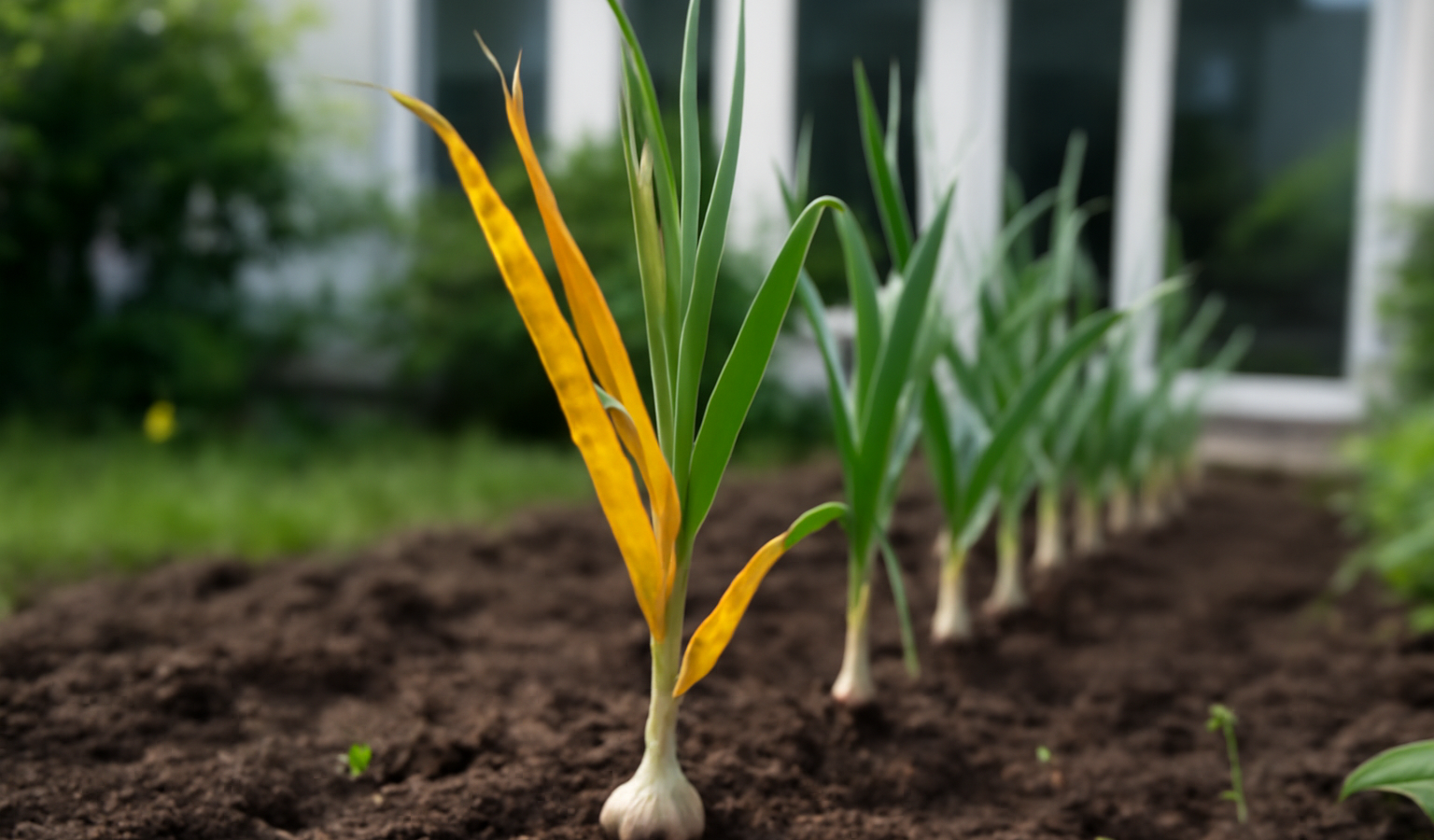
Yellowing garlic leaves usually point to one of six causes: nitrogen deficiency, overwatering or waterlogged soil, natural end-of-season maturation, pests like onion maggot, diseases such as white rot or rust, or cold and frost damage. The single most important thing to know first is timing. If your garlic is yellowing in late spring or early summer and the plants are several months old with fat-feeling necks, that yellowing is normal and tells you harvest is close. If the yellowing shows up early in the season on otherwise young, actively growing plants, something is wrong and you need to diagnose it. This guide walks through each cause, how to tell them apart, and exactly what to do.
Key Takeaways
- Yellowing from the leaf tips downward on the oldest, lowest leaves in spring usually means nitrogen deficiency; side-dress with a nitrogen source.
- Yellowing with mushy bases, foul smell, or soggy soil points to overwatering or poor drainage; cut water and improve the bed.
- Uniform bottom-up yellowing in late spring to early summer on mature plants is normal maturation and signals it is time to harvest.
- Sudden wilting, white fungal threads at the base, or orange leaf pustules indicate pests or disease and require removal of affected plants.
- Garlic needs steady moisture (about 1 inch of water per week) and a feeding of nitrogen in early spring when shoots reach 6 inches.
- Hardneck varieties tolerate cold zones (USDA 3 to 6) best; softnecks suit warmer zones (5 to 9) and store longer.
Nitrogen Deficiency
Nitrogen deficiency is the most common reason garlic leaves turn yellow during active growth, and it shows up most often in early to mid spring. Garlic is a heavy feeder of nitrogen during its vegetative push from March through May. The plant builds leaf mass first, and each leaf corresponds to a wrapper layer on the future bulb, so leaf health directly drives bulb size. When the soil cannot supply enough nitrogen, the plant pulls it out of the oldest leaves to feed new growth, which is why the lowest, oldest leaves yellow first, typically starting at the tips and working back toward the base.
How to diagnose it
Look at which leaves are affected. Nitrogen deficiency works from the bottom of the plant upward and from the leaf tip inward, because nitrogen is mobile and the plant relocates it to younger tissue. The yellowing is usually a soft, uniform pale green to yellow rather than spotty or streaked. Growth often looks stunted overall, with thin, short leaves. This is most likely in sandy soils that leach nutrients quickly, in beds where garlic followed another heavy feeder, or after a wet winter that washed nitrogen below the root zone. If the season is cool and wet, soil microbes release nitrogen slowly, so even decent soil can show temporary deficiency in early spring. A simple soil test confirms it; aim for soil organic matter around 4 to 5 percent and a pH of 6.0 to 7.0, which is where garlic takes up nutrients best.
How to fix it
Side-dress with a nitrogen source as soon as you see the symptoms, ideally when shoots are 6 inches tall and again three to four weeks later. Blood meal (roughly 12-0-0) applied at about 1 pound per 100 square feet gives a fast organic boost. Feather meal or a balanced organic fertilizer such as 10-10-10 at 1 to 2 pounds per 100 square feet also works. For a quick correction, a liquid feed like fish emulsion (around 5-1-1) diluted per the label and watered in at the base acts within days. Apply nitrogen alongside the row, scratch it lightly into the top inch of soil, and water it in so it reaches the roots. Stop all nitrogen feeding by late spring, roughly four to six weeks before expected harvest, because late nitrogen pushes leafy growth at the expense of bulb formation and can shorten storage life. If your beds run low on organic matter, top-dress with an inch of finished compost each fall to build a steady nitrogen reserve for the next crop.
Overwatering, Poor Drainage, and Waterlogged Soil
Garlic hates wet feet. Saturated soil drives oxygen out of the root zone, the roots suffocate and begin to rot, and the plant can no longer take up water or nutrients, even though it is sitting in plenty of moisture. The result is yellowing leaves that look very much like drought stress but for the opposite reason. Overwatering and poor drainage are especially common in heavy clay soils, in low spots that collect runoff, and in raised beds that are watered on a fixed schedule regardless of rainfall.
How to diagnose it
Push a finger into the soil 2 to 3 inches down. If it is wet and stays wet day after day, water is the problem. Yellowing from overwatering tends to be more general across the plant rather than the clean bottom-up pattern of nitrogen deficiency, and the leaf bases and lower stem often feel soft. Pull one suspect plant and check the roots and basal plate; healthy roots are white and firm, while waterlogged roots are brown, slimy, and may smell sour. A rotting basal plate is a serious sign because that is where the bulb forms. Note recent weather too; a stretch of heavy rain over clay can waterlog a bed even if you never irrigated.
How to fix it
Stop watering until the top 2 inches of soil dry out, then water deliberately rather than on autopilot. Garlic needs about 1 inch of water per week including rainfall during active growth, delivered deeply once or twice a week rather than a little every day. Taper watering off entirely in the two to three weeks before harvest to let the bulbs cure underground. For chronic drainage problems, the real fix is structural: grow garlic in raised beds at least 8 to 12 inches tall, and amend heavy clay with compost and coarse organic matter to open up the soil. If a low spot floods repeatedly, regrade it or move the bed. Going forward, plant cloves into well-drained soil in fall and avoid mulching so heavily that the soil never gets a chance to breathe. The same drainage principles that save garlic also protect other bulbing crops, so it is worth reading up on related issues like why onions bolt and stress out in poor conditions before you build next season’s beds.
Normal End-of-Season Yellowing as Bulbs Mature
Here is the cause people worry about most needlessly. As garlic finishes its life cycle in late spring and early summer, the lower leaves naturally yellow, brown, and die back. This is not a problem; it is the plant’s harvest signal. Each green leaf is connected to a protective wrapper around the bulb, and as the lowest leaves die, the corresponding wrappers dry into the papery skins that protect garlic in storage. Reading this dieback correctly is the key to harvesting at the right moment.
How to diagnose it
Check the calendar and the plant’s age. Garlic planted in fall is generally harvested from late May through July depending on your region, with the south finishing earlier and northern zones later. If your plants are six to nine months old, tall and robust, and the yellowing is moving steadily up from the bottom while the upper leaves stay green, this is maturation, not disease. The classic harvest indicator is when roughly the bottom third to half of the leaves have browned and about five or six green leaves remain at the top. Hardneck types also send up a curling flower stalk called a scape in late spring; once you cut the scapes, bulbs size up fast and the leaves begin their natural decline shortly after.
How to fix it
There is nothing to fix, just a harvest to time. When five to six green leaves remain, dig (do not pull) a test bulb and check that the cloves are plump and the wrappers are intact. If the bulb is well filled and the skins are tight, harvest the rest within the next week or so. Waiting too long causes the wrappers to split and the cloves to separate, which ruins storage life; harvesting too early gives small, under-wrapped bulbs. Lift bulbs gently with a fork, brush off loose soil without washing, and cure them in a shaded, airy spot for two to three weeks before trimming. If you grow hardneck varieties in colder zones (USDA 3 to 6) you will usually harvest a little later than softneck growers in warmer zones (5 to 9), so adjust by watching the leaves rather than a fixed date.
Pests: Onion Maggot, Nematodes, and More
Several pests feed on garlic roots and bulbs, and the first symptom is often yellowing, wilting foliage because the plant’s underground plumbing is being chewed apart. The two most damaging are the onion maggot, the larva of a small fly that tunnels into the developing bulb, and stem and bulb nematodes, microscopic worms that infest the basal plate and cause bloated, distorted, soft tissue. Thrips and bulb mites can also stress plants but are less likely to be the main cause of dramatic yellowing.
How to diagnose it
Pest damage usually causes individual plants, not the whole bed, to yellow and wilt suddenly, often while neighboring plants look fine. Pull an affected plant and inspect the bulb and basal plate. Onion maggots leave creamy white legless larvae and brown tunneling damage near the base, and the maggots are worst in cool, wet springs and in beds with lots of undecomposed organic matter. Nematode damage shows as a swollen, spongy stem base, the bulb feels soft, and the basal plate may crack and separate from the cloves; infested cloves are light and discolored inside. If you see fine sawdust-like debris, slimy decay, or actual larvae, you have a pest problem rather than a nutrient or water one.
How to fix it
Remove and destroy infested plants immediately; do not compost them, because both onion maggot pupae and nematodes survive in plant debris and soil. For onion maggot, cover young plantings with floating row cover from emergence to prevent the adult flies from laying eggs at the base, and rotate alliums so they do not return to the same bed for at least three to four years. Avoid working fresh manure into garlic beds, since it attracts egg-laying flies. For nematodes, the only reliable controls are strict sanitation, planting certified disease-free seed garlic (never grocery store cloves), and a long rotation of four or more years out of alliums; solarizing the soil under clear plastic for four to six weeks in the heat of summer can reduce populations. Build healthy soil with compost and beneficial microbes, because vigorous plants in living soil shrug off light pest pressure far better than stressed ones.
Diseases: White Rot, Rust, and Fungal Infections
Fungal diseases are a leading cause of yellowing that gardeners often mistake for a watering or feeding issue. The three to watch are white rot, a devastating soilborne fungus; garlic rust, an airborne leaf disease; and basal rot, including Fusarium, which attacks the root plate. Disease tends to spread, so catching it early and removing affected plants protects the rest of your crop.
How to diagnose it
White rot causes leaves to yellow and die back from the tips, the plant wilts, and at the base you will find a fluffy white fungal growth (mycelium) studded with tiny black structures the size of poppy seeds called sclerotia; the roots rot away and the bulb becomes mushy. White rot thrives in cool, moist soil between 50 and 65 degrees Fahrenheit. Garlic rust is unmistakable: small orange to rust-colored pustules erupt on the leaf surface, which then yellows and dries; it spreads fast in humid, crowded plantings. Basal and Fusarium rot show as yellowing, a soft pink or brown decay at the basal plate, and bulbs that fall apart. The presence of fungal growth, pustules, or distinctive discoloration separates disease from a simple nutrient deficiency.
How to fix it
There is no cure for white rot once it is in a plant, so dig and bag affected plants along with the surrounding soil and dispose of them in the trash, not the compost. The sclerotia can survive in soil for 20 years or more, so the priority is preventing spread: clean tools and boots between beds, never move soil from an infected area, and rotate alliums out of that ground indefinitely. For rust, improve airflow by spacing plants 6 inches apart, avoid overhead watering, remove the most infected leaves, and clear all allium debris at season’s end; in severe cases a labeled sulfur or copper fungicide can slow it, but cultural control is the backbone. For basal rot, plant only certified clean seed garlic, ensure excellent drainage, and rotate. Across all diseases the strategy is the same: sanitation, resistant clean seed stock, good spacing, dry foliage, and crop rotation. Yellowing tied to root and crown rot also shows up in other garden crops, and the diagnostic logic carries over; the walkthrough on why pumpkin leaves turn yellow covers the same fungal versus nutrient distinction in a different family.
Cold and Frost Damage
Garlic is remarkably cold hardy, which is why we plant it in fall and overwinter it, but extreme cold snaps and hard late frosts can still damage the foliage and turn leaf tips yellow or white. This is usually cosmetic rather than fatal, but it is worth recognizing so you do not chase the wrong cause.
How to diagnose it
Frost damage shows up right after a cold event, often as yellowing or bleaching at the very tips of the newest leaves, sometimes with a translucent or water-soaked look that later dries to papery white or tan. It is timing-linked: you will see it appear within a day or two of a hard freeze in late winter or early spring, when garlic has already pushed up tender new growth. Unlike disease, it does not spread, and unlike nitrogen deficiency, it hits the youngest exposed leaves at the top rather than the oldest at the bottom. If a sudden cold night was followed by yellow tips on the new shoots, cold is almost certainly the culprit.
How to fix it
In most cases you simply let the plant grow out of it; the damaged tips will not recover, but the plant will keep pushing healthy new leaves and the bulb is rarely affected by minor frost burn. Do not cut the leaves off, since even partly damaged foliage still feeds the bulb. To prevent damage, mulch the bed with 3 to 4 inches of straw after the ground freezes in late fall, which buffers soil temperature swings and protects the roots through winter. In zones with unpredictable spring frosts, keep some floating row cover handy to throw over emerging shoots when a hard freeze is forecast. Choosing the right type for your climate matters too: hardneck varieties are bred for cold winters in USDA zones 3 to 6 and need that chilling to form proper bulbs, while softneck types are better suited to milder zones 5 to 9 where deep freezes are rare.
How to Prevent Yellowing Garlic Leaves
Most yellowing is preventable with a handful of steady habits that keep garlic vigorous from planting to harvest. Start with the soil: garlic wants rich, well-drained loam with a pH of 6.0 to 7.0 and around 4 to 5 percent organic matter. Work in a couple inches of finished compost before fall planting and grow in raised beds if your native soil is heavy clay. Plant certified disease-free seed garlic, never grocery cloves, choosing hardneck types for cold zones (3 to 6) and softnecks for milder zones (5 to 9), and space cloves 4 to 6 inches apart with good airflow to discourage rust.
Feed on schedule. Garlic is a heavy nitrogen user during spring growth, so side-dress with blood meal or a balanced 10-10-10 fertilizer when shoots reach 6 inches and again three to four weeks later, then stop all nitrogen four to six weeks before harvest so the plant shifts energy into bulbing. Water consistently at about 1 inch per week during active growth, water deeply rather than frequently, and cut off irrigation two to three weeks before you lift the bulbs. Mulch with straw to moderate moisture and temperature, suppress weeds that compete for nitrogen, and protect roots over winter.
Finally, rotate and sanitize. Keep alliums out of the same bed for at least three to four years (longer if white rot has ever appeared), clear all allium debris at the end of the season, and clean tools between beds. Walk your patch weekly so you catch a wilting plant, an orange pustule, or a soggy spot early, when removing one plant still saves the crop. For broader bed planning and companion ideas, the plants and flowers hub is a good starting point for building a resilient, productive garden around your garlic.
Frequently Asked Questions
Should I cut off the yellow leaves on my garlic?
No. Even partly yellowed leaves still photosynthesize and feed the developing bulb, and each leaf corresponds to a protective wrapper on the bulb. Leave them attached. Only remove a whole plant if it is diseased or pest-infested, and in that case dig and discard the entire plant rather than trimming leaves.
Is it normal for garlic leaves to turn yellow before harvest?
Yes. In late spring and early summer the lower leaves naturally yellow and brown as the bulbs mature. When about the bottom third to half of the leaves have browned and roughly five or six green leaves remain at the top, the plant is signaling that harvest is near. Dig a test bulb to confirm the cloves are plump.
How do I tell nitrogen deficiency from overwatering?
Check the soil and the pattern. Nitrogen deficiency yellows the oldest bottom leaves first, from the tips inward, in dry to normal soil. Overwatering yellows the plant more generally, the leaf bases feel soft, and the soil stays wet 2 to 3 inches down. Pull a plant: slimy brown roots mean too much water, while pale stunted growth in firm soil means nitrogen.
Can frost cause my garlic leaves to turn yellow?
Yes, a hard late frost can yellow or bleach the tips of new growth within a day or two of the cold event. It is mostly cosmetic, it does not spread, and it affects the youngest top leaves rather than the oldest bottom ones. Let the plant grow out of it and protect emerging shoots with row cover or straw mulch when freezes threaten.
What is the white fuzzy growth at the base of my yellowing garlic?
That is almost certainly white rot, a serious soilborne fungus marked by fluffy white mycelium and tiny poppy-seed-sized black sclerotia at the bulb base. There is no cure. Dig and bag affected plants with the surrounding soil, dispose of them in the trash, clean your tools, and keep alliums out of that ground for many years since the fungus persists in soil for decades.