

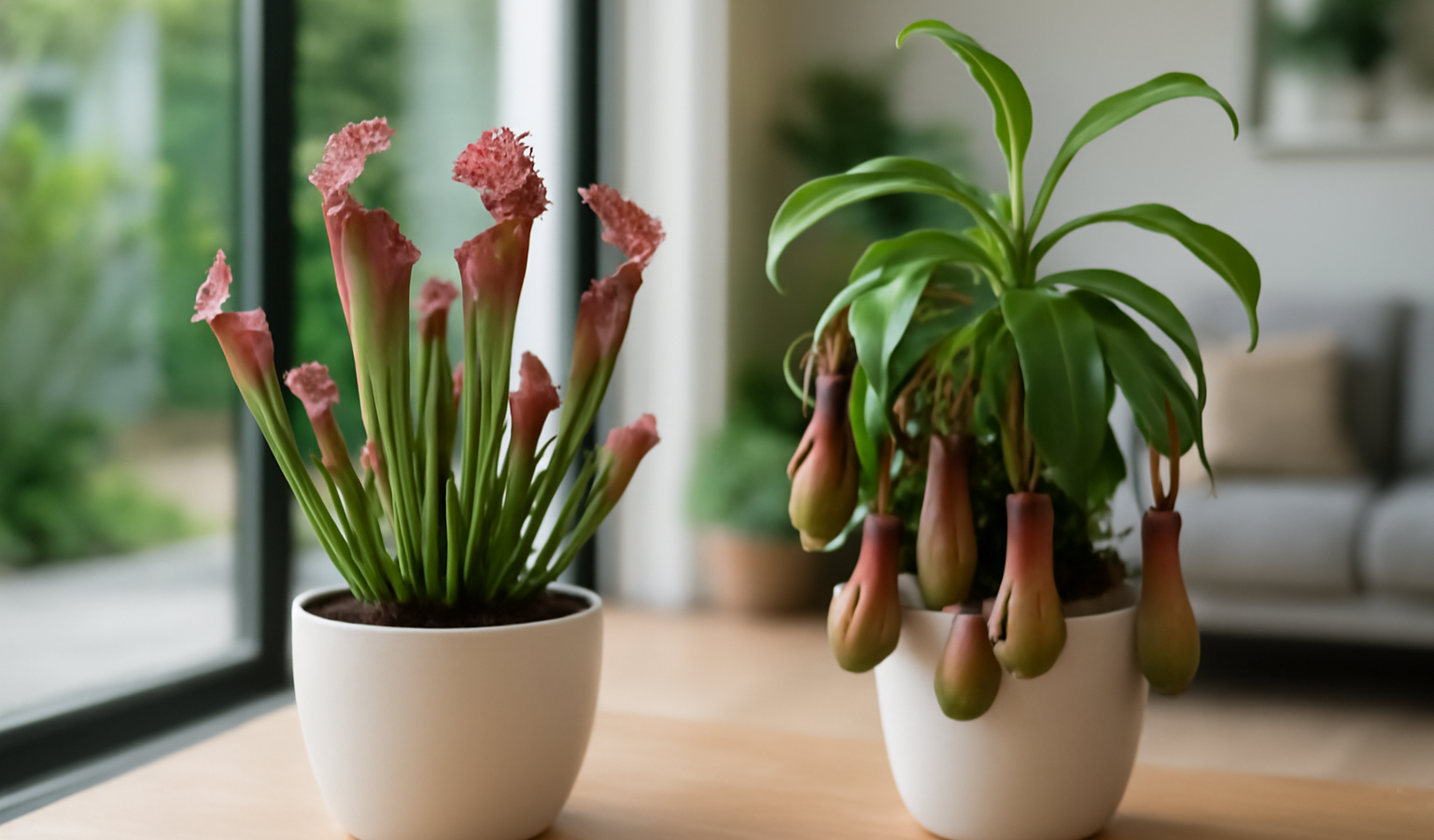
Pitcher plants are carnivores that drown their prey instead of snapping it shut. Insects are lured into a tube-shaped leaf, lose their footing on a slick rim, fall into a pool of digestive fluid, and never climb out. Two very different groups share the name: Sarracenia, the temperate North American pitcher plants that grow upright like trumpets and need a cold winter, and Nepenthes, the tropical “monkey cups” from Southeast Asia that dangle pitchers from vining stems and never go dormant. Their care overlaps in the essentials — pure water, lean soil, no fertilizer in the pot — but differs sharply on temperature, humidity, and dormancy. This guide covers both so you can match the care to whichever pitcher plant you own.
Key Takeaways
- Identify your plant first. Upright trumpet pitchers in pots = Sarracenia (temperate, needs winter dormancy). Pitchers hanging from a vine = Nepenthes (tropical, no dormancy).
- Water both with distilled, RO, or rainwater only — never tap water. Dissolved minerals accumulate and kill carnivorous plants.
- Pot in a lean, acidic mix (peat + perlite/sand for Sarracenia; long-fiber sphagnum + perlite for Nepenthes). No potting soil, no fertilizer in the soil.
- Sarracenia want full sun and a cold dormancy at 35-50°F for 3-4 months. Nepenthes want bright indirect light, warmth, and high humidity year-round.
- Do not fertilize the roots. Pitchers feed themselves on insects; Nepenthes can take a very dilute foliar feed if needed indoors.
Sarracenia vs. Nepenthes: Know What You Have
Before you do anything, identify your plant, because the two groups want opposite winters. Sarracenia (American pitcher plants, including the trumpet pitcher, purple pitcher, and yellow pitcher) form a rosette of hollow, upright leaves rising straight from the soil, often vividly veined in red. They are bog plants from the US Southeast and East Coast, love blazing sun, and require a real cold dormancy. Nepenthes (tropical pitcher plants or monkey cups) grow as climbing or trailing vines, and each pitcher hangs at the end of a tendril extending from the leaf tip. They come from the humid tropics of Borneo, Sumatra, and the Philippines, never experience frost, and never go dormant. If your “pitcher plant” came in a hanging basket with cups dangling from the foliage, it is a Nepenthes; if it sits in a pot throwing up upright trumpets, it is a Sarracenia.
| Need | Sarracenia (American) | Nepenthes (Tropical) |
|---|---|---|
| Light | Full direct sun, 6+ hours | Bright but indirect; some direct morning sun |
| Water | Distilled/RO/rain; tray method, wet | Distilled/RO/rain; top-water, damp not soggy |
| Soil | Peat + perlite or silica sand (1:1) | Long-fiber sphagnum + perlite/bark |
| Temperature | Temperate; cold winter required | Warm 65-85°F year-round; no frost |
| Humidity | Outdoor ambient is fine | High, 50-70%+ |
| Dormancy | Yes — 3-4 months at 35-50°F | None |
Water: The Universal Rule
Both groups share carnivorous plants’ golden rule: water only with distilled, reverse-osmosis, or rainwater — never tap, well, spring, or bottled mineral water. Carnivorous plants evolved in rain-fed bogs with almost no dissolved minerals, and they cannot tolerate the salts in ordinary water. Those minerals (measured as TDS in parts per million) accumulate in the soil with every watering and eventually scorch the roots, killing the plant slowly. Keep your water under about 50 ppm; a cheap TDS meter confirms it. Distilled water reads near zero, rainwater is free and ideal, and an RO filter works well if you grow many plants.
How you apply that water differs. Sarracenia are bog plants that like wet feet, so stand the pot in a tray with half an inch to an inch of water and let it wick up — keep them consistently wet through the growing season. Nepenthes prefer their mix evenly moist but not waterlogged; water them from the top until it drains, then let the surface dry slightly before the next watering, and do not leave them sitting in a deep tray. Never use unglazed terracotta for either; it leaches minerals and dries too fast.
Soil: Lean and Acidic
As with all carnivores, regular potting soil and compost are lethal because they are too rich. For Sarracenia, use a 1:1 mix of plain sphagnum peat moss and either perlite or silica sand — the same bog recipe used for Venus flytraps. For Nepenthes, use a chunkier, airier blend that suits an epiphytic vine: long-fiber sphagnum moss alone, or sphagnum mixed with perlite and orchid bark, so the roots get plenty of oxygen. Buy peat with no added fertilizer or wetting agents, use horticultural silica sand (never beach or builder’s sand), and rinse perlite to remove dust. Repot every one to two years into fresh medium, since old peat and sphagnum break down and accumulate minerals over time.
Crucially, do not add fertilizer to the soil of either plant. Pitcher plants get their nutrients from trapped insects, and root fertilizer burns them. If indoor Nepenthes look starved and aren’t catching prey, a very dilute foliar orchid feed misted onto the leaves (not the roots) is the only safe supplement — and even that is optional. Choosing the right base material matters; our comparison of peat vs. coco coir explains why coir’s residual salts make it a risky substitute for these plants.
Light and Temperature
Sarracenia are full-sun plants. Give them at least six hours of direct sun, and ideally all-day sun outdoors. Strong light produces tall, sturdy, brilliantly colored pitchers; weak light produces floppy, pale, short ones. They thrive outdoors all summer and shrug off heat as long as their tray never runs dry.
Nepenthes want bright but filtered light — an east window, a bright spot a few feet from a south window, or under a grow light. Some species (lowlanders) want warmth of 70-85°F day and night; highland species prefer cooler nights. As a rule, keep common hybrid Nepenthes between about 65°F and 85°F, never letting them get cold. They also crave humidity, ideally 50-70% or higher. A terrarium, a humid bathroom, a pebble tray, or a humidifier helps; if humidity is low, the plant may stop producing new pitchers even while the leaves stay healthy.
Dormancy: Only Sarracenia
This is the make-or-break difference. Sarracenia must have a cold winter dormancy of about three to four months at 35-50°F. In autumn the pitchers brown and die back and the plant rests — this is normal, not death. In zones 6-9, leave them outdoors and let them experience natural cold, mulching the crown in the coldest areas. In colder regions, overwinter them in an unheated garage or refrigerate the rhizome wrapped in damp sphagnum. Keep them just barely moist while dormant. Skip dormancy and a Sarracenia weakens and dies within a couple of years.
Nepenthes never go dormant and must be kept warm and growing year-round. If you live where it frosts, a Nepenthes has to come indoors before temperatures drop near 50°F. Trying to give a tropical Nepenthes a cold rest will simply injure or kill it, so identifying your plant correctly is the whole game.
Feeding and Pitcher Care
Outdoor Sarracenia catch so many insects they often fill their pitchers — no feeding needed. Indoor Nepenthes catch less, but the pitchers still work; a few small insects per pitcher per month is plenty. Each pitcher naturally holds a little fluid, and on Nepenthes you should not pour it out or top it up with tap water. Old pitchers eventually brown and die while new ones form; trim spent ones off with scissors. Never feed pitchers human food like meat or cheese — it rots and fouls the trap. And never use fertilizer in the soil to “boost” a slow plant; improve light, water quality, and humidity instead.
Common Problems
No new pitchers (Nepenthes): usually low humidity or insufficient light — raise humidity and brighten the spot. The vine may make leaves but no cups until conditions improve. Brown, mushy growth or sudden decline: suspect mineral-laden water or fertilizer contamination; flush the pot with distilled water and review your water source. Floppy, pale Sarracenia: not enough sun. Pitchers browning in fall (Sarracenia): normal dormancy. Tall flower stalk in spring: Sarracenia bloom with unusual umbrella-shaped flowers before the pitchers emerge; you can leave them or remove them to conserve energy.
Pitcher plants pair naturally with other bog carnivores. If you are building a collection, our beginner’s carnivorous plant care guide covers grouping species with similar needs, and you can find more grow guides on the Plants & Flowers hub.
Frequently Asked Questions
How do I tell if I have a Sarracenia or a Nepenthes?
Sarracenia grow upright trumpet-shaped pitchers straight out of the soil in a pot and are usually sold as outdoor bog plants. Nepenthes are vines whose pitchers dangle from tendrils at the tips of the leaves, often sold in hanging baskets. The two need opposite winters, so identify yours first.
Can I water my pitcher plant with tap water?
No. Both Sarracenia and Nepenthes need distilled, reverse-osmosis, or rainwater. Tap, well, spring, and bottled mineral water all contain dissolved minerals that build up in the soil and slowly kill carnivorous plants. Aim for water under about 50 ppm TDS.
Should I put water inside the pitchers?
No need. Sarracenia fill their own pitchers with rain and digestive fluid; Nepenthes pitchers come pre-filled with their own fluid. Never top them up with tap water, and don’t pour them out. If a pitcher dries out, the plant simply makes new ones.
Why isn’t my Nepenthes making pitchers?
The most common causes are low humidity and too little light. The vine will keep making leaves but skip the pitchers until conditions improve. Raise humidity to 50-70%, give it bright indirect light, and keep it warm, and new pitchers should follow.
Do pitcher plants need a winter rest?
Sarracenia do — they require a cold dormancy of three to four months at 35-50°F or they decline and die. Nepenthes do not; they are tropical and must be kept warm and growing all year, brought indoors before any frost.