

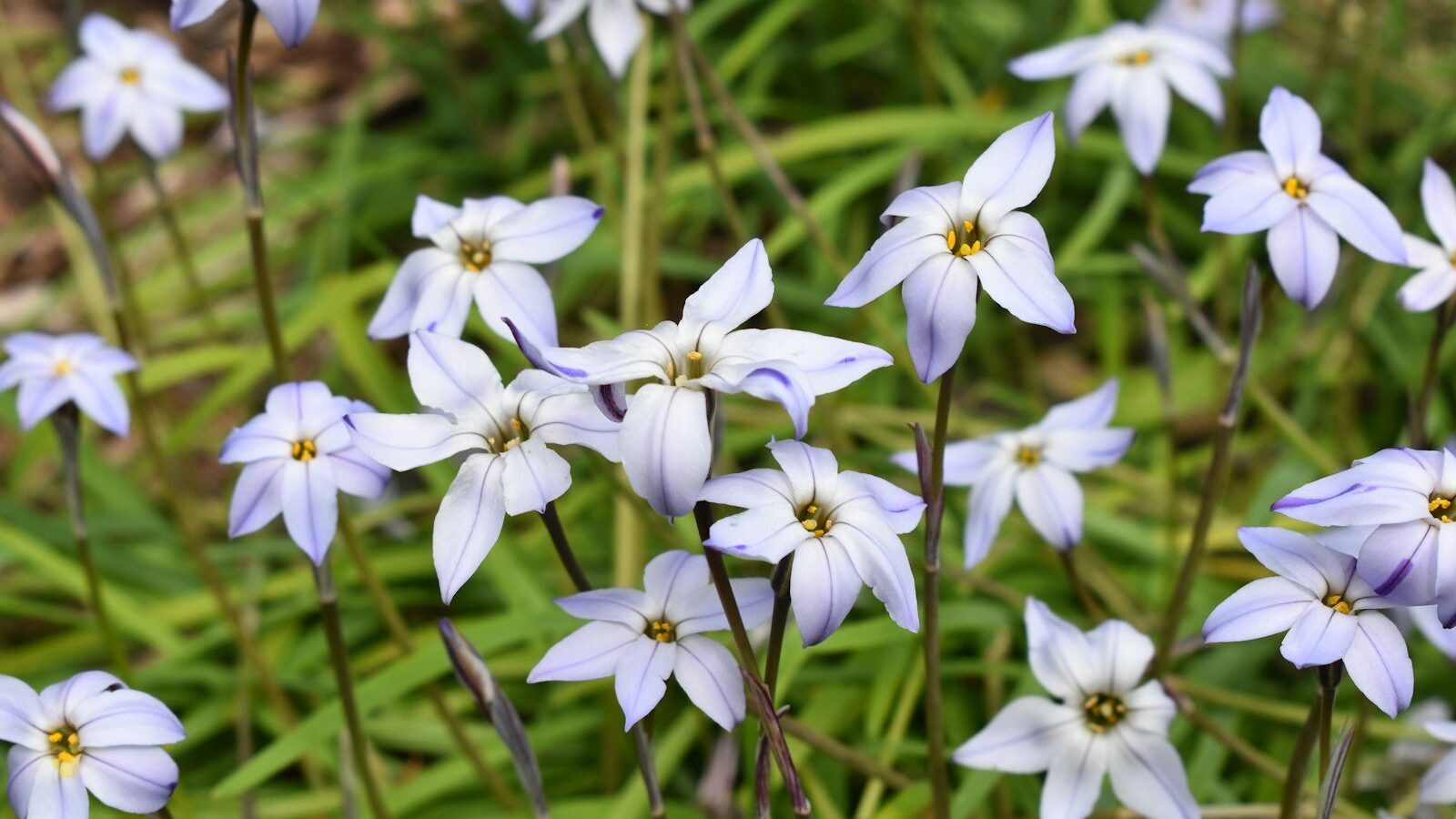
Blue star creeper (Isotoma fluviatilis, sometimes sold as Pratia pedunculata or Laurentia fluviatilis) is a mat-forming ground cover just 1–3 inches tall that fills gaps between pavers and makes a soft, flowering carpet in small areas where grass struggles. It is generally hardy in USDA zones 5–9, grows best in full sun to part shade with steady moisture, and spreads by creeping stems that root as they go. Plant plugs 6–12 inches apart in spring, keep them evenly moist for the first season, and most plantings knit together within one to two growing seasons. It tolerates light foot traffic, not ball games, and its biggest weakness is hot, dry summers — give it afternoon shade and regular water in warm climates.
In this guide
- What Blue Star Creeper Looks Like
- Where Blue Star Creeper Grows Best
- When and How to Plant
- Planting Between Pavers and Stepping Stones
- Using Blue Star Creeper as a Lawn Alternative
- Ongoing Care
- How to Get Blue Star Creeper to Spread Faster
- Common Problems
- Blue Star Creeper vs Other Step-Able Ground Covers
- How to Propagate Blue Star Creeper
- Good Companions
- Frequently Asked Questions
Key Takeaways
- Hardy in roughly zones 5–9; may brown in harsh winters at the cold end and suffer in hot, dry summers at the warm end.
- Full sun in cool regions; morning sun and afternoon shade in hot ones.
- Needs consistently moist but well-drained soil — it is not a drought-tolerant ground cover.
- Space plugs 6–12 inches apart; closer spacing fills faster.
- Handles light, occasional foot traffic; use stepping stones for daily paths.
What Blue Star Creeper Looks Like
Blue star creeper forms a dense mat of tiny, bright green leaves, each about a quarter inch long. From late spring into summer it is covered in small, pale blue, five-petaled star-shaped flowers, with lighter flushes of bloom into fall in mild climates. It stays evergreen in mild winters and may go partly dormant or brown in colder zones, greening up again in spring. A single plant spreads to about 12–18 inches across in a season under good conditions, rooting along its stems.
It is often compared with other step-able ground covers. Creeping thyme handles hot, dry sun far better but is less tolerant of moist shade; Irish and Scotch moss are more mounded; creeping Jenny spreads faster and is more aggressive. Our overview of ground cover plants compares the main choices, and our flowers and perennials guide covers how low growers fit into larger beds.
Where Blue Star Creeper Grows Best
Climate
It thrives in the Pacific Northwest, coastal California, the Mid-Atlantic and much of the Northeast and Midwest, anywhere summers are not relentlessly hot and dry. In zone 5 it may die back in exposed spots during snowless winters; a light layer of evergreen boughs or snow cover helps. In the Southeast and Southwest it can be grown with afternoon shade and regular irrigation, but expect some summer thinning.
Light
- Cool summers: full sun gives the densest mat and the most flowers.
- Hot summers: four to six hours of morning sun with afternoon shade.
- Shade: it tolerates light, dappled shade but becomes sparser and blooms less in deep shade.
Soil
Blue star creeper likes humus-rich, loamy soil that stays evenly moist but never waterlogged. It tolerates a range of pH, roughly slightly acidic to neutral. Sandy soil works if you add compost and water more often. Heavy clay that stays soggy causes rot in winter; loosen it and work in compost before planting.
When and How to Plant
Plant in spring after the last frost, or in early fall in zones 7–9 where autumn is mild and moist. Avoid planting in the heat of midsummer, when plugs dry out before they root.
- Clear the area completely. Remove grass and weeds, including roots. Weeds are the main problem in the first year, and they are much harder to pull once the mat starts to fill in.
- Improve the soil. Work 1–2 inches of compost into the top 4–6 inches.
- Space the plugs. Set plants 6 inches apart for fast coverage, 12 inches for a more economical planting that takes longer. A staggered, checkerboard pattern fills more evenly than straight rows.
- Plant at the same depth the plugs were growing, firm the soil and water thoroughly.
- Keep them moist. Water every day or two for the first two weeks, then a few times a week through the first summer.
Flats of blue star creeper can be cut into small squares with a knife to get more plugs per flat. Each 1- to 2-inch square roots readily if kept moist.
Planting Between Pavers and Stepping Stones
This is where blue star creeper is at its best: filling joints and softening hard edges while handling being stepped on now and then.
- Gap width: joints of about 1–3 inches work well. Narrower gaps dry out too fast; wider ones may need more plants to fill.
- Joint soil: remove sand or gravel from the joints to a depth of 3–4 inches and fill with a mix of roughly equal parts topsoil and compost. Polymeric sand and gravel do not support plants.
- Planting: tuck small divisions into the joints every 4–6 inches and press in firmly.
- Watering: stone heats up and wicks moisture away, so joint plantings dry faster than beds. Water more often during the first summer, and consider a drip line along the edge of the path.
For a new path, setting stones on a compacted base first and then planting the joints gives the best result. Our guides to building a paver walkway and making stepping stones cover the hardscape side.
Using Blue Star Creeper as a Lawn Alternative
Blue star creeper can replace grass in small, low-traffic areas: a shady side yard, a patch under a small tree, the strip between a patio and a bed, or a front-yard island. It needs no regular mowing and stays low. It is not a substitute for a play lawn or a dog run; heavy daily traffic wears it down to bare soil.
Think about water before replacing a lawn. In dry Western climates, blue star creeper may need as much water as turf, which defeats much of the purpose; a creeping thyme lawn or other drought-tolerant cover is usually a better fit there. In wetter regions, it is a good way to retire a struggling patch of grass in part shade.
Also plan the edges. It spreads by surface runners and will creep into adjoining lawn, where it mixes into the turf. Some gardeners like that; others do not. A solid landscape edging between the two keeps them separate.
Ongoing Care
Watering
Established plantings in cool climates generally need about an inch of water per week from rain or irrigation during the growing season. In hot weather, more. The mat shows stress quickly — leaves turn dull, then brown patches appear — so watch it closely during heat waves. Water deeply in the morning rather than lightly every evening, which encourages fungal problems.
Feeding
Very little is needed. A thin top-dressing of fine compost in spring, or a light application of balanced slow-release fertilizer at half the label rate, is plenty. Excess nitrogen makes it lush but floppy and more prone to disease.
Trimming
No regular mowing is required. If the mat becomes uneven, mow once in late summer at the mower’s highest setting or shear with grass clippers. Trim runners that creep onto paths or into beds where you do not want them.
Weeding
Hand-weed frequently in the first year. Once the mat closes, it shades out many weed seedlings, but grassy weeds and clover can still push through. Avoid broadleaf lawn herbicides nearby; blue star creeper is a broadleaf plant and will be damaged.
How to Get Blue Star Creeper to Spread Faster
- Plant closer: 6-inch spacing fills about twice as fast as 12-inch spacing.
- Keep the soil moist: runners root only into damp soil.
- Divide and replant: in spring, lift a few healthy clumps, pull them into small pieces and tuck them into thin spots.
- Top-dress lightly: a quarter inch of screened compost over sparse areas gives runners something to root into.
- Reduce competition: pull weeds before they set seed.
Common Problems
- Brown patches in summer: usually drought or heat stress. Water deeply and add shade if possible; patches often regrow from surrounding runners.
- Brown patches in winter: cold, wind or waterlogged soil. Wait until late spring before deciding a patch is dead.
- Thin growth: too much shade, compacted soil or too much foot traffic.
- Slugs and snails: they hide in the moist mat in wet regions. Use iron phosphate bait or traps.
- Rot: poorly drained soil; improve drainage or plant elsewhere.
- Spreading into the lawn: install edging and pull stray runners.
Blue Star Creeper vs Other Step-Able Ground Covers
| Plant | Height | Light | Water needs | Best use |
|---|---|---|---|---|
| Blue star creeper | 1–3 in | Sun to part shade | Moderate to high, steady moisture | Paver joints, small moist lawn replacements |
| Creeping thyme | 1–3 in | Full sun | Low once established | Hot, dry, sunny paths and slopes |
| Irish / Scotch moss | 1–2 in | Part shade | Moderate | Small mossy accents, cool climates |
| Creeping Jenny | 2–4 in | Sun to shade | High | Damp areas; spreads aggressively |
| Dwarf mondo grass | 2–4 in | Part shade | Moderate | Formal joints and edging, slow to fill |
Pick by your water and sun first. If your paths bake in afternoon sun and you do not want to irrigate, thyme is the better choice. If the area stays damp and gets some shade, blue star creeper is one of the best-looking options. For thyme specifically, see how to grow creeping thyme.
How to Propagate Blue Star Creeper
Division is the easiest way to get more plants for free. In spring or early fall, slice a section from an established mat with a trowel or old knife, keeping some soil attached, then pull it into 1- to 2-inch pieces that each have roots. Plant them immediately in moist soil and keep them watered for a few weeks. Rooted runners can also be snipped from the edges of the mat and replanted. Seed is occasionally available but is slow and less reliable than divisions.
Good Companions
Blue star creeper pairs well with other low, moisture-loving plants for a mixed tapestry: Corsican mint in shade, Scotch moss for gold contrast, dwarf mondo grass and small hostas at bed edges. Along sunny path edges in cooler climates, mixing it with creeping thyme gives a contrast of blue flowers against thyme’s pink and purple, though the thyme will favor the drier, sunnier spots.
Frequently Asked Questions
Can you walk on blue star creeper?
Yes, occasionally. It tolerates light foot traffic between pavers and in low-use areas, but daily traffic on the same line wears it thin. Use stepping stones for regular paths.
How fast does blue star creeper spread?
With good moisture, a plant can spread about 12–18 inches in a season. Plugs spaced 6 inches apart usually knit together in one season; 12-inch spacing often takes two.
Is blue star creeper invasive?
It is not generally listed as invasive, but it spreads readily by runners and will creep into lawns and beds. Edging keeps it contained.
Does blue star creeper stay green in winter?
It stays mostly evergreen in mild winters. In colder zones it may brown or partly die back, then regrow from runners in spring.
Does blue star creeper grow in full sun?
Yes in cool-summer climates, where full sun produces the densest mat. In hot climates, give it afternoon shade and regular water to prevent scorching.