

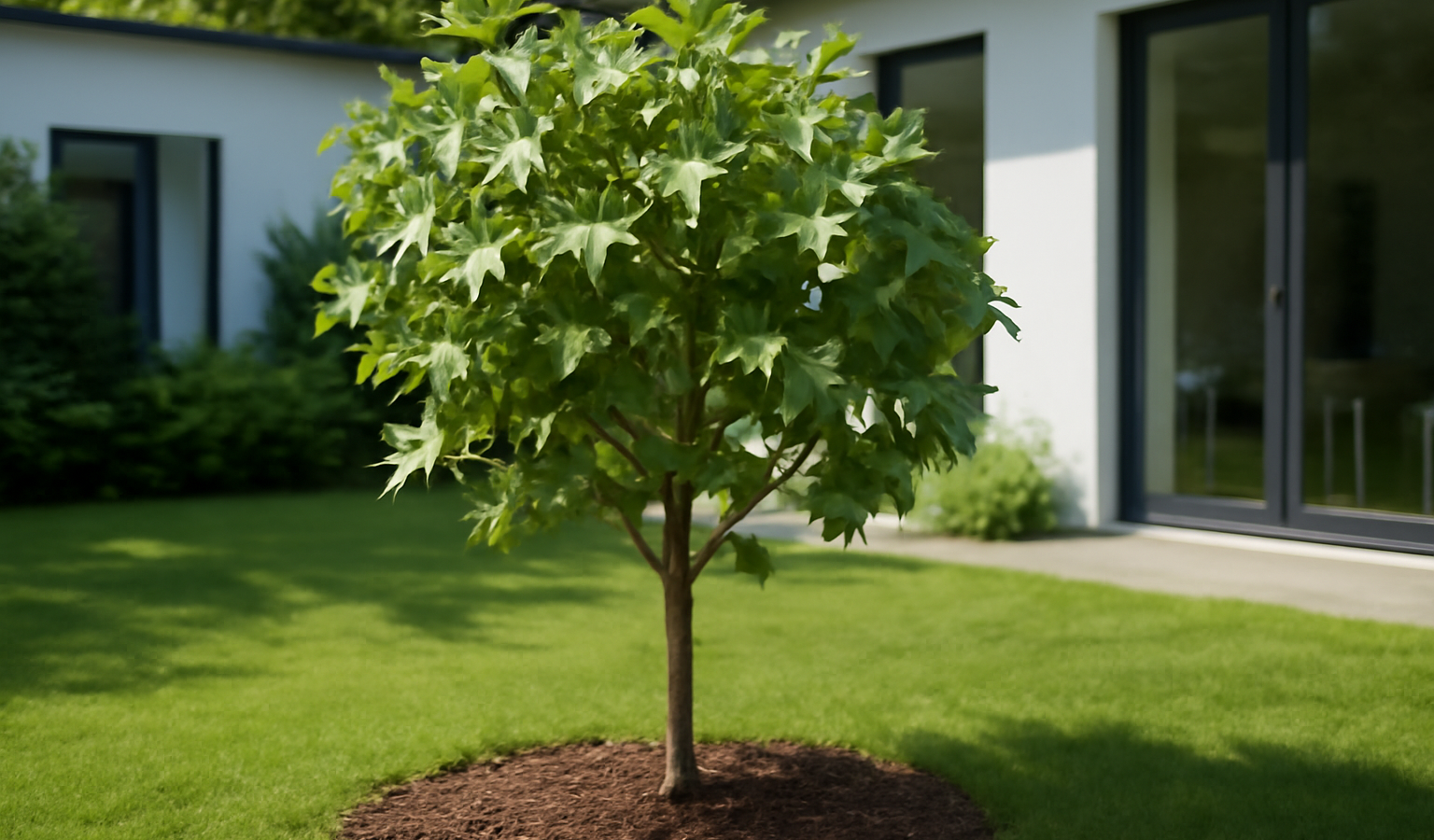
The American sweetgum (Liquidambar styraciflua) is one of the finest fall-color shade trees in North America—its star-shaped leaves turn a riot of yellow, orange, red, and deep burgundy-purple, often on the same tree, holding color longer than most. It’s fast-growing, adaptable, and shapely, with a neat pyramidal-to-oval crown. But sweetgum comes with one notorious catch: the spiky, hard “gumball” seed pods it drops by the hundreds, which can twist ankles, jam mowers, and litter lawns all winter. Whether sweetgum is a great tree or a regrettable one comes down almost entirely to where you site it. This guide covers mature size, zones, planting, care, the gumball problem (and how to avoid it), and exactly where this tree belongs.
Key Takeaways
- Hardy in USDA zones 5–9; native to the southeastern U.S. and widely planted as a shade and street tree.
- Grows large—60–75 feet tall and 40–50 feet wide at maturity, with a fast growth rate (1.5–2+ feet/year when young).
- Full sun and moist, deep, slightly acidic soil give the best growth and fall color.
- Drops spiky gumball seed pods that litter the ground; choose a fruitless cultivar like ‘Rotundiloba’ to avoid them.
- Site it away from patios, walkways, pools, and septic lines—the surface roots and gumballs cause problems near hardscape.
- Outstanding multicolor fall foliage is its signature feature; great as a lawn or open-space shade tree.
- Foliage and pods are not significantly toxic, but the hard pods are a trip-and-mower hazard.
Size, Form, and Growth Rate
Sweetgum is a big tree. Expect a mature height of 60 to 75 feet and a spread of 40 to 50 feet, with some specimens topping 100 feet in ideal conditions over many decades. Young trees grow fast—often 1.5 to 2 feet or more per year—forming a tidy pyramidal shape that broadens into a rounded oval crown with age. The bark is gray-brown and deeply furrowed, and twigs often develop distinctive corky ridges (“wings”).
That mature size is the first thing to plan around. A sweetgum needs room—both above ground for its broad crown and below ground for an extensive, partly shallow root system. It’s a magnificent tree for a large lawn, a park-like property, or an open landscape, but a poor fit for a small suburban lot crowded against the house, driveway, or neighboring trees.
Zones, Sun, and Soil
Sweetgum is hardy in USDA zones 5 through 9. It’s native from Connecticut south to Florida and west to Texas, so it’s well adapted to the eastern and southern U.S., and it’s planted across much of the country. In the colder end of its range (zone 5), choose a hardy seed source and a sheltered site, as late frosts can nip new growth.
Plant in full sun—at least six hours daily—for the strongest growth and the most vivid fall color; in shade the tree grows sparse and colors poorly. Sweetgum prefers deep, moist, well-drained, slightly acidic soil and naturally grows in bottomlands and floodplains, so it tolerates wet and clay soils better than many shade trees. It does struggle on high-pH (alkaline) soils, where it commonly develops chlorosis—yellowing leaves with green veins from iron deficiency. If your soil is alkaline, either amend it toward acidic or choose a different tree.
The Gumball Problem
Here’s the issue that defines sweetgum’s reputation. After flowering, the tree produces hard, woody, spiky spherical seed pods about 1 to 1.5 inches across—the infamous “gumballs.” A mature tree drops them by the hundreds (sometimes thousands) from late fall through winter and into spring. They’re a real nuisance:
- They’re painful to step on and roll underfoot like marbles—a genuine trip-and-fall and ankle-twist hazard, especially on lawns and paths.
- They jam and damage mowers and are tedious to rake up.
- They litter lawns, patios, decks, and pools for months and don’t break down quickly.
- They make a sweetgum a poor choice near play areas, walkways, and seating.
There are three ways to deal with gumballs. First and best: plant a fruitless cultivar. ‘Rotundiloba’ is a popular sterile (or nearly sterile) selection with rounded leaf lobes that produces few or no gumballs while keeping good fall color—this is the single smartest choice for a tree near any used space. Other low-fruiting and improved-color cultivars include ‘Slender Silhouette’ (a narrow columnar form ideal for tight spots) and ‘Worplesdon’. Second: site the tree where the litter doesn’t matter—over a mulched bed, a natural area, or a far corner of the lot where pods can simply lie. Third: manage them—rake regularly, use a rolling nut/ball picker-upper, or, in some cases, have an arborist apply a fruit-suppressing growth regulator (this is hit-or-miss and best left to professionals).
Where to Site a Sweetgum
Siting is everything with this tree. Get it right and sweetgum is a low-maintenance, spectacular shade tree; get it wrong and you’ll fight gumballs and root problems for decades.
- Give it space: Plant where it has room for a 40–50 foot spread and a tall crown—at least 20–25 feet from buildings and 30+ feet from other large trees.
- Keep it away from hardscape: Sweetgum has aggressive, partly shallow surface roots that can heave sidewalks, driveways, patios, and pool decks, and can invade septic lines and old sewer pipes. Plant well back from all paving and underground utilities.
- Avoid high-traffic and bare-foot zones: Don’t place a fruiting sweetgum over a lawn you walk on, near a pool, or beside a play area—the gumballs make these spots miserable.
- Ideal placement: A large open lawn, a back corner of the property, a naturalized area, or a parkway strip wide enough for the roots, ideally underplanted with mulch rather than turf so pods can be left in place.
If your property is small or full of paving, a sweetgum is probably the wrong tree—consider it only if you can place it in genuinely open ground. For other shade-tree options, our guide to growing a hawthorn tree covers a smaller, more lot-friendly flowering tree.
How to Plant a Sweetgum
Plant balled-and-burlapped or container trees in early spring or fall, when temperatures are mild and the roots can establish before stress sets in. Sweetgum has a deep taproot when young and resents heavy root disturbance, so plant young trees and avoid transplanting older ones.
- Dig a hole two to three times as wide as the root ball but no deeper than the ball’s height.
- Set the tree so the root flare (where the trunk widens into roots) sits at or slightly above grade—never plant deep.
- Backfill with the native soil, firming gently to remove air pockets; skip heavy soil amendments in the hole, which can discourage roots from spreading outward.
- Water deeply to settle the soil, then mulch a 3-inch layer over the root zone, keeping it a few inches off the trunk.
- Stake only if needed in windy sites, and remove stakes after the first year.
Watering, Feeding, and Pruning
Water a newly planted sweetgum deeply and regularly through its first two or three years—about an inch or two per week, more in heat—until the root system establishes. Mature trees are reasonably drought-tolerant but appreciate deep watering during extended dry spells, and consistent moisture supports the best fall color.
Sweetgum rarely needs fertilizer in decent soil; a healthy tree in good ground grows fast on its own. If a soil test shows deficiency, or if you see iron chlorosis on alkaline soil, an acidifying or chelated-iron treatment can help, alongside lowering soil pH over time. For background on feeding strategies, see organic vs synthetic fertilizer. Prune in late winter while dormant to remove dead, damaged, or crossing branches and to establish a strong central leader when young. Sweetgum has generally good structure and needs little corrective pruning once established.
Pests, Problems, and Fall Color
Sweetgum is fairly tough and relatively pest-resistant, but watch for:
- Iron chlorosis: Yellow leaves with green veins on alkaline soil—the most common problem. Acidify the soil or apply chelated iron.
- Surface roots: Shallow roots can heave turf and paving and make mowing tricky; mulch the root zone instead of growing grass right up to the trunk.
- Bleeding necrosis and cankers: Occasional dieback on stressed trees; keep trees vigorous with proper water and avoid wounds.
- Webworms, scale, and borers: Usually minor; healthy trees shrug them off.
- Weak fall color: Caused by too much shade, drought stress, or warm fall weather. Full sun and a cool, sunny autumn produce the best display.
When everything lines up, the payoff is one of the most brilliant fall shows in the tree world—leaves shifting through gold, orange, scarlet, and purple over several weeks. That display, on a fast-growing, adaptable tree, is exactly why gardeners keep planting sweetgum despite the gumballs. Just put it in the right place, ideally a fruitless cultivar, and it will reward you for decades. Browse the Plants & Flowers hub for more trees and landscape plants.
Frequently Asked Questions
How big does a sweetgum tree get?
A mature American sweetgum typically reaches 60–75 feet tall and 40–50 feet wide, with some specimens exceeding 100 feet over many decades. It grows fast when young—often 1.5 to 2 feet per year—so give it plenty of room above and below ground, well away from buildings and paving.
How do I stop a sweetgum from dropping gumballs?
The most reliable fix is to plant a fruitless or low-fruiting cultivar such as ‘Rotundiloba’, which produces few or no spiky pods. On existing trees, an arborist can sometimes apply a fruit-suppressing growth regulator (results vary), or you can site the tree over mulch where the gumballs can be left to lie, and rake or use a rolling picker-upper for cleanup.
Where should I plant a sweetgum tree?
In a large, open, sunny space—a big lawn, a back corner, or a naturalized area—well away from patios, walkways, pools, driveways, septic lines, and other large trees. Its broad crown, surface roots, and gumball litter make it a poor choice near hardscape or high-traffic areas. Avoid alkaline soils, which cause chlorosis.
Are sweetgum gumballs or leaves toxic?
Sweetgum is not considered significantly toxic to people or pets. The real hazard from the gumballs is physical—they’re hard and spiky, roll underfoot, and can cause trips and falls, twisted ankles, and mower damage rather than poisoning.
Why are my sweetgum’s leaves turning yellow?
The most common cause is iron chlorosis from alkaline soil—leaves yellow while the veins stay green. Lower the soil pH over time or apply chelated iron. Yellowing can also come from waterlogging, drought stress, or normal fall color change; check the soil pH and moisture to pin down the cause.