

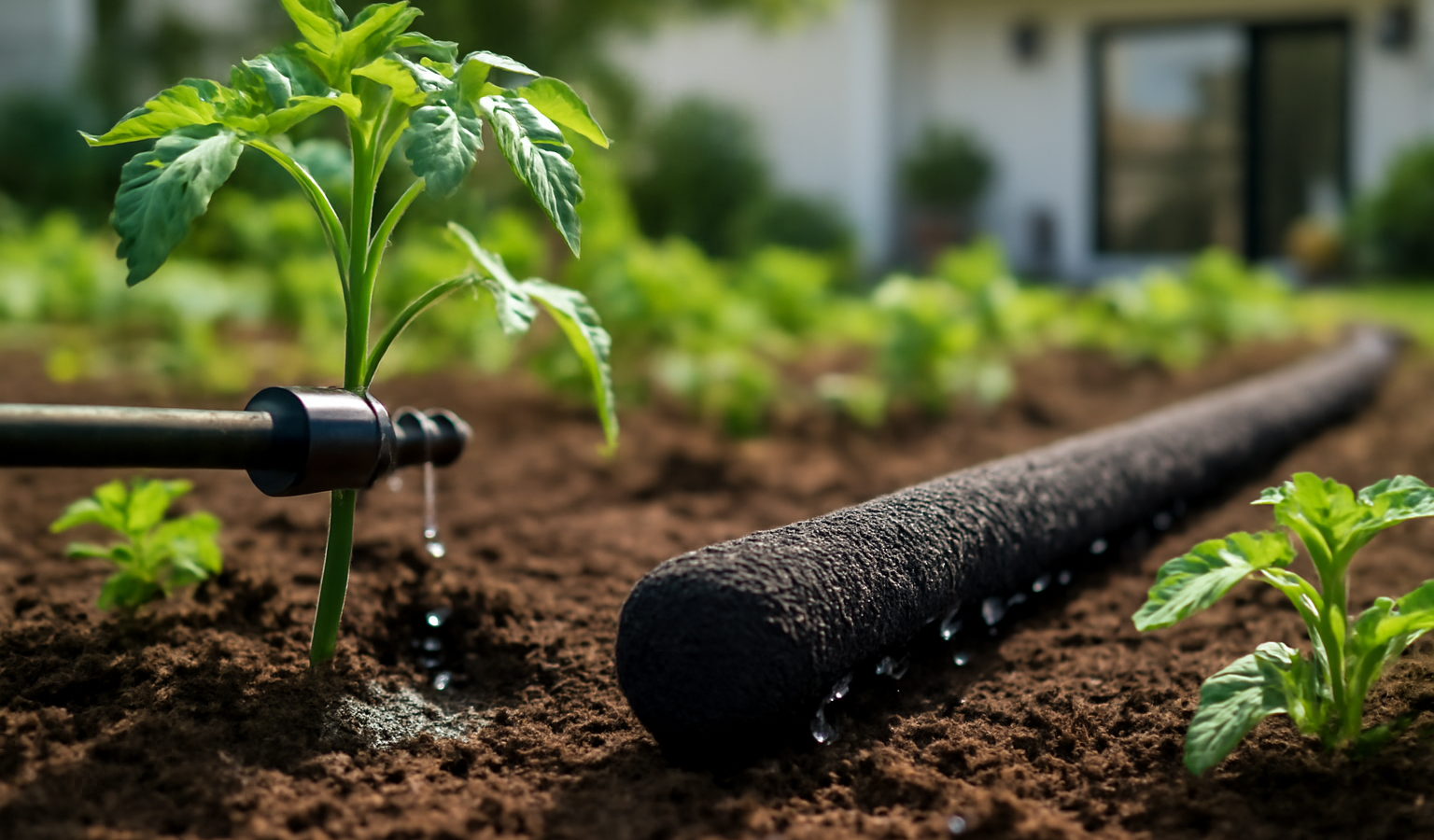
Both drip irrigation and soaker hoses deliver water slowly at soil level, which is exactly what gardens want: deep roots, dry foliage, and far less waste than overhead sprinklers. But the two systems are not interchangeable. A soaker hose is a single porous tube that weeps along its whole length, cheap, simple, and ready in ten minutes. Drip irrigation is a network of tubing and individual emitters that puts a measured amount of water exactly where you place it, more expensive and fiddlier to install, but precise and long-lived. Choosing the wrong one wastes money or leaves half your plants thirsty. This guide compares cost, coverage, water efficiency, lifespan, and maintenance so you can match the system to your garden.
Key Takeaways
- Soaker hoses are cheap ($15–30), install in minutes, and suit short rows and dense beds, but water unevenly and last only 2–4 years.
- Drip irrigation costs more and takes longer to set up, but delivers precise, even water to each plant and lasts 5–10+ years.
- Drip is the most water-efficient method available (up to ~90% efficiency); soaker hoses are efficient but lose pressure over long runs.
- Use a soaker for small, uniform beds; use drip for large gardens, containers, rows of mixed plants, or sloped ground.
- Both should run on a timer and a pressure regulator, and both pair well with mulch on top.
Quick comparison at a glance
| Factor | Soaker Hose | Drip Irrigation |
|---|---|---|
| Upfront cost | Low ($15–30 per hose) | Moderate–high ($50–150+ for a kit) |
| Setup time | Minutes, lay it out and go | 1–3 hours, plan and assemble |
| Water placement | Even line of seepage | Precise, per-plant emitters |
| Even coverage | Drops off over long runs | Uniform with pressure-compensating emitters |
| Water efficiency | High | Highest (~90%) |
| Lifespan | 2–4 years | 5–10+ years |
| Best for | Short rows, dense beds, renters | Large/mixed gardens, containers, slopes |
Soaker hoses: cheap and instant
A soaker hose is a length of porous rubber or recycled-tire tubing that “sweats” water along its entire surface when you turn on the tap. You snake it through a bed, connect it to a spigot, and it begins seeping immediately, no emitters, fittings, or layout planning required. For a small raised bed or a single row of vegetables, you can be watering within ten minutes of opening the package.
The price is the big draw: a 50-foot soaker hose typically runs $15 to $30. That low barrier makes it ideal for renters, first-time gardeners, and anyone testing whether low-flow watering suits their setup. Because the whole hose weeps, soaker hoses excel in densely planted, uniform beds, a bed of lettuce, a flower border, or a row of bush beans where every inch of soil needs moisture and plants are spaced closely.
The limits of soaker hoses
The weakness is uneven output. Water pressure is highest at the spigot end and drops along the hose, so the first 10 feet seep more than the last 10 feet. Practical soaker runs should stay under about 100 feet (ideally 25 to 50 feet) to keep coverage reasonably even, and you should lay them on as flat a grade as possible, on a slope, water races to the downhill end. A pressure regulator (around 10 to 25 psi) keeps the hose from bursting or watering unevenly. Soaker hoses also clog from the inside with mineral deposits and from the outside with soil and roots, and the rubber degrades in sun, which is why their working life is usually only two to four years. Always bury them under mulch, not exposed, to slow UV breakdown and reduce evaporation.
Drip irrigation: precise and durable
Drip irrigation is a system rather than a single product. A main supply line (typically 1/2-inch poly tubing) carries water through the garden, and you tap into it with emitters, drippers, or 1/4-inch micro-tubing that deliver water to specific points, one or more emitters per plant. Emitters are rated by flow, commonly 0.5, 1, or 2 gallons per hour (GPH), so you can give a thirsty tomato two 1-GPH emitters and a small pepper just one. Pressure-compensating emitters release the same amount whether they are first or last on the line, or uphill or down, which solves the even-coverage problem that limits soaker hoses.
That precision is drip’s superpower. You water the root zone of each plant and nothing in between, so weeds get less water, evaporation is minimal, and efficiency reaches roughly 90%, the highest of any irrigation method. Drip also scales: the same system handles a sprawling vegetable garden, mixed perennial borders, rows of shrubs, and even containers (with micro-emitters or spray stakes) on one timer. Components are modular, so you expand or reconfigure the layout as the garden changes.
The cost of drip
The trade-off is upfront effort and money. A starter drip kit runs $50 to $150 or more depending on garden size, and installation takes one to three hours, you plan the layout, cut and connect tubing, punch in emitters, and add a backflow preventer, filter, and pressure regulator at the spigot. There are more parts to fail or pop loose, and emitters can clog (a filter and the occasional flush prevent most of this). But once it is dialed in, a drip system is largely set-and-forget for 5 to 10 years or more, and the per-plant control means you can fine-tune water to exactly what each crop needs. For larger landscapes, this controllability is why drip is the standard in professional landscaping and outdoor-living projects.
Water efficiency and plant health
Both systems beat sprinklers decisively because they water the soil, not the air or the leaves. Keeping foliage dry dramatically reduces fungal diseases like powdery mildew, blight, and black spot, which thrive on wet leaves, this is a major reason gardeners switch away from overhead watering. Both also encourage deeper, healthier roots because slow, low watering soaks down rather than running off.
Between the two, drip edges out soaker hoses on raw efficiency because every drop is metered to a target, while a soaker still wets some bare soil between plants. In practice, both can cut outdoor water use by 30 to 50% compared to sprinklers. For maximum savings with either system, run it early in the morning, put it on a simple hose-end or inline timer, and top the bed with 2 to 3 inches of mulch to slow evaporation, the same mulch that protects a soaker hose from UV. If you are weighing ground covers for that mulch layer, our guide on mulch vs rock covers the trade-offs.
Verdict: which should you install?
Choose a soaker hose if you have a small, densely planted, relatively flat bed (a raised bed, a short veg row, a tidy flower border), you want to spend the least money, you are renting, or you just want watering handled today with no planning. Keep runs under about 50 feet, add a pressure regulator, and bury it under mulch. Choose drip irrigation if you have a larger garden, mixed plants with different water needs, containers, rows on a slope, or you want the most efficient, most precise, and longest-lasting system, and you are willing to invest a couple of hours and more money upfront. For most permanent gardens of any real size, drip is the better long-term value despite the higher entry cost; for a quick, cheap fix on a small uniform bed, a soaker hose is hard to beat. Whichever you pick, pair it with a timer and mulch, and you will water less, lose fewer plants to disease, and spend far less time holding a hose. For more on garden setup and design, see our outdoor living guides.
Frequently Asked Questions
Is drip irrigation worth the extra cost over a soaker hose?
For most permanent gardens, yes. Drip costs more upfront ($50–150+ versus $15–30) and takes longer to install, but it delivers more even, precise watering, scales to any garden size, and lasts 5–10+ years versus 2–4 for a soaker. For a small, uniform bed or a renter, a soaker hose’s low cost and instant setup often win out.
How long should a soaker hose run be?
Keep individual soaker runs under about 100 feet, and ideally 25–50 feet, because water pressure and seepage drop off toward the far end. For larger areas, split into multiple shorter lengths fed from a manifold rather than one long run, and add a pressure regulator (10–25 psi) to keep output even.
Can I use either system on a slope?
Drip irrigation with pressure-compensating emitters is far better on slopes because each emitter releases the same amount regardless of elevation. Soaker hoses water unevenly on a grade, the downhill end gets much more, so reserve them for flat or gently sloped beds.
Do drip and soaker systems need a filter and pressure regulator?
Yes for both. A pressure regulator prevents bursting and uneven output, and a filter keeps grit and minerals from clogging emitters or the porous hose wall. Add a backflow preventer at the spigot too. These inexpensive parts dramatically extend system life and reliability.
Should I cover the hose or tubing with mulch?
Yes. Covering soaker hoses and drip lines with 2–3 inches of mulch protects the rubber and tubing from UV degradation, reduces surface evaporation so more water reaches roots, and hides the lines. Just avoid burying drip tubing in soil where you cannot spot clogs or leaks, mulch on top of the soil is ideal.