

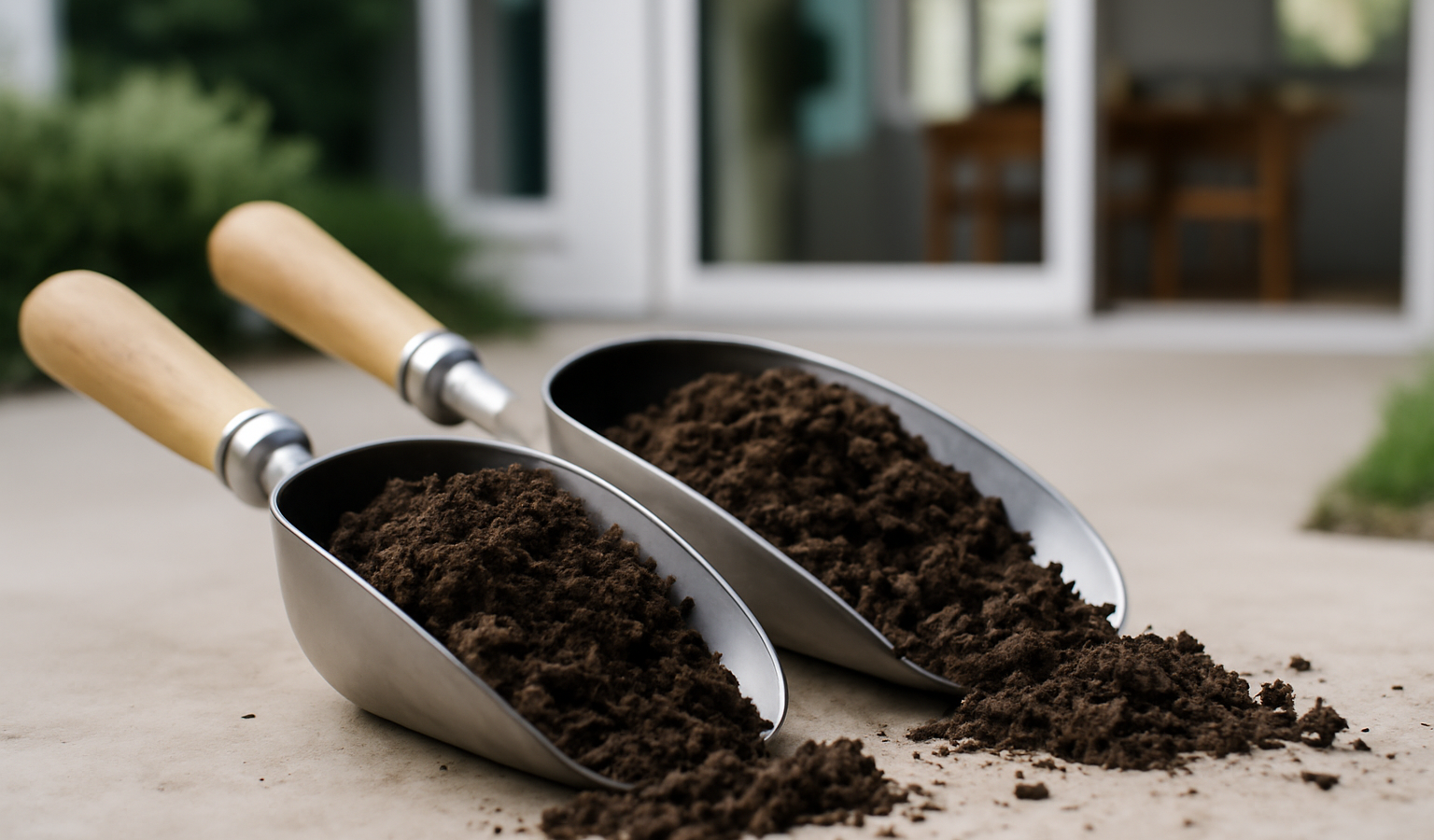
A soil scoop is one of those tools you don’t think about until you’ve spent a whole afternoon filling pots with a hand trowel and your wrist is aching. A scoop is built for moving loose media in volume — potting mix, compost, sand, perlite, chicken feed, ice melt — with a deep, high-sided body that holds far more than a trowel and a pointed nose that digs into a bag without spilling. The right one turns repotting season from a chore into a quick job, and the wrong one bends at the neck the first time you push it into compacted mix. After repotting dozens of plants, filling raised beds, and scooping everything from fine seed-starting mix to coarse bark, we found the gap between a good scoop and a cheap one comes down to three things: how the blade meets the handle, whether the edges are comfortable to grip, and how much the bowl actually holds versus what the listing claims.
Below are the seven soil scoops worth your money in 2026, sorted by who each is best for. We cover heavy-gauge stainless workhorses, light aluminum scoops for all-day potting, ergonomic models for arthritic hands, oversized scoops for filling beds fast, and budget picks that punch above their price. Whether you potter on a balcony or run a backyard nursery, there’s a scoop here sized to your hands and your work.
As an Amazon Associate we earn from qualifying purchases. This page contains affiliate links at no extra cost to you.
Key Takeaways
- The blade-to-handle joint is everything. One-piece forged or single-stamped scoops never loosen; riveted-handle models can wobble or snap under hard use.
- Stainless steel resists rust and bending; aluminum is light for all-day use but softer; heavy-duty plastic is cheap and rustproof but flexes in dense, wet mix.
- High side walls and a deep bowl let you carry more without spilling — the practical difference between two trips and four when filling pots.
- A pointed or beveled nose scoops cleanly from the bottom corner of a bag; a flat front pushes media ahead of it instead of digging in.
- Grip comfort matters more than you’d think — rolled or coated edges and a contoured handle prevent the hand fatigue that thin stamped steel causes.
- Match scoop size to the job: small scoops for seed mix and topdressing, mid-size for potting, oversized for filling raised beds and big containers.
| Product | Best For | Key Spec |
|---|---|---|
| Fiskars Big Grip Garden Scoop | All-around potting | Cast aluminum, contoured grip |
| Edward Tools Stainless Steel Scoop | Heavy-duty digging | One-piece stainless, rust-proof |
| Garrett Wade Heavy-Duty Steel Scoop | Lifetime workhorse | Forged steel, riveted hardwood |
| Yard Butler Soil Scoop | Multi-use / serrated edge | Stamped steel, serrated sides |
| RADIUS Garden Root Slayer Scoop | Ergonomic / sore hands | O-handle, carbon steel |
| Bloem Plastic Garden Scoop | Light potting / budget | Recycled plastic, rustproof |
| Bond Mini Garden Scoop | Seed mix & small pots | Compact aluminum, deep bowl |
1. Fiskars Big Grip Garden Scoop — Best Overall
The Fiskars Big Grip scoop is the one we hand to anyone who asks for a single do-everything scoop. It’s cast from a lightweight aluminum alloy as essentially one piece — bowl, neck, and handle flow together with no rivet to loosen — so it never develops the wobble that kills riveted scoops. The bowl is deep with tall side walls that hold a genuinely useful volume of potting mix without dribbling out the sides, and the front edge is beveled enough to bite into the bottom corner of a bag.
What sets it apart is the namesake grip: the handle is contoured and softened so you can lean on it through an hour of repotting without the hand fatigue thin stamped steel causes. Aluminum keeps the empty weight low, which matters more than people expect when you’re making fifty scoops in a session. It won’t rust, rinses clean, and the integrated build shrugs off the abuse of digging into compacted mix. For balcony gardeners and backyard repotters alike, it’s the most comfortable, most reliable all-rounder here.
Pros
- One-piece cast build with no rivet to loosen
- Contoured Big Grip handle reduces hand fatigue
- Light aluminum is easy to wield all session
- Deep bowl with tall walls holds plenty without spilling
Cons
- Aluminum is softer than steel — can scratch on gravel
- Mid-size bowl is slower for filling large raised beds
- Costs more than basic stamped scoops
2. Edward Tools Stainless Steel Soil Scoop — Best Heavy-Duty
When you regularly dig into compacted media, frozen ice-melt bags, or coarse gravel, you want stainless steel and no rivets — and the Edward Tools scoop delivers exactly that. It’s a one-piece stainless build, blade through handle, so there’s nothing to loosen and nothing to rust. The edges are beveled to cut into dense mix rather than push it, and the gauge of steel is thick enough that it doesn’t flex when you lever a scoopful out of packed compost.
Stainless is heavier than aluminum, which is the trade-off: this scoop has real heft, and after a long session your forearm knows it. But that mass is also why it digs so well — you let the weight do the work instead of forcing it. It rinses to a shine, never corrodes even if you leave it out in the rain, and the durable one-piece construction means it’s the kind of tool you buy once. For gardeners who treat a scoop as a small shovel, this is the toughest pick that won’t break the bank.
Pros
- One-piece stainless steel — rustproof and no rivet to fail
- Thick gauge doesn’t flex in compacted or coarse media
- Beveled edge cuts into dense mix and bag corners
- Buy-it-once durability at a fair price
Cons
- Heavier than aluminum — more arm fatigue over long sessions
- Bare steel handle is less cushioned for the hand
- Can feel like overkill for light seed-mix work
3. Garrett Wade Heavy-Duty Steel Scoop — Best Lifetime Tool
Garrett Wade has a reputation for heirloom-grade hand tools, and its heavy-duty steel scoop is built to be handed down. The bowl is forged from thick steel with high, gently rolled side walls that hold a large volume, and it’s mated to a turned hardwood handle through a robust ferrule-and-rivet joint. Unlike cheap riveted scoops, the attachment here is engineered to stay tight, and the wood handle warms in the hand in a way bare metal never does.
This is the scoop for someone who appreciates a tool with real substance and plans to keep it for decades. The steel bowl will outlast aluminum on abrasion, the wood handle is comfortable and replaceable, and the whole thing feels balanced rather than nose-heavy. The honest caveats: it’s the most expensive scoop here, the steel bowl needs a quick dry-off to avoid surface rust, and the wood handle wants occasional oiling. For gardeners who value craftsmanship and longevity over saving a few dollars, nothing else here matches it.
Pros
- Forged steel bowl built for decades of use
- Comfortable, warm, replaceable hardwood handle
- Large deep bowl with rolled, hand-friendly edges
- Balanced feel rather than nose-heavy
Cons
- Most expensive scoop on this list
- Steel bowl needs drying to prevent surface rust
- Wood handle benefits from occasional oiling
4. Yard Butler Soil Scoop — Best Multi-Use
The Yard Butler soil scoop earns its spot by doing more than scoop. It’s a stamped steel scoop with serrated cutting edges down both sides, so beyond moving media it can saw through root balls, slice open bags, cut twine, and even rough-measure depth thanks to markings on some versions. The pointed nose digs into bags and soil, and the serrations turn it into a genuine multi-tool for the potting bench.
Because it’s stamped rather than cast, the bowl is shallower than the deep workhorses above, so it carries less per scoop — this is a tool optimized for versatility over volume. The serrated edges are its signature: dividing a pot-bound perennial or trimming roots before repotting is far easier when your scoop doubles as a saw. The powder-coated finish resists rust, though the cut edges will need an occasional touch of oil. For the gardener who wants one tool clipped to their belt that handles a dozen small jobs, the Yard Butler is hard to beat.
Pros
- Serrated edges cut roots, twine and bags
- Pointed nose digs cleanly into media and soil
- Genuine multi-tool for the potting bench
- Powder-coated finish resists rust
Cons
- Shallower stamped bowl carries less per scoop
- Serrated edges need occasional oiling to stay sharp
- Not the choice if pure scooping volume is your priority
5. RADIUS Garden Root Slayer Scoop — Best Ergonomic Pick
If wrist or hand pain makes scooping uncomfortable, the RADIUS Garden ergonomic scoop is built around the problem. RADIUS is known for its O-shaped grip, a large looped handle you wrap your whole hand around so force comes from your forearm and shoulder rather than pinching with the wrist and thumb. For gardeners with arthritis or carpal tunnel, that single design change is the difference between a job they can finish and one they can’t.
The blade is tough carbon steel with a beveled edge that bites into compacted media, and the bowl is sized for serious potting volume. The grip is over-molded with a soft, non-slip material that stays comfortable even with wet, gloved hands. The trade-off is bulk: the O-handle makes the tool larger to store and a bit unusual at first if you’re used to a conventional handle. But for anyone whose hands protest after a few minutes of potting, the comfort gain is transformative, and the carbon-steel blade backs it up with real digging capability.
Pros
- O-handle spreads force off the wrist — great for sore hands
- Soft, non-slip over-mold grips even when wet or gloved
- Tough carbon-steel blade digs compacted media
- Generous bowl for real potting volume
Cons
- Bulky O-handle takes more storage space
- Carbon steel needs drying to avoid rust
- Looped grip feels unusual at first
6. Bloem Plastic Garden Scoop — Best Budget Pick
For light potting work on a tight budget, the Bloem plastic garden scoop covers the basics for the price of a coffee. Molded from durable recycled plastic, it’s completely rustproof, weighs almost nothing, and rinses clean instantly — which makes it the scoop you don’t mind leaving in a bag of mix or lending to a neighbor. The bowl is reasonably deep for a plastic scoop and the molded handle is comfortable enough for casual repotting.
The honest limits are what you’d expect from plastic: push it into dense, wet, or compacted media and the edge flexes rather than cutting, and the nose isn’t sharp enough to bite into a packed bag corner. It’s at its best with loose, dry potting mix, perlite, and seed-starting media, where its featherweight feel is a genuine plus. As a first scoop for a balcony gardener, a backup for the shed, or a dedicated scoop for amendments you don’t want contaminating your steel tools, the Bloem is unbeatable value. Pair it with a few good collapsible garden bags and you have a tidy, inexpensive potting station.
Pros
- Cheapest scoop here and completely rustproof
- Featherweight, easy on the wrist for light work
- Rinses clean instantly; fine to leave in a media bag
- Made from durable recycled plastic
Cons
- Edge flexes in dense, wet or compacted media
- Nose isn’t sharp enough to dig into packed bags
- Less durable long-term than metal scoops
7. Bond Mini Garden Scoop — Best for Seed Mix & Small Pots
Sometimes a full-size scoop is the wrong tool — when you’re topdressing a small container, filling 2-inch seed cells, or adding a precise measure of amendment, you want something small and controllable. The Bond mini scoop is a compact aluminum scoop with a surprisingly deep little bowl, sized to fit between rows of seed cells and into narrow pot mouths where a big scoop would spill everywhere.
Being aluminum, it’s light and rustproof, and the small bowl gives you the control to portion media precisely rather than dumping it. It’s the scoop seed-starters and bonsai growers reach for, and it doubles nicely for measuring out slow-release fertilizer or scooping into hanging baskets. Obviously it’s not for filling raised beds — you’d be there all day — but as the precise companion to a larger workhorse, it fills a real gap. Keep one on the seed-starting bench and a bigger scoop for bulk work, and you’ve got both ends of the job covered.
Pros
- Compact size fits seed cells and narrow pots
- Deep little bowl for its size; precise portioning
- Light, rustproof aluminum
- Great companion to a larger workhorse scoop
Cons
- Far too small for filling beds or large containers
- Soft aluminum can dent if pried against hard edges
- Not a one-and-only scoop — a specialist
What to Look For in a Soil Scoop
Material: stainless, aluminum, or plastic
Each material trades off differently. Stainless steel is the toughest — it resists rust, won’t bend digging into compacted mix, and lasts indefinitely, at the cost of weight. Aluminum is the all-day favorite: light enough that your forearm isn’t tired after fifty scoops, rustproof, but softer and prone to scratching on gravel. Heavy-duty plastic is cheapest and fully rustproof, ideal for loose dry media and light work, but it flexes in dense or wet mix and won’t bite into a packed bag. Forged or coated carbon steel sits between stainless and aluminum: very strong but needs drying to avoid rust.
The blade-to-handle joint
This is the single biggest predictor of how long a scoop survives. One-piece designs — cast aluminum or single-stamped stainless where bowl, neck, and handle are continuous — have no joint to loosen and essentially never fail there. Riveted-handle scoops can be excellent if the rivet is robust and well-engineered (as on the Garrett Wade), but cheap rivets develop a wobble and eventually snap under the leverage of digging. If you’ll dig into compacted media, prioritize a one-piece build or a heavy-duty riveted joint from a reputable maker.
Bowl depth, side walls and capacity
A deep bowl with tall side walls is what separates a scoop from a glorified trowel. High walls let you carry a full load without media dribbling off the sides, which is the practical difference between two trips and four when filling a big container. Cast and forged scoops generally have deeper bowls than stamped ones. Match capacity to your work: small bowls for seed mix and topdressing, mid-size for general potting, oversized for filling raised beds and large planters where volume per scoop saves real time.
The nose and the edges
A pointed or beveled nose digs into the bottom corner of a media bag and cuts into compacted mix; a flat, blunt front just pushes media ahead of it. Look for a defined leading edge. Equally important are the side edges you grip and lean on: rolled, coated, or contoured edges are comfortable through a long session, while raw stamped steel edges dig into your palm and cause the hand fatigue people blame on the work itself. Serrated edges, as on the Yard Butler, add cutting versatility if you want a multi-tool.
Comfort, care and building a kit
Weight and grip determine whether you’ll actually enjoy using a scoop. Lighter aluminum and contoured or O-shaped handles win for long sessions and sensitive hands; heavy steel rewards you with digging power if you can handle the heft. For care, dry steel and carbon-steel scoops after use to prevent rust, oil wooden handles occasionally, and rinse plastic and aluminum clean. Most gardeners are best served by two scoops — a mid-size workhorse plus a small precision scoop — rather than one compromise tool. For the wider toolkit, the Tools & Gear hub rounds up the companion gear that makes potting and bed-building faster.
Frequently Asked Questions
What’s the difference between a soil scoop and a trowel?
A trowel has a narrow, pointed blade with low sides, built for digging planting holes and transplanting. A soil scoop has a deep, high-walled bowl built for moving loose media — potting mix, compost, perlite — in volume without spilling. If you’re filling pots or beds, a scoop does it far faster than a trowel; for digging individual holes, the trowel wins.
Is a stainless steel or aluminum scoop better?
It depends on your work. Stainless steel is tougher and won’t bend in compacted media, making it best for heavy digging, but it’s heavier. Aluminum is light and rustproof, ideal for all-day potting where weight causes fatigue, though it’s softer and scratches more easily. For most home gardeners, aluminum’s comfort wins; for those who treat a scoop like a small shovel, stainless is the pick.
Why does the blade-to-handle joint matter so much?
It’s where scoops fail. One-piece cast or stamped designs have no joint to loosen, so they essentially never break there. Cheap riveted handles develop a wobble and eventually snap under the leverage of digging into dense mix. If you’ll dig hard, choose a one-piece build or a heavy-duty riveted joint from a reputable maker rather than the cheapest stamped scoop.
What size soil scoop should I buy?
Match it to the job. A small scoop suits seed-starting mix, topdressing and narrow pots. A mid-size scoop handles general repotting and container filling — the best all-rounder size. Oversized scoops shine when filling raised beds and large planters, where more volume per scoop saves real time. Many gardeners keep a mid-size workhorse plus a small precision scoop rather than one compromise tool.
How do I keep a soil scoop from rusting?
Stainless steel and plastic scoops won’t rust, so a rinse is enough. Carbon-steel and forged-steel scoops will develop surface rust if left wet — dry them after use and wipe occasionally with a light oil. Wooden handles last longer with an occasional rub of linseed or boiled-linseed oil. Storing tools dry and out of the weather is the simplest way to extend any scoop’s life.
For most gardeners, the Fiskars Big Grip is the scoop to buy first: comfortable, one-piece, light, and sized right for everyday potting. Step up to the Edward Tools stainless or the Garrett Wade forged scoop if you dig hard or want a lifetime tool, choose the RADIUS ergonomic model if your hands need it, and add the Bond mini for seed work and the Bloem plastic for cheap light duty. The smartest setup for most benches is two scoops — a mid-size workhorse and a small precision scoop — so every job gets the right tool.