

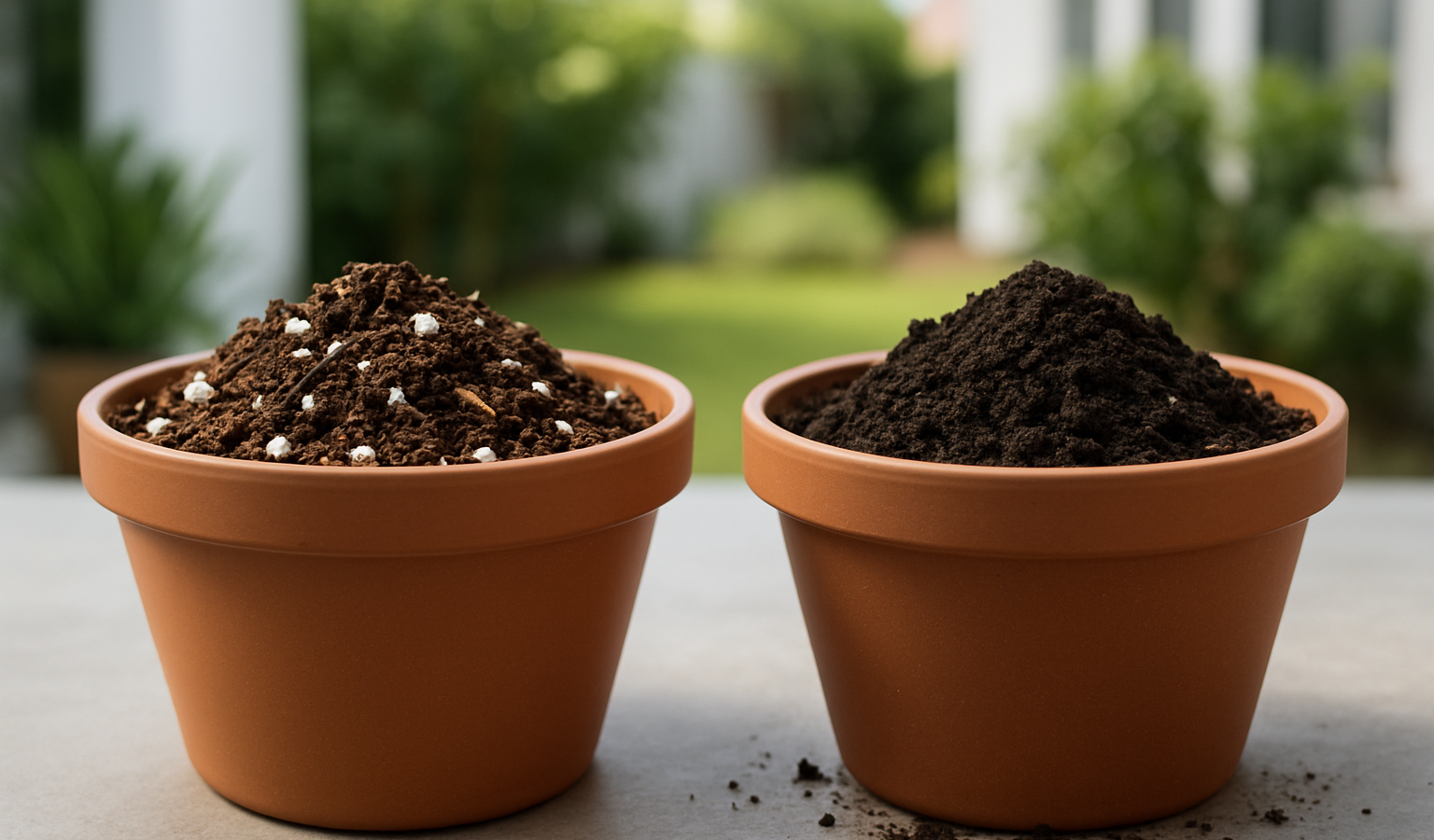
Grab a bag labeled “garden soil” and a bag labeled “potting mix” off the same shelf at the same store, and they look almost identical through the plastic: dark, crumbly, a little damp. They are not interchangeable, and using the wrong one is one of the fastest ways to drown a tomato in a pot or build a raised bed that bakes into a brick by July. The short version is this: potting mix is a soilless blend engineered to drain fast and hold air around roots inside a container, while garden soil is mineral dirt meant to be worked into the ground where worms, microbes, and gravity do half the work for you. Mix them up and you get root rot in the pot and compaction in the bed. This guide breaks down exactly what each product is made of, how drainage and water retention actually behave in a 12-inch pot versus open ground, when to reach for each, whether you can blend or amend them, and what you should expect to pay. By the end you will know which bag belongs where, and how to fix a soil you already bought wrong.
Key Takeaways
- Potting mix is soilless (peat or coir, bark, perlite) and built for fast drainage and aeration in containers; garden soil is mineral dirt meant for the ground.
- Never fill pots with bagged “garden soil” or native dirt alone: it compacts, holds too much water, and suffocates roots, causing root rot.
- Don’t truck bagged potting mix into in-ground beds either: it dries out fast and is far too expensive per cubic foot for that job.
- Quality potting mix is usually sterilized or peat/coir-based, so it carries few weed seeds or pathogens; native and even some bagged garden soils can carry both.
- For raised beds, use a blend (roughly 60% topsoil or garden soil, 30% compost, 10% coarse aeration) rather than straight potting mix or straight dirt.
| Feature | Potting Mix | Garden Soil |
|---|---|---|
| Base material | Soilless: peat moss or coir, bark, perlite/vermiculite | Mineral soil: sand, silt, clay, plus organic matter |
| Drainage | Fast; designed for confined containers | Slower; relies on ground structure and worms |
| Aeration | High, stays fluffy and porous | Lower; compacts under repeated watering |
| Water retention | Moderate, dries out faster in heat | High, holds moisture longer in the ground |
| Weed seeds | Few to none (often sterilized/soilless) | Possible, especially bulk or native soil |
| Pathogens | Low risk in fresh bagged mix | Can carry fungi, nematodes, disease |
| Nutrient charge | Often pre-charged, fades in 4-8 weeks | Variable; native fertility plus amendments |
| Best use | Pots, hanging baskets, seed starting | In-ground beds, lawns, large raised beds |
| Cost per cubic foot | Higher | Lower |
What potting mix actually is
Despite the name, most “potting soil” contains no soil at all. It is a soilless blend, and that is the entire point. A typical bag is built from a moisture-holding base of either sphagnum peat moss or coconut coir, bulked out with composted pine bark, and opened up with perlite (those white volcanic popcorn bits) or vermiculite. Some mixes add a wetting agent so the peat rehydrates instead of repelling water, a starter charge of fertilizer, and sometimes lime to correct the natural acidity of peat. The reason it works in a pot is geometry: a container has a hard bottom, so water cannot keep draining down the way it does in open ground. It pools at the base in a saturated zone called the perched water table. A loose, chunky, soilless mix keeps enough air pockets around the roots that they can still breathe even with that wet zone at the bottom.
Peat-based mixes are cheap and reliable but acidic and slow to rehydrate once fully dry. Coir-based mixes hold water beautifully, rewet easily, and are the more renewable choice, but they hold almost no nutrients of their own and can come loaded with salts if poorly rinsed. If you want to understand the aeration ingredients in depth, the comparison of vermiculite, perlite, and pumice covers which one to add for drainage versus water-holding.
What garden soil actually is
Garden soil is the real thing: mineral particles of sand, silt, and clay in some ratio, shot through with organic matter, living microbes, fungi, and a population of earthworms doing slow tillage for free. Bagged “garden soil” at the store is usually native topsoil or screened soil blended with compost and sold to amend in-ground beds, not to fill containers. The label almost always says “for in-ground use” somewhere on the back, and they mean it. Garden soil has real structure: clay particles bind into aggregates with air gaps between them, and that structure is what holds the water and nutrients a plant draws on between rains. In the ground, gravity and a deep soil column carry excess water away, and roots can chase moisture downward for several feet.
Put that same soil in a pot and the structure works against you. With only 8 or 12 inches of depth and a closed bottom, the fine particles pack down, the air gaps collapse under repeated watering, and you end up with a dense, waterlogged plug that stays soggy for days. Roots in a saturated, airless pot rot. That is the single most common container-gardening mistake, and it comes straight from using dirt where mix belongs.
Drainage, aeration, and water retention
This is the heart of the difference, so it is worth being precise. Drainage is how fast water moves through; aeration is how much air stays in the pore spaces after it drains; water retention is how much moisture the material holds onto for the plant. Potting mix wins on drainage and aeration by a wide margin and gives up some retention to get there. Garden soil wins on retention and total nutrient holding but loses aeration the moment you confine it.
In a container, aeration is the make-or-break factor. Roots need oxygen as much as water, and in a closed pot the only air they get is what is trapped in the mix between waterings. A good potting mix might hold 15 to 25 percent of its volume as air even when freshly watered. Compacted garden soil in that same pot can drop to near zero. That is why a pepper in straight mix thrives and the same pepper in straight dirt yellows, stalls, and drops leaves. In the ground, retention rules instead: you want soil that holds water through a dry week in July so you are not dragging a hose out every morning, and garden soil does that far better than a fast-draining mix ever could. The right material is entirely a function of where the roots live.
Weed seeds, pathogens, and sterilization
Soilless potting mixes start out essentially clean. Peat and coir are naturally low in weed seeds and disease organisms, and many bagged mixes are heat-treated on top of that. For seed starting this matters enormously: a damping-off fungus in your starting medium will kill a tray of seedlings overnight at the soil line, and using a fresh, clean, soilless seed-starting mix is the cheapest insurance against it. Garden soil, by contrast, is alive in every sense. That is its strength in the ground, where the microbial community feeds your plants, but it also means it can carry weed seeds, fungal pathogens like fusarium and pythium, and root-knot nematodes. Bulk soil from a landscape yard is the usual culprit for surprise weeds in a new bed.
You can pasteurize small batches of garden soil at home by heating moist soil to about 180 degrees Fahrenheit for 30 minutes in the oven, which kills most pathogens and weed seeds, but it smells terrible and is rarely worth it for anything beyond a special seed-starting batch. For containers, just buy clean mix.
When to use potting mix
Reach for potting mix anytime roots are confined: any pot, planter, window box, hanging basket, grow bag, or seed-starting tray. If it has a bottom and walls, it gets mix. Containers on a hot patio dry out fast, so for those a coir-heavy or peat-and-vermiculite mix that holds a little extra moisture earns its keep. For succulents and cacti, go the other direction and cut a standard mix with extra perlite or coarse sand, roughly one part grit to two parts mix, so it drains even faster.
Keep in mind the nutrient charge in a bag of mix is temporary. The starter fertilizer in most mixes is exhausted in four to eight weeks of active growth, and because mix drains so freely, every watering flushes nutrients out the bottom. Plan to start a regular feeding schedule with a dilute liquid fertilizer about a month after planting, or work in a slow-release granular at planting time. This is a key reason container plants need more attention than in-ground ones. Apartment and balcony growers can find more container-specific tactics in our urban gardening guides.
Repotting and refreshing mix
Potting mix breaks down over time. The bark and peat decompose, the structure collapses, and after a year or two even a good mix compacts and drains poorly, the very failure you bought mix to avoid. For houseplants, repot into fresh mix every one to two years, or at minimum top off and loosen the surface each spring. For perennial container plants too big to repot, scrape off the top two inches and replace with fresh mix plus a little compost. When you repot, go up just one pot size, an inch or two of extra diameter, not a giant jump; a small plant swimming in a huge volume of wet mix is right back to the root-rot problem.
When to use garden soil
Garden soil belongs in the ground. Use bagged garden soil to amend and build up in-ground beds, to fill the bottom of large raised beds, to repair lawn low spots, and to top-dress existing planting areas. It is the economical choice for any volume application because it costs a fraction of what potting mix does per cubic foot, and in the ground it does not need the extreme drainage that a container demands. If you are building permanent in-ground beds, work in two to three inches of compost on top of your native or bagged garden soil and fork it in to the depth of the spade. That feeds the soil life and keeps the structure open without any bagged mix at all.
One nuance: very large raised beds, the deep ones a foot or more tall, behave more like ground than like pots because the soil column is deep enough to drain. Those should be filled with a soil blend, never straight potting mix, which would dry out instantly and cost a fortune at that scale. Smaller, shallower raised planters that sit up on legs behave like containers and want mix instead. The depth of the soil column is what decides it. For more on building and siting outdoor growing spaces, see our outdoor living hub.
Can you mix them, and how to amend
You can blend them in the right context, and for raised beds you should. A reliable raised-bed recipe is roughly 60 percent topsoil or quality bagged garden soil, 30 percent finished compost, and 10 percent a coarse aeration ingredient like perlite, pumice, or coarse bark. That gives you the moisture retention and nutrient holding of real soil with enough open structure that it does not pack into a brick. Straight potting mix in a big bed is too expensive and dries too fast; straight garden soil compacts and drains poorly. The blend splits the difference and is what most experienced raised-bed gardeners actually run.
What you should not do is dump garden soil into pots to save money. If you are determined to stretch your container budget, the safer move is the reverse: amend garden soil heavily toward a mix. Combine one part garden soil with one part compost and one part perlite or coarse sand, which lightens it enough to function in a large outdoor container, though it will never drain as cleanly as true potting mix and is best reserved for big, forgiving plants like established shrubs rather than fussy seedlings. For small pots, houseplants, and anything you started from seed, just buy the mix; the price difference is not worth a dead plant.
Cost and sourcing
Garden soil is the budget option by volume, which is exactly why it gets misused in pots: it looks like a bargain. But per cubic foot, potting mix typically runs several times the price of bagged garden soil, and bulk garden soil delivered by the cubic yard from a landscape supplier is cheaper still. For a big project, math the volume first. A cubic yard equals 27 cubic feet, so a 4-by-8-foot raised bed filled 10 inches deep needs about 27 cubic feet, a full yard, and buying that in 1.5-cubic-foot potting-mix bags would be wildly expensive compared to a bulk soil-and-compost blend delivered.
For containers, do not chase the cheapest bag. A low-end mix that is mostly fine peat with little aeration will compact within a season and undo the whole reason you bought mix. Look for a chunky, light bag with visible perlite or bark, and read whether it lists a wetting agent and starter nutrients. Buy garden soil from a reputable bulk yard or a trusted bagged brand, and if you are buying bulk, ask whether it is screened and whether weed seed is an issue, because a cheap unscreened pile can seed your whole garden with problems. Storing surplus mix dry and sealed keeps it usable for years; a cool, dry corner or even a converted root cellar works well for off-season storage of bagged amendments.
The Verdict
Match the material to where the roots will live, and the choice makes itself. Anything in a container, a pot, basket, grow bag, seed tray, or a shallow legged planter, gets potting mix, full stop. Pay for a chunky, well-aerated mix, plan to feed your plants after the starter charge fades in a month or two, and refresh or repot every year or two before the mix collapses. Anything in the open ground, including in-ground beds, lawn repair, and the deep soil column of a large raised bed, gets garden soil, ideally cut with two to three inches of compost. For raised beds specifically, run the 60/30/10 blend of garden soil, compost, and aeration rather than either material straight. The one rule that prevents most container failures is simple: never fill a pot with bagged garden soil or native dirt alone. Get that right and you will save yourself a season of soggy roots, yellow leaves, and dead seedlings.
Frequently Asked Questions
Can I use garden soil in pots if I add perlite?
You can improve it, but it still will not match true potting mix. Cut garden soil with equal parts compost and perlite (one to one to one) and it becomes usable in large outdoor containers for forgiving plants like established shrubs. For small pots, houseplants, or seedlings, buy potting mix instead; the drainage and disease-free start are worth the small extra cost.
Why does my potting mix dry out so fast?
That fast drainage is by design and the reason roots get enough air in a pot. To slow it down, choose a coir-based or vermiculite-rich mix, mulch the surface of the pot, move containers out of relentless afternoon sun, or size up to a slightly larger pot that holds more moisture. In peak summer heat, daily watering for small or hanging containers is normal.
Is potting soil the same as potting mix?
The terms are used interchangeably on most bags, and both usually mean a soilless container blend despite the word “soil.” The label that actually matters is “garden soil” versus “potting mix/soil.” Garden soil is for the ground; potting mix or potting soil is for containers. Read the back panel, which states the intended use directly.
How often should I replace potting mix?
Repot houseplants into fresh mix every one to two years, before the bark and peat decompose and the structure collapses. For outdoor annual containers, refresh or fully replace the mix each spring, or at least remove the top two inches and replace it with fresh mix and compost. Reusing tired, compacted mix reintroduces the drainage problems you bought mix to avoid.
What soil should I put in a raised bed?
Use a blend, not straight potting mix or straight dirt. A dependable recipe is about 60 percent topsoil or bagged garden soil, 30 percent finished compost, and 10 percent a coarse aerator such as perlite, pumice, or bark. Deep raised beds drain like open ground, so they do not need pure potting mix and would dry out and cost far too much if filled with it.