

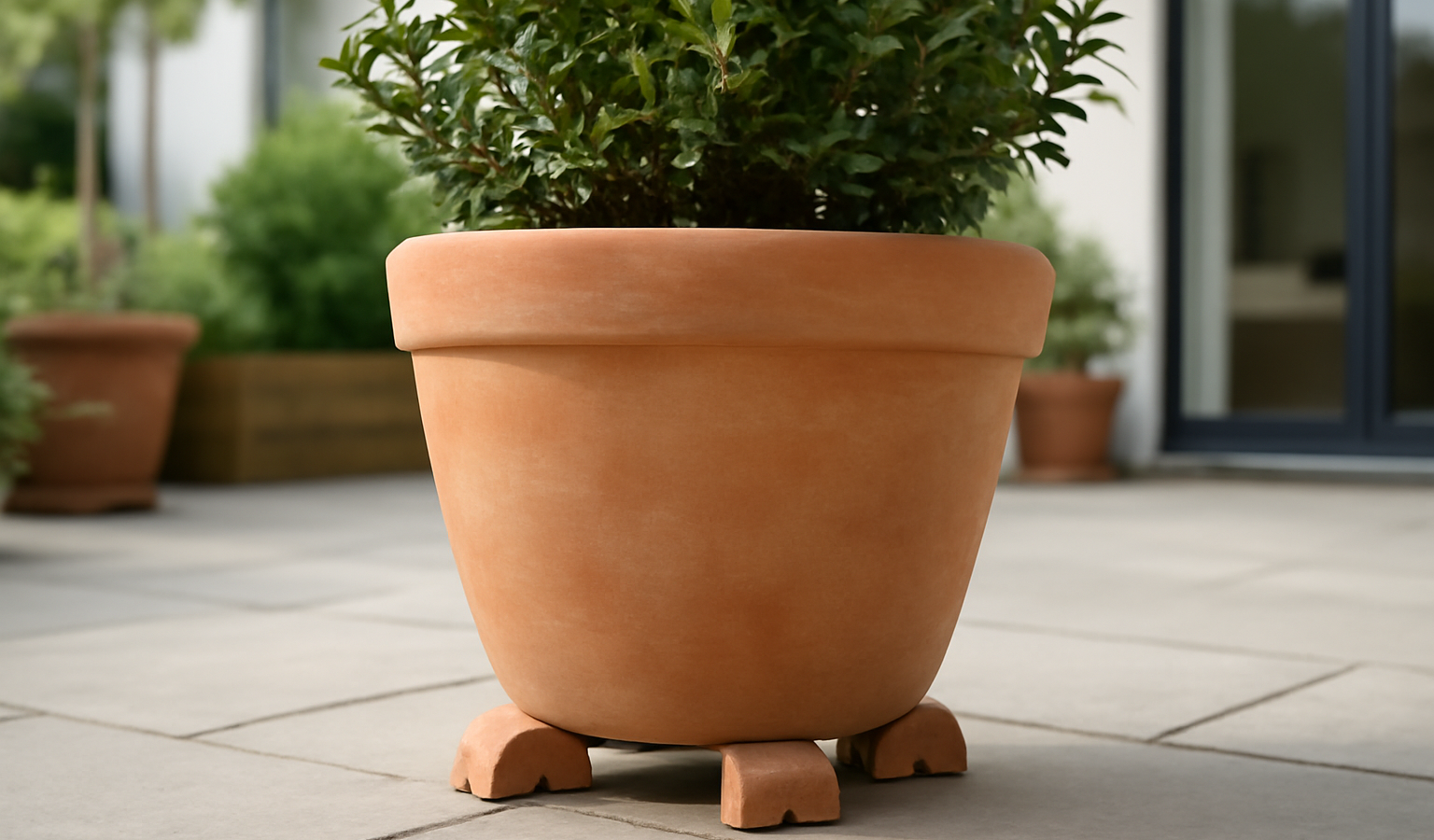
A heavy planter sitting flat on a deck or patio is a slow-motion problem. The drain hole gets sealed against the surface, water pools under the pot, the soil stays waterlogged, and roots rot from the bottom up. On wood you also get black rot rings and trapped moisture that shortens the life of the boards; on concrete and stone you get hard-water staining and efflorescence. The fix is dead simple and costs a few dollars: lift the pot off the surface with pot feet or a riser so water drains freely and air moves underneath. The catch is that the cheap options crack, stain, blow over, or look ugly, and the good ones are not obvious until you have tried a few.
As an Amazon Associate we earn from qualifying purchases. This page contains affiliate links at no extra cost to you.
I have used pot feet and risers under everything from glazed ceramic herb pots to 24-inch fiberglass planters and concrete urns, on cedar decking, brick, and bare soil. Below are the seven options worth buying in 2026, organized by what they are actually best at: invisible drainage, decorative display, heavy loads, and rolling mobility. I have noted where each one fails so you can match the right product to your pots and your surface. Prices shift constantly, so I focus on materials, load capacity, and real-world behavior rather than dollar figures.
Key Takeaways
- For pure drainage with no visual clutter, invisible/hidden pot feet tucked under the rim are the best value.
- For display on a patio, terracotta or cast-stone decorative feet look intentional and match traditional pots.
- For pots over ~50 lb or anything you want to move, use a rolling plant caddy rated above the loaded weight.
- On wood decks, lifting the pot 0.5 to 1 inch off the boards prevents rot rings and lets the deck dry.
- Three feet beat four for stability on uneven surfaces; always position feet under the pot’s wall, not the unsupported center.
| Product | Best For | Material / Load |
|---|---|---|
| Invisible Pot Feet (hidden risers) | Drainage with no visible clutter | ABS plastic / light-med pots |
| Terracotta Pot Feet Set | Matching classic clay pots | Terracotta / medium pots |
| Cast-Stone Decorative Feet | Display, traditional patios | Resin/cast stone / heavy pots |
| Rolling Plant Caddy (round) | Heavy pots you need to move | Plastic + casters / 100+ lb |
| Heavy-Duty Steel Plant Dolly | Very heavy planters & trees | Steel / 300+ lb |
| Rubber Deck Pot Risers | Wood decks, non-slip grip | Rubber / medium pots |
| Adjustable Pot Feet Glides | Uneven surfaces, leveling | Nylon/metal / light-med pots |
Invisible Pot Feet (Hidden Risers) — Best Overall Value
These are small ABS plastic wedges or discs, usually sold in sets of a dozen or more, that tuck just under the outer rim of the pot so the pot appears to sit flat while actually floating about half an inch off the surface. You typically use three per pot. Because they hide beneath the lip, they work with any style of planter without clashing, and they are by far the cheapest way to solve the drainage and deck-rot problem.
The honest limitation is load and exposure. The plastic is fine under light to medium pots but can splay or crack under a heavy ceramic or concrete planter, so check the listed weight rating and use more feet for big pots. They can also become brittle after several years of UV and freeze-thaw. For the price, though, nothing matches them for keeping a deck dry without anyone noticing they are there.
Pros
- Cheapest effective drainage fix
- Hidden under the rim; works with any pot style
- Sold in big multipacks; outfit a whole patio cheaply
Cons
- Plastic can crack or splay under very heavy pots
- Can get brittle after years of UV and freeze-thaw
- Low lift; minimal airflow versus tall feet
Terracotta Pot Feet Set — Best for Classic Clay Pots
Sold in sets of three or four, these little fired-clay feet shaped like paws, scrolls, or simple wedges are made to match terracotta and glazed pots. On a traditional patio they look intentional rather than improvised, and the clay breathes and ages to the same patina as your pots. They lift the pot a solid inch or so, giving real airflow under the base.
The flip side of clay is fragility in winter. Terracotta absorbs water, and in a hard freeze that water expands and can spall or crack the feet, just as it does unglazed pots. In cold climates, bring them in or store them dry over winter. They are also a touch pricier per foot than plastic. For drainage plus looks on a temperate or summer patio, they are hard to beat.
Pros
- Looks intentional with clay and glazed pots
- Decent lift for good airflow under the base
- Breathable clay ages to match your pots
Cons
- Can crack or spall in hard freezes
- Pricier per foot than plastic
- More visible than hidden risers
Cast-Stone / Resin Decorative Feet — Best for Heavy Display Pots
Cast-stone and stone-look resin feet are the upgrade when you want decorative feet that can carry a serious load. Molded as lion paws, scrolls, or simple blocks, the resin versions in particular shrug off frost where terracotta would crack, and the better ones are weighted enough to feel solid under a big concrete urn or large glazed planter. They lift the pot well clear of the surface for strong drainage and airflow.
Quality varies a lot. Cheap resin can fade or chalk in strong sun, and some “stone” feet are hollow and lighter than they look, which undercuts stability under a tall pot. Buy from a maker that lists a real load rating and UV resistance. For a formal patio with substantial pots, these are the most polished-looking option here.
Pros
- Carries heavy pots that crush plastic feet
- Resin versions resist frost cracking
- Decorative, formal look for display pots
Cons
- Cheap resin can fade or chalk in sun
- Some “stone” feet are hollow and lighter than they look
- Most expensive decorative option
Rolling Plant Caddy (Round) — Best for Pots You Need to Move
A rolling plant caddy is a round plastic platform on three or four swivel casters that the pot sits on, lifting it off the surface and letting you roll a heavy planter aside to sweep, chase the sun, or bring it under cover. For anyone with large patio pots, indoor floor plants, or fig and citrus trees that migrate seasonally, a caddy turns an impossible drag into a one-finger push.
Match the caddy diameter to your pot base and the load rating to the loaded, watered weight, which is far heavier than the empty pot. The weak point is always the casters: cheap ones seize, crack, or lose their swivel under load, especially on textured outdoor surfaces. Caddies with locking casters and a metal-reinforced or ribbed deck are worth the premium. On a wood deck, a caddy also keeps the pot off the boards for drainage as a bonus.
Pros
- Move heavy pots with one hand
- Lifts the pot for drainage as a bonus
- Great for seasonal sun-chasing or moving plants indoors
Cons
- Cheap casters seize or crack under load
- Must match diameter and watered weight carefully
- Plastic decks can crack under very heavy pots
Heavy-Duty Steel Plant Dolly — Best for Trees & Huge Planters
When you are moving a 24-inch concrete planter, a mature potted citrus, or a heavy ceramic urn, plastic caddies are out of their depth. A welded steel plant dolly with industrial casters carries 300 pounds and up without flexing, and the metal frame will not crack the way a plastic deck eventually does. These are the right tool under indoor fiddle-leaf figs in big pots and outdoor specimen plants that overwinter in a garage or greenhouse.
The downsides are cost, weight, and looks. A steel dolly is heavier and more expensive than a plastic caddy, and bare or powder-coated steel can rust at scratches if left out in the weather. They are also industrial-looking rather than decorative. But for genuinely heavy loads, they are the only thing here that will not fail.
Pros
- Handles 300+ lb without flexing or cracking
- Industrial casters roll heavy loads smoothly
- The right tool for potted trees and big urns
Cons
- Heavy and more expensive than plastic caddies
- Steel can rust at scratches if left in weather
- Industrial look, not decorative
Rubber Deck Pot Risers — Best Grip on Wood Decks
Rubber risers are simple molded blocks or discs that lift a pot off the deck and grip both the pot and the boards so nothing slides in wind or when you bump it. The rubber will not scratch a finished deck, will not crack in frost the way clay or hard plastic can, and the grip is genuinely useful on a sloped or windy deck where lightweight pots tend to walk.
They are utilitarian and visible, so they do not add anything decorative, and dark rubber can leave a faint mark on very light decking over time, so check periodically. The lift is also modest. For function over looks on a wood deck, though, they are a smart, durable choice that survives winters left outside.
Pros
- Grips pot and deck; stops sliding in wind
- Will not scratch decking or crack in frost
- Durable left outside year-round
Cons
- Utilitarian; adds nothing decorative
- Dark rubber can mark very light decking
- Modest lift versus tall feet
Adjustable Pot Feet Glides — Best for Uneven Surfaces
Adjustable glides are threaded nylon or metal feet, much like furniture levelers, that screw up and down so you can level a pot on an uneven patio, brick, or sloped surface. They are the answer when a pot rocks on a flagstone joint or sits crooked on a graded deck. Set three or four under the base, dial each one until the pot is dead level, and the wobble is gone.
They are more fiddly to set up than fixed feet and usually need to be glued or seated to the pot base, which makes them semi-permanent. Load ratings are modest, so they suit light to medium pots rather than concrete monsters. For leveling a planter on a stubbornly uneven surface, though, nothing else does the job as cleanly. For more on patio and surface care, see our outdoor living hub, and pair these with the right pots from our tools and gear guides.
Pros
- Level a pot on uneven brick, stone, or sloped decking
- Eliminates wobble and rocking
- Threaded adjustment is precise
Cons
- Fiddly setup; often need to be glued on
- Modest load ratings; not for heavy pots
- Semi-permanent once attached
How to Choose Pot Feet & Risers (Buyer’s Guide)
Start with your surface and your goal. On a wood deck, the priority is lifting the pot 0.5 to 1 inch so the boards can dry and you avoid rot rings; rubber risers and invisible feet both do this well. On stone or concrete, you mainly want drainage and to avoid staining. If you ever need to move the pot, skip feet entirely and use a caddy or dolly that solves drainage and mobility at once.
Match the load to the watered weight. The number that matters is the loaded, freshly watered weight of the pot, not the empty weight, which can be three to four times higher. Under-rate a plastic foot or caddy and it splays or the casters seize. For heavy ceramic, concrete, or potted trees, step up to cast-stone feet or a steel dolly.
Three feet beat four for stability. On any surface that is not perfectly flat, three feet always make contact and the pot sits solid; four feet can rock on the one that is high. Position the feet directly under the pot’s wall, where the structure is strongest, never under the thin unsupported center of the base.
Think about winter. Terracotta and cheap hard plastic can crack in freeze-thaw cycles. If your feet stay outside through a cold winter, choose resin, rubber, or steel, or bring clay feet inside with the pots. A few dollars of the right material saves replacing a whole set every spring.
Frequently Asked Questions
Do pot feet really improve drainage?
Yes. When a pot sits flat on a surface, the drain hole is sealed and water pools underneath, keeping the soil waterlogged. Lifting the pot even half an inch lets water drain freely and air circulate under the base, which is one of the simplest ways to prevent root rot.
How many pot feet do I need per pot?
Three is the sweet spot. Three feet always sit flat on uneven surfaces, while four can leave the pot rocking on a high foot. For very large or heavy pots, use four or more rated feet positioned under the pot wall, not the unsupported center.
Will pot feet protect my wood deck?
Largely, yes. Lifting the pot off the boards lets the deck dry after watering and rain, preventing the dark rot rings and trapped moisture that damage decking. Rubber risers and invisible feet are both good choices; just check occasionally that the feet themselves are not trapping debris.
What is the difference between pot feet and a plant caddy?
Pot feet are small fixed lifts purely for drainage and airflow. A plant caddy is a wheeled platform that also lets you roll the pot around. If you never move the pot, feet are cheaper and tidier; if you move it to chase sun or bring it indoors, a caddy earns its keep.
Can I just use bricks or wood blocks instead?
You can, and it works for drainage, but bricks stain decks and hold moisture against the boards, and wood blocks rot. Purpose-made feet or risers are cheap, lift the pot cleanly, and are designed not to trap water against your surface, so they are worth the small cost.
Bottom line: for most people, a multipack of invisible pot feet solves the drainage and deck-rot problem for a few dollars. Step up to terracotta or cast-stone feet when looks matter, switch to a caddy or steel dolly when you need to move heavy pots, and choose adjustable glides only when you are fighting an uneven surface. Match the rating to the watered weight, use three feet for stability, and your pots and your deck both last longer.