


The best indoor plant pot has a drainage hole, a saucer that catches runoff, and a size only an inch or two wider than the root ball. Material comes next: glazed ceramic looks good and holds moisture, plastic is light and cheap and keeps soil moist longer, and self-watering pots help forgetful waterers. For most houseplant owners, a small set of ceramic pots with drainage and saucers, such as the Gepege 6-inch pair below, is the easy upgrade from nursery pots, while a multi-size plastic set handles repotting a whole collection. Below are seven current listings matched to common needs, followed by how to pick the right material and size.
Part of our Houseplants & Container Gardening guide →
In this guide
- 1. Gepege Ceramic Plant Pots, 6 Inch — Best Ceramic Pots Overall
- 2. YNNICO 6-Size Plastic Planters — Best Multi-Size Set
- 3. Fielda Self-Watering Pots, 8/10/12 Inch — Best Self-Watering
- 4. Ton Sin Textured Ceramic Pots, Set of 3 — Best Decorative Small Set
- 5. SQKH 4-Inch Plant Pots, 6-Pack — Best for Small Plants
- 6. FUIJOL Clear Nursery Pots, 20-Pack — Best for Orchids and Cuttings
- 7. RooTrimmer 10-Inch Plastic Planters, 5-Pack — Best for Medium Floor Plants
- What to Look For in Indoor Plant Pots
- Frequently Asked Questions
Disclosure: Urban Lotus Project is reader-supported. As an Amazon Associate we earn from qualifying purchases made through links on this page, at no extra cost to you.
How we compared: we compared 7 current Amazon listings on what each listing states about drainage, saucers, material, sizes and pot count. We did not test or handle the products, and availability changes.
| Product | Best for | Key features | Buy |
|---|---|---|---|
| Gepege Ceramic Pots, 6 in | Best ceramic pots overall |
| Buy now →Check current price |
| YNNICO 6-Size Plastic Set | Best multi-size set |
| Buy now →Check current price |
| Fielda Self-Watering Pots | Best self-watering |
| Buy now →Check current price |
| Ton Sin Textured Ceramic Set | Best decorative small set |
| Buy now →Check current price |
| SQKH 4-Inch Pots, 6-Pack | Best for small plants |
| Buy now →Check current price |
| FUIJOL Clear Nursery Pots | Best for orchids and cuttings |
| Buy now →Check current price |
| RooTrimmer 10-Inch 5-Pack | Best for medium floor plants |
| Buy now →Check current price |
Prices change often; check Amazon for today’s price. As an Amazon Associate we earn from qualifying purchases.
1. Gepege Ceramic Plant Pots, 6 Inch — Best Ceramic Pots Overall

Set of two ceramic pots with large drain holes, mesh pads and matching ceramic saucers.
Check price on AmazonWhy We Like It
- Real drainage holes with mesh pads to hold soil
- Matching ceramic saucers, not flimsy plastic
- Fits a standard 5-inch nursery pot
- Saucer can sit two different ways
| Specification | Details |
|---|---|
| Material | Ceramic |
| Count | 2 pots, 2 saucers, 2 mesh pads |
| Pot size | 5.9 inch top, 3.15 inch base, 5.15 inch tall |
| Drainage | Large drain hole with mesh pad |
| Fits | A 5-inch inner nursery pot |
Gepege ceramic 6-inch set — compressed specs
Most houseplants come home in a 4- or 5-inch nursery pot, and this pair is sized right for that step. The listing gives exact dimensions and says each pot fits a 5-inch inner pot, so you can either repot directly or drop the plastic nursery pot inside as a cachepot. The large drain hole plus mesh pad is the detail we like most: it lets water out freely without soil washing through, which is the main failure point of decorative ceramic.
The tapered shape, wide at the top and narrow at the base, suits succulents, small orchids, pothos and peperomia but is less stable for tall, top-heavy plants. Compared with the Ton Sin set, you get two identical pots rather than three graduated sizes.
Pros
- Drainage done right
- Ceramic saucers included
- Exact dimensions listed
Cons
- Only two pots
- Narrow base for tall plants
- Single size
Check Gepege Ceramic Pots, 6 in price on Amazon
2. YNNICO 6-Size Plastic Planters — Best Multi-Size Set

Six matte plastic pots from 5 to 8 inches with drainage holes, deep saucers and a string for bottom watering.
Check price on AmazonWhy We Like It
- Six graduated sizes for a whole collection
- Thick 4mm polypropylene walls
- Multiple drainage holes plus saucers
- Optional wick for bottom watering
| Specification | Details |
|---|---|
| Material | Recyclable polypropylene |
| Sizes | 8, 7, 6.5, 6, 5.5 and 5 inches |
| Wall thickness | 4mm |
| Drainage | Multiple bottom holes |
| Extras | Saucers and wicking string |
YNNICO 6-size planter set — compressed specs
If you are repotting several plants or moving up sizes over time, a graduated set is practical. Six pots stepping up by half an inch to an inch let you move each plant up a single size, which is exactly what most houseplants want. The listing notes thick 4mm walls and a large bottom tray, with a string you can thread through for wick watering.
Plastic holds moisture longer than unglazed terracotta, which suits thirsty tropicals like ferns, calatheas and peace lilies but means you should water less often for succulents. Among the plastic options on this list, it offers the widest range of sizes in one box.
Pros
- Six useful sizes
- Sturdy walls
- Drainage and saucers
Cons
- Plastic look is plain
- Holds water longer than clay
- Largest pot is only 8 inches
Check YNNICO 6-Size Plastic Set price on Amazon
3. Fielda Self-Watering Pots, 8/10/12 Inch — Best Self-Watering

Three wick-fed planters with a clear water level window, detachable reservoir trays and drainage holes.
Check price on AmazonWhy We Like It
- Water level window shows when to refill
- Listing honestly states usable planting depth
- Larger sizes suit monstera and palms
- Drainage holes as well as reservoir
| Specification | Details |
|---|---|
| Sizes | 8, 10 and 12 inches (top diameter) |
| Usable planting depth | 5.8, 6.1 and 7.6 inches |
| Watering system | Cotton wick from detachable reservoir |
| Indicator | Transparent window with markings |
| Fits nursery pots | 4 to 6, 6 to 8 and 8 to 10 inches |
Fielda self-watering planters — compressed specs
Self-watering pots are the most useful upgrade for people who forget to water or travel often. A cotton wick draws water up from a reservoir into the soil, and the listing says this keeps soil evenly moist for up to 7 to 10 days. The clear window with markings removes guesswork. We also appreciate that the listing is upfront about usable depth, which is smaller than the overall height because of the reservoir, and recommends which nursery pot sizes fit.
Self-watering pots suit moisture lovers like pothos, peace lily, ferns and fiddle-leaf figs. They are a poor fit for succulents, cacti and plants that want to dry out. For more options, see our roundup of self-watering planters.
Pros
- Clear water level indicator
- Three larger sizes
- Honest depth specs
Cons
- Not for succulents
- Reduced planting depth
- Wicks need occasional checks
Check Fielda Self-Watering Pots price on Amazon
4. Ton Sin Textured Ceramic Pots, Set of 3 — Best Decorative Small Set
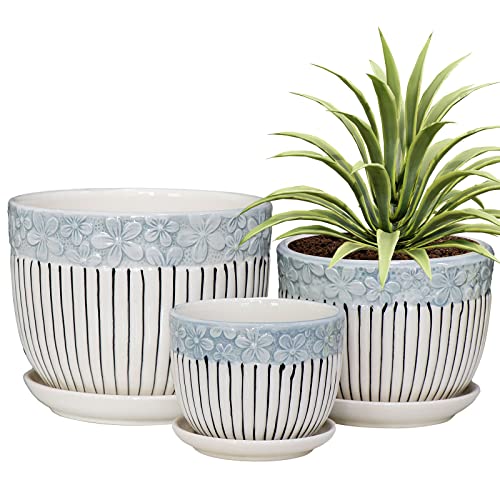
Three embossed ceramic pots, 4.2 to 6.7 inches, each with a drainage hole and matching saucer.
Check price on AmazonWhy We Like It
- Three graduated ceramic sizes
- Drain hole and saucer on every pot
- Textured finish looks good grouped
- Gift-ready packaging
| Specification | Details |
|---|---|
| Material | High-temperature fired ceramic |
| Sizes | 6.7 x 5.5, 5.5 x 4.2 and 4.2 x 3.3 inches (diameter x height) |
| Drainage | Bottom hole in each pot |
| Saucers | 3 matching saucers |
| Mesh pads | Not stated in listing |
Ton Sin textured ceramic set — compressed specs
A graduated trio is the easiest way to style a shelf or windowsill. This set gives three sizes in the same textured gray finish, each with a drainage hole and saucer. The smallest suits succulents and small cuttings, the largest a small snake plant, pothos or African violet.
Compared with the Gepege pair, you get more variety in size but no mesh pads are mentioned, so cover the hole with a piece of mesh or a coffee filter before adding soil. Glazed ceramic dries out more slowly than terracotta; our terracotta vs ceramic pots comparison explains when each works best.
Pros
- Three useful sizes
- Drainage and saucers
- Attractive finish
Cons
- Small sizes only
- No mesh pads listed
- Single color per set
Check Ton Sin Textured Ceramic Set price on Amazon
5. SQKH 4-Inch Plant Pots, 6-Pack — Best for Small Plants

Six 4-inch polypropylene pots with 48 drainage holes each and attached trays, in mixed colors.
Check price on AmazonWhy We Like It
- 48 drainage holes per pot
- Attached trays catch drips
- Good size for starts and small succulents
| Specification | Details |
|---|---|
| Material | Thick polypropylene |
| Size | 4 inches, about 3.7 inches tall |
| Count | 6 pots |
| Drainage | 48 holes per pot |
| Trays | Attached |
SQKH 4-inch pots — compressed specs
Lots of small drainage holes are ideal for plants that hate wet feet: succulents, cacti, small orchids and herbs. Many decorative pots have a single small hole that clogs; this listing describes 48 holes per pot plus an attached tray. Six pots in one pack is useful for propagated pothos cuttings, spider plant babies and new succulents.
At 4 inches, they are too small for most mature houseplants. Treat them as starter pots and step plants up as they grow.
Pros
- Excellent drainage
- Trays attached
- Six pots per pack
Cons
- Small size only
- Mixed colors may not suit all decor
- Plastic look
Check SQKH 4-Inch Pots, 6-Pack price on Amazon
6. FUIJOL Clear Nursery Pots, 20-Pack — Best for Orchids and Cuttings

Twenty clear plastic pots in 4, 5, 6 and 7 inch sizes, each with a matching saucer and drainage holes.
Check price on AmazonWhy We Like It
- See roots and moisture without unpotting
- Four sizes, five of each
- Saucer for every pot
- Works inside decorative cachepots
| Specification | Details |
|---|---|
| Material | Clear plastic |
| Count | 20 pots: five each of 4, 5, 6 and 7 inches |
| Saucers | Matching saucer for each pot |
| Drainage | Bottom drainage holes |
FUIJOL clear nursery pots — compressed specs
Clear pots let you see roots and the moisture in the mix, which is useful for epiphytic orchids such as phalaenopsis, rooted cuttings and anyone learning when to water. You can check whether a cutting has rooted without tugging it. Twenty pots across four sizes makes this the best-value option on the list for propagation and repotting a collection.
Clear plastic is functional rather than decorative. Most people slip them inside a ceramic cachepot for display, lifting them out to water and drain.
Pros
- Root visibility
- Many pots, four sizes
- Saucers included
Cons
- Not decorative
- Light can encourage algae on the mix
- Thin plastic
Check FUIJOL Clear Nursery Pots price on Amazon
7. RooTrimmer 10-Inch Plastic Planters, 5-Pack — Best for Medium Floor Plants

Five reinforced 10-inch plastic pots with bottom drainage and rim slots that also allow hanging.
Check price on AmazonWhy We Like It
- Five 10-inch pots in one pack
- Reinforced rim and bottom
- Rim slots let you hang them
| Specification | Details |
|---|---|
| Material | Thick plastic, reinforced rim and base |
| Size | 10 inches wide, about 6.4 inches tall |
| Count | 5 pots |
| Drainage | Multiple bottom holes |
| Saucers | Not stated in listing |
RooTrimmer 10-inch planters — compressed specs
Once a monstera, pothos or rubber plant outgrows a 6- or 8-inch pot, a 10-inch pot is the usual next step. This pack gives five, which is handy for a growing collection. The listing describes reinforced rims and bases and three slots on the rim for hanging, so trailing pothos can go up near a window.
Saucers are not mentioned, so add your own before using them indoors. They are relatively shallow for their width, which suits pothos, philodendrons and other fairly shallow-rooted plants better than tall, top-heavy specimens. For bigger statement plants, see our large indoor planters roundup.
Pros
- Five larger pots
- Sturdy construction
- Hanging option
Cons
- No saucers listed
- Shallow for tall plants
- Plain look
Check RooTrimmer 10-Inch 5-Pack price on Amazon
What to Look For in Indoor Plant Pots
Drainage first
Root rot from waterlogged soil kills more houseplants than anything else. Every pot needs at least one drainage hole, and a saucer to protect furniture. If you love a pot without a hole, use it as a cachepot: keep the plant in a plastic nursery pot inside it and lift it out to water.
Material
- Plastic: light, inexpensive, holds moisture longest. Good for tropicals and people who underwater.
- Glazed ceramic: heavy, stable, decorative; moisture retention similar to plastic.
- Unglazed terracotta: porous, dries fastest; best for succulents, cacti and people who overwater.
- Self-watering: reservoir and wick for consistent moisture; avoid for succulents.
Size
When repotting, go up only 1 to 2 inches in diameter. A pot far larger than the roots holds wet soil the roots cannot reach, inviting rot. Our guide on choosing the right pot size covers this in detail, and the houseplants and containers hub covers repotting and care.
Shape and stability
Tall plants need a wide base or heavy material to avoid tipping. Tapered pots look elegant but make root balls hard to remove when repotting. Shallow, wide pots suit succulents and trailing plants; deeper pots suit plants with long roots.
Frequently Asked Questions
Do indoor plant pots need drainage holes?
Yes, for nearly all houseplants. Without drainage, water collects at the bottom and rots roots. Use pots without holes only as decorative covers around a draining nursery pot.
Are ceramic or plastic pots better for houseplants?
Both work. Plastic is lighter and cheaper; glazed ceramic is heavier and more decorative. Both hold moisture longer than terracotta, so water a little less often than you would in clay.
What size pot should I repot my plant into?
Choose a pot 1 to 2 inches wider than the current one for small and medium plants, and 2 to 4 inches wider for large floor plants.
Are self-watering pots good for all plants?
No. They suit moisture-loving plants like pothos, ferns and peace lilies, but keep succulents, cacti and snake plants too wet.
Should I put rocks in the bottom of a pot?
It is not recommended. A gravel layer raises the wet zone of soil closer to the roots rather than improving drainage. Use a drainage hole and a mesh pad instead.