

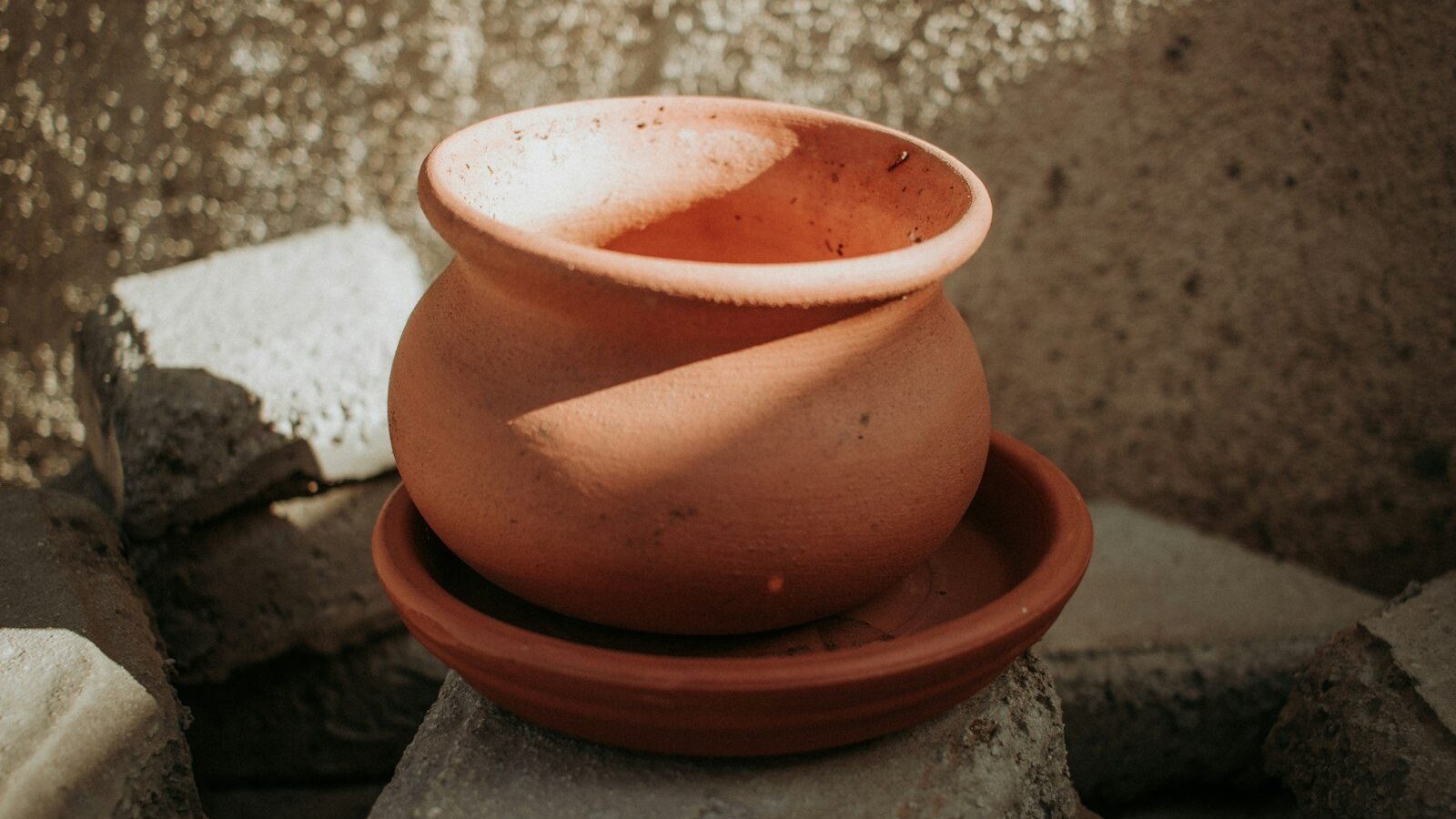
Terracotta self-watering pots work on a simple principle: unglazed clay is porous, so water held against it slowly wicks through the wall and into the soil as the soil dries. That gives you two families of products. The first is a clay pot that sits inside a glass or ceramic reservoir, so the whole pot drinks from below. The second is the olla, a sealed clay vessel you bury in the soil of a large pot or bed and fill with water. Both keep moisture steadier than a watering can, and both suit herbs and houseplants that hate swinging between soggy and bone dry. Below are the terracotta and olla-style options worth considering, what each listing actually states, and how to choose between them.
Part of our Houseplants & Container Gardening guide →
In this guide
- How Terracotta Self-Watering Works (and Its Limits)
- 1. D’vine Dev Self Watering Terracotta Planter, 6 in 2-Pack — Best Overall for Houseplants
- 2. Nuogo Self Watering Terracotta Pot Set, 4 in and 6 in — Best Mixed-Size Set
- 3. D’vine Dev Self Watering Terracotta Planter, 4 in 4-Pack — Best for Windowsill Herbs
- 4. Back to the Roots Self-Watering Terracotta Olla, 3-Pack — Best Olla for Large Pots
- 5. GARDENBRO XL 32 oz Olla Pots, 2-Pack — Best for Raised Beds
- 6. B SEPOR Classic Ollas, 400 ml 4-Pack — Best for Long Trips
- 7. Didaey Terracotta Pots With Saucers, 4-Pack — Best Simple Clay Planter
- What to Look For in a Terracotta Self-Watering Pot
- Frequently Asked Questions
Disclosure: Urban Lotus Project is reader-supported. When you buy through links on this page we may earn an affiliate commission at no extra cost to you.
How we compared: we compared 15 current Amazon listings on what each listing states about material, size, capacity and intended use; we did not test or handle the products, and availability changes.
| Product | Best for | Key features | Buy |
|---|---|---|---|
| D'vine Dev 6 in 2-Pack | Best overall for houseplants |
| Buy now →Check current price |
| Nuogo 4-Pack, 2 Sizes | Best mixed-size set |
| Buy now →Check current price |
| D'vine Dev 4 in 4-Pack | Best for windowsill herbs |
| Buy now →Check current price |
| Back to the Roots Olla 3-Pack | Best olla for large pots |
| Buy now →Check current price |
| GARDENBRO XL 32 oz Ollas | Best for raised beds |
| Buy now →Check current price |
| B SEPOR 400 ml Ollas | Best for long trips |
| Buy now →Check current price |
| Didaey Clay Pots and Saucers | Best simple clay planter |
| Buy now →Check current price |
Prices change often; check Amazon for today’s price. As an Amazon Associate we earn from qualifying purchases.
How Terracotta Self-Watering Works (and Its Limits)
Clay pulls water by capillary action and releases it more readily when the surrounding soil is drier. In practice that means the soil next to the clay stays evenly moist rather than flooded, which is why ollas have been used in dry-climate gardens for a very long time. The limits are just as important. Clay only moves water a few inches into the soil, so an olla needs to sit near the roots, and a reservoir pot only works if the soil inside makes good contact with the clay wall. Hard water leaves mineral crust on clay over time that slows seepage, and very thirsty plants in hot, sunny spots can drink faster than clay delivers.
If you want a broader look at reservoir planters in plastic, ceramic and fiberglass, see our guide to the best self-watering planters. This page sticks to terracotta and olla-style designs only.
1. D’vine Dev Self Watering Terracotta Planter, 6 in 2-Pack — Best Overall for Houseplants

Unglazed clay pot nested in a clear glass reservoir so you can see when to refill.
Check price on AmazonWhy We Like It
- Glass reservoir shows the water level at a glance
- Six-inch pot fits most small houseplants and herbs
- No drainage hole, so nothing leaks onto shelves
- Two sets per pack for a matched pair
| Specification | Details |
|---|---|
| Design | Terracotta inner pot inside a clear glass cup |
| Clay pot size | About 6.2 in diameter by 5.9 in tall |
| Overall size | About 6.2 in tall and 6.2 in across |
| Pieces | 2 pot-and-glass sets |
| Drainage | None; water wicks through the clay wall |
| Suggested plants | Herbs, aloe, small spider plants per listing |
D’vine Dev 37-Y-B-1 — compressed specs
This is the classic terracotta self-watering design: you fill the glass cup until the water covers roughly half of the clay pot, and the clay draws water into the soil as the plant uses it. The listing notes the pots are handcrafted, so expect slight size variation between pieces. The 6-inch size is the most versatile on this list for pothos, philodendron, peperomia, basil or a young spider plant.
Compared with the Nuogo set below, D’vine Dev gives you two identical medium pots rather than a mix of sizes. The same design is also sold as a single 6-inch set and in 4-inch packs, so you can build a matching collection. Because there is no drainage hole, use a light, airy potting mix; dense mixes can stay wet against the clay.
Pros
- Visible water level removes guesswork
- Clean look with no saucer needed
- Good mid-size for common houseplants
Cons
- Glass is breakable
- Algae can grow in a clear reservoir in bright light
- Too small for large floor plants
Check D'vine Dev 6 in 2-Pack price on Amazon
2. Nuogo Self Watering Terracotta Pot Set, 4 in and 6 in — Best Mixed-Size Set

Two small and two large clay pots, each with its own glass outer reservoir.
Check price on AmazonWhy We Like It
- Two sizes in one box for different plants
- Glass outer pots show water level clearly
- Listing says one fill lasts about a week
- High-temperature fired clay inner pots
| Specification | Details |
|---|---|
| Design | Terracotta inner pots in clear glass outer pots |
| Small pots | About 3.9 in diameter by 4.9 in tall |
| Large pots | About 6.1 in diameter by 7.3 in tall |
| Pieces | 8 total: 4 clay pots and 4 glass pots |
| Fill level | Water to about two-fifths of pot height |
| Refill interval | About a week per fill, per listing |
Nuogo AO-Nuogo-5076 — compressed specs
Nuogo uses the same clay-in-glass idea as D’vine Dev, but packs two sizes into one set, which is handy if you are potting a cutting and a more established plant at the same time. The large pots are slightly taller than D’vine Dev’s 6-inch version, which leaves a little more room for roots. The listing is also specific about how high to fill the reservoir, which is helpful for first-time users.
The week-long refill figure is the seller’s estimate; real intervals depend on the plant, pot size, light and humidity. A thirsty basil on a sunny sill will drain the small reservoir much faster than a snake plant in a bedroom.
Pros
- Two useful sizes in one set
- Clear fill guidance in the listing
- Taller large pots give roots more depth
Cons
- Glass outer pots are fragile
- Only two of each size
- Heavier to ship and move than plastic
Check Nuogo 4-Pack, 2 Sizes price on Amazon
3. D’vine Dev Self Watering Terracotta Planter, 4 in 4-Pack — Best for Windowsill Herbs

Four small clay-and-glass sets sized for a row of kitchen herbs on a sill.
Check price on AmazonWhy We Like It
- Four matching pots for a herb row
- Small footprint fits narrow windowsills
- Same visible-reservoir design as the 6-inch
| Specification | Details |
|---|---|
| Design | Terracotta pot in a clear glass cup |
| Clay pot size | About 4 in diameter by 3.9 in tall |
| Overall size | About 4 in across by 4.3 in tall |
| Pieces | 4 pot-and-glass sets |
| Drainage | None |
D’vine Dev 37-Z-A-1-F — compressed specs
Small pots dry out fastest, which is exactly where a reservoir helps most. Four 4-inch sets line up neatly on a kitchen sill for chives, thyme, oregano and parsley, or for rooted cuttings you are growing on. A 2-pack of the same 4-inch size is also listed if you need fewer.
Keep expectations realistic: a 4-inch pot holds very little soil, so basil and mint will outgrow it within a season and need moving up to a 6-inch pot. For a dedicated indoor herb setup, our guide to a windowsill herb garden covers light and harvesting.
Pros
- Four pots for a tidy herb lineup
- Reservoir offsets fast drying of small pots
- Matches the larger D’vine Dev sizes
Cons
- Small soil volume limits plant size
- Reservoir needs frequent topping up in sun
- Glass is breakable
Check D'vine Dev 4 in 4-Pack price on Amazon
4. Back to the Roots Self-Watering Terracotta Olla, 3-Pack — Best Olla for Large Pots

700 mL buried ollas with rubber stoppers, sized for large containers and small beds.
Check price on AmazonWhy We Like It
- 700 mL capacity per olla
- Rubber stopper limits evaporation
- Listing claims 18-inch coverage for two plants
- Seller offers a grow guarantee
| Specification | Details |
|---|---|
| Type | Buried terracotta olla |
| Capacity | 700 mL each |
| Coverage | 18 in diameter, per listing |
| Lid | Weather-proof rubber stopper |
| Pieces | 3 ollas |
Back to the Roots 44018 — compressed specs
Ollas are the better choice once a plant outgrows a 6- or 8-inch pot. You bury the clay bulb up to its neck near the roots of a large container, fill it, and cap it. Back to the Roots lists 700 mL per olla and positions it for long weekends away. The rubber stopper matters more than it sounds; an open olla loses water to evaporation and invites mosquitoes and debris.
A single-olla version of the same product is also listed if you only have one big container. Compared with the GARDENBRO XL below, these are smaller and better scaled to patio pots and a fiddle-leaf fig or citrus in a large planter than to a full raised bed.
Pros
- Good size for large houseplant pots
- Sealed stopper reduces evaporation
- Three-pack covers several containers
Cons
- Must be buried at planting or repotting
- Hard to see the water level
- Too large for small pots
Check Back to the Roots Olla 3-Pack price on Amazon
5. GARDENBRO XL 32 oz Olla Pots, 2-Pack — Best for Raised Beds

Two large lidded ollas aimed at raised beds and big planters, with a moisture checker.
Check price on AmazonWhy We Like It
- Largest capacity olla on this list
- Listing claims up to 14 sq ft irrigation area
- Snug lid keeps leaves and soil out
- Includes moisture checker and plant labels
| Specification | Details |
|---|---|
| Type | Buried terracotta olla with lid |
| Capacity | 32 oz each |
| Coverage | Up to 14 sq ft, per listing |
| Refill check | 1–2 times per week, per listing |
| Extras | Soil moisture checker, labels, cleaning pad |
GARDENBRO TERRAGLOBE.32oz — compressed specs
For outdoor containers, half barrels and raised beds, bigger ollas mean fewer refills. GARDENBRO’s XL version holds 32 ounces and the listing pitches it for raised beds and large planters. Treat the coverage claim as a best case; in sandy soil water spreads less sideways, and in practice you will want ollas spaced so every plant’s roots sit within reach of one.
GARDENBRO also sells a 14-ounce, four-piece version better suited to big indoor pots. The included moisture checker is a useful extra for learning how fast your soil actually dries between refills.
Pros
- Large capacity cuts refill trips
- Lid keeps water clean
- Useful extras in the box
Cons
- Only two ollas per pack
- Too big for most indoor pots
- Coverage claim depends on soil type
Check GARDENBRO XL 32 oz Ollas price on Amazon
6. B SEPOR Classic Ollas, 400 ml 4-Pack — Best for Long Trips

Tall clay ollas strong enough to hold an upturned bottle for extra reservoir volume.
Check price on AmazonWhy We Like It
- Accepts an upturned 1-liter bottle for extra volume
- Improved clay blend described as sturdier
- Four ollas for several pots
- Slim profile fits medium containers
| Specification | Details |
|---|---|
| Type | Buried clay olla, open neck |
| Capacity | 400 ml each |
| Size | About 3.3 in wide by 6.5 in tall |
| Pieces | 4 |
| Lid | not stated in listing |
| Refill check | 1–2 times per week, per listing |
B SEPOR Classic Ollas — compressed specs
The standout detail here is the bottle trick: the listing says the olla is sturdy enough to hold an inserted recycled bottle, such as a 1-liter soda bottle, which multiplies the reservoir for longer absences. That makes it the most practical pick if you travel for a week or more and have medium to large pots.
The slim shape fits containers too narrow for the wider Back to the Roots and GARDENBRO bulbs. The trade-off is that an open neck without a bottle can collect debris, so cap it with the bottle or a small stone when not in use.
Pros
- Bottle refill extends watering time
- Slim enough for medium pots
- Four-pack value for multiple plants
Cons
- No lid mentioned in the listing
- Bottles look less tidy indoors
- Smaller capacity than XL ollas
Check B SEPOR 400 ml Ollas price on Amazon
7. Didaey Terracotta Pots With Saucers, 4-Pack — Best Simple Clay Planter

Four undrilled clay pots with matching saucers for a mild, low-mess self-watering effect.
Check price on AmazonWhy We Like It
- Four pots plus four matching saucers
- No drainage holes keeps sills clean
- Stackable shape stores easily
| Specification | Details |
|---|---|
| Type | Undrilled terracotta pot with saucer |
| Size | About 5.9 in top diameter by 5.1 in tall |
| Shape | Conical with rounded rim |
| Pieces | 4 pots and 4 saucers |
| Reservoir | None; relies on clay to slow drying |
Didaey MAN-Didaey-6417 — compressed specs
Didaey’s listing describes a “mild self-watering effect” rather than a true reservoir: the clay pots have no drainage holes, and the saucer catches what seeps through the wall. Think of these as low-mess clay planters for succulents and small foliage plants rather than a vacation solution. They are the most traditional-looking option here.
Without drainage holes, careful watering matters. Add small amounts, and pair a pot with a small olla or switch to a reservoir design like D’vine Dev if you need real hands-off watering.
Pros
- Classic terracotta look
- Matching saucers included
- Easy to clean and reuse
Cons
- No reservoir, so limited self-watering
- Easy to overwater without drainage
- Not for thirsty plants
Check Didaey Clay Pots and Saucers price on Amazon
What to Look For in a Terracotta Self-Watering Pot
Reservoir pot or buried olla?
Use a clay-in-glass reservoir pot for small and medium houseplants and herbs up to about 6–7 inches across. Use an olla for anything larger: floor plants in 10-inch and bigger pots, patio containers and raised beds. Ollas also let you keep a decorative pot you already own. Several listings, including the GARDENBRO and Back to the Roots ollas, are sold as indoor and outdoor tools, while the glass-reservoir sets are clearly built for indoor tabletops.
Capacity and refill interval
Seller refill claims range from about a week to two weeks, but those are best-case figures. Expect shorter intervals in summer, in bright windows, near heating vents and for leafy plants such as basil, ferns and calatheas. Bigger capacity and a lid or stopper both stretch the interval. Check a new setup every few days for the first couple of weeks to learn its real pace.
Unglazed clay
Only unglazed terracotta wicks water. A glazed or sealed interior blocks the effect. All of the picks above are listed as natural clay. Note that some listings use “terra cotta” as a color name for plastic pots; two such plastic wick planters showed up in our search and were left out for that reason.
Lid or stopper
For ollas, a lid or stopper cuts evaporation, keeps soil and leaves out and stops mosquitoes breeding outdoors. If your olla has an open neck, a flat stone or an upturned bottle does the same job.
Soil and plant match
Self-watering terracotta suits plants that like evenly moist soil: pothos, philodendron, peace lily, spider plant, ferns, basil, mint, parsley and chives. It is less suited to cacti and many succulents, which prefer to dry out fully; if you use it for them, keep the reservoir low and let it run dry between fills. Use a light, chunky potting mix so the soil stays aerated. For broader guidance on clay containers, see our comparison of terracotta vs. plastic pots, and for every kind of indoor container visit the houseplants and containers hub.
Maintenance
Hard water leaves a white mineral crust on clay that gradually slows seepage. Every few months, scrub reservoir pots with a brush and a mild vinegar solution, rinse well, and soak before reuse. Ollas can be lifted at repotting time and cleaned the same way. In cold climates, bring outdoor ollas in before hard freezes, since water inside clay can crack it as it freezes. If you mainly need a plan for watering while you travel, our guide on how to water plants while on vacation compares ollas with other approaches.
Frequently Asked Questions
Do terracotta self-watering pots really work?
Yes, within limits. Unglazed clay moves water into nearby soil by capillary action, keeping moisture steady for small and medium plants. They will not keep a large, thirsty plant in a hot window going for weeks, and mineral buildup slows them over time unless cleaned.
What is the difference between an olla and a self-watering terracotta pot?
A self-watering terracotta pot is the plant’s container, set inside a water reservoir. An olla is a sealed clay vessel you bury in the soil of an existing pot or bed and fill with water; the plant grows in your own container around it.
How long does one fill last?
Listings on this page estimate about one to two weeks, but real intervals depend on plant size, light, temperature and humidity. Check every few days at first to learn how fast your setup empties.
Can I use terracotta self-watering pots for succulents?
You can, but keep the reservoir shallow and let it empty completely before refilling. Most succulents prefer to dry out between waterings, and constant moisture can cause root rot.
Why is there white crust on my terracotta pot?
That is mineral residue from hard water or fertilizer salts wicking through the clay. Scrub it off with a brush and diluted vinegar, rinse thoroughly, and consider using rain or filtered water to slow buildup.