

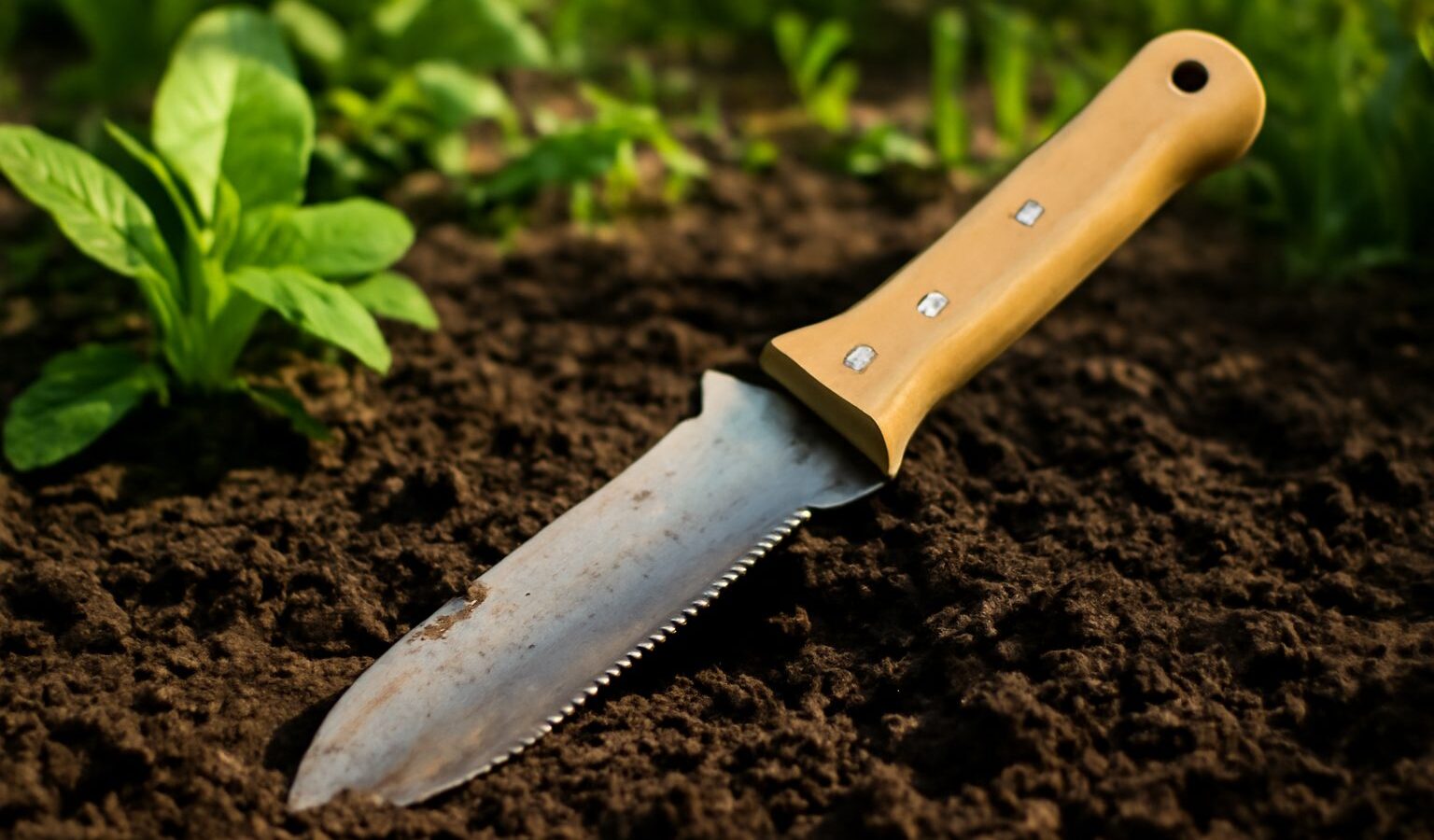
If you have spent any time digging in a garden, you have probably reached a point where a trowel feels too clumsy and a knife feels too flimsy. The hori hori solves that problem. Originally a Japanese soil knife (the name roughly translates to “dig dig”), it is a heavy, dagger-shaped tool with a concave, scoop-like blade that does the work of a trowel, a weeder, a dibber, a root saw, and a transplanting knife all at once. The blade is forged or stamped from stainless or high-carbon steel, usually between 6.75 and 7.5 inches long, with one straight cutting edge and one serrated edge. Many blades carry depth gradations stamped in inches and centimeters so you can set bulbs and seedlings at a consistent depth without guessing.
The reason gardeners get almost cult-like about the hori hori is that it genuinely replaces several tools in the bucket. The concave shape lets you scoop and dig like a narrow trowel; the straight edge slices through roots, twine, and sod; the serrated edge saws through tough rhizomes and small woody stems; and the pointed tip pries weeds out by the taproot. Once you carry one for a season, going back to a stamped-steel trowel feels like a downgrade. The catch is that not all hori horis are built the same. Cheap ones have thin tangs that bend or snap at the handle, soft steel that will not hold an edge, and sheaths that fall apart in a month. This guide walks through seven real, widely available models, what each one is genuinely good for, and the honest trade-offs, followed by a buyer’s guide and a short FAQ. For more tool comparisons, browse our Tools & Gear hub.
As an Amazon Associate we earn from qualifying purchases. This page contains affiliate links at no extra cost to you.
Key Takeaways
- A hori hori replaces a trowel, weeder, dibber, and small saw in one tool, thanks to its concave blade with both a straight and a serrated edge.
- Stainless steel is lower-maintenance and rust-resistant; high-carbon steel takes and holds a sharper edge but needs oiling to prevent rust.
- Full-tang construction (the steel running the entire length of the handle) is the single biggest predictor of whether a hori hori will survive prying.
- Depth gradations stamped on the blade make consistent bulb and transplant planting much faster.
- The Nisaku NJP650 is the long-standing all-rounder; the Barebones Classic is the premium pick; the Fiskars Big Grip is the easiest entry point on a budget.
| Product | Best For | Key Spec |
|---|---|---|
| Nisaku NJP650 | Best overall all-rounder | 7.25 in stainless, ~Tomita stainless blade |
| Truly Garden Hori Hori | Best starter bundle | Stainless, leather sheath + sharpening stone |
| Barebones Hori Hori Classic | Best premium build | Full tang, walnut handle, ~6.75 in blade |
| Fiskars Big Grip Garden Knife | Best budget / ergonomics | Composite handle, cast stainless blade |
| Sungmor Heavy Duty | Best for heavy digging | High-carbon steel, thick blade |
| Garrett Wade Tornado | Best carbon-steel edge | Japanese carbon steel, traditional grind |
| Senkichi Japanese Hori Hori | Best traditional wood handle | Carbon steel, wood handle, ~7 in blade |
1. Nisaku NJP650 Hori Hori
The Nisaku NJP650 is the knife most experienced gardeners name first, and for good reason. It is made in Japan from Tomita stainless steel with a roughly 7.25-inch blade and a simple beveled wooden handle. The concave blade is genuinely useful for scooping soil, the straight edge holds a working edge for slicing roots and twine, and the serrated side saws through tougher material without binding. Depth markings are stamped along the blade in inches, which makes setting bulbs at a uniform depth painless. It is not a flashy tool, but it has been the reference-standard hori hori for decades because the steel is good and the geometry is right.
The trade-off is that the NJP650 is a partial-tang design rather than a full slab tang, so it is happiest digging and slicing rather than being used as a heavy pry bar against buried rocks. The included sheath is functional but plain, and the wooden handle benefits from an occasional wipe of linseed oil. For all-around garden work, though, this is the safe recommendation.
Pros
- Genuine Japanese Tomita stainless that holds a usable edge
- Clear depth gradations for consistent planting
- Well-balanced 7.25-inch blade for scooping and slicing
- Proven, long-running reputation among serious gardeners
Cons
- Partial tang, so not ideal as a hard pry bar
- Plain sheath; no bundled sharpening stone
- Wood handle needs occasional oiling
2. Truly Garden Hori Hori
The Truly Garden hori hori is the model to buy if you want a complete kit out of the box rather than a bare knife. It pairs a stainless-steel blade with both a straight and serrated edge, a full leather sheath with a belt loop, and a small sharpening stone so you can keep the edge keen without buying anything extra. For a gardener who is buying their first hori hori and does not already own a whetstone, that bundle removes a lot of friction and makes it an easy, low-risk entry point.
The blade steel is solid mid-grade stainless: it resists rust well and is easy to maintain, but it is softer than a good carbon blade, so you will touch it up more often. The leather sheath looks great but, like all leather, needs to be kept dry and conditioned or it will stiffen and crack. As a gift or a starter, though, the packaging and included stone make this one of the friendliest options on the list.
Pros
- Complete kit: knife, leather sheath, and sharpening stone
- Rust-resistant stainless, easy to maintain
- Both straight and serrated edges for versatility
- Excellent first-knife or gift choice
Cons
- Stainless is softer and needs more frequent honing
- Leather sheath needs conditioning to last
- Not as refined as premium full-tang knives
3. Barebones Hori Hori Classic
If you want the nicest hori hori on the shelf and do not mind paying for it, the Barebones Classic is hard to beat. It is built around a full-tang stainless blade roughly 6.75 inches long, set into a beautifully finished walnut handle with brass-look rivets. The full tang means the steel runs the entire length of the handle, so you can lean on it and pry stubborn weeds and roots without worrying about the blade snapping at the neck. The fit and finish are a clear step above the budget knives, and it comes with a waxed-canvas sheath that feels built to last.
The honest caveats are price and weight. This is the most expensive knife on the list, and the heft that makes it feel premium also makes it slightly more tiring for delicate, all-day weeding compared to a lighter blade. The walnut handle is gorgeous but, like any wood handle, should be wiped dry and occasionally oiled. If you want a tool that will likely outlast several cheaper ones and looks the part, this is the upgrade pick.
Pros
- True full-tang construction handles hard prying
- Premium walnut handle and excellent fit and finish
- Durable waxed-canvas sheath included
- Feels like a buy-it-for-life tool
Cons
- Highest price on this list
- Heavier; can tire the hand on long sessions
- Wood handle needs occasional maintenance
4. Fiskars Big Grip Garden Knife
The Fiskars Big Grip is the most accessible hori hori-style knife here, and the one I most often recommend to beginners or anyone with hand-strength issues. It uses a cast stainless-steel blade with a serrated edge and a deep concave channel, paired with a large, contoured composite handle that is genuinely comfortable to grip even with wet or gloved hands. Fiskars backs it with a long warranty, and the composite handle will not crack, splinter, or need oiling the way wood does. For light-to-moderate digging, dividing perennials, and weeding, it does the job for a fraction of the price of the premium models.
Where it gives ground is in steel quality and prying strength. The cast blade does not take as fine an edge as a forged Japanese blade, and because the steel transitions into a molded handle rather than a continuous slab tang, it is not the tool for levering large rocks or hacking through thick woody roots. Treat it as a comfortable, budget-friendly all-rounder and it will serve you well for years.
Pros
- Large composite grip is comfortable and weatherproof
- Budget-friendly with a strong Fiskars warranty
- No handle maintenance required
- Great for beginners and those with grip-strength limits
Cons
- Cast blade does not hold as fine an edge
- Not a full tang; avoid heavy prying
- Often sold without a sheath
5. Sungmor Heavy Duty Garden Hori Hori
The Sungmor Heavy Duty is the pick when your soil is more rock and clay than loam. It uses a thick high-carbon steel blade that is noticeably stouter than the typical stainless offering, which translates into more confidence when you are chopping through compacted ground, dense root balls, or heavy clay. The serrated edge is aggressive and saws well, and the overall heft gives the digging stroke real authority. For dividing established perennials, removing stubborn weeds, and breaking new ground, the extra mass earns its keep.
The flip side of carbon steel is rust. Out of the box you will want to keep this blade wiped dry and lightly oiled, especially if you garden in a humid climate or leave tools out. It will develop a patina, and if neglected it will spot with rust. The included sheath is functional rather than luxurious. If you are willing to do a little maintenance in exchange for a blade that bites hard and holds an edge, this is a lot of digging tool for the money.
Pros
- Thick high-carbon blade built for tough soil
- Holds a sharp edge once honed
- Aggressive serrations cut through dense roots
- Good value for a heavy-duty digger
Cons
- Carbon steel will rust if not oiled and dried
- Heavier than average; more hand fatigue
- Basic sheath quality
6. Garrett Wade Tornado Hori Hori
Garrett Wade has long catered to gardeners who appreciate traditional Japanese tools, and their Tornado-style hori hori reflects that. It is a Japanese carbon-steel blade with a classic grind, giving it the kind of keen, slicing edge that stainless simply cannot match. If your main complaint with hori horis is that they feel more like diggers than cutters, this one shifts the balance: the carbon steel takes a razor edge for cleanly slicing through twine, sod, and roots, and the traditional geometry feels purposeful in the hand.
As with any carbon-steel tool, the maintenance tax applies. You trade rust resistance for edge performance, so plan to dry and oil the blade and accept a darkening patina over time. The fit and finish lean traditional rather than modern-ergonomic, and pricing sits above the budget options. For a gardener who values a truly sharp edge and the character of a Japanese carbon blade, it is a satisfying choice. If you grow a lot of perennials, our guide on how to grow hostas pairs well with a sharp hori hori for clean division.
Pros
- Japanese carbon steel takes a very keen edge
- Excellent slicing performance on roots and sod
- Traditional grind and feel
- From a retailer known for quality garden tools
Cons
- Carbon steel requires drying and oiling to prevent rust
- Above budget pricing
- Traditional ergonomics may feel less modern
7. Senkichi Japanese Hori Hori
The Senkichi is the traditional, no-nonsense Japanese hori hori for gardeners who want the authentic article with a classic wood handle. It runs a carbon-steel blade of roughly 7 inches with the familiar concave profile, straight and serrated edges, and depth markings. The wood handle is comfortable, warm in the hand, and easy to grip, and the whole tool has the honest, utilitarian feel of something made to be used hard and sharpened often rather than babied. For the price, the steel quality is reassuringly good.
The compromises are the predictable ones for a traditional carbon-steel knife: it will rust if left wet, the wood handle needs the occasional wipe of oil, and the bundled sheath is basic. Availability can also be spotty depending on the import, so you may not always find it in stock. But as a daily-driver traditional hori hori that takes a sharp edge and feels great in the hand, it is an excellent value.
Pros
- Authentic Japanese carbon-steel build
- Comfortable, warm traditional wood handle
- Takes a sharp edge; good steel for the price
- Depth markings and dual edges as expected
Cons
- Carbon steel rusts without care
- Wood handle needs occasional oiling
- Availability can be inconsistent
What to Look For in a Hori Hori Knife
Hori horis look superficially similar, but the differences in steel, tang, and sheath separate a tool you will keep for a decade from one you will replace next spring. Here is what actually matters when you are comparing models.
Blade Steel: Stainless vs Carbon
This is the first fork in the road. Stainless steel resists rust, shrugs off neglect, and is the right call for most gardeners who leave tools in a damp shed or garden in a humid climate. The trade-off is that stainless is generally softer, so it does not take quite as fine an edge and needs more frequent honing. High-carbon steel is the opposite: it takes and holds a noticeably sharper edge and bites harder into tough soil, but it will rust if you leave it wet. Carbon blades develop a gray patina over time, which is normal and actually offers a little protection. If you are diligent about wiping the blade dry and giving it an occasional rub of oil, carbon rewards you with better cutting. If you know you will not maintain it, choose stainless.
Full-Tang Construction
The tang is the part of the blade steel that extends into the handle. A full tang runs the entire length and width of the handle as a single slab of steel, with the handle scales riveted on either side. This is by far the strongest construction and is what you want if you intend to pry rocks, lever out taproots, or otherwise abuse the tool. A partial or rat-tail tang, where a thin tongue of steel pokes into a molded or pinned handle, is fine for digging and slicing but is the most common failure point when people use a hori hori as a pry bar. If durability is your top priority, look for the words “full tang” and the visible steel running through the handle.
Depth Markings
Many hori horis are stamped or etched with depth gradations along the blade, usually in both inches and centimeters. This sounds like a gimmick until you are planting a hundred bulbs and want every one at the same depth, or transplanting seedlings that need a precise hole. The blade becomes a built-in ruler, so you push it in to the marked depth and you are done. Etched markings last longer than printed ones, which can wear off. It is a small feature that pays off constantly during planting season.
Handle Material: Wood vs Composite
Wood handles feel warm, look beautiful, and offer a classic grip, but they need a little care: wipe them dry, and oil them once or twice a season so they do not dry out and crack. Composite or rubberized handles are virtually maintenance-free, often more comfortable when wet or gloved, and will not splinter. They lack the character of wood but win on practicality. Whatever the material, look for a handle that fills your palm and has some contour or a guard so your hand does not slide onto the blade when you push hard into soil.
Sheath Quality
A hori hori is a sharp, pointed tool, so a good sheath is a safety item, not a luxury. Look for a sheath with a secure belt loop and, ideally, a snap or strap to keep the knife from sliding out when you bend over. Leather looks great and lasts if you condition it, but it stiffens and cracks if it gets repeatedly soaked. Nylon and waxed-canvas sheaths are more weather-tolerant and a sensible choice for working gardeners. A flimsy sheath that the blade cuts through within a season is a real downgrade, so factor it into the value.
Serrated Edge Usefulness
Most hori horis have one straight cutting edge and one serrated edge, and the serrations are more useful than they first appear. They saw through fibrous rhizomes, root balls, twine, landscape fabric, sod, and small woody stems far better than a straight edge, which tends to bind or skate. When you are dividing an overgrown clump of grasses or daylilies, the serrated edge does the heavy lifting. A few cheaper knives skip the serrations or make them too shallow to bite; a well-cut serrated edge genuinely expands what the tool can do.
Frequently Asked Questions
What is a hori hori knife used for?
A hori hori is a Japanese soil knife that replaces several tools at once. The concave blade scoops and digs like a trowel, the straight edge slices roots and twine, the serrated edge saws through tough rhizomes and sod, and the pointed tip pries out weeds by the taproot. It is also used for transplanting, dividing perennials, and planting bulbs at a consistent depth.
Is stainless or carbon steel better for a hori hori?
It depends on your habits. Stainless resists rust and needs little care, making it the easy, low-maintenance choice for most gardeners. High-carbon steel takes and holds a sharper edge and digs harder, but it will rust if left wet, so you must wipe it dry and oil it occasionally. Choose carbon if you will maintain it, stainless if you will not.
How do I keep a hori hori from rusting?
After each use, wipe the blade clean and dry, removing soil and moisture. For carbon-steel blades, rub on a thin coat of camellia oil, mineral oil, or even WD-40, then store the knife in a dry place rather than leaving it outside. A light patina on carbon steel is normal and protective; active orange rust should be scrubbed off and the blade re-oiled.
How do I sharpen a hori hori?
Use a sharpening stone or a coarse diamond file on the straight edge, holding a consistent low angle and working from heel to tip. The serrated edge rarely needs sharpening, but you can touch up individual teeth with a small tapered file or ceramic rod. A few passes after each heavy use keeps the straight edge slicing cleanly.
Can a hori hori be used as a pry bar?
Only if it is full-tang. A full-tang hori hori, where the steel runs the entire length of the handle, can handle prying rocks and levering taproots. Partial-tang and cast-handle models can bend or snap at the neck under heavy prying, so use those for digging and slicing instead. Match the task to the construction.
For most gardeners, the Nisaku NJP650 is the easiest recommendation: proven steel, the right geometry, and a fair price. If you want a premium tool that handles prying, step up to the Barebones Classic; if you are just starting out or watching your budget, the Fiskars Big Grip or the Truly Garden kit will get you digging without regret. Whichever you choose, a quality hori hori quickly becomes the one tool you reach for first.