

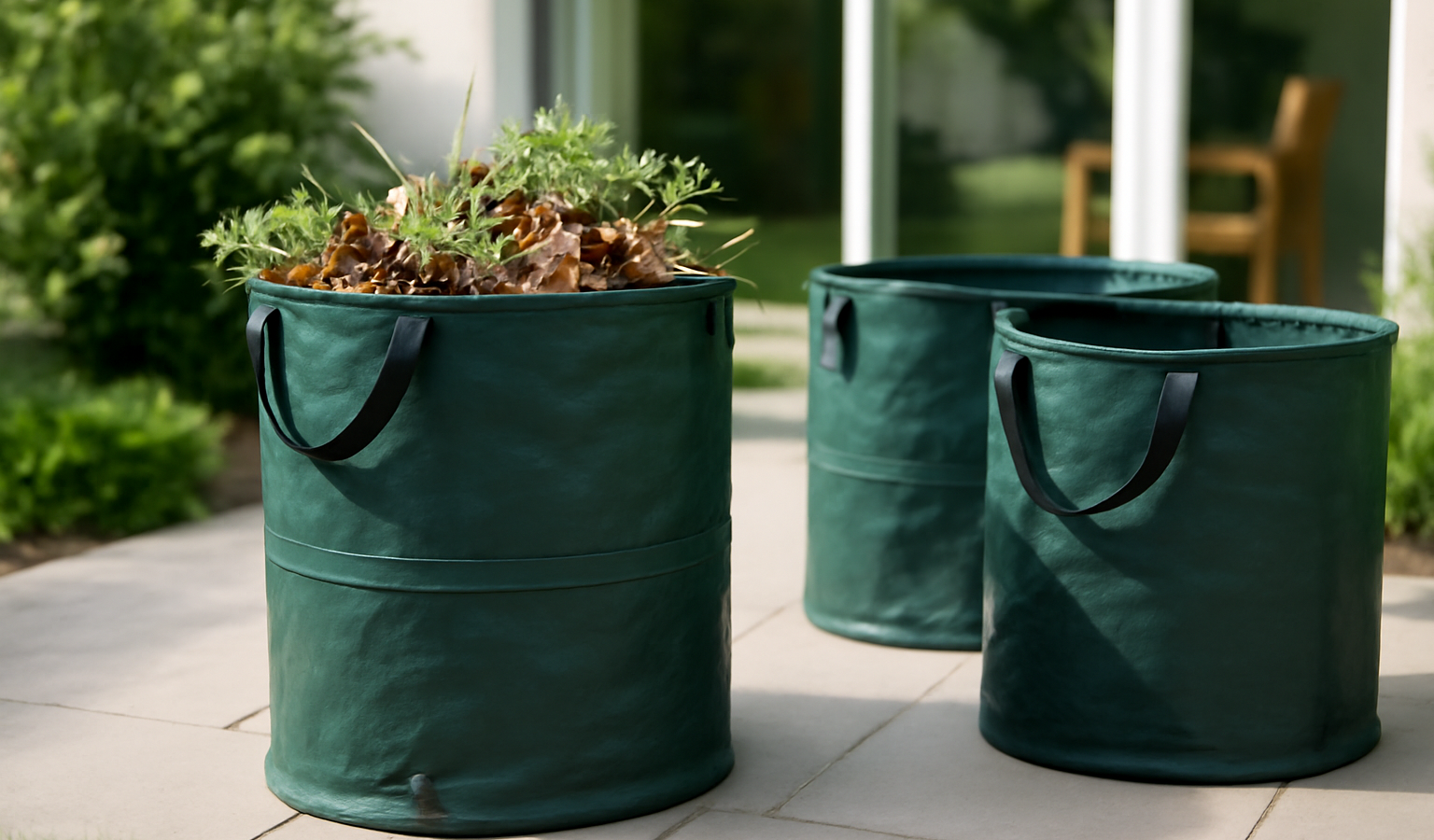
If you have ever filled a flimsy plastic trash bag with wet leaves and watched it split open halfway to the curb, you already understand why a good collapsible garden bag earns its keep. These pop-up, reusable totes give you a rigid mouth that stays open while you rake or weed with both hands, tough walls that shrug off thorny prunings, and the ability to fold flat to the size of a dinner plate when the job is done. After a full season of hauling oak leaves, hedge clippings, spent tomato vines, and the occasional load of mulch around a half-acre yard, we found that the differences between bags are bigger than the price tags suggest. Capacity numbers are routinely optimistic, handle stitching is where cheap bags fail first, and “self-standing” means very little if the rim collapses the moment you lean a rake against it.
Below are the seven collapsible garden bags we would actually buy again, organized by who each one is for. We cover true heavy haulers for tree-and-shrub people, lightweight pop-ups for tidy small-yard work, multi-bag value packs for big fall cleanups, and a couple of specialty picks. Whether you are bagging spring weeds or wrestling a maple’s worth of autumn leaves, there is a pick here that fits your yard and your back.
As an Amazon Associate we earn from qualifying purchases. This page contains affiliate links at no extra cost to you.
Key Takeaways
- Capacity is measured in gallons — most popular bags run 30 to 80 gallons. A standard kitchen trash bag is about 13 gallons, so a 72-gallon tote replaces roughly five of them per trip.
- Sprung-steel rims hold their shape and pop flat for storage, but they store the spring tension, so look for a coiled-frame design with a sleeve to keep it folded safely.
- Handle stitching and a reinforced bottom are where bags fail. Bar-tacked, double-stitched handles and a doubled base outlast bags rated for higher capacity but built thinner.
- PE woven fabric (the tarp-like material) resists tearing on thorns and dries fast; cheaper Oxford polyester soaks up water and gets heavy.
- Pop-up bags are fast but light-duty; structured heavy-haul totes carry rocks, soil and wet debris but weigh and store bulkier.
- Buy at least two — a single bag becomes a bottleneck during a real cleanup, and multi-packs cost far less per bag.
| Product | Best For | Key Spec |
|---|---|---|
| Gardzen Reusable Garden Bag | All-around fall cleanup | 72 gal, 3-pack, PE woven |
| Reliancer Heavy Duty Lawn Bags | Big hauls / soil & rock | 80 gal, reinforced bottom |
| Gorilla Grip Reusable Bag | Premium durability | 72 gal, double-stitched handles |
| TUSCOM Pop-Up Garden Bag | Fast light yard work | Spring frame, 32 gal, folds flat |
| HOMyfoam Collapsible Bucket Bag | Small jobs / harvest | 10 gal, hard plastic, scoop-friendly |
| Joygardener Leaf Bag Holder | Bagging into trash bags | Holds 30-gal liners open, hands-free |
| YeahuTong 2-Pack Garden Bags | Budget multi-bag value | 53 gal, 2-pack, low cost |
1. Gardzen 72-Gallon Reusable Garden Bag (3-Pack) — Best Overall
The Gardzen 72-gallon bag is the one we reach for most because it nails the balance that matters for general yard work: it is big enough to swallow a serious pile of leaves, tough enough for prunings, and it actually folds flat for storage. The body is a thick PE woven polyethylene — the same family of material as a heavy-duty tarp — so thorns from rose canes and blackberry don’t punch through, and rain beads off rather than soaking in. The four web handles are bar-tacked, and you get two sets: short loops on the rim for carrying and longer loops you can clip together to drag a full bag across the lawn.
The mouth is held open by a coiled spring sewn into the rim, so the bag self-stands while you rake into it two-handed. At 72 gallons it holds roughly five-and-a-half kitchen trash bags’ worth, which means a typical front-yard maple cleanup goes from a dozen trips to three or four. Coming as a 3-pack, you can stage one at each work zone instead of constantly dragging a single bag around. When emptied, each bag twists down into a flat coil about 16 inches across and tucks behind a shelf.
Pros
- Three bags in the box — stage one per work zone
- Thick PE woven fabric resists thorns and sheds water
- Self-standing sprung rim stays open for two-handed raking
- Bar-tacked handles in two lengths for carry or drag
Cons
- Coiled spring takes a knack to fold the first few times
- No bottom drain holes, so wet debris can pool
- 72 gal of wet leaves is genuinely heavy to lift
2. Reliancer Heavy Duty 80-Gallon Lawn Bags — Best for Big Hauls
When the load includes more than leaves — think sod chunks, gravel, spent potting soil, or a pile of wet branch trimmings — the Reliancer heavy-duty bags are built for the abuse. The standout feature is a genuinely reinforced bottom: a doubled layer of PP woven fabric sewn across the base so the seam doesn’t blow out when you drop in 60 pounds of damp soil. The walls are rated to a thick gauge and the bag holds its cylindrical shape well even when only half full, which keeps debris from spilling as you lean over it.
At 80 gallons this is the largest bag on our list, and it earns that capacity for hardscape and renovation work rather than delicate raking. The four heavy handles are reinforced where they meet the body, the spot most bags fail. The trade-off is that the rim here is a stiffened sewn band rather than a true pop-up spring, so it stands up but doesn’t snap perfectly round on its own — you nudge it open. For sheer hauling muscle, that is a fair compromise.
Pros
- Doubled, reinforced bottom handles soil, gravel and sod
- Largest capacity here at 80 gallons
- Heavy handles reinforced at the attachment points
- Holds shape well even when partly filled
Cons
- Stiffened rim is not a true self-popping spring
- Heavy and bulky to store compared with pop-ups
- Easy to overload past what one person can lift
3. Gorilla Grip Reusable Garden Bag — Best Premium Pick
Gorilla Grip has built its reputation on stitching that doesn’t quit, and its 72-gallon reusable garden bag is the one to buy if you want a tote that survives years of seasonal cleanups. The fabric is a dense Oxford-backed PE laminate that feels noticeably stiffer in the hand than budget bags, and every stress point — the four handles, the rim seam, the base corners — is double-stitched and bar-tacked. In our use it held its rigid cylindrical shape best of any bag here, standing fully upright and open without any coaxing.
That structure is the selling point: because the walls stay vertical, you can pack debris densely without it slumping out, and a rake or broom leaned against the rim won’t fold it. It collapses flat for storage, though the stiffer fabric makes the fold a touch less compact than a thin pop-up. If you only buy one premium bag and want it to outlast the cheaper three-packs, this is the value-over-time choice.
Pros
- Best-in-class double-stitched, bar-tacked handles and seams
- Rigid walls stay vertical and self-standing under load
- Dense laminate fabric resists punctures and abrasion
- Backed by Gorilla Grip’s reputation for durability
Cons
- Priced higher than multi-bag value packs
- Stiffer fabric folds slightly bulkier than thin pop-ups
- Usually sold as a single bag, not a pack
4. TUSCOM Pop-Up Garden Bag — Best Lightweight Pop-Up
For tidy, frequent small-yard chores — deadheading, light weeding, sweeping up after a hedge trim — a true spring-frame pop-up is the fastest tool you can own. The TUSCOM pop-up uses a sprung-steel coil that snaps the bag from a flat disc into a fully open 32-gallon cylinder in one motion. There is no setup, no unfolding panels; you flick it and it stands. That immediacy is the whole point: you grab it for a five-minute job without dreading the cleanup.
The fabric is a lighter PE woven than the heavy haulers, which keeps the empty weight low and lets the spring do its job, but it also means this is not the bag for rocks or wet soil. It excels with dry leaves, grass clippings, and prunings. When you are done, you twist and fold it into a flat ring that slips into the included sleeve so the spring stays safely contained. For a one-or-two-bag household that mostly does light maintenance, it is the easiest bag here to live with.
Pros
- Spring frame pops open instantly with one flick
- Light empty weight, easy for anyone to handle
- Folds to a flat disc with a containment sleeve
- Perfect for quick, frequent light cleanups
Cons
- Lighter fabric not meant for soil, gravel or wet loads
- Smaller 32-gal capacity fills quickly in big jobs
- Sprung steel can pinch if you fold it carelessly
5. HOMyfoam Collapsible Bucket Garden Bag — Best Small Bag
Not every job calls for a 72-gallon monster. For harvesting vegetables, carrying tools out to a bed, soaking up weeds from a single border, or mixing a small batch of potting mix, the HOMyfoam collapsible bucket bag is the right scale. It is a 10-gallon collapsible made of a thick, food-safe TPU-coated fabric with a stiffened rim, so it stands open like a bucket but squashes flat to about two inches tall for storage in a shed cubby or the trunk.
The wide flat base makes it stable enough to scoop into without tipping, and the smooth interior rinses clean, which matters when you have used it for harvested produce one day and weeds the next. The sturdy top handles let you carry a surprisingly heavy load of fruit or freshly pulled weeds in one hand. It is the bag we keep clipped to a hook by the back door for the ten daily garden errands that don’t justify dragging out the big totes.
Pros
- Right size for harvesting, tools and small weeding jobs
- Food-safe coated fabric rinses clean easily
- Collapses nearly flat for compact storage
- Wide stable base resists tipping when you scoop into it
Cons
- 10-gal capacity is far too small for leaf cleanup
- Coated fabric can crack if stored folded in hard freezes
- Single handle pair, no drag loops
6. Joygardener Leaf Bag Holder — Best Hands-Free Bagging Tool
If your town requires debris in paper or plastic disposal bags rather than letting you dump from a reusable tote, the Joygardener leaf bag holder solves the most annoying part of that chore: keeping the disposal bag’s mouth open while you fill it. It is a collapsible frame that grips the top of a standard 30-gallon trash or paper lawn bag and holds it wide open and upright, so you can rake straight in with both hands instead of fighting a floppy bag that keeps collapsing on itself.
The frame folds flat between uses and weighs almost nothing. Clips or elastic grips secure the bag rim so it doesn’t slide down as the bag fills. It is not a bag itself, so we list it as the specialty pick — but for anyone bound by municipal bagging rules, pairing this holder with disposal bags is genuinely faster than wrestling them solo, and it stores in the same flat footprint as a collapsible tote. Think of it as the bridge between reusable totes and the curbside rules you can’t avoid.
Pros
- Holds disposal bags wide open for two-handed raking
- Fits standard 30-gallon paper and plastic lawn bags
- Folds flat and weighs next to nothing
- Solves curbside bagging where reusable totes aren’t allowed
Cons
- It’s a holder, not a reusable bag — you still buy liners
- Bag rim grips can slip with very full, heavy loads
- Limited to roughly 30-gal disposal-bag size
7. YeahuTong 53-Gallon Garden Bags (2-Pack) — Best Budget Value
When you just need bags that work and don’t want to spend premium money, the YeahuTong 53-gallon 2-pack delivers the essentials at the lowest cost per bag on our list. Each bag is a mid-weight PE woven cylinder with a stiffened self-standing rim and four web handles. It is not as thick as the Gorilla Grip or as reinforced as the Reliancer, but for the bread-and-butter task of bagging leaves and clippings it holds up to a full season of normal use.
At 53 gallons each, the two together give you over 100 gallons of staging capacity for the price most premium brands charge for one bag. They fold flat for storage like the others. The honest trade-off is longevity: the lighter fabric and simpler handle attachment mean these are the bags most likely to show wear after a couple of hard years, and we would keep them to leaves and clippings rather than abusing them with rock or soil. For a first set of garden bags or as spare staging totes, the value is hard to beat. If you also handle heavier loads, see our notes on building a complete kit in the buyer’s guide below.
Pros
- Lowest cost per bag of any pick here
- Two bags give 100+ gallons of staging capacity
- Self-standing rim and four handles cover the basics
- Folds flat like the pricier totes
Cons
- Lighter fabric wears faster under hard use
- Simpler handle attachment than premium bags
- Best limited to leaves and clippings, not soil or rock
What to Look For in a Collapsible Garden Bag
Capacity and how it maps to your yard
Bag capacity is quoted in gallons, and the numbers are easy to misjudge. A standard kitchen trash bag is about 13 gallons, so a 72-gallon tote replaces roughly five of them and a 30-gallon pop-up about two. For a small townhouse yard, a single 30-to-40-gallon pop-up is plenty. For a quarter-acre with a couple of mature trees, you want at least 60 to 72 gallons and ideally two or three bags so you are not constantly emptying. Remember that a fully loaded 72-gallon bag of wet leaves can weigh 40 to 60 pounds — capacity you can fill but might struggle to lift, so the drag handles matter as much as the gallons.
Fabric: PE woven vs. Oxford polyester
The two common materials behave differently. PE (polyethylene) woven fabric — the tarp-like weave — resists tearing on thorns, sheds water, and dries quickly, which makes it the better all-rounder. Oxford polyester feels softer and is common on cheaper bags; it works but absorbs water, getting heavy and slow to dry. Whichever you choose, fabric thickness matters more than the material name on the listing. A thick Oxford bag beats a thin PE one. If the listing gives a gram-per-square-meter (GSM) figure, higher is sturdier.
Frame style: pop-up spring vs. structured rim
Pop-up bags use a coiled spring sewn into the rim that snaps the bag open instantly and folds it flat into a disc. They are the fastest to deploy and the most compact to store, but the spring tension means lighter fabric and lighter loads. Structured bags use a stiffened sewn band that holds the mouth open without a spring; they stand up more solidly for heavy hauling and pack denser loads without slumping, at the cost of bulkier storage and a slightly slower setup. Match the frame to the work: pop-up for quick light jobs, structured for serious hauling.
Handles, base and the failure points
Bags almost always fail in two places: where the handles meet the body and along the bottom seam. Look for bar-tacked or double-stitched handles and a reinforced or doubled base, especially if you’ll carry soil. Two sets of handles — short carry loops plus longer drag loops — let you move a full bag you can’t lift. A reinforced bottom is the single best predictor of how long a bag survives heavy use. The same logic applies whether you are storing your bags alongside other gear; if you are organizing a whole kit, our roundup of the best soil scoops pairs naturally with these totes for potting and mix work.
Storage, drainage and longevity
All collapsible bags fold down, but how small varies — pop-ups shrink to a flat disc, structured bags to a thicker pad. Store them dry and out of constant UV; sunlight slowly degrades PE fabric, so a shed or garage shelf beats leaving them outside year-round. A few bags include small bottom drain grommets so rainwater doesn’t pool — handy if you stage bags outside during a multi-day project. For the broader picture of equipping a productive plot, browse the Tools & Gear hub for companion guides.
Frequently Asked Questions
How big a collapsible garden bag do I need?
Match capacity to your yard. A small townhouse lot is fine with one 30–40 gallon pop-up. A quarter-acre with mature trees needs 60–72 gallons and ideally two or three bags so you aren’t constantly emptying. Remember a kitchen trash bag is about 13 gallons, so a 72-gallon tote replaces roughly five of them per trip.
Can I put soil, gravel or rocks in a collapsible bag?
Only in bags with a reinforced, doubled bottom — like the Reliancer heavy-duty model. Standard leaf totes and lightweight pop-ups are built for leaves and clippings; loading them with soil or rock will blow out the base seam and overload the handles. When in doubt, keep heavy mineral loads to bags specifically rated for them.
Are pop-up spring bags or structured bags better?
It depends on the job. Pop-up spring bags snap open instantly and fold to a flat disc — ideal for fast, frequent light cleanups. Structured bags with a stiffened rim hold their shape better under heavy, dense loads and stand more solidly, but they’re bulkier to store and slightly slower to set up. Many gardeners own one of each.
How do I fold a sprung-steel pop-up bag flat?
Hold the rim, twist it to form a figure-eight, then fold the two loops together so the coil nests into a flat disc. It feels awkward the first few times but becomes second nature. Slip it into the included sleeve or band so the spring stays contained — an uncontained coil can spring open and pinch fingers.
How do I make collapsible garden bags last longer?
Store them dry and out of constant sunlight, since UV slowly degrades PE fabric. Rinse and dry coated bucket bags before folding so they don’t mildew, and avoid storing coated fabrics folded through hard freezes, which can crack them. Don’t overload past what the handles and base were built for — overloading is the fastest way to ruin any bag.
Across a season of real use, the Gardzen 72-gallon 3-pack is the pick that fits the most yards: enough capacity, tough PE fabric, self-standing rim, and three bags so you can stage them. Step up to the Reliancer if you haul soil and rock, splurge on the Gorilla Grip if you want one bag to last for years, and grab the TUSCOM pop-up or the YeahuTong 2-pack for fast light work and budget value. Whatever you choose, buy at least two — a single bag is always the bottleneck on cleanup day.