

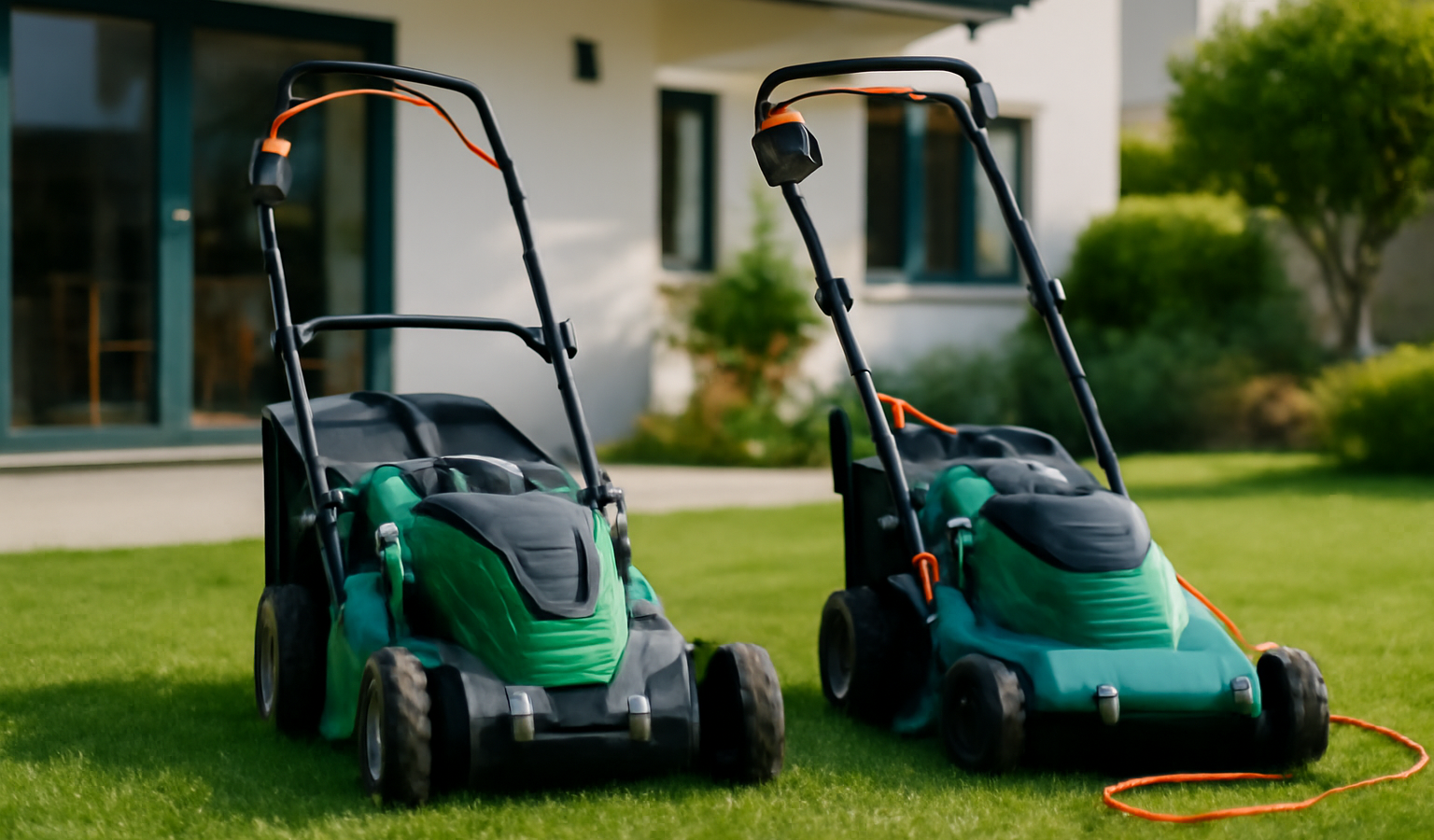
If your lawn is small, flat, and close to an outlet, a corded electric mower is the cheapest, lightest, never-runs-out option you can buy. For everything else—any yard with obstacles, distance, or a need to roam freely—a battery (cordless) mower is worth the higher price. Both are electric, so both skip the oil changes, spark plugs, fumes, and pull-cord struggles of gas. The real question between them is freedom versus simplicity: a battery mower gives you cordless range and instant tool-platform compatibility but costs more and runs on a limited charge, while a corded mower gives you unlimited runtime and a low price in exchange for being tethered to an extension cord. This guide compares range, power, runtime, weight, and cost so you can match the right plug-in or cordless mower to your specific lawn.
Key Takeaways
- Corded = cheapest, lightest, unlimited runtime, but tethered to ~100–150 ft of cord and an outlet.
- Battery = full cordless freedom, no tripping hazard, works far from power—but costs more and runs on a limited charge.
- Lawn size & shape: corded suits small, simple, obstacle-free lawns; battery suits anything larger or with trees, beds, and turns.
- Power: both cut well; high-voltage battery models (40V–80V) rival the strongest corded units.
- Platform bonus: a battery mower’s packs often power your trimmer, blower, and other tools—corded offers no such ecosystem.
| Factor | Battery (Cordless) | Corded Electric |
|---|---|---|
| Range | Unlimited (no cord) | ~100–150 ft from outlet |
| Runtime | 30–60 min per charge | Unlimited |
| Power | Good to excellent (by voltage) | Steady, consistent |
| Weight | Heavier (battery) | Lighter |
| Upfront cost | Higher | Lowest |
| Best lawn size | Small to medium | Small only |
| Tool-platform compatibility | Yes (shared batteries) | No |
| Tripping/safety hazard | None | Cord risk |
Battery (Cordless) Mowers: Freedom to Roam
A battery mower runs on a removable lithium-ion pack, typically 40V to 80V. Its defining benefit is freedom: no cord to drag, untangle, or accidentally mow over, and no limit on how far you can wander from the house. You can mow a back corner, a detached side yard, or anywhere an outlet does not reach. Push-button start, instant torque, and self-propelled options on many models make them easy and pleasant to use, and—like all electric mowers—they need essentially no maintenance.
Power scales with voltage and the battery’s amp-hour (Ah) rating. A 40V mower handles small lawns comfortably; 60V and 80V platforms deliver enough grunt to rival gas on most turf. Runtime is the trade-off: expect 30 to 60 minutes per charge, enough for most lawns up to roughly a third of an acre. The standard solution is a second battery—swap it in and keep going while the first recharges. The pack also makes the mower noticeably heavier than a corded unit, which you feel when turning or going uphill, though self-propelled drive offsets it.
The other big advantage is the ecosystem. Buy into a platform—Ego, Greenworks, Ryobi, Makita, DeWalt—and the same batteries run your string trimmer, leaf blower, hedge trimmer, and more, so you are not buying a separate power source for every tool. The downsides are real but manageable: higher upfront cost (especially with a spare battery), and packs that lose capacity over time and eventually need replacing after several years of regular use. For the broader plug-in-versus-gas picture, see our electric vs gas lawn mower comparison.
Corded Electric Mowers: Unlimited Runtime, Lowest Cost
A corded mower plugs into a wall outlet through a heavy-duty extension cord and draws constant power, which gives it two unbeatable strengths: unlimited runtime—you will never stop mid-lawn to recharge—and the lowest price of any mower type, with no battery to buy now or replace later. They are also the lightest mowers around because there is no heavy pack on board, making them easy to push and simple to hang on a garage wall for storage. Maintenance is the same near-zero as any electric mower: no oil, no fuel, no plugs.
The cord is both the feature and the flaw. You are limited to roughly 100 to 150 feet from the outlet (use a properly gauged outdoor extension cord—12-gauge for longer runs—to avoid voltage drop and motor strain), and the cord must be managed constantly so you do not run it over, trip on it, or snag it on obstacles. That makes corded mowers genuinely awkward on lawns with trees, garden beds, fences, or tight corners, because every turn risks tangling. They work best on small, open, rectangular lawns near the house where you can sweep back and forth with the cord trailing safely behind.
Cutting power is steady and consistent—no fade as a battery drains—and plenty for routine mowing of a tidy lawn, though most corded models top out with narrower decks (typically 14 to 21 inches) and modest motors. There is no tool-platform benefit either: a corded mower is a single-purpose machine. For a small urban or starter lawn, though, the combination of low price, light weight, and no-recharge convenience is hard to beat. Whatever mower you run, handling clippings well keeps the lawn healthy—our guide on mulching vs bagging clippings explains the best routine.
Deck width and cut quality deserve a mention too. Corded mowers often come with narrower decks—14 to 19 inches is common—because the motors are sized for small lawns, which means more passes to cover the same area. Higher-end battery mowers offer 20- to 21-inch decks that match gas, finishing a lawn in fewer laps. Both electric types deliver a clean cut with a sharp blade, and both let you adjust cutting height the same way. Just remember the universal rules: keep the blade sharp, mow when the grass is dry, and never remove more than a third of the blade height at once. A dull blade tears grass and stresses the lawn no matter what powers the mower.
Range, Power, and Cost Compared
Range is where the two diverge most sharply. A battery mower goes anywhere; a corded mower is permanently leashed within an extension cord’s reach. If any part of your yard sits beyond about 150 feet from an outlet, or the path to it crosses obstacles, corded is impractical and battery is the only sensible electric option. On runtime the corded mower wins outright—unlimited versus 30 to 60 minutes—but in practice a single charge already covers most small-to-medium lawns, and a spare battery erases the gap.
On power they are closer than people assume. A quality corded mower delivers steady, fade-free cutting, and a high-voltage battery mower matches or exceeds it. On cost, corded is the clear value: lowest sticker price, no battery to replace down the road. Battery mowers cost more upfront and carry an eventual pack-replacement cost, but reward you with cordless freedom and a shared-battery tool ecosystem. Weight favors corded (lighter, no pack); convenience and safety favor battery (no cord to trip on or sever). Neither beats the other on every axis—it comes down to your lawn’s size and layout.
Storage and longevity round out the picture. A corded mower has almost nothing to fail beyond the motor and switch, so a well-treated unit can last many years with zero seasonal prep—just coil the cord and hang it up. A battery mower is also low-maintenance, but the pack is a consumable: store it indoors at moderate temperatures, avoid leaving it fully drained for months, and expect to buy a replacement eventually. Neither needs winterizing the way a gas engine does—no fuel to stabilize, no oil to change—which is a shared advantage that makes any electric mower far less hassle to live with over the years.
Which Should You Choose?
Let your lawn’s size, shape, and distance from an outlet make the call.
Choose a corded electric mower if your lawn is small (roughly under a quarter acre), flat, open, and close to a power outlet, and you want the lowest price, the lightest machine, and never having to think about charging. It is the classic pick for a compact city or townhouse lawn.
Choose a battery (cordless) mower if your lawn is medium-sized or has trees, beds, fences, or tight turns that a cord would snag, if any part sits far from an outlet, or if you want batteries that also power your other yard tools. The freedom and safety of no cord is worth the higher cost for most homeowners.
Quick rule of thumb: if you can mow your whole lawn comfortably while trailing a 100-foot cord with no obstacles in the way, corded saves you money; the moment that feels awkward, go battery. Either way you are choosing clean, quiet, low-maintenance electric power. For more lawn and yard guides, visit our Outdoor Living hub.
Frequently Asked Questions
How far can a corded electric mower reach?
Generally about 100 to 150 feet from the outlet, limited by safe extension-cord length. Use a heavy-gauge outdoor cord (12-gauge for longer runs) to prevent voltage drop that strains the motor. Beyond that range, a cordless battery mower is the practical choice.
Are corded mowers more powerful than battery mowers?
Not necessarily. A corded mower delivers steady, fade-free power, but high-voltage battery models (60V–80V) match or exceed it. For routine mowing both cut well; the difference is runtime and range, not raw cutting ability on a normal lawn.
Is it safe to mow over wet grass with an electric mower?
Light dampness is fine, but avoid mowing in rain or soaking-wet conditions—especially with a corded model, where water near the cord and connections raises shock risk. Wet grass also clumps and clogs. For the cleanest cut and safety, mow when the lawn is dry.
Can I use my mower battery in other tools?
Yes, if you stay within one brand’s platform. Battery mowers from Ego, Greenworks, Ryobi, and similar use packs that also fit the same brand’s trimmers, blowers, and hedge tools. Corded mowers have no such ecosystem—they are single-purpose machines.
How long do mower batteries last before replacement?
Most lithium-ion mower batteries last roughly 500 charge cycles, or about three to five years of regular use, before capacity drops noticeably. That eventual replacement is a real cost to factor in—one corded mowers avoid entirely since they have no battery.