

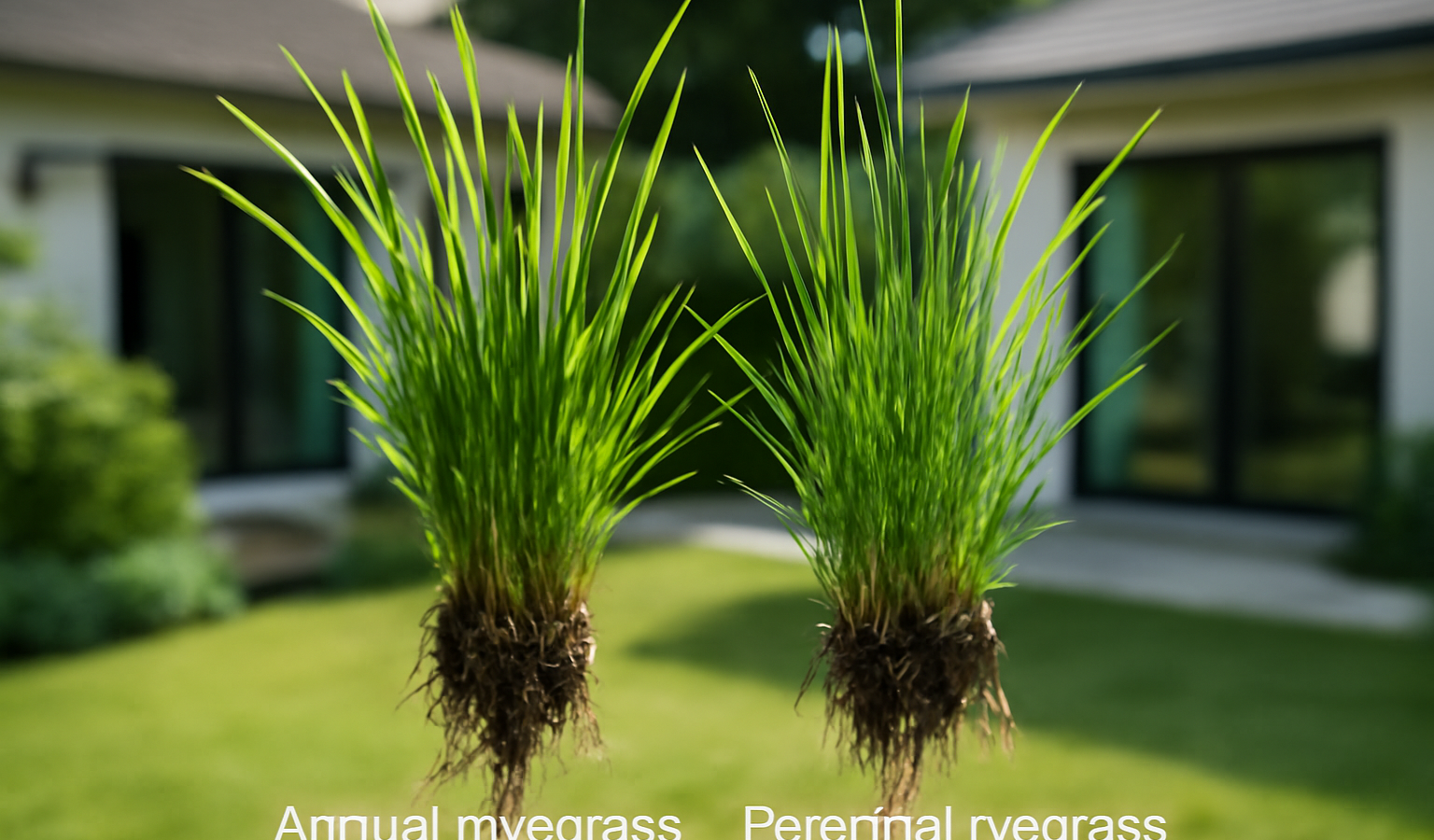
Walk into any garden center and you will find two bags labeled “ryegrass,” and they could not behave more differently. Annual ryegrass (Lolium multiflorum) is the fast, cheap, disposable one—it sprouts in days, grows like crazy for a season, and then dies. Perennial ryegrass (Lolium perenne) is the refined, permanent one—slower to fill in, finer-textured, more expensive, and built to come back year after year as part of a real lawn. They are not interchangeable, and using the wrong one is one of the most common seed-aisle mistakes. If you are overseeding a winter lawn in the South, patching a bare spot, or building a permanent cool-season turf in the North, the right pick changes completely. Here is exactly how they differ and when to reach for each.
Key Takeaways
- Annual ryegrass germinates in 5–10 days, grows fast, lives one season, then dies—cheap and temporary.
- Perennial ryegrass is finer, denser, slower (7–14 days), and persists for years as permanent cool-season turf.
- Overseeding warm-season lawns for winter green: annual is cheaper and dies off cleanly in spring; perennial transitions slower but looks better.
- Erosion control / nurse crop / quick cover: annual ryegrass is the go-to.
- Permanent lawn or quality overseed: perennial ryegrass, often blended with bluegrass and fescue.
Quick comparison
| Trait | Annual Ryegrass | Perennial Ryegrass |
|---|---|---|
| Lifespan | One growing season | Several years (true perennial) |
| Germination | Very fast, 5–10 days | Fast, 7–14 days |
| Texture | Coarse, light green | Fine, dark glossy green |
| Density | Open, clumpy | Dense, uniform |
| Cost | Cheapest grass seed | Moderate—more per pound |
| Mowing | Grows fast, frequent mowing | Moderate growth rate |
| Wear tolerance | Low | High (sports turf) |
| Best use | Quick cover, erosion, nurse crop, cheap winter overseed | Permanent lawn, quality overseed |
Annual ryegrass: fast, cheap, and temporary
Annual ryegrass is the sprinter of the grass world. Sown into warm-to-cool soil it germinates in well under two weeks—often visible green in five to seven days—and grows aggressively, throwing up coarse, light-green blades and a clumpy, upright habit. That speed is exactly its value. It is the cheapest grass seed you can buy, frequently sold by the 25- or 50-pound bag for a fraction of what fine turf seed costs.
Use annual ryegrass when you need temporary cover, not a lawn. It excels at erosion control on bare slopes and construction sites, holding soil while a permanent planting establishes. It works as a nurse crop, sown with slower permanent grasses to provide quick cover and shade for the seedlings beneath—though sown too heavily it will out-compete them, so keep the rate light. It makes a fine cover crop in vegetable beds, scavenging nutrients and adding organic matter before winterkill. And in the South it is the budget option for winter overseeding a dormant Bermuda or Zoysia lawn to keep it green through the cool months.
The catch is right in the name: it is annual. It will die after one season—killed by summer heat in the South or hard winter cold in the North—leaving you with bare ground unless something permanent was meant to take over. It also grows fast enough to demand frequent mowing, its coarse texture and clumping habit never look like premium turf, and it tolerates foot traffic and drought poorly. As a stand-alone permanent lawn it is the wrong tool entirely.
Perennial ryegrass: fine, durable, permanent
Perennial ryegrass is a genuine cool-season turfgrass. It still germinates fast for a permanent grass—one of its big selling points—but it establishes into a fine-bladed, dark glossy-green, dense lawn that looks and wears like quality turf. It has excellent wear tolerance, which is why it is a backbone of athletic fields and is blended into premium lawn mixes across the cool-season North (USDA Zones roughly 3–7) alongside Kentucky bluegrass and fine or tall fescue.
In a blended cool-season lawn, perennial ryegrass plays the “quick establisher and traffic absorber” role: it green up fast where bluegrass is slow, and it takes the foot traffic while bluegrass spreads to fill in. It does have limits—it is a bunch grass, so it does not self-repair by spreading the way bluegrass does, and it is less heat- and drought-tolerant than tall fescue, struggling in the transition zone’s hot summers. But for a permanent, good-looking, durable cool-season lawn, or for a high-quality winter overseed that transitions more gracefully in spring, perennial ryegrass is the right choice.
Don’t confuse ryegrass with “rye”
One source of constant confusion is the word “rye.” Ryegrass (Lolium) is a turf and forage grass and is not the same plant as cereal rye, also called winter rye or grain rye (Secale cereale), which is a tall grain grown as a cover crop and for flour. Both are used as cover crops and both germinate fast, but cereal rye grows much taller, is far more cold-hardy, and is meant to be tilled or terminated rather than mowed as turf. If a seed bag says “winter rye” or “cereal rye,” that is the grain, not the lawn grass. For a lawn or a winter overseed you want ryegrass—annual or perennial—not cereal rye. Read the botanical name on the bag if you are unsure.
Seeding rates and establishment
Rates differ by purpose. For a permanent perennial ryegrass lawn or a heavy overseed, broadcast roughly 5 to 9 pounds per 1,000 square feet; for blending into an existing lawn, lighter is fine. Annual ryegrass for erosion or quick cover is often sown heavier, and as a light nurse crop you want only a thin scattering so it does not smother the permanent grass underneath. Whatever the rate, the establishment routine is the same: rake to expose soil, broadcast evenly, lightly cover or topdress, firm the seedbed, and keep the top inch consistently moist with light frequent watering until germination, then taper to deeper, less frequent watering as the grass roots in.
Timing matters too. Cool-season ryegrass establishes best when soil temperatures are in the 50s to low 60s °F—early fall is ideal in the North, with early spring a workable second choice. Southern winter overseeding goes down in fall once the warm-season lawn starts to slow. Both germinate fast enough that you will usually see green within a week to ten days if moisture is kept up.
The overseeding question
The most common real-world decision is winter overseeding in the South. When Bermuda or Zoysia goes dormant and brown in fall, gardeners overseed ryegrass for a green winter lawn. Annual ryegrass is cheaper and dies off quickly and cleanly when spring heat arrives, getting out of the warm-season grass’s way—but it is coarse and needs frequent mowing through winter. Perennial ryegrass gives a finer, darker, better-looking winter lawn and holds longer into spring, but that persistence can compete with the awakening Bermuda, so many people use it knowing they may need to scalp and stress it to force the transition. For a budget winter green-up, annual; for the best-looking winter lawn, perennial.
Whatever you sow, technique matters: mow the existing lawn low, rake to expose soil, broadcast at the bag’s stated rate, lightly topdress, and keep the seedbed consistently moist until germination. For more on feeding a newly seeded lawn, see our guide on spring vs fall lawn fertilizer, and for weed management around new grass, read granular vs liquid weed killer. The Outdoor Living hub has the full lawn-care library.
The verdict
Choose annual ryegrass when you need fast, cheap, temporary cover: erosion control, a nurse crop, a cover crop, or a budget winter overseed that you want to disappear by summer. It is not a lawn—it is a stopgap. Choose perennial ryegrass when you want a permanent, fine-textured, durable cool-season lawn, or a higher-quality winter overseed worth the extra cost. In practice, most homeowners building a real lawn in the North should buy a blended mix that includes perennial ryegrass with bluegrass and fescue rather than ryegrass alone, since the blend covers each grass’s weaknesses. Read the bag, match the grass to the job, and you will avoid the classic mistake of planting a one-season sprinter where you wanted a lawn that lasts.
Frequently Asked Questions
Will annual ryegrass come back next year?
No. Annual ryegrass completes its life cycle in one season and dies—killed by summer heat or winter cold. It can occasionally reseed itself if allowed to flower, but you cannot rely on it returning. For grass that comes back, use perennial ryegrass.
Which germinates faster?
Annual ryegrass is the fastest, often showing green in 5–7 days. Perennial ryegrass is close behind at 7–14 days and is one of the quickest permanent turfgrasses, which is why it is added to lawn mixes to provide fast initial cover.
Can I use perennial ryegrass as my whole lawn?
You can in cool climates, and it makes a fine, durable, good-looking turf. But because it is a bunch grass that does not spread to fill gaps, most experts blend it with self-repairing Kentucky bluegrass and heat-tolerant fescue for a more resilient lawn.
Which is best for overseeding a dormant Bermuda lawn?
Annual ryegrass is cheaper and dies off cleanly in spring, getting out of the Bermuda’s way. Perennial ryegrass looks finer and darker all winter but persists longer and can compete with reviving Bermuda, sometimes needing extra effort to transition out.
Is ryegrass good for erosion control?
Annual ryegrass is excellent for it—fast germination quickly holds bare soil on slopes and disturbed sites while permanent vegetation establishes. Just remember it is temporary, so pair it with a long-term planting that will take over once the ryegrass dies.