

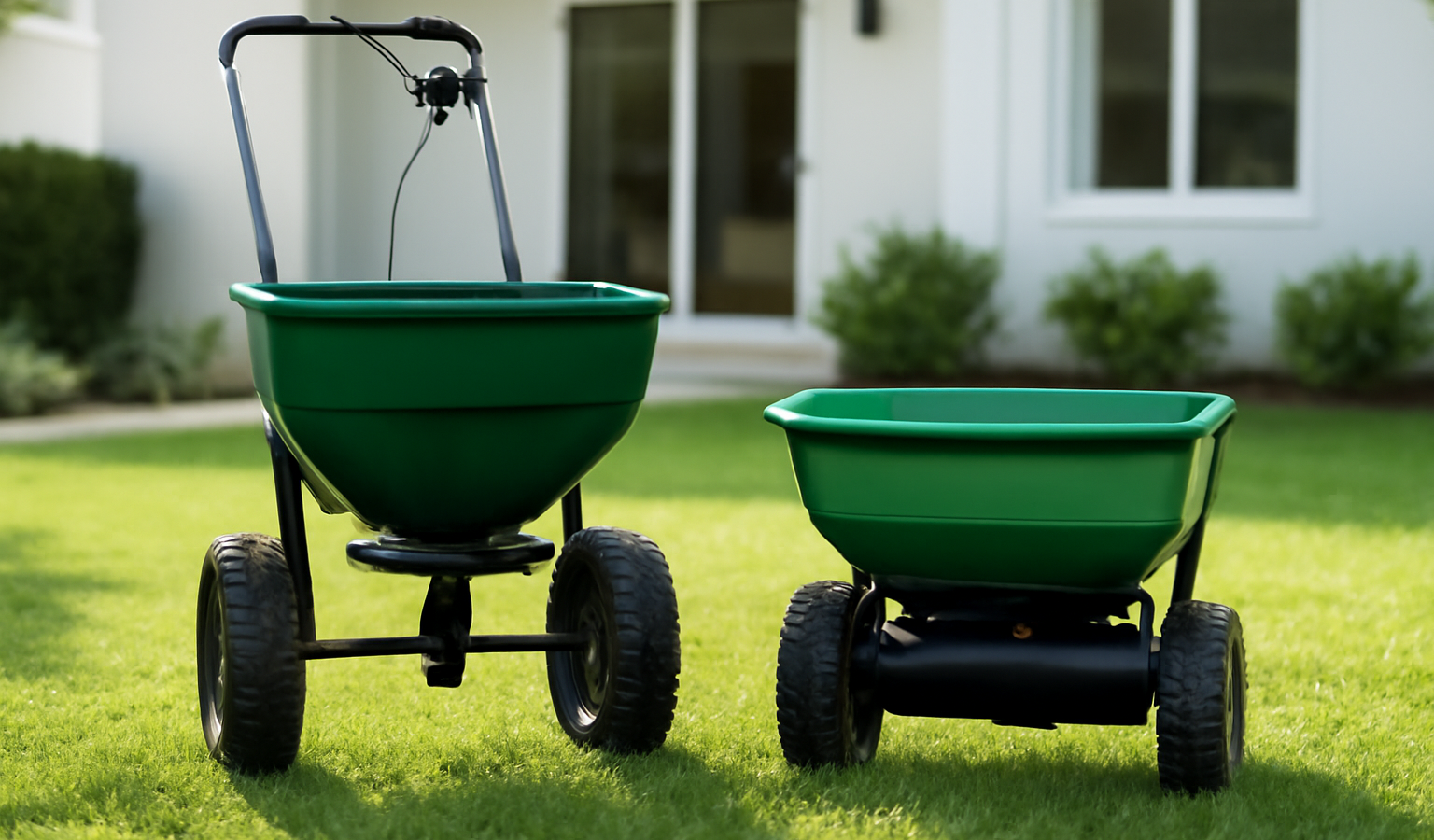
If you’ve stood in the store aisle holding two spreaders and wondering which one your lawn actually needs, here’s the quick version: a broadcast spreader (also called a rotary spreader) flings granules in a wide fan and covers ground fast, while a drop spreader releases product straight down in a precise band exactly as wide as the hopper. Broadcast wins on speed for open lawns; drop wins on precision near beds, walkways, and property lines. Pick wrong and you either spend all afternoon on a tiny yard or end up with fertilizer in your flower beds and striped, uneven turf. The right choice depends mostly on the size and shape of your lawn and the product you’re applying.
In this guide
Key Takeaways
- Broadcast/rotary spreaders throw granules in a wide arc — fast coverage, ideal for large open lawns.
- Drop spreaders drop product straight down in a band — precise, no throw, ideal near beds and edges.
- Broadcast covers two to four times faster but can fling product into beds and requires overlapping passes.
- Drop spreaders demand careful, overlapping passes or you get striping (missed or doubled rows).
- For most suburban lawns under a quarter acre with tidy edges, a broadcast spreader plus careful edge control is the practical pick.
Quick comparison at a glance
| Feature | Broadcast (Rotary) | Drop |
|---|---|---|
| Spread pattern | Wide fan, 6–12+ ft per pass | Narrow band = hopper width (~22 in) |
| Speed / coverage | Fast — best for large areas | Slow — many passes needed |
| Precision / edge control | Lower; granules fly into beds | High; product stays in the band |
| Risk of striping | Lower (overlapping fan blends) | Higher (gaps or overlaps show) |
| Best lawn size/shape | Large, open lawns | Small, tight, edge-heavy lawns |
| Product waste | More near edges and obstacles | Less; very controlled |
| Best for | Fertilizer, lime, grass seed, ice melt | Edges, slopes, near water, weed-and-feed |
How a broadcast (rotary) spreader works
A broadcast spreader meters granules onto a spinning disk (the impeller) that flings them outward in a wide fan, typically covering a swath six to twelve feet across or more depending on the unit and the product’s weight. Because it covers so much ground per pass, it’s the efficient choice for big, open lawns — you can fertilize a quarter-acre in minutes rather than the better part of an hour. The spread isn’t perfectly even across the whole fan, though: granules land heaviest near the center and thin out at the edges, which is exactly why you overlap each pass to blend the light edges together into uniform coverage.
That wide throw is also the broadcast spreader’s main drawback. It will fling product several feet to either side, which is great in the open but a problem along driveways, patios, ponds, and flower beds, where you’ll scatter fertilizer or weed killer where it doesn’t belong. Better units include an edge guard or side-shield that blocks the spinner on one side so you can run along a border without throwing product onto pavement or into a bed. Spread rate also varies with your walking speed — walk faster and you apply less per square foot — so consistent pace matters more than with a drop spreader.
Best uses for a broadcast spreader
Large open lawns, overseeding wide areas, applying granular fertilizer and lime over big spaces, and spreading ice melt on long driveways. It’s the workhorse for anyone with real square footage and relatively forgiving edges. Pair it with the edge-guard feature and a tidy mowing strip and it handles most suburban properties well.
How a drop spreader works
A drop spreader has a row of holes along the bottom of the hopper that release granules straight down between the wheels, laying a band of product exactly as wide as the hopper — usually around 18 to 24 inches. Nothing is thrown sideways, so you get precise control: product lands only where the spreader passes, with a sharp edge. That makes it the right tool along flower beds, walkways, patios, and the edge of a pond or stream where you can’t afford to fling fertilizer or herbicide off-target. It’s also more controllable on slopes, where a broadcast spinner can sling product downhill unevenly.
The trade-off is speed and the discipline it demands. Because each pass is so narrow, covering a big lawn takes many passes and a lot of walking. More importantly, drop spreaders are unforgiving about overlap: leave a hair of a gap between passes and you get a pale stripe of unfertilized grass; overlap too much and you get a dark, over-applied stripe — or, with weed-and-feed, a burned line. The fix is to align the wheel tracks of each pass precisely with the edge of the previous band, and many people apply at half rate in two perpendicular directions (a crosshatch) to even out any wheel-track striping.
Best uses for a drop spreader
Small, tightly bordered lawns; precise application next to beds, water features, and hardscape; weed-and-feed where you must keep product off ornamentals; and slopes where controlled placement matters. Many careful lawn owners keep a drop spreader just for edges and obstacles and a broadcast spreader for the open middle.
Calibration and getting even coverage
Whichever you use, calibration is what separates a healthy uniform lawn from a striped, patchy one. Always set the spreader to the rate printed on the product bag — most fertilizer, seed, and weed-control labels list a specific setting number for common spreader brands. If your product doesn’t list a setting, start low; it’s far easier to make a second pass than to fix an over-applied burn. Apply at half the recommended rate and make two passes at right angles (a crosshatch pattern) for the most even result, especially with drop spreaders prone to striping.
Fill the hopper on a tarp or driveway, not over the lawn, so spills don’t burn a spot. Close the hopper gate when you stop walking, turn, or reach the end of a row, so you don’t dump a concentrated pile. Walk at a steady, consistent pace — speed changes the application rate on a broadcast spreader. Sweep stray granules off pavement back onto the lawn or into the bag rather than letting them wash into storm drains, particularly with fertilizer and herbicide products. If you’re applying a granular pre-emergent or weed-and-feed, our guide on pre-emergent vs post-emergent herbicide covers timing, and selective vs non-selective herbicide explains which products are safe over turf.
Which should you choose?
- Large open lawn (quarter acre and up): broadcast spreader — the speed is worth it, and open space forgives the wide throw.
- Small lawn with lots of beds and edges: drop spreader for control, or a broadcast with a reliable edge guard.
- Applying near a pond, stream, or vegetable garden: drop spreader, so you keep product out of water and off food crops.
- Weed-and-feed you must keep off ornamentals: drop spreader for precise placement around beds.
- Overseeding a big bare area fast: broadcast spreader for quick, blended coverage.
- You only own one and want maximum versatility: a broadcast spreader with an edge guard handles the widest range of lawns and products.
For the average suburban yard, a broadcast spreader with an edge-guard feature is the most practical single choice — it’s fast, and the edge guard tames its main weakness near beds and pavement. Step up to a drop spreader (or own both) when your lawn is small, slope-heavy, or laced with beds and water where precision beats speed. For more lawn-care project planning, browse our outdoor living guides.
Frequently Asked Questions
Can I use one spreader for fertilizer, seed, and ice melt?
Yes — both types handle most dry granular products, but the correct setting differs for each because granule size and weight vary. Always look up or recalibrate the setting for the specific product, and rinse and dry the spreader after corrosive products like ice melt or fertilizer to prevent rust and clogging.
Why is my lawn striped after fertilizing?
Striping almost always comes from a drop spreader with gaps or overlaps between passes, or from a broadcast spreader without enough overlap. Apply at half rate in two perpendicular directions to blend the pattern, and align each pass carefully with the previous one.
How much should I overlap each pass?
With a broadcast spreader, overlap so the thin outer edge of one fan reaches the wheel track of the previous pass — the spread chart for your model shows the effective width. With a drop spreader, line up the wheel exactly on the edge of the previous band with no gap.
Which spreader is better on a slope?
A drop spreader gives more control on slopes because it places product straight down; a broadcast spinner can sling granules downhill and apply unevenly. If you only have a broadcast spreader, slow down and work across the slope rather than up and down.
What setting should I use if my product doesn’t list one?
Start at a low setting and make a test pass over a measured area, weigh how much product you used, and adjust. It’s always safer to under-apply and make a second pass than to over-apply, which can burn the lawn — especially with fertilizer and weed-and-feed.