

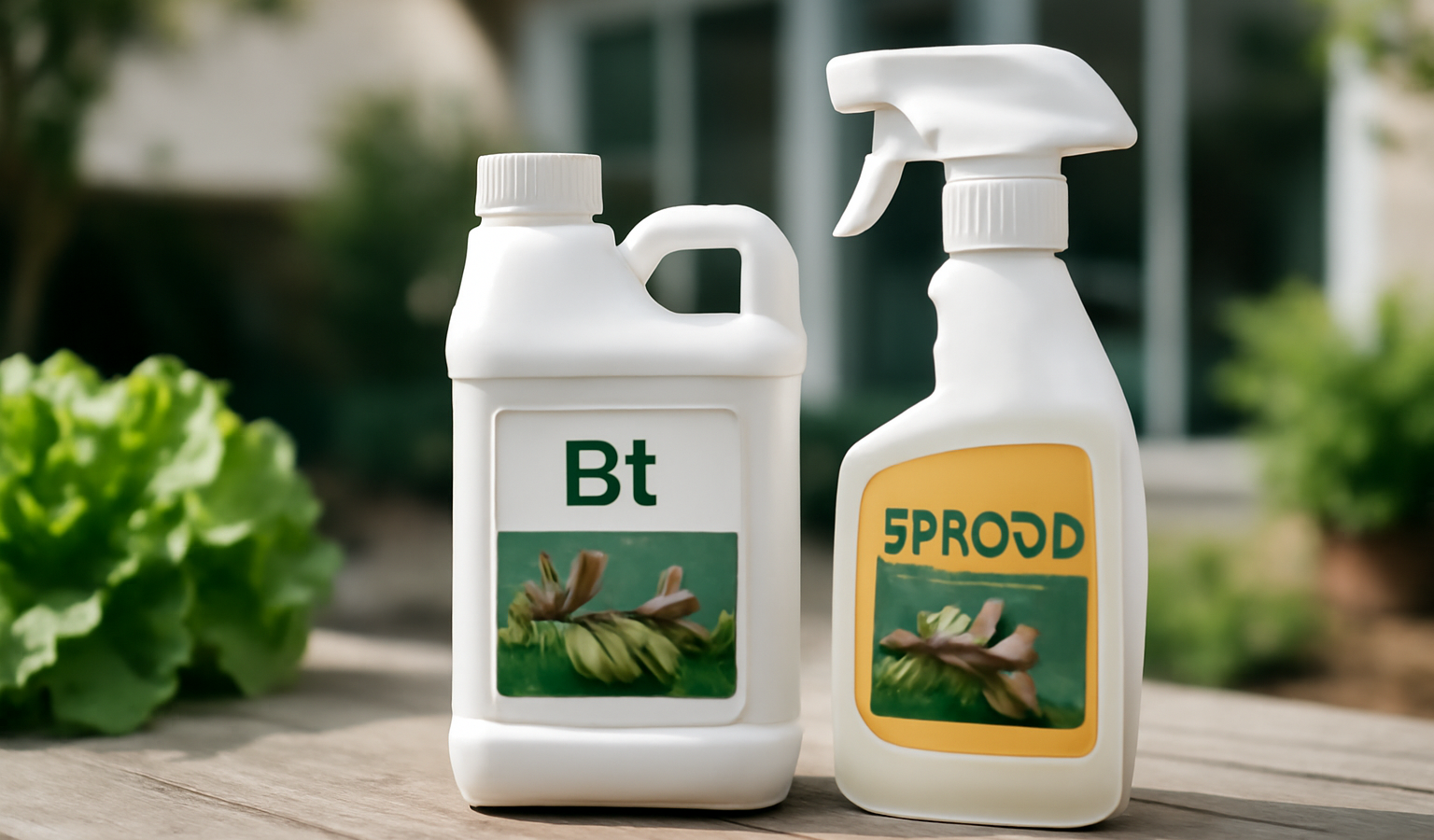
When caterpillars are shredding your kale or hornworms are stripping your tomatoes, two organic-approved sprays come up again and again: Bt (Bacillus thuringiensis) and spinosad. Both are derived from soil microbes, both are listed for organic gardening, and both kill caterpillars effectively. But they are not interchangeable. Bt is narrowly targeted at caterpillars and a few specific larvae and is exceptionally gentle on everything else. Spinosad kills a much broader range of pests — caterpillars, thrips, leaf miners, beetles, fire ants — but that wider reach comes with real risk to bees if you spray carelessly. This guide explains how each one works, what it controls, and exactly when to reach for one over the other.
Key Takeaways
- Bt is a bacterial protein that must be eaten to work; it only kills the larvae of specific insect groups, with the common garden strain (kurstaki) targeting caterpillars.
- Spinosad is a broader-spectrum microbial toxin that attacks the nervous system of caterpillars, thrips, leaf miners, beetles, fire ants and more.
- Bt is the safest choice around bees and beneficials; spinosad can kill bees while the spray is wet, so spray at dusk.
- Both break down quickly in sunlight and leave no lasting residue, and both are OMRI-listed for organic use.
- Reach for Bt for a caterpillar-only problem; reach for spinosad when you face thrips, beetles, or mixed pests Bt won’t touch.
| Factor | Bt (kurstaki) | Spinosad |
|---|---|---|
| Source | Bacterium Bacillus thuringiensis | Fermentation of Saccharopolyspora spinosa |
| Mode of action | Gut toxin — must be eaten | Nervous-system toxin — eaten or contacted |
| Pests controlled | Caterpillars (kurstaki); mosquito/fungus-gnat larvae (israelensis); some beetle larvae (galleriae/tenebrionis) | Caterpillars, thrips, leaf miners, spotted-wing drosophila, Colorado potato beetle, fire ants, some borers |
| Speed | Pest stops feeding in hours, dies in 1–3 days | Pest stops feeding fast, dies in 1–2 days |
| Bee safety | Very safe to bees | Toxic to bees while wet; safe once dry |
| Residual | 1–7 days; UV-degraded | Up to ~1–2 weeks; longer residual |
| Resistance risk | Low–moderate | Moderate — rotate to avoid |
Bt: How It Works
Bacillus thuringiensis is a naturally occurring soil bacterium that produces crystalline protein toxins (called Cry proteins) during sporulation. When a target larva eats sprayed foliage, those crystals dissolve in the insect’s alkaline gut and bind to specific receptors in the gut lining. The toxin punches pores in the gut wall, the gut contents leak into the body cavity, the insect stops feeding almost immediately, and it dies within one to three days from a combination of starvation and septicemia. The key word is specific: the receptors that the toxin binds to exist only in certain insect groups, which is why Bt is so selective.
Different strains target different pests. Bt kurstaki (Btk) is the one most gardeners buy — it kills caterpillars: cabbage worms, hornworms, loopers, tomato fruitworm, gypsy moth, tent caterpillars and more. Bt israelensis (Bti) targets mosquito, black fly and fungus-gnat larvae and is sold as mosquito dunks. Bt galleriae and Bt tenebrionis (san diego) target certain beetle larvae. Make sure you buy the strain that matches your pest — Btk will do nothing to a beetle.
Application and limits
Because Bt must be eaten, thorough coverage of the leaves the caterpillars are chewing is essential, including leaf undersides. It works best on young, actively feeding larvae; large caterpillars near the end of their cycle are harder to kill. Bt degrades in sunlight within a few days, so reapply after rain and roughly every five to seven days while pressure is high. It has no contact activity, so a caterpillar that is not currently eating will not be affected. Safety: Bt is considered among the safest pesticides available — non-toxic to humans, pets, birds, fish, earthworms and adult bees. You can harvest the same day after the spray dries (observe any label-specific interval).
Spinosad: How It Works
Spinosad is made from spinosyns, compounds produced by fermenting the soil actinomycete Saccharopolyspora spinosa, originally discovered in a Caribbean rum distillery. It attacks the insect nervous system, binding to nicotinic acetylcholine receptors and GABA receptors in a way that causes continuous nerve firing, involuntary muscle contractions, paralysis and death. Insects stop feeding quickly and die within one to two days. Unlike Bt, spinosad works both when eaten and on contact, though ingestion is more lethal — so coverage still matters.
The big difference is breadth. Spinosad controls caterpillars like Bt does, but it also kills thrips, leaf miners, spotted-wing drosophila (a major fruit pest), Colorado potato beetle larvae, fire ants, sawflies and some borers. That makes it the more versatile single product when you face multiple pests or a pest Bt cannot touch. For a pest like thrips that hides in flowers and buds, spinosad is often the go-to organic option.
Bee safety is the catch
Spinosad is highly toxic to bees while the spray is still wet. Once it dries — usually within about three hours — the residue is far less hazardous and considered relatively safe to foraging bees. The practical rule is to spray at dusk or after bees have stopped foraging, never on open blooms during the day, and let it dry overnight. This single precaution is the most important difference in how you handle spinosad versus Bt. It also has somewhat longer residual activity (up to one to two weeks), which means more lasting control but also more reason to time applications carefully. Because pests can develop resistance to spinosad, rotate it with other modes of action and don’t rely on it exclusively.
Safety: spinosad has low toxicity to mammals, birds and adults of many beneficial insects once dry, but it is harmful to bees when wet and toxic to aquatic invertebrates — keep it out of ponds and waterways. Observe the label’s pre-harvest interval, typically one to three days.
Head-to-Head: Spectrum, Safety and Speed
The decision usually comes down to two questions: what pest do you have, and how worried are you about bees? If your only problem is caterpillars on leafy crops, Bt is the better-targeted, gentler choice — it leaves predatory insects, parasitic wasps, ladybugs and bees completely alone, which protects the natural enemies that keep future outbreaks down. Encouraging those predators is a smart long-term strategy; see our guide on how to attract beneficial insects.
If you are dealing with thrips, leaf miners, beetle larvae, fruit flies, or a confusing mix of damage, spinosad earns its place because Bt simply will not control those pests. The trade-off is that spinosad’s broader toxicity means you must protect pollinators by spraying in the evening. Both products break down quickly in sunlight and leave no persistent residue, and both are approved for organic production — so the choice is about targeting and timing, not about one being “more natural” than the other.
One more practical point: Bt is cheap and shelf-stable in its concentrate form, and a caterpillar-specific approach pairs well with hand-picking and floating row covers. Spinosad is the more powerful single tool but should be rotated with other controls to slow resistance. Pollinator-friendly gardens benefit from thoughtful pesticide use overall; if you grow to feed bees and butterflies, see our notes on how to attract pollinators to your garden before reaching for any spray.
Verdict by Scenario
Cabbage worms, hornworms or loopers on vegetables: Choose Bt (kurstaki). It’s the most targeted, bee-safe option for a caterpillar-only problem and spares your beneficial insects.
Thrips, leaf miners, or spotted-wing drosophila: Choose spinosad. Bt has no effect on these pests; spinosad is one of the few effective organic options.
Colorado potato beetle or fire ants: Choose spinosad. Standard Btk won’t touch beetles or ants; spinosad controls both.
You’re spraying near blooming plants and active bees: Choose Bt if the pest allows it. If you must use spinosad, apply only at dusk so it dries before bees forage.
Mixed pest pressure on a single crop: Spinosad gives you broader coverage in one application, but rotate it with other controls and protect pollinators by timing carefully.
For most kitchen gardeners, the ideal toolkit holds both: Bt as the everyday, low-impact caterpillar control, and spinosad on the shelf for the harder, broader problems Bt can’t solve. Match the strain to the pest, spray for full coverage of leaf undersides, reapply after rain, and you’ll keep most outbreaks in check without resorting to harsher chemistry.
How to Apply Both for Best Results
Both products live or die by coverage and timing, so a little technique goes a long way. Mix only as much as you’ll use in one session, since neither holds up well sitting diluted in a sprayer overnight, and shake the tank frequently to keep the formulation suspended. Spray to the point of runoff on both the tops and undersides of leaves, working into the leaf axils and growing tips where small caterpillars and thrips hide. With Bt especially, every bit of leaf surface a larva might chew should carry the spray, because anything the pest doesn’t eat does nothing.
Scout your plants regularly rather than spraying on a fixed calendar. Flip leaves and look for the first chewed holes, frass (dark caterpillar droppings), or the fine stippling and silvering that signal thrips. Catching pests young matters because both products work far better on small, early-instar larvae than on big caterpillars near pupation. When you do find a problem, treat at the first sign, then reapply every five to seven days while pressure continues and after any rain that washes the spray off, since neither product is rain-fast or long-lived in sunlight.
A note on resistance: pests adapt to anything used repeatedly, and spinosad in particular has documented cases of resistance where it’s been over-relied upon. Rotate it with Bt and with non-chemical tactics — hand-picking, row covers, and encouraging predators — so no single mode of action carries the whole load. This rotation keeps both products effective for years and reduces how often you need to spray at all.
What Neither Product Will Do
It helps to know the limits before you’re disappointed. Neither Bt nor spinosad controls sap-sucking pests like aphids, scale, or true bugs — for those you’d reach for insecticidal soap, horticultural oil, or predators. Standard Btk does nothing to beetles, slugs, or spider mites, and even spinosad, broad as it is, won’t touch aphids or mites. Both are also surface treatments with little systemic movement, so pests boring inside stems or fruit, or feeding on roots underground, are largely out of reach. Recognizing what you’re actually fighting — chewing caterpillar versus sucking insect versus soil grub — is the first step, because the right diagnosis points you to the right tool and saves you from spraying something that was never going to work.
Frequently Asked Questions
Is Bt or spinosad safer for bees?
Bt is far safer — it does not harm adult bees at all. Spinosad is toxic to bees while the spray is wet but becomes relatively safe once dry, usually within about three hours. If you must use spinosad near pollinators, spray at dusk so it dries overnight.
Can I use Bt and spinosad together?
You generally wouldn’t need to, since spinosad already controls caterpillars. For resistance management, it’s better to rotate between them and other modes of action rather than mix them. Use Bt for caterpillar-only jobs and save spinosad for pests Bt can’t control.
Why didn’t Bt kill my caterpillars?
Common reasons: the caterpillars weren’t actively feeding on sprayed leaves (Bt must be eaten), the larvae were too large, sunlight degraded the spray before they ate it, or you used the wrong strain. Spray thoroughly including leaf undersides, target young larvae, and reapply every 5–7 days.
Does spinosad work on contact or only when eaten?
Both, though it is more lethal when ingested. This gives spinosad an edge over Bt for pests that aren’t chewing leaves, like thrips. Still aim for thorough coverage to maximize the chance the pest contacts and consumes it.
Are Bt and spinosad allowed in organic gardening?
Yes, both are commonly OMRI-listed for organic production. They are derived from soil microbes, break down quickly in sunlight, and leave no persistent residue. Always check that the specific product you buy carries organic certification if that matters to you, and follow the label’s pre-harvest interval.