

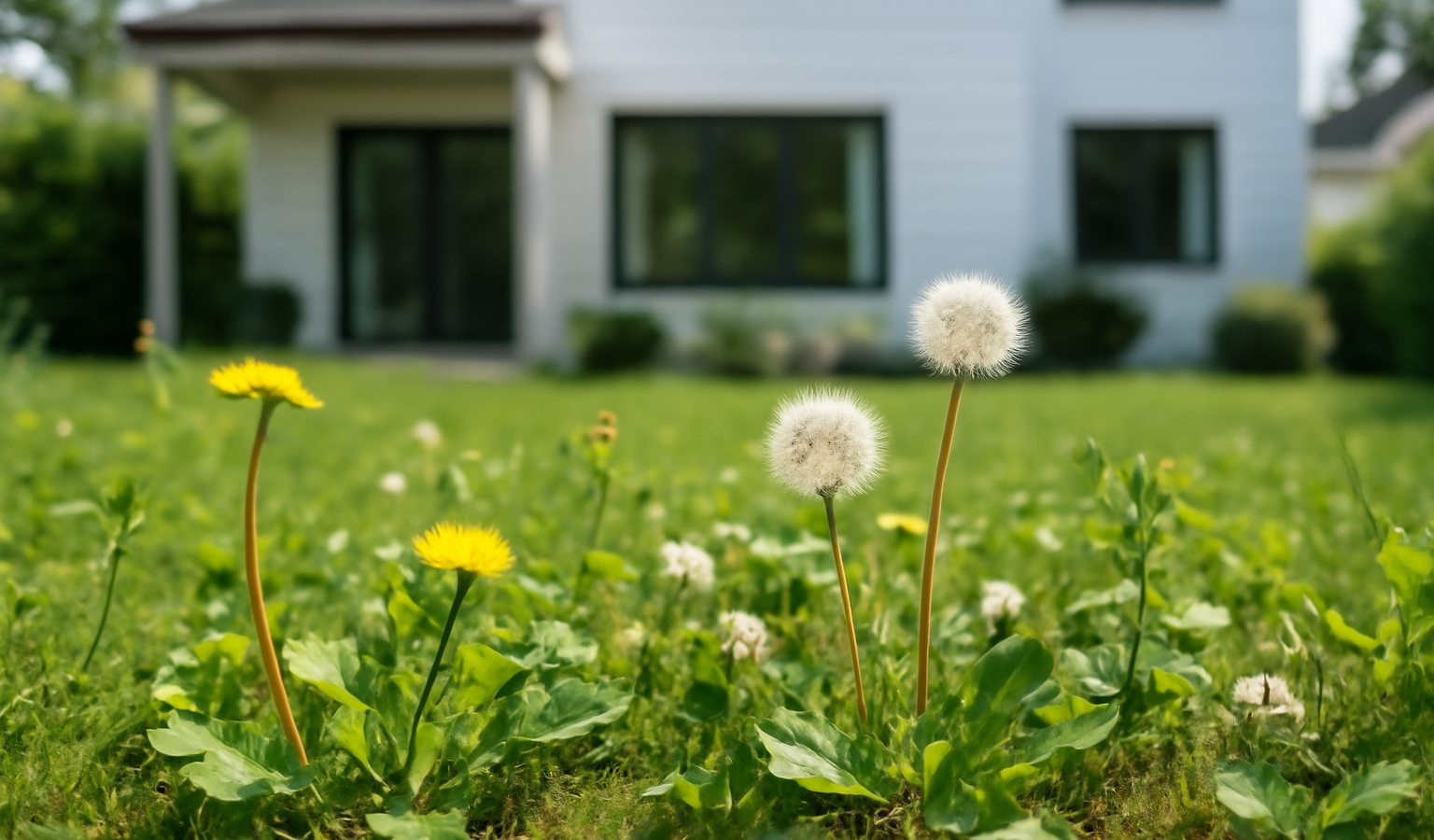
A lawn full of weeds is rarely a weed problem. It is a turf problem. Crabgrass, dandelions, clover, and nutsedge do not muscle out a thick, healthy stand of grass. They move into the gaps the grass leaves open: thin patches, scalped crowns, compacted ground, bare spots, and underfed soil. Spray every weed you see and you will be spraying again next year, because nothing has changed about why the weeds got in. The fix is to figure out which of the five common causes is opening the door, close that door, and let dense grass do the long-term weed control for you. This guide walks through each cause, how to tell if it is yours, and what to do about it with specific heights, rates, and timing.
Key Takeaways
- Weeds are a symptom of thin turf; the cure is density, not just herbicide.
- Mow tall (3 to 4 inches for cool-season grass) and never remove more than one-third of the blade at once.
- Overseed thin areas at 4 to 8 pounds per 1,000 square feet to crowd weeds out.
- Pre-emergent stops crabgrass before it sprouts (soil 55 degrees F); post-emergent and broadleaf products handle weeds already up.
- Compacted, low-fertility soil favors weeds, so aerate, test pH (aim 6.0 to 7.0), and feed on a real schedule.
Cause 1: Thin or Sparse Turf Letting Weeds In
This is the root cause behind most weedy lawns. Grass and weeds compete for the same sunlight, water, and root space. When the grass stand is thin enough that sunlight reaches bare soil between the plants, weed seeds, which are already sitting in your soil by the thousands, germinate. A dense lawn shades the soil surface and starves those seeds of the light they need to sprout. Thin turf is the opening; everything else on this list is usually a reason the turf got thin.
How to diagnose it
Look straight down at the lawn from standing height. If you can see soil between the grass plants, the stand is too thin. A healthy cool-season lawn has roughly 6 or more grass plants per square inch; a struggling one might have 2 or 3. Get down on your knees and part the grass with your fingers. Bare soil showing through, or daylight reaching the ground, tells you weeds have an open lane. Where you see broadleaf weeds like dandelion and clover spreading flat and wide, they are reaching for the light the grass is failing to capture. Thin turf along driveways, under trees, and on slopes is the usual pattern.
How to fix it
Overseed. This is the single most effective weed control most lawns never get. Mow at your lowest reasonable setting once, rake out dead thatch and debris to expose soil, and spread quality seed at 4 to 8 pounds per 1,000 square feet for new or heavily thinned areas, or 2 to 4 pounds for a light over-the-top reseed. Cool-season grasses (Kentucky bluegrass, tall fescue, perennial ryegrass) seed best in late summer to early fall, roughly mid-August through September, when soil is warm but air is cooling and weed pressure is dropping. Warm-season grasses (bermuda, zoysia) establish best in late spring. Keep the seedbed consistently moist with light daily watering until germination, then taper to deeper, less frequent watering. One important catch: most pre-emergent herbicides also stop grass seed from germinating, so do not put down a crabgrass pre-emergent within about 8 to 12 weeks of seeding (siduron-based products are the exception). Get the timing right and dense new grass does the heavy lifting against weeds for years.
Cause 2: Mowing Too Low or Scalping
Cutting the lawn short feels efficient because you mow less often, but it is one of the fastest ways to invite weeds. Short grass has short roots, exposes more soil to sunlight, dries out faster, and recovers slowly from any stress. Crabgrass in particular thrives in low-cut, sun-baked turf, which is exactly why it shows up first along sidewalks and curbs where people scalp the edges. Scalping, removing too much blade in a single pass, shocks the plant and can leave brown crowns that take weeks to recover, and weeds fill those weeks.
How to diagnose it
Check your mower deck height with a ruler on a hard surface; many people run theirs at 1.5 to 2 inches without realizing it. If the lawn looks pale, brown, or stubbly right after mowing, you are cutting too low. Look for crabgrass concentrated in the most closely cut zones, near edges and high-traffic strips. Another tell: you mow, and a few days later the lawn looks ragged and thin rather than lush. If you are removing far more than a third of the blade height each time, that is scalping, and the visible stress confirms it.
How to fix it
Raise the deck. For cool-season grasses, mow at 3 to 4 inches, leaning toward the taller end in summer heat. Tall fescue is happiest around 3.5 to 4 inches. Warm-season grasses go shorter: bermuda at 1 to 2 inches, zoysia at 1 to 2.5 inches, St. Augustine at 2.5 to 4 inches. Follow the one-third rule: never cut off more than one-third of the blade length in one mowing, which usually means mowing every 5 to 7 days in peak growth rather than waiting two weeks and hacking it down. Keep the mower blade sharp; a dull blade tears grass, leaving frayed brown tips that stress the plant and open the door to disease and weeds. Leave the clippings on the lawn to recycle nitrogen. Taller grass shades out germinating weed seeds, so this one change alone noticeably reduces weed pressure over a season.
Cause 3: Soil Compaction
Compacted soil is squeezed so tight that air, water, and roots cannot move through it. Grass roots need oxygen and pore space; when the soil is packed, roots stay shallow and weak, and the turf thins. Many weeds, on the other hand, are perfectly adapted to compacted ground. Prostrate knotweed, plantain, and annual bluegrass actually prefer it, which is why you see them thriving on footpaths, near play areas, and along driveways where the soil gets pounded down.
How to diagnose it
Do the screwdriver test. After a normal watering or a day after rain, push a long screwdriver or a pencil into the soil. In healthy soil it slides in 6 inches with light pressure; in compacted soil it stops short or needs real force. Watch where water goes after irrigation or rain: if it puddles or runs off instead of soaking in, the soil is compacted. High-traffic lanes, areas over buried construction debris, and heavy clay soils are the usual suspects. The presence of plantain and knotweed clustered in walked-on areas is a strong visual signal that compaction is your problem.
How to fix it
Core aerate. Use a core aerator (rent one or hire it out) that pulls finger-sized plugs of soil out of the ground rather than a spike machine that just punches holes and compacts the walls. Aim for plugs every few inches across the lawn; one pass in two directions on badly compacted ground. Leave the cores on the surface to break down. Aerate cool-season lawns in early fall and warm-season lawns in late spring, while the grass is actively growing so it can heal the holes. Aeration is the perfect partner to overseeding, so do both in the same session: aerate, then spread seed, and many seeds drop into the holes for excellent soil contact. For more on building healthy, productive ground, the outdoor living and lawn care hub covers soil work that pays off across the whole yard. Top-dressing with a quarter inch of compost after aeration improves structure over time and gives heavy clay a fighting chance.
Cause 4: Bare Spots From Damage
Any patch of open soil is a weed nursery. Bare spots come from a long list of causes: pet urine, grub damage, fungal disease, drought scorch, spilled gasoline or fertilizer burn, dragged furniture, dog paths, and heavy shade where grass simply will not hold. Wherever grass dies and the soil sits open, weed seeds, which travel on wind, water, mowers, and shoes, land and germinate fast. Crabgrass and dandelions are especially quick to claim a fresh bare patch.
How to diagnose it
Walk the lawn and map the bare areas, then ask what caused each one, because the cause tells you whether the spot will keep returning. Round dead patches with a yellow halo often mean dog urine. Spots where the turf peels back like a loose carpet point to grubs feeding on the roots underneath; tug a handful of dead grass, and if it lifts with no resistance and you find white C-shaped larvae, grubs are the culprit. Worn linear tracks are foot or pet traffic. Bare ground under trees is usually too much shade. If the bare spot is recurring in the same place, the underlying cause is still active and must be addressed before reseeding.
How to fix it
Fix the cause first, then patch. For grubs, treat with an appropriate grub control product at the right time of year (preventive in early summer, curative in late summer when larvae are active). For pet spots, flush the area with water and reseed once the salts have leached out. To patch, scratch up the bare soil to about a half inch deep, rake in fresh seed at roughly 4 to 6 pounds per 1,000 square feet (or use a quality seed-and-mulch patch product), press it into firm contact, and keep it damp until it fills in. For deep shade where grass keeps failing, stop fighting it: switch to a shade-tolerant fescue blend, thin the tree canopy to let in more light, or convert the area to mulch, groundcover, or a shade bed. Some of the shade-tolerant plants and groundcovers make a far better long-term solution for a spot grass will never want. The goal is simple: get something growing in that bare soil so weeds cannot.
Cause 5: Poor Fertility and Under-Feeding
Grass is a hungry plant. Starve it and it grows slowly, thins out, loses color, and cannot outcompete weeds. Many weeds are far less demanding and will dominate underfed soil. Clover is the classic example: it fixes its own nitrogen from the air, so in a low-nitrogen lawn clover has a built-in advantage and spreads while the grass languishes. A lawn that is yellow-green, slow to grow, and steadily losing ground to clover and other weeds is almost always underfed, growing in the wrong soil pH, or both.
How to diagnose it
Honestly count how many times you fed the lawn last year. If the answer is zero or once, under-feeding is likely. Pale, yellow-green color and sluggish growth even with adequate water point to a nitrogen shortage. Lots of clover is a near-certain sign of low nitrogen. The definitive test is a soil test: pick up an inexpensive kit or send a sample to your county extension office. It tells you pH and nutrient levels for real instead of guessing. Most turfgrasses want a soil pH of 6.0 to 7.0; outside that range, nutrients get locked up and the grass cannot use them even if they are present. Acidic soil below 6.0 also tends to favor moss and certain weeds.
How to fix it
Feed on a schedule. A typical cool-season lawn wants about 2 to 4 pounds of nitrogen per 1,000 square feet per year, split across the season, with the most important feeding in early-to-mid fall. A practical program is a light spring feeding, a summer application only if the grass needs it, and a strong fall feeding to build roots and density going into winter. Use a slow-release fertilizer so the nitrogen feeds steadily rather than spiking. Correct pH based on your soil test: apply lime to raise a low pH, or elemental sulfur to lower a high one, knowing pH shifts take months. A well-fed lawn grows thick and dense, and density is what crowds out clover and every other weed for good.
How to Prevent a Weedy Lawn Going Forward
Prevention is a rhythm, not a one-time rescue. The whole strategy is to keep the turf so thick that weeds never find an opening, and to catch the few that try with the right product at the right time. Build these habits into the year.
Apply pre-emergent at the right moment. Pre-emergent herbicide creates a barrier that stops weed seeds, especially crabgrass, from establishing. It only works before the seeds germinate, so timing is everything: put it down in spring when soil temperatures reach about 55 degrees F (a common cue is when forsythia and lilac bloom, or before soil hits 55 for several days). A second pre-emergent application in late summer heads off fall-germinating weeds like annual bluegrass. Remember the seeding conflict: do not use standard pre-emergent if you plan to overseed within a couple of months.
Use the right post-emergent for the weed. For weeds already growing, match the product to the type. Broadleaf weeds (dandelion, clover, plantain, chickweed) are controlled by selective broadleaf herbicides, often a 2,4-D or three-way blend, that kill the weed without harming the grass. Grassy weeds like crabgrass need a different chemistry; mature crabgrass takes a specific grassy-weed post-emergent. Nutsedge, which is neither a true broadleaf nor a typical grass, is a sedge and needs a dedicated sedge product (such as halosulfuron) because broadleaf herbicides barely touch it. Spot-treat rather than blanket-spray, and apply when weeds are young and actively growing for the best kill. Always follow the label rate.
Lock in the cultural basics. Mow tall and frequently with a sharp blade, water deeply and infrequently (about 1 to 1.5 inches per week including rain, in one or two soakings rather than daily sprinkles) to drive roots down, aerate compacted areas every year or two, overseed thin spots each fall, feed on schedule, and keep your soil pH in the 6.0 to 7.0 range. None of these is dramatic, but together they produce the dense, deep-rooted turf that is the only permanent answer to a lawn full of weeds. The outdoor living lawn care resources tie these seasonal tasks into a calendar you can actually keep. Win the density battle and the weed battle takes care of itself.
Frequently Asked Questions
Should I kill the weeds first or fix the lawn first?
Do both, in order. Knock down the worst existing weeds with the right post-emergent so they stop seeding, then immediately address the underlying cause (thin turf, compaction, low fertility) and overseed. Killing weeds without fixing the bare soil just opens the door for the next batch.
Can I overseed and apply pre-emergent at the same time?
No, with one exception. Standard pre-emergent herbicides stop grass seed from germinating just like weed seed, so they cancel out your overseeding. Wait 8 to 12 weeks after seeding before applying pre-emergent. Siduron-based products are formulated to let desired grass seed through and are the exception.
Why does crabgrass keep coming back every summer?
Crabgrass is an annual that drops thousands of seeds before it dies in fall, reseeding next year. It thrives in thin, low-mowed, sun-exposed turf. Break the cycle by applying pre-emergent in spring at 55 degree F soil temperature, mowing taller to shade the soil, and thickening the lawn through overseeding.
How do I get rid of nutsedge?
Nutsedge is a sedge, not a grass or broadleaf, so ordinary weed killers barely affect it. It spreads by underground tubers, and pulling it usually leaves tubers behind to resprout. Use a dedicated sedge herbicide such as halosulfuron, and improve drainage since nutsedge loves wet, poorly draining soil.
Is clover in my lawn actually a problem?
Not necessarily. Clover fixes nitrogen, stays green in drought, and supports pollinators, and some homeowners welcome it. But heavy clover is also a signal that your grass is underfed on nitrogen. If you want a pure grass lawn, feed it properly and the grass will outcompete the clover; if you do not mind it, leave it.