

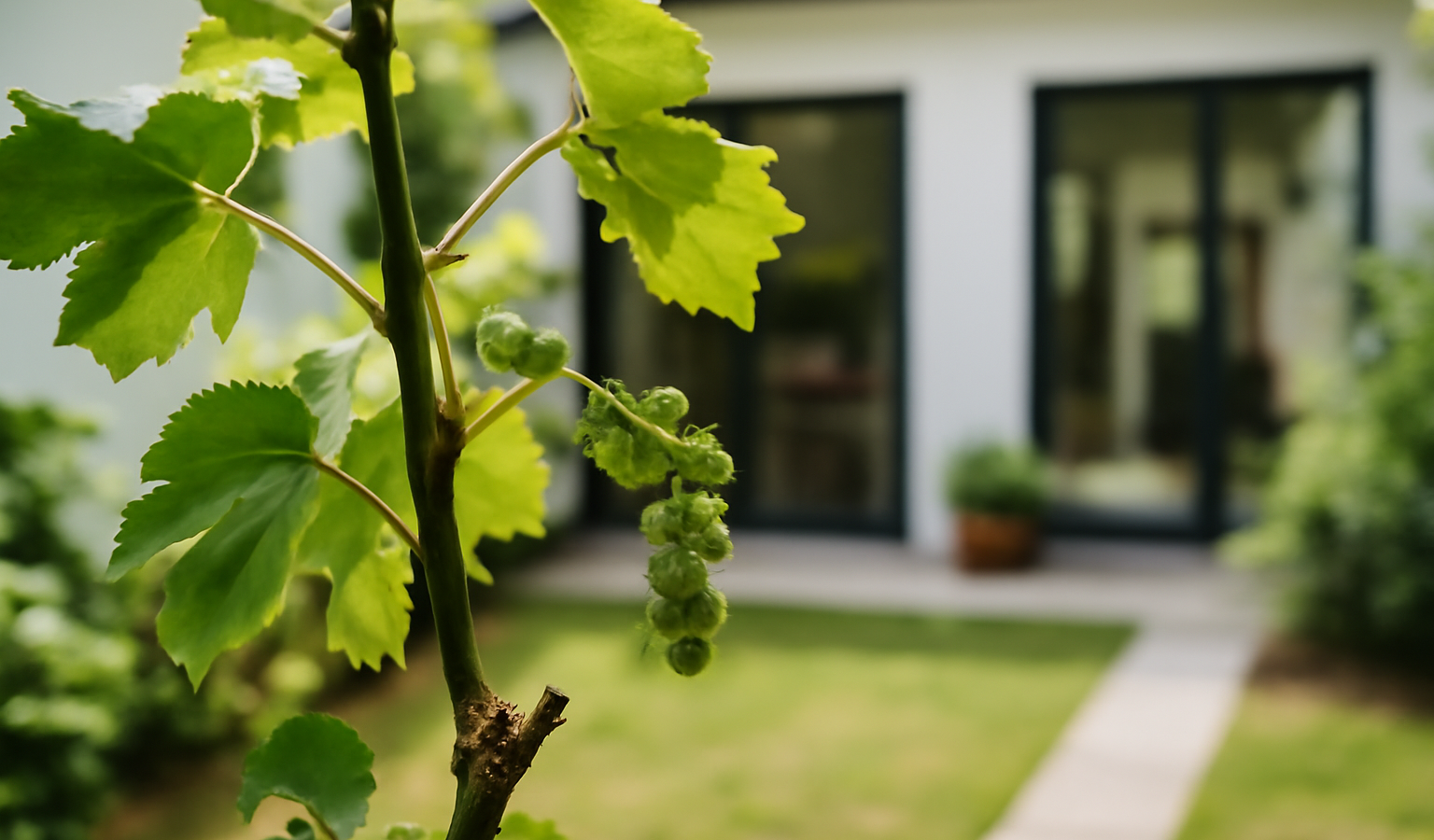
A grapevine that grows like a green fountain every summer yet never hands you a single cluster is one of the most common frustrations in the home vineyard. The vine itself is usually perfectly healthy. The problem is almost always cultural, and in the great majority of cases it traces back to one thing: pruning, or rather the lack of it. Grapes are unusual among fruit crops because they bear on shoots that emerge from one-year-old wood, which means the way you cut the vine each winter directly determines how much fruit it sets the following season. Get that wrong and you can have a vine the size of a garage that produces nothing but leaves.
That said, pruning is not the only culprit. A vine that is simply too young will not crop no matter how skillfully you cut it. A vine buried in shade cannot form fruitful buds. A vine drowning in nitrogen and water will pour all its energy into vegetative growth at the expense of flowers. And even a well-managed vine can lose a crop to a hard spring frost or a cold, wet bloom. This guide walks through each cause in the order you should suspect them, with a way to diagnose the problem and a concrete fix for each. Work through them top to bottom and you will almost certainly find the reason your grapevine is not producing grapes.
Key Takeaways
- Grapes fruit on shoots growing from one-year-old wood, so heavy annual dormant pruning, removing roughly 90 percent of last season’s growth, is essential for a crop.
- An unpruned or lightly pruned vine produces masses of foliage and very few grapes; the cure is harder cutting, not feeding.
- Young vines need about three years to carry their first real crop; spend the first one to two seasons building a strong trunk and cordons.
- Grapevines demand full sun, seven to eight hours, and open canopy management so buds receive light and become fruitful for next year.
- Excess nitrogen and overwatering drive rampant leafy growth at the expense of fruit; aim for moderate, controlled vigor.
- Spring frost, cold wet weather at bloom, and overcropping in alternate years can all wipe out an otherwise reliable crop.
Improper or Insufficient Pruning: The Number One Cause
If you remember nothing else from this article, remember this: grapevines must be pruned hard every single winter, and most home gardeners do not cut anywhere near enough. The single most common reason a mature vine refuses to fruit is timid pruning. People look at a vine covered in healthy canes and cannot bring themselves to remove most of it, so they tip back a few stems and call it done. The result is a tangle that gets denser and shadier every year and crops less and less.
The biology behind this is straightforward once you understand it. A grapevine produces its fruit on green shoots that grow in the current season, and those shoots emerge from buds that were laid down on wood that grew the previous year, the so-called one-year-old wood. Wood that is two years old or older will not produce fruiting shoots. So every season you need a fresh supply of one-year-old canes positioned where you want fruit, and you need to ruthlessly remove everything else. In practice that means cutting away roughly 90 percent of the previous year’s growth during the dormant season. It feels brutal the first time. Do it anyway.
How to diagnose a pruning problem
Look at the vine in late winter before it leafs out. If it is a thick mass of old, gnarled wood with a confusing snarl of canes and you cannot trace a clear trunk and a few defined arms, the vine is under-pruned. Another tell: in summer the vine is enormously leafy, the interior is dark and humid, and what few flower clusters appear are buried deep in shade and drop without setting. If you pruned last winter but only shortened the canes rather than removing whole ones, that is insufficient pruning. A vine that has never been pruned at all, common with ornamental arbor vines, will almost always be the leafy, fruitless kind.
How to fix it
Prune during full dormancy, typically late winter, roughly February into early March in most temperate USDA zones 5 through 8, after the hardest cold has passed but before the buds swell. Pruning then minimizes the risk of winter injury to the cuts and lets you see the bud structure clearly. Some bleeding of sap from the cuts is normal and harmless if you prune a touch later as the vine wakes.
You have two systems to choose from. With cane pruning, you keep one or two long one-year-old canes on each side of the trunk, each typically retaining around 8 to 15 buds, and you also leave a short renewal spur of two buds near the trunk to grow next year’s replacement canes. This suits varieties whose lowest buds are not very fruitful, including many American and hybrid grapes such as Concord. With spur pruning, you maintain permanent horizontal arms called cordons and cut the canes along them back to short spurs of two buds each, spaced about a hand’s width apart. This suits many vinifera wine grapes. Either way the principle is the same: leave only a defined, limited number of buds on young wood and remove everything else, including all wood older than one year that is not part of the permanent trunk or cordon. A mature vine on a backyard trellis might be cut back to fewer than 50 buds total. Sharp, clean tools make this far easier and reduce disease entry; it is worth learning how to sharpen garden tools before you start a winter pruning session.
The Vine Is Too Young to Fruit
Patience is part of growing grapes. A newly planted vine simply does not have the root system or the permanent framework to carry fruit, and forcing it to try will set the plant back for years. Many gardeners panic in year two when nothing appears, when in fact the vine is doing exactly what it should: building structure.
As a rule, expect about three years from planting before you take a meaningful crop. The first growing season is devoted entirely to root establishment and growing a single strong shoot up to form the trunk. The second season is for extending that trunk to the top wire and beginning to lay down the cordons or selecting the canes that will become the fruiting arms. Only in the third year, with a sound trunk and established arms in place, should you allow the vine to set a real crop.
How to diagnose age-related failure
This one is simple arithmetic. If you planted the vine one or two seasons ago, it is too young, full stop. A vigorous young vine may even throw a few flower clusters in its first or second summer; this is a trap. Those clusters appearing on a vine without an established trunk are a sign of youth, not readiness.
How to fix it
Do not let a young vine fruit early. In the first and second years, pinch off any flower clusters that form as soon as you see them. Redirecting that energy into wood and roots pays off enormously: a vine that builds a thick, well-anchored trunk and strong cordons in its formative years will outproduce a stunted vine that was allowed to fruit too soon for the rest of its long life. Train the chosen trunk shoot up a stake or to the wire, remove competing shoots low on the trunk, and be deliberate about which canes you keep for the future framework. The vine can live and crop productively for decades, so two years of restraint is a small investment.
Too Much Shade
Grapes are sun worshippers. A vine in partial shade may grow leaves enthusiastically, but it will set little or no fruit, and the grapes it does manage will be sour and slow to ripen. There are two distinct shade problems, and a vine can suffer from both at once: the site is too shady, and the canopy is too dense.
The site issue is about where the vine is planted. Grapes want full, direct sun for seven to eight hours a day. A vine tucked on the north side of a fence, under a tree’s drip line, or hemmed in by buildings will never receive enough light to fruit well no matter how perfectly you prune it. The canopy issue is more subtle and ties directly back to pruning. Even in full sun, an overgrown vine shades its own interior, and there is a critical wrinkle to this.
Here is the part that trips people up: the buds that will produce next year’s fruit are forming inside this year’s canopy, during this summer. For those buds to become fruitful rather than blind, they must receive direct light while they develop. A bud that spends the summer in deep shade in the middle of a leafy thicket will be vegetative next year, producing a leafy shoot with no flowers. So a shaded canopy does not just cost you this year’s crop; it sabotages next year’s before the season is even over.
How to diagnose a light problem
Watch the vine through a sunny day and count the hours of direct sun the main body of the plant actually receives. Anything under six hours is marginal; under four is hopeless. For canopy density, look into the vine at midday in summer. If the center is dark and you cannot see daylight through it, and the leaves are stacked several layers deep, the buds in there are not seeing light. Fruitless shoots arising from the shaded interior in following years confirm the diagnosis.
How to fix it
If the planting site is genuinely too shady, the honest fix is to move the vine to a sunny position during dormancy or to remove whatever is casting the shade. There is no feeding or pruning trick that substitutes for sunlight. Where light is adequate but the canopy is dense, practice active canopy management through the growing season: position shoots so they fill the trellis in a single layer rather than piling up, remove excess shoots early, and pull a few leaves from around the developing buds and clusters in the fruiting zone in midsummer to open the canopy to light and air. Combined with proper dormant pruning, an open, well-exposed canopy is what makes the difference between a vine that merely grows and a vine that fruits. This same dynamic of light driving flower formation shows up across the garden; if you grow other reluctant bloomers, the principles overlap with sorting out why a clematis is not blooming.
Too Much Nitrogen and Over-Vigorous Growth
A grapevine that is too well fed becomes its own worst enemy. Generous nitrogen and abundant water tell the vine to grow, and grow it will, throwing out long, thick, leafy canes with great vigor. But that vegetative growth comes directly at the expense of fruiting. The vine has finite energy, and when conditions push it toward foliage, flowers and fruit lose out. This is a genuinely counterintuitive cause: the gardener sees a fruitless vine, assumes it is hungry, and feeds it more, which makes the problem worse.
The ideal is a vine of moderate, balanced vigor. You want enough growth to fill the trellis and ripen a crop, but not the rampant, jungly excess that signals an over-fed plant. Grapes are not heavy feeders by the standards of vegetable gardens, and on reasonably fertile ground they often need very little supplemental fertilizer at all.
How to diagnose excess vigor
Look at the canes the vine produced last year. On a balanced vine, a healthy fruiting cane is about pencil thickness with internodes a comfortable few inches apart. If instead the canes are very thick, often described as bull canes, with long stretched internodes, oversized leaves, and a generally lush, dark, sappy appearance, the vine is over-vigorous. A history of regular high-nitrogen feeding, a lawn fertilizer regime that spills into the vine’s root zone, or rich manure piled around the base all point to the same cause.
How to fix it
Stop feeding nitrogen. Withhold all nitrogen fertilizer for a season or more and keep lawn feed well away from the vine’s roots. Cut back on supplemental irrigation once the vine is established, since grapevines are deep-rooted and quite drought-tolerant; a little water stress actually encourages fruiting over foliage. Avoid piling rich manure or compost against the trunk. With the nitrogen tap turned off, the vine’s vigor will settle over a year or two into the moderate range where it begins to channel energy into fruit. Combine this with the hard dormant pruning described above, since a vigorous vine that is also under-pruned is the worst of both worlds.
Poor Pollination, Fruit Set, and Weather Damage
Sometimes a vine that is the right age, well pruned, in full sun, and not over-fed still comes up short, and the cause lies in the weather and the bloom. Most grape varieties grown by home gardeners are self-fertile, so a lonely single vine is rarely the problem. The issues are more often about timing and conditions during the brief, vulnerable flowering window in late spring.
Spring frost is the classic crop killer. Grapevines push tender green growth in spring, and a late frost after budbreak can blacken and kill those young shoots and the embryonic clusters they carry, eliminating the crop in a single cold night. Cold, wet, windy weather during bloom is the next problem: grape flowers need calm, warm, dry conditions to pollinate and set fruit, and a stretch of cold rain right at flowering can cause poor fruit set, where flowers fall without forming berries, or shatter, where clusters set only a scattering of grapes. Finally, vines have a natural tendency toward biennial bearing and respond badly to overcropping. A vine allowed to carry an enormous crop one year may exhaust itself and produce little the next, a swing the vine reinforces on its own if you let it.
How to diagnose weather and set problems
Think back over the spring. Did the vine leaf out normally and then suddenly show blackened, wilted shoot tips after a cold snap? That is frost damage. Did flower clusters form and then drop or develop into sparse, gappy bunches with only a few berries? That points to poor pollination during cold, wet bloom weather. If the vine cropped heavily last year and is light this year, suspect biennial bearing driven by overcropping. Weather causes tend to be erratic year to year, whereas pruning, age, shade, and nitrogen problems persist season after season, so a one-off failure in an otherwise productive vine usually points to weather.
How to fix it
You cannot control the weather, but you can hedge against it. For frost, site the vine on a gentle slope or higher ground where cold air drains away rather than in a frost pocket at the bottom of the garden, and have row cover or old sheets ready to drape over the vine on nights when a late frost threatens after budbreak. In cold-climate zones, choosing later-budding and frost-tolerant varieties reduces exposure. For poor set, there is little to do in the moment beyond ensuring the vine is otherwise healthy and well exposed to sun and air so it makes the most of the calm days it does get. For overcropping and biennial bearing, the remedy is disciplined cluster thinning: in a heavy year, remove a portion of the clusters in early summer so the vine ripens a sensible load and retains the energy to flower well the following year. Balanced annual pruning is itself the best long-term insurance against the boom-and-bust cycle.
Prevention: Keeping a Vine in Reliable Production
Preventing a fruitless grapevine is mostly a matter of doing a few unglamorous things consistently. Prune hard every dormant season without fail, removing about 90 percent of the prior year’s growth and leaving a defined, limited number of buds on one-year-old wood using either cane or spur pruning to suit your variety. Treat that winter pruning as the single most important task in the grape year, not an optional tidy-up.
Plant in full sun with seven to eight hours of direct light and on free-draining ground, ideally with some frost protection from slope or aspect. Through the growing season, manage the canopy actively so light reaches the buds that will fruit next year; a single, well-spaced layer of foliage beats a dense thicket every time. Feed sparingly, lean toward controlled moderate vigor, and resist the urge to fertilize a fruitless vine into even more leafy growth. Give new vines the three years they need to mature, removing flowers in years one and two while you build trunk and cordons. And in heavy years, thin clusters to keep the crop load sane and head off biennial bearing. Do these things and the vine will reward you with grapes for decades. For more guides on coaxing the most from your plantings, browse our plants and flowers hub.
Frequently Asked Questions
How many years until a new grapevine produces grapes?
Expect about three years from planting before a meaningful crop. Use the first season for root and trunk establishment, the second to extend the trunk and form cordons or canes, and allow the first real crop in year three. Remove any early flower clusters in years one and two so energy goes into building structure.
Why does my grapevine have lots of leaves but no grapes?
Heavy foliage with no fruit is the classic sign of either insufficient pruning, excess nitrogen, or both. Grapes fruit on shoots from one-year-old wood, so without hard dormant pruning the vine just makes leaves. Too much nitrogen and water pushes the same leafy growth. Prune hard and stop feeding nitrogen.
How hard should I prune my grapevine?
Very hard. Remove roughly 90 percent of the previous year’s growth during dormancy in late winter. With cane pruning keep one or two canes per side at 8 to 15 buds each plus renewal spurs; with spur pruning cut canes on the cordons back to two-bud spurs. A backyard vine may end up with fewer than 50 buds total.
Can a grapevine fruit in partial shade?
Not well. Grapes need full sun, seven to eight hours of direct light daily, to set fruit and ripen it. In shade the vine grows leaves but sets little fruit, and grapes that form stay sour. Just as important, the buds that will fruit next year must receive direct light this summer, so a shaded or overly dense canopy reduces future crops too.
My grapevine fruited well last year but not this year. Why?
An on-then-off pattern usually means either weather damage this season, such as a late spring frost killing buds or cold wet weather spoiling pollination at bloom, or biennial bearing after the vine overcropped last year. Thin clusters in heavy years to even out production, and protect against late frosts after budbreak.