

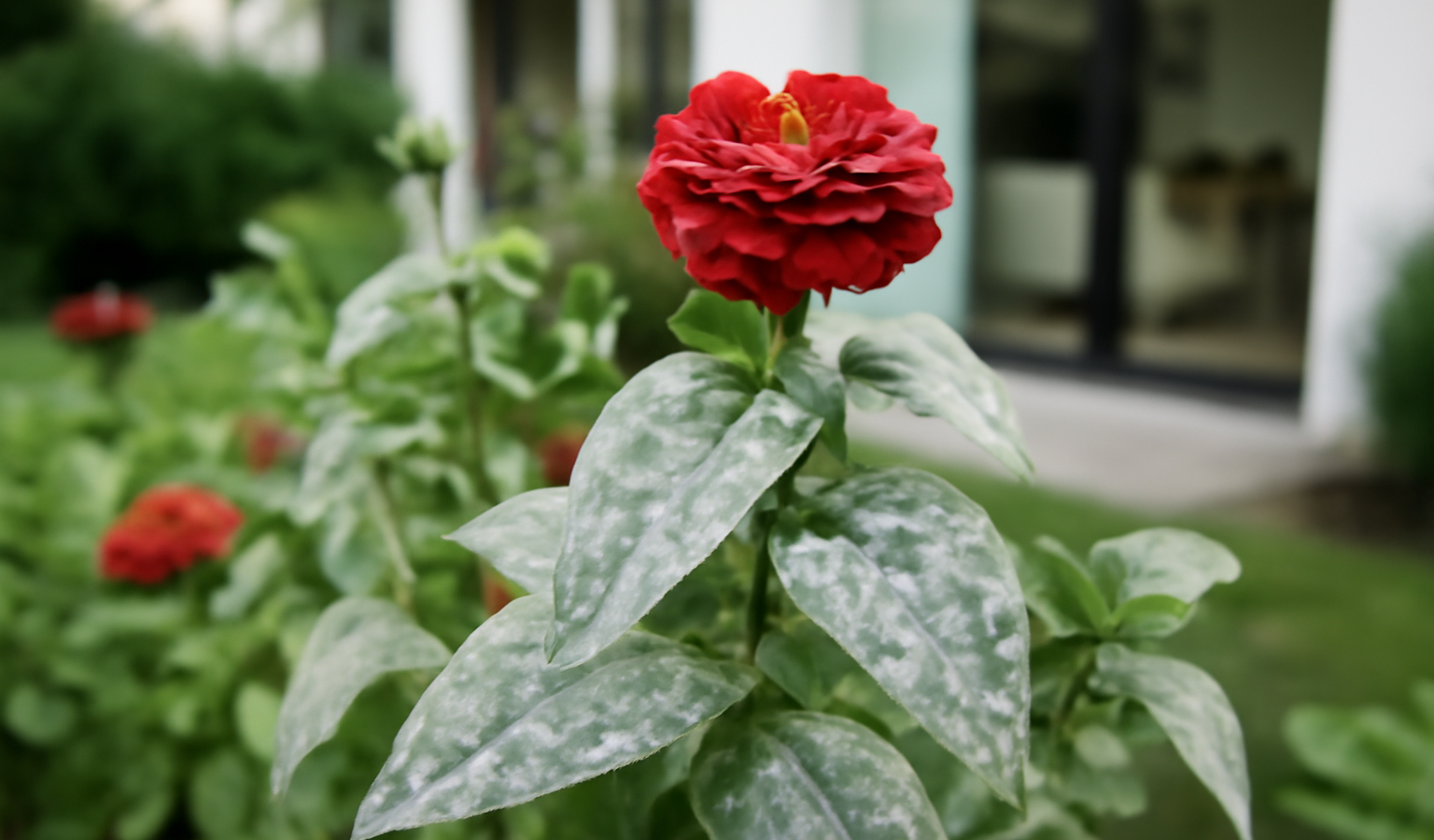
If your zinnias are sporting a dusty white or gray coating across their leaves, you are looking at powdery mildew — far and away the most common disease this otherwise tough, sun-loving annual will hand you. It usually shows up in late summer, starting as faint white patches on the upper leaf surfaces and spreading until whole leaves look like they were dredged in flour, then yellow, curl, and drop. The good news is that zinnias powdery mildew is rarely fatal; plants keep blooming even when badly infected. The bad news is that once it takes hold it is hard to reverse, so the real win is understanding what invites it and shifting the conditions in your favor. This guide walks through every cause I see in real gardens, exactly how to diagnose each one, how to treat an active outbreak with sulfur, neem, potassium bicarbonate or a milk spray, and how to keep it from coming back next season.
Key Takeaways
- Powdery mildew on zinnias is driven by poor airflow, crowded spacing, and shade far more than by rain — the spores actually germinate best in dry leaves with humid air.
- It looks like a white-to-gray powdery film on leaves and stems; rub a leaf and the dust smears, unlike downy mildew which lives on the leaf underside.
- Overhead watering and high overnight humidity create the damp, sheltered microclimate the fungus loves — water at the base, in the morning.
- Treat active infections with sulfur, neem oil, potassium bicarbonate (1 tbsp per gallon), or a milk spray (1 part milk to 9 parts water) — applied early and repeated weekly.
- Prevention beats cure: space plants 9–12 inches apart, plant in full sun, choose resistant varieties like Profusion and Zahara, and remove infected debris in fall.
Poor Airflow, Crowded Spacing, and Too Much Shade
This is the root cause behind the majority of powdery mildew outbreaks, and it surprises people because we instinctively blame water. Powdery mildew fungi (on zinnias, usually Golovinomyces cichoracearum, formerly Erysiphe cichoracearum) are unusual: unlike most plant pathogens, their spores germinate best when the leaf surface is dry and the surrounding air is humid. Stagnant, still air trapped between densely packed plants holds a film of humidity right against the foliage all night long, and that is the perfect launchpad for spores. Crowd your zinnias, plant them in a low spot with no breeze, or tuck them in part shade, and you have built the fungus a greenhouse.
Diagnose it
Look at where the mildew is worst. If the interior leaves and the lower, shaded foliage are coated first while the sun-exposed tips stay cleaner, crowding and poor airflow are almost certainly the culprits. Stand among the plants on a still morning — if the air feels close and the leaves are touching their neighbors with no gaps for a breeze to move through, that confirms it. Check your spacing against the seed packet: zinnias jammed at 4–6 inches apart will mildew far sooner than the same variety at 12 inches. Also note sun exposure honestly. Zinnias want a minimum of six hours of direct sun; a bed that gets only morning light and sits in afternoon shade stays cooler and damper and invites disease. Tall varieties (the Benary’s Giant and State Fair types reaching 3–4 feet) are especially prone because their dense canopy shades and traps moisture around the lower stems.
Fix it
You can dramatically improve airflow even mid-season. Thin out crowded plantings by pulling or cutting every other plant if they are packed tighter than about 9 inches — yes, sacrificing plants now saves the rest. Strip off the lowest 4–6 inches of foliage on tall varieties so air moves freely around the base; this also keeps soil-splash spores off the leaves. Remove any leaves that are already heavily coated and bag them — do not compost diseased foliage or shake spores around the bed. Cut back nearby plants, weeds, or overhanging branches that block the breeze or cast shade. If the bed is genuinely too shady, make a note to relocate next year, because no spray will outrun a fundamentally damp, dim, airless site. For a fuller picture of how light and siting affect flowering annuals, our plants and flowers guide is a good companion read. Going forward, plan your spacing at planting time — which I cover in the prevention section below — because it is the single most powerful lever you have.
Overhead Watering and High Humidity
Watering technique is the second big driver, and it interacts with the airflow problem in a frustrating loop. While powdery mildew spores prefer to germinate on dry leaves, the disease still thrives in a humid microclimate — and nothing raises humidity around your zinnias like spraying the whole plant with a hose or running an overhead sprinkler in the evening. Wet foliage that cannot dry before nightfall keeps the canopy damp and cool for hours, which is exactly the high-humidity, moderate-temperature window (think 60–80°F nights with heavy dew or watering) when spores spread fastest. Late-summer weather, with warm days and cool, dewy nights, is naturally peak powdery mildew season for this reason, even in dry climates where it rarely actually rains.
Diagnose it
Think about how and when you water. If you have been watering with an overhead sprinkler, hand-spraying the leaves, or watering in the late afternoon and evening so foliage stays wet overnight, you are feeding the problem. A telltale sign is mildew that appears or worsens within a few days of a humid stretch or a run of evening waterings. Also watch for plants packed against a fence, wall, or hedge where evening air does not circulate and morning dew lingers late — those spots stay humid long after open beds have dried, and they mildew first. If your whole region has been muggy with heavy dews, expect pressure to spike regardless of your own watering.
Fix it
Change two things and you remove most of this driver. First, water at the base of the plant, not over the top — use a watering can aimed at the soil, a soaker hose, or drip irrigation so the leaves stay dry. Zinnias have moderate water needs; give them a deep soak at the roots once or twice a week rather than frequent light sprinkles. Second, water in the morning. If foliage does get wet — from rain, dew, or unavoidable overhead watering — morning watering gives the sun all day to dry it, whereas evening watering leaves it damp through the high-risk overnight hours. This is the same logic that solves a lot of common annual-flower complaints; if you have wrestled with moisture-stressed bedding plants before, the diagnostic approach in our piece on why impatiens wilt follows the same observe-the-conditions method. Mulching the soil with a couple of inches of organic mulch also helps by reducing the splash of soil-borne spores and stabilizing soil moisture so you water less often.
Treating an Active Infection: Fungicide Options
Once you see powdery mildew, no spray will erase the damage already done, but you can stop it spreading to clean foliage and protect new growth. The key is to start early — at the first white patches, not when half the plant is coated — and to spray on a regular schedule, typically every 7 to 14 days, because these treatments are largely protective and wash off or break down over time. Always test any spray on a few leaves first and apply in the cool of the morning or on an overcast day, never in hot sun, which can scorch treated leaves. Cover both the upper and lower leaf surfaces. Below are the four treatments I reach for, all of which are accessible to home gardeners and acceptable in an organic-leaning garden.
Sulfur
Sulfur is one of the oldest and most reliable fungicides for powdery mildew, sold as a wettable powder or pre-mixed liquid. It works as both a preventive and an early curative, disrupting the fungus’s metabolism. Mix according to the label — commonly around 1 to 3 tablespoons of wettable sulfur per gallon of water — and coat the foliage thoroughly. The two critical cautions: never apply sulfur when temperatures are above about 85–90°F or it will burn the leaves, and never apply it within two weeks of using an oil spray (like neem or horticultural oil), because the combination is severely phytotoxic. Sulfur is most effective applied before infection is heavy, so it shines as an early-season protectant on plants you know are mildew-prone.
Neem oil
Neem oil is my go-to all-rounder because it both suppresses powdery mildew and deters insect pests. Use cold-pressed, pure neem oil and mix roughly 1 to 2 tablespoons per gallon of water along with about a teaspoon of mild liquid soap as an emulsifier, since oil and water otherwise separate. Shake constantly while spraying and coat all leaf surfaces. Reapply every 7 to 14 days and after rain. Because neem is an oil, observe the same heat rule as sulfur — apply in the morning, avoid spraying above 85°F, and keep at least a two-week gap from any sulfur application. Neem works partly by smothering existing fungal growth and partly by interfering with spore germination, so it has a modest curative effect as well as protective.
Potassium bicarbonate (and baking soda)
Bicarbonates kill powdery mildew on contact by disrupting the pH and ion balance at the fungal cell surface, which makes them genuinely curative on light infections rather than merely protective. Potassium bicarbonate is the better choice — mix about 1 tablespoon per gallon of water with a few drops of liquid soap to help it stick and spread. Baking soda (sodium bicarbonate) works at the same 1-tablespoon-per-gallon rate and is what most people have on hand, but the sodium can build up in soil and on leaves over repeated use, so potassium bicarbonate is gentler for frequent spraying. Apply weekly, coating both leaf surfaces, and reapply after rain. This is often the fastest knockdown for an outbreak you have just noticed.
Milk spray
It sounds like folklore, but diluted milk is a surprisingly effective and completely non-toxic powdery mildew treatment, backed by trial work on cucurbits and other susceptible crops. The leading theory is that proteins in the milk react with sunlight to produce compounds that are antifungal, which is why milk spray works best applied in bright morning light. Mix roughly 1 part milk to 9 parts water (any milk works; low-fat is fine and less likely to smell). Spray a fine mist over the foliage, both sides, on a sunny morning, and repeat every 7 to 10 days. It is a great option for edible gardens, for gardeners avoiding any commercial fungicide, and as a rotation partner with bicarbonate so you are not relying on a single mode of action.
Whichever you choose, rotate two of these through the season rather than hammering one, remove the worst-coated leaves before you spray so the treatment reaches living tissue, and keep realistic expectations: the aim is clean new growth and continued bloom, not the restoration of leaves already damaged. If the infection is advanced and the plant is mostly defoliated, sometimes the kindest move is to cut it back hard or pull it and protect the rest of the bed.
How to Prevent Powdery Mildew on Zinnias
Everything above is reactive; this is where you actually win the war. Powdery mildew is far easier to prevent than to cure, and a handful of decisions made at planting time will keep most zinnias clean through the season — even in a humid climate.
Space generously. This is the highest-impact change. Give standard zinnias 9 to 12 inches between plants (more for the giant 3–4 foot varieties), and resist the urge to fill every gap. Wide spacing lets air move through the planting, dries the foliage faster after dew or rain, and breaks the still, humid microclimate the fungus needs. A well-spaced bed in full sun rarely develops serious mildew until very late in the season.
Choose resistant varieties. If powdery mildew is a perennial problem in your garden, the easiest fix is genetics. The Profusion and Zahara series (both interspecific hybrids derived in part from Zinnia angustifolia) carry excellent powdery mildew resistance and shrug off conditions that flatten the old-fashioned Zinnia elegans types. Zinnia angustifolia (narrowleaf zinnia) itself is highly resistant. The big-flowered heirlooms like Benary’s Giant and State Fair are gorgeous but the most susceptible — grow them only if you can give them full sun, wide spacing, and a preventive spray program.
Plant in full sun. Six-plus hours of direct sun keeps foliage dry, the canopy warm, and the plant vigorous enough to resist disease. Avoid shaded, sheltered corners and low frost-pocket spots where dew lingers and air stagnates.
Water at the base in the morning. Keep the leaves as dry as you can. Drip irrigation or a soaker hose delivered to the roots, run in the early morning, is ideal; if you must use overhead water, do it at dawn so everything dries by midday.
Feed for steady, not lush, growth. Over-fertilizing with high nitrogen pushes soft, sappy foliage that mildew colonizes readily, and a dense flush of new growth also worsens crowding. Use a balanced feed and go easy.
Clean up and rotate. At the end of the season, pull and bag all zinnia debris rather than composting it, since the fungus overwinters on plant material and in some climates produces resting spores that survive to reinfect next year’s plants. Avoid planting zinnias in the exact same spot every year if mildew has been bad. A preventive spray of sulfur or potassium bicarbonate starting in midsummer — before symptoms appear — is cheap insurance on susceptible varieties. Many of the same airflow, sun, and watering principles apply across the sun-loving annuals; if you grow them alongside zinnias, you may also find our guide on why sunflowers droop useful, since healthy structure and good siting prevent a whole range of problems at once.
Frequently Asked Questions
Will powdery mildew kill my zinnias?
Rarely. Powdery mildew is unsightly and weakens plants by reducing photosynthesis, causing leaves to yellow and drop, but zinnias usually keep blooming even when infected. The bigger risk is to overall vigor late in the season. Treat it to protect new growth and keep the plant productive, but a mild infection on an otherwise healthy plant is not a death sentence.
Can I still cut and use flowers from a zinnia with powdery mildew?
Yes. The mildew lives on leaves and stems, not in the petals, so the blooms are fine to cut for arrangements. Strip the affected lower foliage off the stem when you cut, and avoid bringing heavily coated leaves indoors. Cutting flowers regularly actually encourages more blooms and lets you remove diseased tissue at the same time.
Does powdery mildew spread to my other plants?
Powdery mildew fungi are fairly host-specific, so the species on your zinnias may not jump to, say, your roses or squash — those are usually caused by different fungal species. However, the cucurbit-and-aster strain that hits zinnias can affect related plants like asters, dahlias, and cucumbers. Either way, the same humid, crowded, shady conditions favor all powdery mildews, so fixing those conditions protects the whole garden.
Is it too late to treat once the leaves are fully white?
You cannot restore badly coated leaves — they will not turn green again — but you can still stop the spread to healthier foliage and new growth. Remove the worst leaves, then begin a weekly spray of potassium bicarbonate or neem on what remains. If the plant is more than half defoliated and looks rough, it is often better to cut it back hard or remove it entirely to protect nearby plants.
What is the best organic spray for zinnia powdery mildew?
For a fast knockdown on a fresh outbreak, potassium bicarbonate at 1 tablespoon per gallon (with a drop of soap) is hard to beat and is genuinely curative. For ongoing protection plus pest control, neem oil works well. A 1:9 milk-to-water spray applied in morning sun is the gentlest option and great for edible gardens. Rotating two of these and spraying weekly gives the best organic control.