

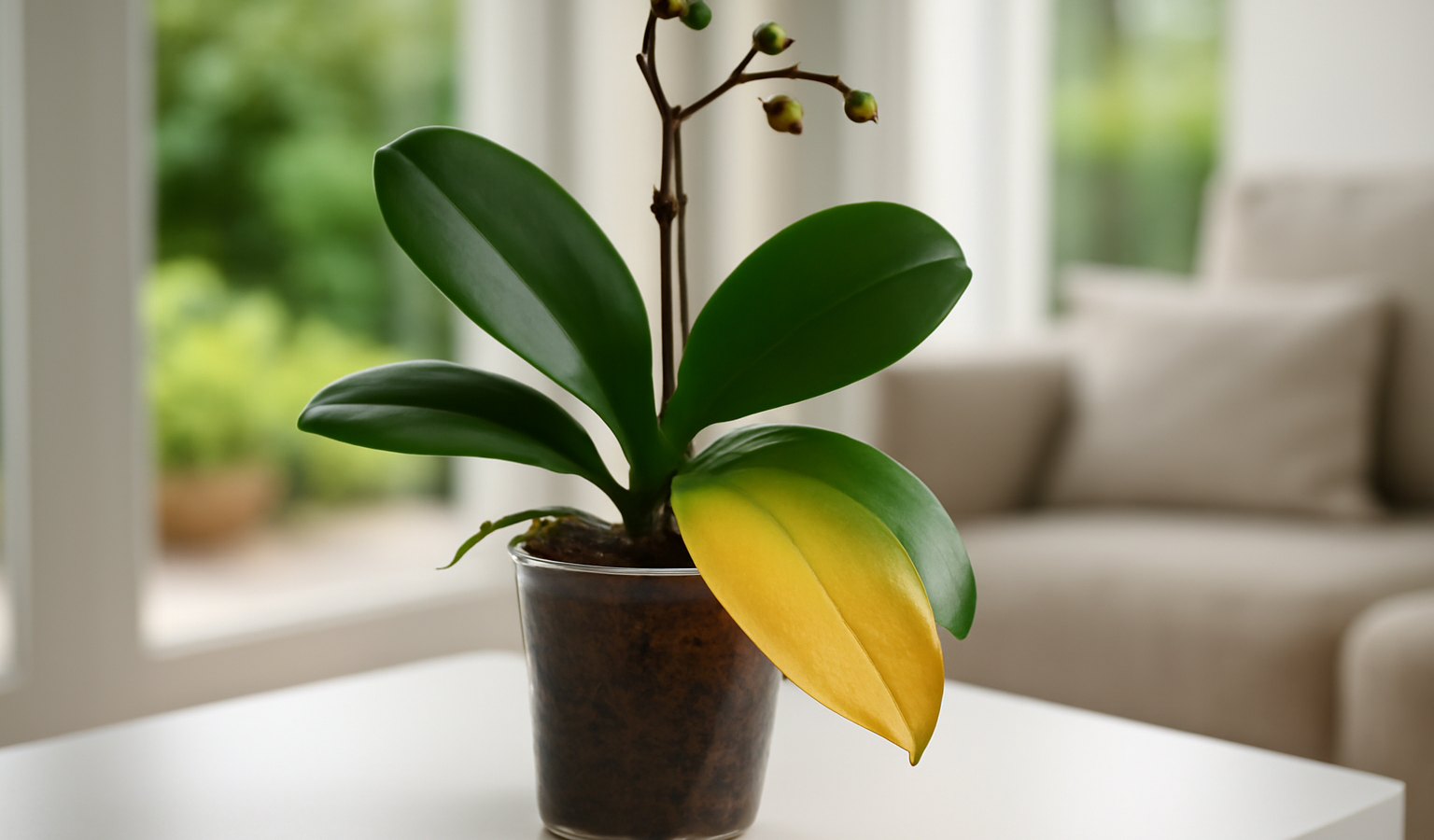
Few things rattle a houseplant owner faster than watching a glossy green orchid leaf slowly fade to yellow. With a Phalaenopsis (the supermarket moth orchid that most of us own) the panic is understandable, because these plants only carry a handful of leaves at a time, so losing even one feels like a quarter of the plant disappearing. The reassuring news is that yellowing leaves on an orchid are not always a problem. Quite often the plant is simply retiring its oldest leaf on a normal schedule, exactly the way a tree drops a leaf in autumn. The trick is learning to tell the difference between that harmless, predictable shedding and the kind of widespread yellowing that signals overwatering, sunburn or another stress you need to correct right now.
This guide walks through every realistic reason an orchid leaf turns yellow, gives you a quick way to diagnose each one, and tells you exactly what to do about it. I have led with the normal, do-nothing cause on purpose so you can rule it out before you start changing your care routine, because the most common mistake people make is “fixing” a plant that was never broken. After the causes, there is a prevention section that keeps the rest of the leaves green for the long haul.
Key Takeaways
- One yellowing bottom leaf at a time is usually normal aging and nothing to worry about.
- Several leaves yellowing at once, especially soft or mushy ones, almost always points to overwatering and root rot, the single most common problem cause.
- Check the roots: silvery-green and plump means healthy, while brown, mushy and hollow means rot.
- Yellow patches with brown or bleached centers on upper leaves are sunburn from too much direct sun.
- Cold drafts below 55F, dehydration and post-bloom decline each have their own telltale signs.
- Water with a thorough weekly soak, give bright indirect light, and keep temperatures in the 65 to 80F range to prevent most yellowing.
Cause 1: Normal Aging and the Oldest Bottom Leaf (Usually Nothing to Worry About)
Start here before you do anything else. Orchids, like every other plant, do not keep their leaves forever. A Phalaenopsis grows from a central crown, adding new leaves at the top while the oldest leaves at the very bottom eventually finish their working life and are discarded. When that happens, the lowest leaf on the plant turns uniformly yellow, often softens, and after a week or two detaches cleanly on its own. This is the plant reabsorbing nutrients from the spent leaf and reallocating them to new growth. It is healthy housekeeping, not a disease, and it is the most likely explanation when only one leaf is affected.
How to diagnose it
Ask yourself one question: is it just the single lowest leaf, while everything above it stays firm and green? Normal aging shows up as one bottom leaf yellowing evenly from the tip or the base, with the rest of the plant looking perfectly healthy. The new growth in the center of the crown should be green and active, and the roots should be plump and silvery-green. If the plant recently finished a flowering display, a tired bottom leaf is especially common, because blooming is demanding and the plant trims away its least productive leaf afterward.
What to do
Nothing, and that is the hardest part for most people. Resist the urge to change your watering, repot, or fertilize in response to a single aging leaf, because intervening can do more harm than good. Let the yellow leaf finish its cycle and fall away naturally, or once it is fully yellow and limp, gently wiggle it free where it meets the stem. Do not tear a leaf off while it is still partly green, since the open wound is an entry point for rot. If a fresh new leaf is emerging from the crown at the same time, you have all the confirmation you need that this is routine turnover.
Cause 2: Overwatering and Root Rot (The Most Common Problem)
If more than one leaf is yellowing, or the yellowing leaves feel soft, limp or mushy, overwatering is the prime suspect. This is by far the most common way people accidentally hurt their orchids. Phalaenopsis are epiphytes: in the wild they cling to tree bark with their roots exposed to air, so their roots need to breathe and dry out between drinks. When they sit in soggy media or standing water, the roots suffocate, then rot. Rotted roots cannot deliver water or nutrients, so the leaves yellow and wilt in a way that confusingly looks like thirst even though the plant is drowning.
How to diagnose it
Slide the plant out of its pot and look at the roots, because that is where the truth lives. Healthy orchid roots are firm and plump, silvery-gray when dry and turning bright green when wet. Rotting roots are the opposite: brown or black, mushy, and so collapsed that if you pinch one the outer layer slides off and leaves a thin stringy thread behind. A hollow, papery feel is also a sign the root has died. Other clues include media that stays wet for many days, a sour or musty smell from the pot, and multiple leaves yellowing low on the plant at once. If the pot has no drainage holes, or it sits inside a decorative cover pot that traps runoff, you have your answer.
How to fix it
Unpot the orchid and clear away all the old media. With clean, sharp scissors sterilized in rubbing alcohol, cut off every brown, mushy or hollow root, taking the cut back to firm, healthy tissue. Be ruthless; leaving rot behind lets it spread. Repot into fresh, chunky orchid bark in a pot with plenty of drainage holes, and from now on only water when the media has dried and the roots have turned silvery. The difference between true rot and simple overwatering can be subtle, and our guide to root rot versus overwatering walks through how to tell them apart and nurse the plant back. A badly rotted orchid can still recover if even a few good roots remain, so do not give up on it.
Cause 3: Too Much Direct Sun and Sunburn
Orchids want bright light, but Phalaenopsis evolved in dappled shade under a forest canopy, so direct midday sun scorches their leaves. Sunburn is the second most common reason for yellowing, and it shows up differently from a watering problem. Instead of a whole leaf fading evenly, you get yellow or bleached patches, often on the upper leaves that catch the most light, and these patches can develop dry brown or tan centers where the tissue has actually died.
How to diagnose it
Look at where the yellowing sits and which leaves are affected. Sunburn hits the leaves and the parts of leaves that face the window directly, especially in a hot south- or west-facing window in summer. The damage is localized rather than uniform: a yellow or whitish blotch with a sunken brown center, sometimes feeling dry and papery. Healthy orchid leaves should be a medium grassy green; if they look very dark green, the plant actually wants more light, but if they are yellowish overall and flushed with red or purple, they are getting too much. Put your hand between the plant and the window at midday, and if you feel real heat on your skin, the leaves are feeling it too.
How to fix it
Move the orchid out of direct sun into bright indirect light. An east-facing window with gentle morning sun is close to ideal, as is a spot a few feet back from a brighter south or west window, or behind a sheer curtain that diffuses the rays. In foot-candle terms, Phalaenopsis are happy around 1,000 to 2,000 foot-candles, the kind of light where you can read comfortably without a lamp but the plant never sits in a hot beam. The burned patches will not turn green again; that tissue is dead. But once the plant is in the right light it will stop spreading, and you can leave the damaged leaf in place as long as it is still partly functional, removing it only once it yellows fully.
Cause 4: Underwatering and Dehydration
Overwatering gets all the attention, but orchids can absolutely be underwatered too, and chronic dehydration shows up as yellowing leaves. When an orchid cannot take up enough water, either because you water too rarely or because the bark has gone bone dry and water runs straight through without soaking in, the plant pulls moisture out of its oldest leaves to survive. Those leaves yellow, and they often wrinkle or go leathery and floppy first.
How to diagnose it
Check the roots and the leaf texture together. Dehydrated orchid roots look silvery-white, shriveled and thin rather than plump, and the leaves feel limp, soft and wrinkled like a slightly deflated balloon, with the wrinkling running along the length of the leaf. This is the opposite of overwatering, where the leaves go mushy and the roots go brown. If you lift the pot and it feels feather-light, and the bark inside is dry and dusty, the plant is thirsty. People who follow the “three ice cubes a week” routine often end up here, because a few ice cubes simply do not deliver enough water to fully hydrate a bark mix.
How to fix it
Give the plant a proper soak rather than a sip. Take the orchid to the sink and run room-temperature water through the pot for a minute or two until it drains freely, or set the pot in a basin of water for 10 to 15 minutes so the bark can absorb moisture all the way through, then let it drain completely. Skip the ice cube myth entirely; not only does it underwater, but cold water on tropical roots is its own stressor. After a thorough rehydration, the existing wrinkled leaves may plump up partway, and new growth will come in firm. Settle into watering roughly once a week, adjusting by how fast your bark dries rather than by the calendar.
Cause 5: Cold Drafts and Temperature Shock
Phalaenopsis are tropical plants that resent the cold, and a sudden chill is a classic trigger for yellowing leaves. A leaf exposed to a cold draft, a frosty windowpane in winter, or a blast from an air-conditioning vent can yellow, sometimes developing soft sunken patches where the tissue was chilled. A bigger temperature swing, such as leaving the plant in a car or by an open door on a cold night, can shock the whole plant into dropping leaves.
How to diagnose it
Think about location and timing. If the yellowing started in winter, or after a cold snap, and the plant sits near a single-pane window, an exterior door, or directly in the path of an AC vent, cold is a strong candidate. Chill damage often appears on the side of the plant facing the cold source, and the affected areas may look water-soaked or pitted before they yellow. Orchids are happiest between about 65 and 80F during the day and prefer not to drop below 60F at night; sustained exposure below 55F causes visible stress.
How to fix it
Move the orchid away from cold glass, drafty doorways and air-conditioning or heating vents. In winter, pull plants back from the windowsill at night, because the air right against the glass can be many degrees colder than the room. Keep the plant in a stable spot where temperatures stay in the comfortable 65 to 80F band and avoid sudden swings, which orchids dislike even more than a steady cool temperature. Damaged leaves will not recover, but the plant will stop deteriorating once it is warm and stable, and new leaves will grow in normally.
Cause 6: Nutrient Deficiency
Orchids are not heavy feeders, but they still need a small, steady supply of nutrients, and a plant that has been in the same exhausted bark for a long time without fertilizer can run short. Nitrogen, magnesium and iron deficiencies all show up as yellowing, though it tends to be a slow, generalized pale-green-to-yellow fade across several leaves rather than the abrupt yellowing of rot or sunburn.
How to diagnose it
Deficiency yellowing is gradual and even. A nitrogen shortage pales the older leaves first as the plant moves nitrogen to new growth, so the lower leaves go uniformly light. An iron shortage shows on the newest leaves, which come in yellow with green veins still visible (interveinal yellowing). If the roots are healthy and firm, the watering is correct, the light is right, and yet the leaves are slowly losing color over weeks, suspect feeding, especially if you cannot remember the last time you fertilized or if the bark is old and broken down.
How to fix it
Feed with a balanced orchid fertilizer diluted to about half strength, following the long-standing “weakly, weekly” approach: a weak dose roughly every week or two during active growth, skipping the dose every fourth watering and flushing with plain water to prevent salt buildup. If the bark has broken down into a dark, dense, soil-like texture, it has lost its structure and its ability to hold nutrients and air, so repot into fresh bark. Do not overdo it; too much fertilizer burns orchid roots and causes its own brown leaf tips, so when in doubt feed less rather than more.
Cause 7: Natural Post-Bloom Decline
After an orchid finishes a long flowering display, it is common to see a leaf or two yellow as the plant shifts gears from blooming back into vegetative growth. Flowering is energy-intensive, and the plant may shed an older leaf as part of resetting. This overlaps with normal aging, but it is worth calling out because the timing right after a months-long bloom worries a lot of owners who assume the spent flowers and the yellow leaf are connected to a disease. Usually they are not.
How to diagnose it
If the flowers have recently dropped and one lower leaf is yellowing while the crown and roots stay healthy, this is post-bloom housekeeping, the same harmless process described in Cause 1. The flower spike itself may also yellow and dry, which is separate and normal. The warning sign that something more is wrong would be several leaves going at once or the new central growth looking stunted or discolored.
What to do
Let the plant rest and recover. Keep care steady with good light, weekly soaks and light feeding, and let the single old leaf finish yellowing and drop on its own. You can trim a fully spent, browned flower spike back to the base, or leave a still-green spike to see if it reblooms. The plant is simply rebuilding; give it a few weeks and you should see fresh leaf growth resume from the center. For more on coaxing the next round of flowers and reading the signs of a healthy plant, our Plants and Flowers hub collects guides on orchids and other flowering houseplants.
How to Prevent Orchid Leaves From Turning Yellow
Most yellowing comes down to a handful of care fundamentals. Get these right and the only yellow leaves you will see are the occasional old bottom leaf retiring on schedule, which is exactly what you want.
- Water by the roots, not the calendar. Wait until the bark is dry and the roots turn silvery, then give a thorough weekly soak that drains completely. Never let the pot sit in standing water, and skip the ice cube routine entirely.
- Use the right media and pot. Grow in chunky orchid bark for maximum airflow, or sphagnum moss if you tend to underwater, since moss holds moisture longer and needs watering less often. Always use a pot with drainage holes, ideally a clear one so you can watch the roots.
- Give bright indirect light. An east window with morning sun, or a spot back from a south or west window behind a sheer curtain, keeps leaves a healthy grassy green without scorching them. Aim for roughly 1,000 to 2,000 foot-candles.
- Hold steady, comfortable temperatures. Keep the plant between 65 and 80F, away from cold glass, drafty doors and AC or heating vents, and avoid sudden swings.
- Feed lightly and flush. A half-strength balanced orchid fertilizer every week or two during growth, with a plain-water flush every fourth feeding, prevents both deficiency and salt burn.
- Repot every one to two years. Fresh bark before it breaks down into mush keeps roots oxygenated and is the best insurance against rot.
Finally, learn to read the plant before reacting. A single soft bottom leaf is routine; several yellowing leaves, mushy roots or bleached patches are calls to action. If you see brown patches rather than yellowing, that is a different problem worth checking against our guide on why houseplant leaves get brown spots, which covers the fungal and physical causes that overlap with orchid leaf trouble.
Frequently Asked Questions
Should I cut off a yellow orchid leaf?
No, not while it is still attached and partly green. Let a yellowing leaf finish its cycle and drop on its own, or gently wiggle it free once it is fully yellow and limp. Cutting or tearing a leaf early leaves an open wound that can invite rot.
Is one yellow leaf on my orchid normal?
Usually yes. A single yellowing bottom leaf while the rest of the plant stays firm and green is normal aging, where the orchid retires its oldest leaf and reabsorbs the nutrients. It becomes a concern only when several leaves yellow at once or the leaves feel soft and mushy.
How can I tell overwatering from underwatering?
Check the roots and leaf feel. Overwatered orchids have brown, mushy, hollow roots and soft yellow leaves, often with a wet pot and sour smell. Underwatered orchids have shriveled silvery roots and limp, wrinkled leaves, with bark that feels bone dry and a pot that lifts feather-light.
Will a yellow orchid leaf turn green again?
No. Once a leaf has yellowed, that tissue will not recover its color. The goal is to fix the underlying cause so the remaining green leaves stay healthy and new growth comes in strong, rather than trying to save the leaf that has already turned.
Can too much sun make orchid leaves yellow?
Yes. Direct sun, especially in a hot south or west window, scorches Phalaenopsis leaves and creates yellow or bleached patches with dry brown centers, typically on the upper leaves facing the light. Move the plant to bright indirect light, such as an east window or behind a sheer curtain.