

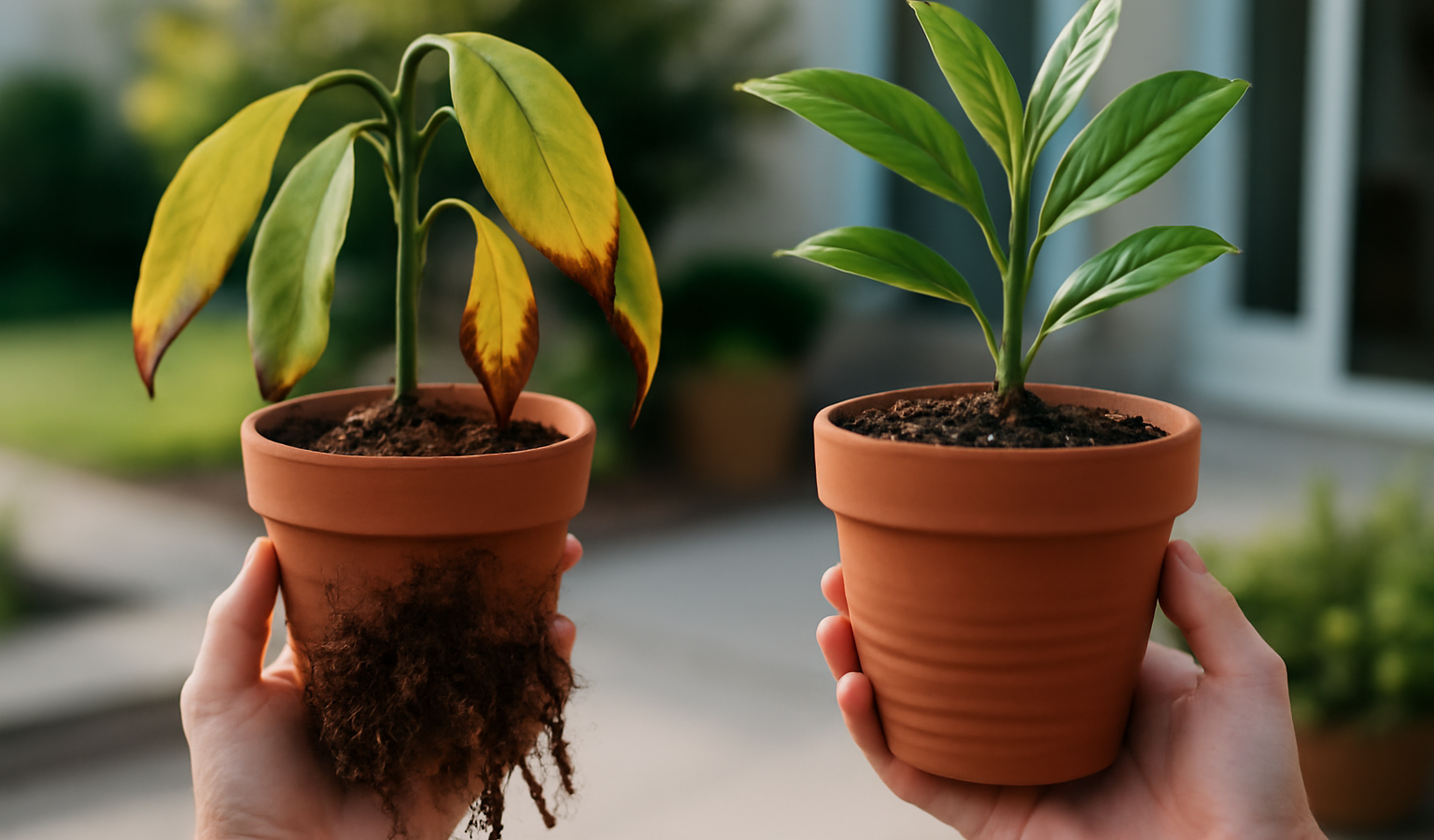
Here is the single most important thing to understand before we go any further: root rot and overwatering are not two competing diagnoses—they are a cause and its consequence. Overwatering is what you do; root rot is what happens as a result. People search “root rot vs overwatering” expecting an either/or answer, but the honest answer is that overwatering (more precisely, soil that stays waterlogged) is the most common cause of root rot, and root rot is the most common serious effect of overwatering. They sit on the same chain of events. Understanding that relationship is exactly what lets you tell, at any given moment, whether your plant is merely sulking from too much water or has already crossed into active root decay—and that difference decides whether you simply let it dry out or have to perform emergency surgery.
Key Takeaways
- Cause and effect: Overwatering (waterlogged soil) is the cause; root rot is the result. They are stages of the same problem, not rivals.
- Overwatering alone = soggy soil, yellow leaves, but roots still firm and pale—reversible by drying out.
- Root rot = roots are mushy, brown/black, smelly, and slough off—a fungal/oomycete infection that needs cutting away.
- The tell: Pull the plant and feel the roots. Firm and white = overwatered. Mushy, dark, foul = rotted.
- Both look similar above ground; the only reliable diagnosis is to check the roots themselves.
The relationship: how overwatering becomes root rot
Roots need air as much as water. Healthy soil is full of tiny pockets that hold oxygen, and roots breathe through them. When you overwater—too often, or into a pot with no drainage, or in dense soil that does not dry—those air pockets fill with water and stay full. The roots suffocate. Oxygen-starved root cells weaken and begin to die, even before any infection is present.
That low-oxygen, constantly-wet environment is exactly what soil-borne pathogens—water molds like Pythium and Phytophthora, plus fungi like Fusarium and Rhizoctonia—need to thrive. They are present in most soil already, harmless when conditions are good, but they explode in waterlogged, anaerobic soil and invade the already-weakened roots. That invasion is root rot. So the sequence is: too much water → no oxygen → roots weaken and start dying → pathogens move in → roots rot. Overwatering is the open door; root rot is what walks through it. This is why “just water less” cures an overwatered plant but cannot, by itself, cure one whose roots have already rotted.
Quick comparison
| Sign | Overwatered (no rot yet) | Root Rot (infection present) |
|---|---|---|
| Stage | The cause—early | The effect—advanced |
| Roots | Firm, pale, white/tan | Mushy, brown/black, slimy |
| Smell | Earthy, neutral | Foul, sour, rotten-egg |
| Leaves | Yellow, soft, may drop | Yellow/brown, wilting despite wet soil |
| Stem base | Normal | Soft, mushy, darkened |
| Soil | Wet, slow to dry | Wet, sour-smelling |
| Reversible? | Yes—dry it out | Only by cutting away rot |
Overwatering: the early, reversible stage
A plant that is merely overwatered but not yet rotting is sending a warning, not a death notice. Above ground you will see yellowing leaves (often lower leaves first), a generally soft or droopy look, sometimes leaf drop, and—confusingly—wilting even though the soil is wet, because suffocating roots cannot take up water properly. The soil stays damp for far longer than it should between waterings.
The defining feature is what you find when you check the roots: they are still firm, pale, and white or tan, with no bad smell. The plant is stressed and starved of oxygen, but the roots are intact. At this stage the cure is simple—stop watering, move it somewhere brighter and airier, and let the soil dry out substantially before watering again. If the pot has no drainage hole, fix that. Caught here, most plants bounce back with no surgery at all.
Root rot: the advanced, infectious stage
Once rot sets in, the picture changes. Above ground the symptoms overlap heavily with overwatering—yellowing, wilting, browning, drooping—which is exactly why you cannot diagnose rot from the leaves alone. The leaves of an overwatered plant and a rotting plant can look identical. The difference is underground and unmistakable once you look.
Rotted roots are mushy and slimy, colored brown to black instead of white, and they often slough their outer layer off when you pinch them, leaving a thin stringy core. The clincher is the smell: healthy and merely-wet soil smells earthy, but rot smells foul—sour, swampy, like rotten eggs or sewage. In advanced cases the rot climbs into the stem base, which goes soft and dark. This is no longer reversible by drying out, because the rotting tissue is dead and infected; leaving it in place lets the rot spread to the remaining healthy roots.
How to tell them apart in 60 seconds
Stop guessing from the leaves and look at the roots. Gently slide the plant out of its pot and brush soil from the root ball. Then ask three questions: Texture—firm or mushy? Color—white/tan or brown/black? Smell—earthy or foul? Firm, pale, earthy means you caught it at the overwatering stage; dry it out and you are fine. Mushy, dark, and foul means root rot has begun, and you need to act. There is no other reliable test—above-ground symptoms cannot separate the two.
How to fix each one
For overwatering only: Stop watering. Let the soil dry until the top inch or two is dry to the touch, improve light and airflow, and going forward water only when the plant actually needs it—lift the pot to feel its weight, or push a finger into the soil. Ensure the pot drains and never let it sit in a saucer of water.
For root rot: Surgery. Remove the plant, rinse the roots clean, and with sterilized scissors cut away every mushy, dark, smelly root back to firm white tissue. Trim a proportional amount of foliage so the reduced root system is not overwhelmed. Repot into fresh, fast-draining mix in a clean pot with drainage—never reuse the old soggy soil—and water sparingly while it recovers. If more than two-thirds of the roots are gone, the odds are poor, and taking a healthy cutting to start over may be the better bet.
Prevention is the same for both because they are the same problem: water on need rather than on schedule, use a well-draining mix, give every pot a drainage hole, and match watering to the season and light. For more on diagnosing soggy-soil symptoms, see our guide on why houseplant soil gets moldy and why houseplant leaves get brown spots. The Plants & Flowers hub has more troubleshooting guides.
The verdict
Root rot vs overwatering is not a choice between two diseases—it is recognizing where your plant sits on a single timeline. Overwatering is the cause and the early, reversible stage; the roots are still firm and white, and simply drying out fixes it. Root rot is the effect and the advanced stage; the roots have turned mushy, dark, and foul-smelling, and only cutting the rot away can save the plant. Because the leaves look nearly identical either way, never diagnose from the top—pull the plant and check texture, color, and smell of the roots. Do that one thing and you will always know whether to reach for patience and a drier pot, or for the scissors.
Frequently Asked Questions
Is root rot the same as overwatering?
No—they are linked but different. Overwatering is the cause: waterlogged soil suffocates roots. Root rot is the effect: pathogens invade the weakened, oxygen-starved roots and decay them. Overwatering can exist without rot yet, but rot almost always starts with overwatering.
How can I tell if my plant has root rot or is just overwatered?
Check the roots, not the leaves. Firm, pale, white roots with an earthy smell mean it is only overwatered and will recover if dried out. Mushy, brown or black, foul-smelling roots mean root rot has set in and you must cut the rot away.
Can a plant recover from root rot?
Often, if caught early. Cut away all mushy, discolored roots back to firm tissue, trim some foliage to match, and repot in fresh fast-draining soil. If more than two-thirds of the roots have rotted, recovery is unlikely—take a healthy cutting instead.
Why is my plant wilting if the soil is wet?
Counterintuitive but classic: overwatered or rotting roots cannot absorb water, so the plant wilts despite soggy soil. Wilting in wet soil is a strong sign of overwatering or root rot—never respond by adding more water.
How do I prevent both problems?
Water on need, not on a fixed schedule—check that the top inch or two of soil is dry first. Use a well-draining potting mix, make sure every pot has a drainage hole, never let pots sit in standing water, and water less in low light and winter.